Time to Talk Day is today and it is ‘the nation’s biggest mental health conversation’. This year’s theme is Brave the Big Talk, have conversations about mental health experiences that might feel a bit unspoken, with an aim to destigmatise mental health issues.
Today I would like to talk about living in remission with Bipolar 1 Disorder (I was diagnosed aged 16 in 2004 and am now 37!). I am lucky that although the illness I have when unmedicated is severe- I have had episodes of psychosis and mania and suicidal depression, and been hospitalised twice, I live in remission these days.
What does remission mean to me?
It means my medication (Lithium and Quetaipine- a mood stabiliser and anti psychotic) stops the very high (manic) and very low (depressive) moods and I can cope better. I am still a work in progress but its way less severe!
It means that although I have ongoing therapy to deal with past trauma, I don’t need to see a psychiatrist at present and am managed by my GP.
It also means that I don’t have to worry too much about bipolar episodes, which is not the same for everyone with our illness! I do however still struggle with anxiety, which I have spoken about before and some days can be harder than others.
Time to Talk Day say, ‘ Talking openly and honestly can be the first step towards better mental health for everyone. It can even save lives. Talking can reduce stigma and help people feel comfortable enough to seek help when they need it.‘
Autumn (or if you’re in the USA, Fall) is one of my favourite seasons. Beautiful autumn leaves, the weather getting gently cooler, cosy hot chocolates and pumpkin spice, the autumn harvest of pumpkins, snuggling in blankets with a good book or TV show and for some- walks in nature with the orange and yellow trees and landscapes. However, did you know that the clocks going back and the change in light and dark, with nights drawing in, can affect your mental health? Studies have shown that when its darker, people are more prone to depression and anxiety and some (like myself at times) struggle with Seasonal Affective Disorder.
There are many ways to take care of yourself if you feel your mood dipping or you are becoming more anxious. If you feel it is affecting your daily functioning, please reach out for support from your doctor (and if you have one, a therapist or psychologist). Here I talk about a few tips to help support your mental health this Autumn.
Make sure you rest as well as play and work
Work can become all consuming, but if you prioritise rest this season too, your body will thank you. Autumn is all about slowing down, recovering, resting (and for animals (and some humans) hibernating). Yes you can work and play hard if you prefer, but make sure you find that balance to support your wellbeing. In our busy lives and for those who are parents or just struggling with their mental health, self care can slip. Practising good self care- eating well, resting, gentle exercise, can really help our minds.
2. Release Control- Give Stress Over
Gabby Bernstein, my favourite spiritual teacher, often says ‘Release control to find peace, surrender it to the Universe’. Surrendering means not obsessing about what we can’t control, but giving it over to a higher power or the universe. This can really help when we feel overwhelmed and stressed, to pray and meditate or simply write down how you are feeling and then ask the universe to take it from you. Journalling thoughts and feelings can help too.
3. Nature walks
Despite the cold, this Autumn, walking in nature can help get the blood pumping and our minds to reset. Sometimes going with a friend, spouse or family member can cheer you up- there is something about the colours of nature, the soft greens that is truly calming.
(image: Erika Mendes, Unsplash)
4. Make your home cosy
Whether its getting some new cushions or blankets, fairy lights or lamps, investing in cosy and light interiors for the darker seasons is a must! I like to use lamps when the nights draw in.
5. Get enough sleep (but not too much!)
During the Autumn/ Winter period, most of us naturally want to hibernate in the evenings. Sometimes this period can make depression and anxiety worse. I know with my bipolar that sometimes I feel lower or more anxious. Getting enough daylight and if you struggle with seasonal affective disorder, use an SAD lamp, which can help you to wake up gently in the mornings. Similarly, make sure you get enough sleep for you to keep your mental and physical health at its best. Depression can cause us to sleep longer hours and hide away- I find daytime distractions can help me not to sleep too much.
6. Take your medication as prescribed
If you struggle with mental health in winter and are prescribed antidepressants or other meds, do not suddenly stop them as this can cause a relapse in your mental health. Make sure you speak to your doctor first!
7. Treat yourself
Treat yourself to a hot chocolate (or pumpkin space drink) and a good book or TV show, wrapped in a cosy hoodie or blanket. You deserve it!
Wishing you all a wonderful and well Autumn/Fall season.
More than one million people (including myself) are living with bipolar in the UK and, despite the summer meaning excitement and positivity for most, for many living with bipolar this is not always the case.
Common challenges in summer can impact people living with the condition- including high temperatures which can interfere with certain medications (including Lithium and anti psychotics or anti depressants), the longer daylight hours which can disrupt mood stability, and travelling which can sometimes trigger symptoms.
There are ways to manage seasonal challenges, and Bipolar UK is now sharing its top tips to help people navigate the summer months!
Top tips for navigating the next few summer months if you have bipolar from Bipolar UK:
Sleep
Maintaining a regular sleep routine is an important way to support mood stability. Lighter nights can make it more difficult to switch off and wind down; and early sunrises can cause disruptions to sleep. Blackout curtains or an eye mask might help.
Heat
Hot weather can affect both physical and mental wellbeing. Certain medications used to treat bipolar can make it harder for the body to regulate its own temperature, leading to overheating. Staying cool, drinking plenty of water and staying out of the sun during the hottest parts of the day can help reduce the risk of overheating and becoming dehydrated. Rest is important so communicate with friends and family about how you’re feeling and if you need to rearrange plans.
Travel
Be mindful when travelling to different time zones. Jetlag can have an impact on bipolar symptoms. Try to make time to sleep and rest whilst on the plane and when you arrive so you can acclimatise. Set a reminder on your phone of when you need to take your medication so you can stick to your schedule.
Sensitivity
Some bipolar medications can increase sensitivity to sunlight so protecting your skin with a high factor suncream when outside is important, as well as seeking shade when possible. Continue to take your medication as prescribed but do speak to your medical professional if you have any concerns.
Socialising
There are often more social activities during the summer, with people wanting to make the most of the better weather. If it all feels too much, learn to say “no” and preserve your energy. Pick and choose which activities you’d like to do, but don’t feel obliged to do them all.
Routine
Longer days can lead to changes in routine which can trigger shifts in mood. Some people with bipolar feel their mood can shift more easily into hypomania and mania during the summer months, whereas others notice their mood dips into depression. Noticing the signs early and speaking to your mental health team, family or other support network can ensure you get help when you need it and potentially avoid a relapse.
Last week, acclaimed chef, restauranteur and mental health advocate, Heston Blumenthal OBE starred in the BBC documentary ‘Heston: My Life with Bipolar’ which explored his fairly recent bipolar disorder diagnosis. Heston subsequently became an ambassador for national charity Bipolar UK, and has been actively supporting the charity’s mission to help reduce the average 9.5 year delay to diagnosis and end the stigma surrounding the condition.
In 2023, Heston began experiencing both depressive and manic episodes, hearing voices and seeing hallucinations, as well as depression with suicidal thoughts. Mania can also cause you to have intense creativity, speak faster and not listen to others as well as causing delusions and psychosis. Heston’s wife Melanie could see that his health was deteriorating rapidly and that he was a danger to himself. Despite the trauma of sectioning and hospitalisation, this set Heston on the path of not only a bipolar diagnosis, but medicine, therapy and ongoing treatment to help him live a healthy and happy life again.
Heston said to Bipolar UK, “I was living with undiagnosed bipolar for many years, so it’s been an extraordinary journey to get where I am today, and I’m delighted to have had the opportunity to talk to others living with the condition and find out more about their experiences.
“There is still a lot of stigma regarding bipolar, and mental health support is still lacking, but it is vital to be able to talk openly about the condition. I know this isn’t always easy, but I hope by sharing my experience, people will gain a greater understanding of bipolar and an insight into how I’m managing it.”
The documentary was extremely powerful to watch and sad in places, but inspiring. As someone who faced a similar situation to Heston in terms of a manic episode with psychosis/delusions that led to being sedated, sectioned by psychiatrists and hospitalised, my heart went out to him as I know how traumatising this can be. I found the needle being shown as a reenactment for sedation quite challenging to watch! However, the documentary was more than just showing what happened to Heston, who didn’t know he had bipolar til 2023, when he was in his 50s.
I found the discussion that Heston had with his son Jack, about how he was during a manic episode to be really enlightening. A lot of children of parents with bipolar find it challenging when their parents personality is almost hijacked by the episodes. Mania can lead to quickened speech, manic and grandiose ideas, lack of sleep and risky behaviour. You could see how much love Heston and Jack had for each other and how special is family is to support him through this and appear on camera. This includes his wife Melanie, who has been Heston’s rock!
The documentary ended with Heston visiting the mother of Rebecca McLellan, a young woman with bipolar who died by suicide due to neglect from mental health services. Rebecca had raised the alarm with the crisis team at her local hospital various times but was not treated with respect and dignity. The pressure of her illness and lack of support led her to take her own life.
Heston wants to highlight the suicide risk that bipolar brings and how much more mental health support is needed from the government. He is now working as an ambassador with Bipolar UK to raise awareness. Bipolar UK is on a mission to ensure people with bipolar get a quicker diagnosis so they can access effective treatment, support, and self-management, enabling them to live well and fulfil their potential.
Simon Kitchen, Bipolar UK CEO, added: “Heston is such an incredible ambassador for everyone in the UK living with, or affected by, bipolar. We could not be prouder to be working with him. His willingness to be so vulnerable on camera and to share such personal details about his experiences has resonated with many people in our community – and will help people who don’t know much about bipolar to begin to understand this complex and much-misunderstood condition. Heston is living proof that despite the sometimes severe and fluctuating nature of the condition, living with bipolar should not be a barrier to following your ambitions”
As one of the million people in the UK living with bipolar, I know how much more funding is needed in the NHS and a new bipolar pathway with more mental health support needs to be set up. Early prevention and support is key to stop bipolar escalating into suicide or mania.
Although it was a very personal watch for me, due to having been diagnosed with bipolar since aged 16 and my Dad having bipolar too, I thought that Heston’s documentary was so inspiring. He has only been living with the condition for two years and is using his platform for the good. Heston is now on Lithium medication to stabilise his moods as well as an anti psychotic medication.
Bipolar UK say that according to the stats, someone with bipolar takes their own life every day. Hopefully Heston’s documentary will act as a reminder and catalyst to our government to begin change. Thank you Heston and Melanie for being vulnerable and sharing your important story.
(image: Bipolar UK)
Heston: Life with Bipolar is out now on BBC Iplayer.
Self-medicating to resolve mental health issues can sometimes leave the door open for substance abuse. A lot of information goes into choosing the right psychiatric medicine, and it is not something you should choose without medical input. To avoid this common problem, here are a few things you should know about self-medication.
The Consequences
Mental and physical health are a top priority for dual diagnosis treatment. Depression, mania, anxiety and irritability are only a few underlying mood changes that someone may experience. On their own, these mental health conditions are already hard to deal with. When those same conditions are combined with possible substance use disorders, it creates a co-occurring disorder. As an example, a person that is suffering from anxiety will try to self-medicate with unprescribed depressant drugs. These downers are sedatives by nature, and can quickly turn into an addiction for someone who becomes dependent on how it makes them feel. These should only be prescribed by doctors and taken with care.
The Truth
When you’reaware of the consequences of self-medication, the treatment steps become much clearer as a goal. Without professional experience, you can’t diagnose the original underlying cause of your condition. Not all symptoms are created equally, and there is no way for a patient to factor in how a specific medication will interact. Psychiatric medications should never be combined with alcohol, which includes things like cough medicines. Self-medication is not good for you and your body or mind should never be the experiment to find out what works.
Risky Behaviour
Mental health stigmas are one of the reasons that people are open to the dangers of self-medication. They feel that society has a judgmental attitude towards mental health prescriptions. With self-medication, these same prescriptions and their variants are purchased after going through multiple illegal hoops.
Besides the legal issues that could arise, there is a good chance that you are not treating the correct condition. Getting medication to treat depression is a terrible idea for someone that is suffering from bipolar disorder. And when you’re suffering from anxiety, the risk of overdose rises. There is no reason to risk themental and physical consequences of self-medicating when there are more appropriate avenues to treat your condition. Please seek help from your psychiatrist or get referred to one.
Reaching A Personal Goal
When your health is in danger, think twice about going the risky route of self-medicating. It’s easy to use clouded judgement as an excuse for not getting better. No matter how you start, a healthy mind will always be positively fuelled by making healthy personal decisions. Sometimes, self medication can turn into addiction, which can wreak havoc on your body and mind. Reach for appropriate medical support to help support your recovery.
I wrote it to explain how I turned the darkness that bipolar episodes can bring, into light. And so people reading feel less alone, so stigma can fall. So important to talk about our illnesses once we are better, so that it isn’t so hard to understand.
Living with severe mental illness like bipolar psychosis. mania or suicidal depressions can be very challenging. However, they do not have to be your entire life. For me, medication and therapy over time have helped me. Its different for everyone.
If you would like to read my story or gift it to a friend to help them, please see Amazon or other well known bookshops.
And remember- we are never truly alone although being ill can feel unbearable- hold on to hope if you can:
In 2021, I was hospitalised for the second time in my life, due to an acute psychotic episode as a result of my then-recent diagnosis of Bipolar Disorder (Type One). Hospitalisation is one of the scariest, most unsettling periods of time but – a sometimes – necessary stage to recovery. I was so deep within my psychosis for the first week of my admission that I was quite oblivious to my surroundings and the people I was sharing the space with.
However, when my psychosis started to subside and I began to return to my true self, more free from delusions and mania, I was struck with a strong feeling of not belonging. I felt truly and utterly lost.
My ward was made up of around fifteen other women, with varying diagnosis, in differing mental states and from different walks of life. Yet, somehow I still felt like an outsider.
At first I was trying to think why. Was it because I was a Northerner in a Southern hospital? Was it because I was one of few that was the same ethnicity as myself? Was it that I was younger than most? There were so many factors that could have been the result of me feeling at a loss and not finding belonging.
Ultimately, no one wants to feel like they belong inside a psychiatric hospital. However, I believe there is merit in feeling like you have a place and in finding a sense of belonging helped me to have grounding and a base that wasn’t initially there.
Here are a few factors, of which helped me to find belonging:
Acceptance – A lot of my initial struggle was the complete denial, fuelled mainly by my delusional thoughts, that I wasn’t mentally ill and I was in the wrong place. The acceptance that I was a patient in a place that was designed to help me was a key turning point within my recovery. I belonged and thus was worthy of treatment and a future.
Routine – Although I grappled with feeling like I was becoming institutionalised, I think sticking to the routine of the ward was really important. Asides from the benefits of attending meal times, having the structure meant seeing familiar faces, both staff and patients and having positive interactions.
Involvement – Attending the therapy sessions that were available were so beneficial. My ward had a brilliant occupational therapist and other specialists that would come in to do structured sessions such as music therapy, cooking or yoga classes. Again, I got to see familiar faces and it brought with it a sense of community.
Authenticity – One of my biggest struggles throughout both manic, and depressive periods, is finding it hard to connect to my true authentic self. Reconnecting to myself and allowing myself to just be me meant that I felt more relaxed and at ease.
Finding this sense of belonging in a place where no one wants to belong ultimately gave me the grounding to go forward and look forward to a brighter future.
Katie is a freelance writer who lives with bipolar disorder in recovery and has courageously shared her experiences of being hospitalised here.
Today is World Bipolar Day and for those of us living with bipolar disorder we know that living with it every day, year round is more accurate. However today is our day to talk about life with mental illness and to try and eradicate the stigma around the illness… ‘crazy lady’ ‘nuts’ ‘drama queen’.
World Bipolar Day is designed to raise awareness worldwide of bipolar conditions and to work to eliminate social stigma whilst providing information to educate and help people understand the condition.
Even though I live in remission/recovery with the illness, I am medicated daily to be this way, and I have undergone years of therapy and learnt coping methods too, with support from family.
Well, before I found medication that stabilises my bipolar highs and lows, life looked very different.
There were times I couldn’t work. I was so depressed I lay in bed in all day, only getting up to eat. I was scared to have a shower and wash my hair.
Life looked bleak. All I wanted was my duvet and oblivion. I had intrusive thoughts about ending my life, I was in a lot of emotional pain and this would last for weeks, sometimes months on end.
Bipolar isn’t just a bit high or a bit low…. its depression and mania, suicidal ideation and psychosis, self harm thoughts, hypersexuality, hyper activity, believing delusions that aren’t real…..SO much. Its episodic but it can ruin your life. Some turn to drugs, alcohol, sex to cope. Some hear voices too.
I have been in hospital twice for fairly long stays. I have been sectioned under the mental health act and held in a hospital unit against my will. I have been injected with sedatives to calm my mind and body when I couldn’t consent. I have met people in hospital who were suicidal, anxious, depressed, high on drugs, in psychosis. I lived on a ward where I heard people being restrained.
So, not much fun really. Luckily this month I am celebrating 9 years of remission out of hospital! I also came out of hospital as a nervous wreck and thankfully, therapy has helped.
(Image: speakingbipolar.com)
This blog is inspired by one of my followers who asked me what was my ‘Aha’ moment in recovery.
As well as finding the medicine Lithium, a salt that controls the mood fluctuations, the biggest thing I did for my own healing was go through therapy for my panic attacks and PTSD like symptoms. This was done with the support of my husband and family and because I has been on an NHS waiting list for 2 years, I needed help. My therapist and I have done EMDR trauma therapy which has helped me to process things.
In fact, I still do get anxiety attacks – just less. I have been in a very good place generally in the past year. Finding support at home, at work and from friends and family has been the most stabilising part.
I have had bipolar since I was 15, I am 34 and can tell you that this has not always been the case and my mental health has and will fluctuate.
I learnt recently that bipolar brains are neurodiverse, meaning our brain chemicals act differently to a neurotypical brain. Always good to understand the biology behind it too as this illness can be inherited and run in families- my Dad and I and other relatives have it.
On World Bipolar Day I hope:
-Employers adhere to the disability act and make reasonable adjustments to help those of us with bipolar to work in a better way for them, including hybrid working.
-People with mental illness aren’t fired because they can’t get to a physical workplace.
-Mental health services need better funding, so that people with bipolar can get a correct diagnosis sooner and get the help they need.
-People not in the Western world will get access to mental health medication and therapies that they desperately need.
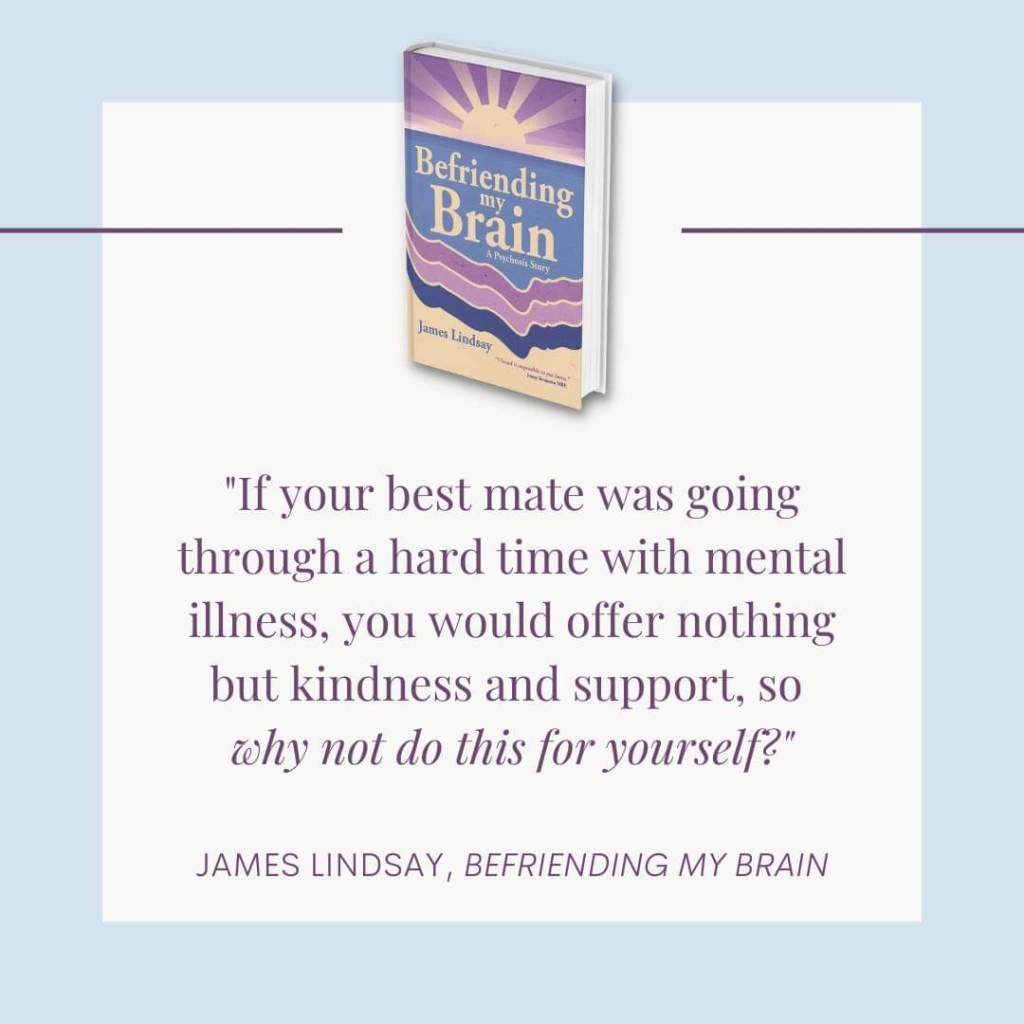
I first ‘met’ my Twitter friend James Lindsay online when he was first starting to talk about his schizoaffective disorder and psychosis. James also works for Mind doing important work in the mental health sphere and we both live locally to one another. I am really proud of James’s determination, not only in his own life, but to help others through his writing and his new book ‘Befriending My Brain’ with Cherish Editions (Trigger Publishing).
An eye-opening memoir about a young man’s descent into schizoaffective disorder– and the steps he took to regain control of his life.
It’s no secret that, in recent years, mental health has become a major topic of conversation. But just because many people feel comfortable discussing their depression, anxiety or other mental health conditions, doesn’t mean that we have removed all stigma from such diagnoses. This is especially true when it comes to psychotic disorders, which affect less than 1 in 100 people in the UK each year (Mind), thus leaving these disorders shrouded in mystery. It doesn’t help that what the media portrays as schizophrenia or psychosis is not always what the sufferer experiences in real life.
As such, it’s vital that we start to bring psychotic disorders, including psychosis, to the forefront. According to a 2016 report from Public Health England, “psychosis is one of the most life-impacting conditions in healthcare.” But with the proper treatment and understanding, it doesn’t have to be life-altering. The same report states that the sooner someone is treated for their psychosis, the better the chances that they will recover and return to their normal lives.
James Lindsay has experienced the ups and downs of schizoaffective disorder first-hand, and his book does the vital work of removing some of the mystery surrounding such a diagnosis. It includes the red flags he recognises in hindsight after psychosis landed him in hospital for the better part of a month, but it also retells the inspiring journey he took to recovery in all aspects of his life.
In his case, psychosis and his path to better mental health gave him a new passion in life: helping others through their own diagnoses and getting their lives back, just as he did. No matter where readers are on their journeys, James’ memoir will resonate and remind them, as he puts it, that “recovery is always possible, and hope is never far away.”
You can buy a copy of Befriending My Brain: A Psychosis Story by James Lindsay at Amazon, Trigger, Waterstones, WH Smith and all good bookshops.
MORE ABOUT THE AUTHOR Hailing from Watford, Hertfordshire, James Lindsay works for Hertfordshire Mind Network and uses his free time to advocate for mental health care by blogging and appearing on podcasts and TV. James enjoys playing football, going to the cinema, spending time with friends and family, and exploring new places, with his partner, Holly. Befriending My Brain is his first book.
Happy new year everyone! Gosh its nearly the end of January and I havn’t written a blog for a while so thought I would share some things that have been happening here and talk a bit about mental health stuff too.
Firstly, my mental health is fairly stable at the moment, as has been the case for a number of years. I don’t get typical bipolar depressive or manic episodes on my medications and this year is my 9th year out of hospital , which is always a positive. However, I still suffer with anxiety and stress and get overwhelmed so have to pace myself! I have bad days too where things feel too much but thankfully they don’t escalate into a depression.
So for the positives- I have achieved some huge anxiety wins for me. Since November, I have been on the tube (first time in 3 years), I have gone up to the West End with Rob to the theatre using public transport, my panic attacks have been lessening, I have been able to see more people in person and I also passed my probation at work and have been made permanent (huge win!). I am someone who struggles with agarophobia when I feel more anxious and stressed and going out alone can still be a challenge.
I have been allowing myself to venture into previously anxiety provoking situations- for example, I get cabs alone home from work. I had to start doing this last year and it helped me get back into the world again. It wasn’t easy due to many fears I had but I have been able to do it, slowly. My job is also hybrid so I can work from home too- but getting back out into the world and having kind work colleagues at an office has been such a vital part of my recovery too. My therapist has been so helpful in dealing with the panic attacks and anxiety and I do still get triggered but at the moment on a lesser scale. I still find blood tests, hospitals and general health stuff scary because of what I have been through. I really recommend therapy.
I sometimes do have to cancel arrangements when things feel too much so am sorry to anyone I have had to postpone… its not easy and I hate doing it as I feel bad… but I am learning the balance of looking after me and socialising too. I don’t always get it right but I am trying.
Then, my friend in Bushey, Lee, texted me a few weeks back and asked if I would like to speak in my childhood community for the Jami (Jewish charity) Mental Health Awareness Shabbat. I hadn’t done public speaking about my story since before Covid in 2019, when I spoke with my Dad Mike at Limmud and at Chigwell shul (synagogue, my husbands community). I have had drama training so for me speaking publicly as someone else is OK, but when I have to stand up and share my own story, I get nervous as its so personal. The first time I was asked to speak in a shul at Belsize Square, I made it to the community but my Dad had to give the talk by himself as i was too panicked to attend the service. I managed in time to dip my toe in slowly, always with the support of my Dad and my therapist.
This talk in Bushey felt significant. It’s the Jewish community I grew up in and was a part of until I was 23. I felt like I was going home. The Bushey team told me they had two other speakers, but would I like to speak and share my story with bipolar disorder?
I thought to myself… I am ready, my panic attacks and social anxiety are more under control. To me being asked to come home to Bushey shul was a sign. My Grandpa Harry passed away in 2021 from Covid- and he and Grandma had lived in Bushey since the 1990s, when we were little. Our family lived in both Bushey and Bushey Heath and I studied at Immanuel College, across the road from our home and my grandparents. The area contains so many happy memories for me. I knew the new senior Rabbi and Rebbetzen, as he had officiated at my grandparents funerals and was so kind to our family. My Dad is also still a member of the shul and I still know a lot of people who live in the community too. Its a very special community and one I am proud to be from (and still feel.a small part of despite not being a local anymore).
So, I decided, with my Dad and Rob’s support on the day (and anxiety meds), that I could stand up in shul and speak with the other two speakers on the Shabbat (sabbath) morning. My Mum and step dad were supporting from afar and looking after our guineapigs.
The senior Rabbi and Rebbetzen hosted us for the Friday night which was wonderful as we got to meet lots of new couples and see the Ketts, the other Rabbi and Rebbetzen! For lunch after the service, we went to Lee’s house, which was very special as she was my batmitzvah teacher and is a good family friend.
I was initially told the talk was going to be in a break out room- but on the day it was decided that it would be from the pulpit. Last time I ventured to that pulpit and stood up there was when I was 12 years old, sharing my batmitzva portion of the Torah. The year my Dad was very ill and diagnosed with bipolar. I became ill just 3 years later.
Now, here I was back as a married woman of 34, revealing about the mental illness that had found its way into my family and caused a lot of devastation. However, the main reasons I wanted to stand up and talk about bipolar disorder are because I know that this illness runs in families, many Jewish families struggle with it. I wanted to give the message that you can live with this illness but you can have periods of remission, recovery, you can find hope.
And as I spoke to the audience of people – many of whom I had known since my childhood, who saw me grow up and saw my family eventually leave Bushey for Edgware, I felt humbled. I felt honoured to be asked to speak and I hoped that by sharing my own journey with bipolar (being diagnosed at 16, in hospital twice, the last time in 2014 for a very serious manic episode), that I could touch someone who needed to hear it. My Dad gave me permission to tell his story too.
When I grew up in. the early 2000s, talking about mental illness and particularly in Jewish spaces, was not the norm. I hope that through sharing my own journey and my Dads (he was undiagnosed for 9 years until he was 44), that I will have helped someone.
Most importantly, I felt I had come home. The kindness and warmth shown to me by the members of the Bushey community who I have known since I was a little girl was something so incredibly special and touching. People confided in me after the service about their own struggles. Others thanked me for sharing my story. I was hugely touched by the other two speakers who spoke after me about their own journeys with mental health and their children’s. I won’t name them here in case they want to be anonymous but I learnt so much from them and their experiences.
So I want to say a huge thank you to Lee, to the Rabbis and Rebbetzens and to everyone in Bushey who I have known for years and have loved- for hosting us, for inviting me to talk about something so personal in such a special community. It touched my heart. I really hope it helps.
I genuinely did not know how I stood up there to speak to 90 odd people- what kept me going is knowing I was doing this to help eradicate the stigma of mental illness but also I hope that the words I spoke gave comfort to anyone going through mental illness, that it does get better. It can improve. You won’t be ill forever.
When I was unwell in 2014, Jonny Benjamin MBE was speaking and sharing about mental illness. He taught me that sharing your story to help others is vital. So thanks Jonny for all your support too (whether you knew you gave me the courage or not :).
I also want to thank Jami charity, Laura Bahar and Rabbi Daniel Epstein. I was part of the volunteering team that helped set up the first mental health awareness shabbat. The project has blossomed and is now annual and it is truly wonderful to see.
What I want to clarify is that although I am currently a lot better with my anxiety, it is very much a grey area, day by day thing. That can be hard for people to understand- how one day you can be great with loads of energy and the next you have to stay home and recuperate- self care. But I think knowledge of mental health is increasing now, so do check in with your friends and family and offer a safe space without judgement- its so helpful.
Thank you again for reading this if you got this far. You can do whatever you put your mind too- reach for help from medical teams, medication, therapists and never give up.












 beurownlight.com