Love and Remission by Annie Belasco: Book review

loveandremission

(image: Trigger Publishing and Annie Belasco)

I only tend to review books that make an impact on me and that really touch my heart.

I ordered Annie’s book ‘Love and Remission’ , about her life recovering from breast cancer in her twenties and finding the love of her life. Annie and I have been connected on Twitter and she is signed to the same publisher as me so I was super excited to read her inspirational story.

When reading, I found a person of immense strength and an amazing sense of humour. Annie was diagnosed with stage 3 breast cancer aged just 25 years old. Her entire life was falling apart but she found a way through treatment, through the chemotherapy and radiotherapy-to put it back together. She describes what it was like for her to lose her hair and buy wigs, and to go through a masectomy and trying to feel womanly again- which she succeeded in doing. She was scared that the treatment wouldn’t work but she is now incredibly,  in remission.

Annie also had mental health issues due to the trauma but talks about how she slowly overcame her anxiety to live again.

The ‘love’ part in the title refers to her now husband, who she met while undergoing treatment and who stood by her against all the odds.

I don’t want to reveal any more than that- but this book was so inspiring, so moving, so well written that I read it in just two days!

I really recommend this book to anyone who wants to learn more about cancer and mental health whilst being a young woman. Annies story truly blew me away- with her strength, courage and unique take on life- she is so fun loving- and really loves her friends and family.

I was so touched by this book and her story. Thank you for writing it.


(You can buy the book now by Trigger on Amazon and in bookstores).

Dealing with my mental health on holiday abroad: Trip to Israel

recharge
(image: GoThinkBig)

On Monday, I returned from a wonderful holiday to Israel with my fiance Rob, seeing friends and family. I hadn’t been to Israel in 9 years for various reasons and he hadn’t been for 13 years (!) so we were determined to make the most of our trip. We definitely don’t want to leave it so long next time.

We travelled around the country staying with family and in hotels too. If anything, we almost packed in too much trying to see everyone- and I still didn’t get to see everyone I wanted to as we were only there for a week. I was also very conscious of the fact that it was very hot and it became apparent that I couldn’t cope with walking  in 36 degree heat for too long!

I made sure that I had lots of water on me as my medication, Lithium,  dehydrates my body quickly so I have to intake more water than most. I found that through heat and dehydration, I would get tired quite quickly so if we had spent a morning travelling, I would need to spend a few hours either resting in air conditioning or sleeping.

In general, my anxiety is better when I am abroad, though there were a few days where morning anxiety did overwhelm  and I chose to rest and sleep and then go out later in the day. My fiance was very understanding of this and went for a wander some mornings. However, once I was rested and had eaten breakfast/ drunk lots of water, I was able to enjoy and do lots of fun things.

On our trip we went to visit my best friend/ cousin and her family in a place called Tel Mond, near Netanya and we went for a day trip to Netanya- which is a beach side resort. They also made a barbeque for us when we arrived which was lovely and we saw other friends who live there. We met their newest arrival – gorgeous baby girl- and I had lots of cuddles with my new cousin!

We then went to Jerusalem for a few days- to the Western Wall to pray, walking in the Old City, seeing my other cousins and catching up over ice cream and meeting friends for dinner in the evening. We spent time in the Jerusalem First station near our hotel, which has restaurants and stalls as well as live music- a bit like Covent Garden! Rob and I went shopping and bought things for our future home as well as for family in England.

After this, we travelled to spend Jewish sabbath- shabbat with my other cousins who moved to Israel last year- and spent time walking around where they live and meeting their friends. It was restful and lovely to catch up with them, eat delicious food and rest.

Our final day was spent in Tel Aviv, going in the swimming pool,  walking around the streets by the beach, drinking iced coffee and going out for dinner with another cousin who happened to be travelling there with her friends. Rob and I also had time to ourselves which was important and we didn’t want to leave!

I am lucky that my medication very much helps my bipolar and so I was able to do all of the above.

For me when abroad, my main concerns are taking my medication on time and each day, getting enough sleep, eat well, staying out the sun at hot times and making sure I rest and drink enough. If I follow that, I can largely function.

Sometimes my anxiety  about being in a new place can kick in upon waking- so I was thankful my fiance understood it took me a bit longer to adjust to the day, but once I was rested, I was able to really enjoy the holiday.

Its important to note that everyone is different on holiday. However, it is vital to cut yourself slack, take rest days (or rest half days) and also take medication on time. I don’t drink alcohol on my meds- but keeping hydrated if you are is so important too.

Also make sure you declare your condition on travel insurance so you are covered if you become unwell abroad! This will make it more expensive but worth it. You don’t want to get sick abroad and have no cover.

I am pleased too that I stayed well- despite being very tired on my return. I made sure I caught up on sleep and didn’t go straight in to work – although I am now back at work.

I am missing my trip already and so thankful to my fiance, friends and family for making it so special.

Metro article extract by Eleanor: ‘My Dad and I have helped each other through our Bipolar disorder’

Our founder Eleanor and her Dad shared their story with Metro.co.uk for Fathers Day and Dads Mental Health Day. Here is an extract:

I am the child of a father with bipolar disorder. I was diagnosed with the same condition aged 16 in 2004 – this was only four years after my dad was diagnosed at the age of 44. Our story is a special and unique one, and dad and I have a strong bond as a result.

However, it has not always been easy for me and my family.  Growing up with my mum, dad and younger sister in Hertfordshire, I didn’t fully know that my dad had serious mental health issues until my teenage years. I was largely sheltered from it by my mum and my loving grandparents as a child. My grandparents would look after us when dad was ill with depression and mum had to work.

I am the eldest, and being the child of someone with a mental illness did bring its own challenges. I have always felt a sense of duty and responsibility to look after my sister and both my parents, despite receiving a lot of love and care. This sentiment has meant that I have always felt a need to look after those around me, and make sure my dad is stable with his health.

Many children of those with serious mental health issues are exposed to a lot more than I was. My childhood was largely happy. My dad was never sectioned or hospitalised and never experienced the psychosis that I have experienced with my own bipolar. There were no alcohol or drug issues in my home but dad did experience mood fluctuations with both mania and depression.

He also experienced panic attacks that stopped him from working. Dad remembers having these when I was just four-years-old. In 1996, he had his first bout of severe depression and anxiety. His panic attacks meant that he had to stop working at his job in finance after collapsing there.

Mum became the breadwinner, with two children under seven. My sister was only five-years-old. I know this wasn’t easy for anyone though I don’t fully remember it. I have been told that dad was often not around during the day due to his depression. He would retreat into his bed and sleep, but would come and see us in the evenings, once we came home from school.

I do remember visiting him in hospital one time after his severe panic made him collapse in the street. He was having his heart monitored to rule out a heart attack and was eventually discharged home.

Dad was never referred to a psychiatrist and he believes this is why his bipolar was undiagnosed for so long. He gradually recovered with antidepressant medication and support from the GP and my mum.

He slowly coaxed himself out of bed and out the house to walk down the road to buy a paper. This would take several hours. His depression lifted and he eventually went back to work. Life was easier for our family for a while, although financially, things were tight and there was always a risk my dad might not be able to work.


Read the rest of the article : https://metro.co.uk/2018/06/17/my-dad-and-i-have-helped-each-other-through-bipolar-disorder-heres-our-story-7627817/?ito=cbshare

Twitter: https://twitter.com/MetroUK | Facebook: https://www.facebook.com/MetroUK/

Dealing with Loss: Losing Grandma

ladyof.jpg
(image of Lady of Shalott Roses : Pinterest)

This blog post is really hard for me to write.

Many of you know, that my beloved Grandma passed away last week after a long battle with Parkinsons disease and dementia. Both are horrible conditions and it was very difficult to see her suffering.

I am happy that she is free from the severe symptoms she experienced. Grandma was bedbound for over a year and her mind was taken over by the dementia too.

I have such wonderful memories of my Grandma- she was kind, caring, loving, beautiful, glamourous, with a huge heart. She gave so much love to her friends and family and to us grandchildren. She believed in us, motivated us and was a second mother.

I know part of her will always lie within me.

We are Jewish and have just come out of the week of mourning. This is called shiva and friends and family come to support the family.

It was very helpful but I still can’t believe shes not here any more. Grandma was a light in my world and I will always, always miss her. The only comfort is that she is at peace and has relief from suffering.

The above picture is of the Lady of Shalott rose. The poem by Tennyson-  The Lady of Shalott- was one of my Grandmas favourites that we read to her in hospital. I am named after my Grandmas Mum, Rose. Our family found these Lady of Shalott roses at Kenwood, when they got up from their week of mourning during a walk there- a special and comforting sign.

I will love my Grandma always and I know she will be there with me on my wedding day next year. I take comfort from the fact she knew I was happy and settled and my last conversation with her was about my engagement.

We are still grieving for her. It takes time. We are trying to be there for my Grandpa too- they were married for 66 years.

Grandma- I will love you always and forever. You will be in my heart and never forgotten.


We’ve won awards- Top 10 UK Depression Blog and Top 10 UK Anxiety Blog from Feedspot.com

We are delighted to have won some more awards from Anuj and his team at Feedspot.com!

Be Ur Own Light has been named as a Top 10 UK Depression Blog and Top 10 UK Anxiety blog alongside some amazing mental health bloggers and charities. It is a true honour.

Anuj has said: CONGRATULATIONS to every blogger that has made this Top UK Anxiety Blogs list! This is the most comprehensive list of best UK Anxiety and Depression blogs on the internet and I’m honoured to have you as part of this! I personally give you a high-five and want to thank you for your contribution to this world.

You can see us in the lists here. Thank you Feedspot!

awardanx

https://blog.feedspot.com/uk_anxiety_blogs/


awarddep

https://blog.feedspot.com/uk_depression_blogs/


Taking a Mental Health Day: Retriggering the Anxiety Cycle by Eleanor

‘Sometimes you’ve got to face the darkness to step into the Light again’– James Arthur ‘Sermon’

mentalhealthday.png

(image: rockonruby.co.uk)
I just want to start this post by saying that I am doing alright- I just have moments of bad anxiety or panic when triggered by specific issues. This week, I have been feeling more anxious than normal and when this happens I often have to take a step back, take a mental health day to rest and relax and recover.

As many of you know, I have social anxiety and this manifests in various ways. At the moment, I have issues with body image as I have put on a lot of weight over the past 5 years- partly due to medication and partly to lifestyle (I love sugar and don’t move as much). However, this means that in some situations,  my anxiety gets a bit heightened.

Early mornings are also the worst time for me in terms of anxiety so I try and do things later in the day now.

So what do my mental health days look like?

Sometimes they can involve:

– Sleeping or resting if needed for a few hours
– Watching something funny- today I watched the Windsors Royal Wedding special
– Speaking to a friend
– Eat something healthy that I love (and sometimes eating chocolate.. which I am trying to stop)
– Taking space and time from work to breathe. As I am self employed, I make my own hours so I know this isn’t the same for everyone.

Listening to relaxing music, taking a bath, doing something mindful eg colouring or going for a walk if I feel able are also good.

I am looking forward to a more restful weekend and taking care of my mental health. Once I’ve had a mental health day I usually feel better, more rested, calmer and centred.

Overwhelm is hard but it doesnt have to rule everything.

I’d love to hear about what you do when overwhelm sets in, to help ease the tension?

Love,

Eleanor x 

Guest Post: Interview with Dr Janina Scarlet, author of new book ‘Therapy Quest’

I have got to know Dr Janina Scarlet, psychologist as I have written more across the media. Janina writes about therapy and mental health in an approachable and meaningful way. She also loves superheroes and fantasy and incorporates them into her work!

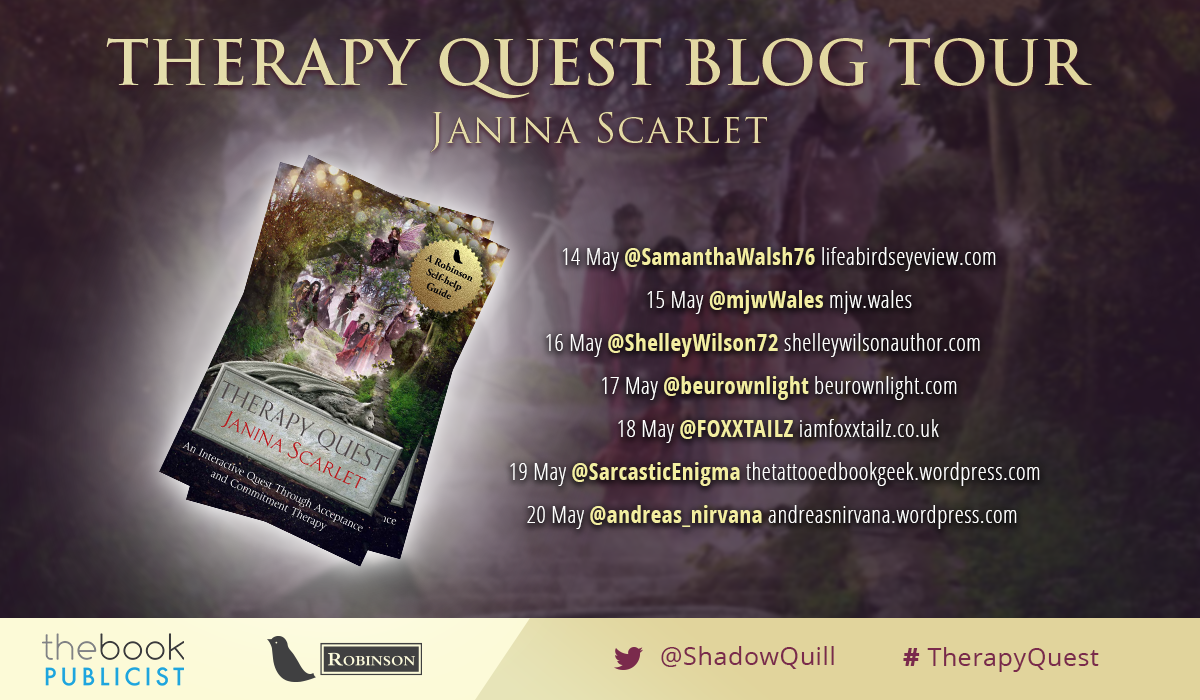
This week for Mental Health Awareness Week, I spoke to her as she launches her  new book ‘Therapy Quest’.

bloggertour.png
(image: The Book Publicist/ Dr Janina Scarlet)


What is your new book Therapy Quest about?

Therapy Quest is an interactive fantasy book in which YOU (the reader) are the main character. You are transported to a magical world of Here and are the Chosen One to stop an evil sorceress, Mallena, from destroying the world. Only you don’t feel like a hero. Not at all. Your anxieties and insecurities nearly lead you to abandon your quest altogether. However, if you decide to partner up with some new friends, such as a vampire with an eating disorder, and an Ogre who struggles with obsessive-compulsive disorder, you just might be able to become a hero after all.

The book is written in a game-like format, which allows you to make choices along the way. Each choice you make will change the rest of your journey and can either allow you to earn or lose points. Some choices can kill your friends or your character, so you have to be careful.

Each time you make a choice, you will also learn a mental health skill, and you will need all the skills you can learn along the way to help you in your final battle.

What was your inspiration for writing it?

I knew I wanted to write a fantasy book with self-help elements in it, in which the reader could learn these skills through the characters they were reading about. My editor, Andrew McAleer, had the brilliant idea of having a similar format to “Choose Your Own Adventure” fighting fantasy books. This sounded like a very interesting challenge to me, and I am extremely honoured to have been able to work on it.

Could you explain a bit about what Superhero Therapy is and how it works in the book?

Superhero Therapy refers to incorporating elements of popular culture, such as fantasy and science fiction books, movies, TV shows, as well as video games, comic books (Superhero or otherwise) into evidence-based (research-supported) therapy to help clients to become their own version of a superhero in real life (IRL).

In Therapy Quest, the reader is the Chosen One, the Hero of their own journey even if they question their ability to do so. Through learning skills such as mindfulness, self-compassion, acceptance, and following their own core values, the readers are invited to take their own superhero journey and develop their own superhero skills, which can be utilized in their every day life as well.

Who could you recommend the book to?

I would recommend this book to anyone age 12 and up who might enjoy fantasy books and would like to learn skills to manage depression, anxiety, trauma, or other mental health struggles.

drjanina

Dr Janina Scarlet is a clinical psychologist and the author of Therapy Quest, a revolutionary self-help book which combines therapy with an interactive fantasy quest.

5 Tips to Manage Stress: Guest post by Cloe Matheson

stressfree1

(image: Healthy Today Club)

With research increasingly demonstrating the correlation between prolonged stress and a shorter lifespan, we would all like to avoid the spectres of stress and anxiety.  But since chances are the vast majority of us have been confronted with both at some point and will be again in the future, what does it take to manage pressure yourself – or even better, to build a lifestyle which doesn’t allow stress a look in?

Check out our 5 simple tips to get started on your journey to calm.


  • Avoid triggering substances or habits


We hear it all the time, but it’s true: the things you fuel your body with significantly affect how you feel. Particularly if you’ve been diagnosed with a gut condition such as IBS (which has been shown to worsen in times of stress), you’ll want to ensure your diet is full of colourful, digestible wholefoods. In times of stress, a salad is often the last thing most of us want to reach for – but even if your current best move is reducing your caffeine intake, that is a step in the right direction.

If you’re currently using other substances to self-medicate during or after a long day – we’re talking nicotine (a stimulant) and alcohol (a depressant) – then let this be the push you need to give up those bad habits.


  • Anticipate and respond


Particularly for perfectionists and people who experience social anxiety, stress is unavoidable in daily life.  Although easier said than done, try to embrace this inevitability as best you can – as our fears often lose their power if we are prepared for them to manifest.  When you are in the midst of responding to stress directly, keep these coping mechanisms in mind:

  • Exercise – put those fight-or-flight hormones to good use and have a workout while restoring yourself to calm. This doesn’t have to be an hour-long run at peak intensity: it can be as simple as walking around your office block when you need a workload break.


  • Breathe – if you’re delayed in a waiting room or have just received challenging news, don’t panic.  Sit or stand somewhere comfortable, close your eyes, visualise a serene place in your mind, slowly breathe in and out, and relax to the sound of your exhalations until your heartbeat slows and you can figure out your next step.


  • Sleep


Even for those of us who believe we need no more than 5 hours of sleep per night, humans just aren’t built to withstand such short stints of shut-eye on a regular basis.  

The proper functioning of both body and mind rely on essential processes that occur during sleep, including the renewal of skin cells and the retention of information in the hippocampus – the main memory-processing section of the brain.  Since these processes can only be completed in a state of sleep, it’s best to take your zzz’s seriously.


But since stress may be the exact thing keeping you up at night, here are some rituals to build into your bedtime routine:

  • Stop work at least an hour before bed
  • Have a warm bath or shower at night
  • Put some lavender oil on your pillow
  • Read (a book, rather than a screen!) before you turn off the light
  • In the dark, focus on relaxing every separate limb and muscle of your body before going to sleep.


  • Get talking


John Donne was right: no man is an island. Bottling up your stress and trying to manage alone may work in the short-term, but not forever. To avoid building up pressure that leads to breakdowns, consider chatting to a counsellor or a grounded friend about how you’re feeling, or join a club or society which will allow you to talk with like-minded people who may struggle with similar problems. If you are internet savvy, even online discussion boards and forums can be a safe place to air your woes.


  • Prioritise and identify


Are you staring down a hectic month of appointments, task-juggling, and trying to perfectly fulfil a different role for everyone in your life?  Compartmentalise to deal with the mayhem.

What do you need to prepare for your next move?  Tackle your tasks individually and avoid thinking about your myriad other tasks until you are finished working on each one.  Stress often peaks when we consider all our problems or tasks in their monstrous sum, whereas they are much more manageable taken alone.

If you struggle through every month, you need to identify what causes your stress. No one can do everything, and you may find that you have overcommitted to tasks. What can you say No to? At times like this, it’s worth remembering that you are the only person in control of your life: so put your wellbeing first.

Cloe Matheson, the author of this article is a writer and blogger. She can be contacted here:  https://cloewrites.tumblr.com/

Guest Post: Using Essential Oils to help relieve the symptoms of Depression by Trysh Sutton at Pure Path Essential Oils

pixabay

(image: Pixabay)

Essential oils are slowly becoming more and more popular for a number of reasons. They are known to have calming effects on a person and can provide a number of benefits along with it.

Essential oils are volatile compounds obtained from plants, usually through a process known as distillation, providing the purest form of the nutrients and benefits that the plant has to offer. The oils are extracted from various parts of the plant, right from the roots and stems, to the flowers and fruits.

Aromatherapy is an alternative form of medicine that can contribute to overall well being, and benefit the body in more ways than one. This science has been around for thousands of years, and some of the oldest known civilizations have used aromatherapy to help cure diseases, and to help people with different medical issues.

Still, many individuals are skeptical. Thankfully, there are many published studies which have proved and disproved various beliefs about the abilities of essential oils.

Their many uses and benefits are actually why they are so popular all over the world. That many people couldn’t be experiencing placebo, right?  

From relieving stress to helping improve energy levels, essential oils can be a huge plus in one’s life.

Essential Oils In The Treatment Of Mental Disorders

Essential oils traditionally have also been used for the treatment of a number of mental disorders. Aromatherapy has been known to help relieve the symptoms of things like anxiety and sleep disorders. One of the things that essential oils are also known to help with is depression.

Depression is a disorder which is characterized by the feeling of sadness and low mood which the person has no control over, and finds hard to remedy without help.

While it is essential to know that essential oils do not outrightly cure depression, they can help to reduce the symptoms that one experiences when they have been diagnosed with depression or depressive disorders.

Inhalation can take place in two ways – directly or by diffusion. As inhale, your body absorbs the chemicals in these oils, which then work on a cellular level.

They also get absorbed into the bloodstream and can work to stimulate different parts of the brain, thereby helping people who are prone to experiencing different symptoms when they are diagnosed with depression.

Essential Oils To Curtail Symptoms Of Depression

Depression can be a huge hurdle in the lives of people who are affected by it, which is why treating it correctly and getting the right medication for it is essential.

However, constantly taking medications can sometimes take a toll on the body, which is why people who are diagnosed with this tend to find some or the other means of alternative medicine that won’t cause as much harm to the body, but still is effective in treating symptoms. Medication can also be expensive, which can make matters worse if the patient isn’t in a position to buy them consistently.

People who are diagnosed with depression tend to experience a whole spectrum of symptoms, which may differ from person to person, and also depend on the severity of the condition. They tend to experience symptoms such as anxiety, restlessness, sadness, sleep disruptions, narcolepsy, loss of appetite and many more.

Here are just 3 essential oils that are commonly known to successfully tackle the symptoms of depression:

Lavender

Lavender is one of the most commonly used essential oils for the treatment of depression. The floral scent of lavender is known to have an incredibly calming effect on people, and helps relieve symptoms of anxiety and helps a person relax more.

Furthermore, lavender is known to help decrease stress in people, which is something those suffering from depression regularly experience.

Wild Ginger

There have been studies conducted that show that wild ginger may have antidepressant properties, but these claims haven’t entirely been set in stone.

There was a study  that showed that when under stress and exposed to wild ginger, the mice showed signs of relief. Wild ginger is also known to improve the serotonin generation in the brain, thereby making a person feel happier and more relieved.

Bergamot

Bergamot may be known for its brilliant citrus scent but it is also known for helping to reduce anxiety, according to a study that was conducted just a few years ago.

Even though people with depression don’t necessarily get diagnosed with anxiety disorder as well, it is a common symptom that people tend to experience.


Trysh Sutton is the author of this blog and an expert in aromatherapy and essential oils. She works at Pure Path  

Guest Post: Mental Health in Schools- Support, Goals and Prevention by Jon Manning at Arthur Ellis: School Enterprise

arthurellis

Last year, 916 children per day in the UK were referred to the Child and Adolescent Mental Health Service. In some areas of the UK, there are mental health appointment waiting times of up to 2 years.

As with everything, we need to learn from this, adapt and solve. Many of our children are subject to a huge amount of information through a variety of channels including social media, news, peers etc, much, much more than if you look at only ten years ago. With these added pressures, we need to ensure they have a more robust support system in place that is ready to react when they need it.

Arthur Ellis: School Enterprise is a non-profit organisation solving mental health issues. Founded through the real life experience of Jon Manning who suffers with Bipolar Disorder. With the help from Medical Professionals, Teachers and Local Authorities, AEforSchools was created, a support system that embeds itself in schools and mentors pupils on those waiting lists and provides empowering workshops for those within school counselling.

Like many things, a mental health issue snowballs, it doesn’t always go away, it may get worse. With the numbers rising, our young people need to understand and be able to differentiate between good mental health and mental illness and know how to take control of their lives to minimise the effects of it. The more children that can take this control at a young age, the more resilient they will become and be able to live fuller lives as they grow.

One thing that I have learnt from my journey to gaining a diagnosis, is that a support network is key. You need to be able to feel comfortable enough to open up to someone who can listen and work with you to support you. Not everyone will be able to help with everything. Personally, my Mum and Dad had different approaches, I would approach one for certain things and the other for something else.

Another main task I took on was exercise, no matter how small. Some days, I didn’t feel able , which is okay. I would however, make sure I did three lots of exercise per week. I found that setting an achievable goal helped so much with giving me a purpose, I could relate that back to how I felt after a jog or a few press ups and it began feeling better…with that, I added a day. This sometimes took so long I felt there was no progress at all but I knew the most important thing was that I was doing it. I found that my Mum was the part of my support network to help push me to not to forget those press ups! You tend to do it when a strong, female is telling you to!

Making little goals and having a support network to help push you to strive towards goals is a great way of tackling issues. You may need medical intervention but this is a good way to help without it (or with it depending on what you need). It is easier to stop a snowball rolling down a hill while it’s still small. The further down it gets, the more help you will need- and that is OK. Be open. Those that are close to you often understand, tell someone you trust.

When I first told people about my diagnosis I often got the reaction ‘Well that makes sense’. We had all been thinking the same thing but hadn’t spoken about it. I was shaking at the thought of telling people, not knowing how they would react, what they would say and what they wouldn’t say- but how they might look. However, because it was the right people, it was fine, liberating in fact to disclose my bipolar!

So use that network you have around you, talk about how you’re feeling and think about something you love, do it in small doses and get your network to help you complete those goals.

Teach your children the same and they will grow up more resilient, more confident and able to handle the ups and downs of life.

Jon Manning, Founder, Arthur Ellis: School Enterprise  https://www.arthurellisltd.com/

This post was featured by Twinkl in their Mental Health in Schools Blog‘.