Why Wait: Eating Disorder Awareness Week and My story with Anorexia: Guest post by Hannah Brown

storms1

(image: rebloggy)

Please read with care: Trigger Warning: Eating disorder Discussion

As Eating Disorder awareness week progresses, it has really got me thinking about my own journey and the symptoms that I experienced as part of my anorexia.

The hashtag #WhyWait is being used this week as we all come to terms with the fact that according to Beat 34% of UK adults cannot name a symptom of an eating disorder, and that even more shockingly sufferers wait 3 years before seeking any sort of treatment.

Aged 19,I started the diet that I thought would give me a wealth of happiness, how wrong I was. What I also started was my gradual decline into anorexia. There were warning signs, there were behaviours that were obsessive and out of control, my physical appearance was changing, becoming weaker and I was almost translucent in colour-  but most strikingly was the change to my personality.

Extreme calorie restriction causes a massive reduction in personal motivation and general apathy. Studies have shown how thoughts become obsessed on food and their behaviours around meals soon turns slightly absurd.

This was absolutely my experience, it crept up on me scarily, without warning. As my diet became more and more refined, my thoughts were turning more and more to food, how I could further restrict, avoid the meal time or alter plans in order to exercise more.

There were so many signs, so many warning lights that for some reason I chose to ignore. I brushed them under the carpet, and kept up with the pretence of “I’m fine”.

Ignoring the issue, or refusal to acknowledge that a problem was developing was a symptom of my perfectionism and the denial that I was experiencing was concurrent with my theme of being the strong one, both within my peer groups and within my family unit.

But why was I waiting, what was I waiting for?

findyourhappy
(image: Rebloggy)

What I didn’t realise was that by waiting to act on my symptoms with any sort of conviction and determination, I was simply prolonging the agony that I would face in the initial stages of my recovery, making those first few months even more difficult. As the behaviours became more entrenched, they became habitual in nature. Personality traits that were once alien and unrecognisable soon become my identity.

There came a time, that I decided to reach out to my GP and unfortunately I didn’t quite get the support that I thought I was going to- whilst I wasn’t turned away, my weight certainly wasn’t critical enough to cause any sort of concern from the medical profession and the advise was to add a dessert into my meal plan, perhaps the occasional spread of butter.

In hindsight, perhaps if I had listened to this very basic advice I wouldn’t have gone on to lose more weight. However, there was no attention given to the mental battles that I was starting to have with my intuition and my fear of food- or the the fear of losing control over it.

Visiting my GP had taken a great deal of courage, as I said I’m always the one that is simply fine, is there for everyone else, often at the expense of myself. To get this quite flippant advice left me feeling slightly desensitised. I left wth their advice- put it in a box and chose to ignore it, my mental health not addressed.

But I don’t want my experience to stop you, or your loved ones reaching out to your GP, because for many they can be the most valuable resource available. Go in, if you can with a loved one and don’t leave that room until you have been given care that you totally deserve.

Alternatively use the Beat help finder page to find that source of support that will be right for you, grab it and don’t let go.

It is OK not to be OK, it is OK to struggle, and it is OK to ask for help. The term “admitting” has slightly negative connotations, like we are owning up to something, a crime. But please, please do not think of it like this. You wouldn’t ever wait after discovering a lump, or if feeling constantly unwell- the same should be said for your mental health.

My journey continued and things didn’t get better until they had got much much worse. I ended up in hospital, but even then I was naive at just how unwell I had become. Hospital was an experience that I will never forget, it was difficult and lonely but undoubtedly it did save my life.

I know, deep down though, that it could have been avoided, I could have saved myself and prevented all the heartache that I endured as part of my recovery.

In reading this, please ask yourself the question: Why Wait?

And take it from me, i might not know you, but you absolutely deserve to receive support and help.

You’re not weak but wholesome and rich, go to my website https://aneartohear.co.uk/- because you deserve to be heard. We can help you.

Guest Post: Charlotte Underwoods Story: How I lost my loved one to Suicide and Recovery from my own Mental Health Issues.

Charlotte Underwood, writer and mental health campaigner, shares her courageous story with us. Trigger warning: discussions of suicide and substance abuse.

bekind1

(image: Pinterest)

Life has not been especially easy for me. I’ve got more layers than an onion due to this, though my mental health really took a turn for the worst when my father went missing for over a month. He was found, suicide was confirmed.

It was hard to process, suicide was supposed to be for movies, not for real life, right? I went through a lot of things after that, blaming others, blaming myself, creating conspiracy theories, just so I didn’t have to accept that my best friend, my daddy, was gone.

Losing a loved one to suicide is so hard because it’s often sudden and leaves a lot of questions and nuclear damage that domino effects into every single person who knew and loved the victim. I’m all reality, it is no ones fault for a suicide, not even the victims.

There are so many possible causes and things that can trigger a suicidal episode that it is impossible to always know that someone is at risk, we often miss signs even when they are right in front of us.

My dads death led me to substance abuse and my own suicide attempt, I didn’t want to live without him, I was a daddy’s girl and he was the only one who helped me with my own mental health. For three years I refused to grieve and my life was looking to be pretty similar to my fathers demise, a life of hiding my feelings because I didn’t want to upset anyone or cause a problem.

It wasn’t until I met my husband and learnt to think about myself that I realised through it all, I had lost track of who I was. I decided then and there to start being selfish (without being mean) and to love myself and fight back and work with my own mind.

It’s been a rollercoaster since, recovery isn’t linear, my mood changes in seconds and each day is a battle, I may look fine but there’s always so much going on inside my head and body (mental health has physical effects too!).

What I have learnt though is to not be ashamed of who I am, to demand the help and support I need and to not let my mental health limit me because it does not define me, I am Charlotte, plain and simple.

It’s important to remember that all your feelings are valid, it’s ok to hurt and be angry and to have all this going on because it’s your body responding to trauma or something in your environment eg stressors.

That’s why it’s so important to talk and to be reminded that it’s ok not to be ok and that you are not alone!

Charlotte is an author, is on Twitter and can be found at https://charlotteunderwoodauthor.wordpress.com/

Extract from my article for Metro UK: How to Improve on-screen depictions of Mental Illness

metrodepiction

This is an extract from an  article our founder Eleanor Segall wrote for Metro.co.uk. To read the full article click here:

http://metro.co.uk/2018/02/21/how-to-improve-on-screen-depictions-of-mental-illness-7315828/

As someone with bipolar disorder, I am often intrigued by depictions of mental illness on TV and film. For many years, mental illness has been stigmatised, and this has been reflected on screen. Thankfully, this stigma is beginning to be broken down, but it is still present.

In her award-winning article, Mental Illness in the Media, for the International Bipolar Foundation, Hosana Tagomori, who was a high school student when she worked on the piece, wrote: ‘The media often portrays characters with mental illness as incomprehensible, tortured and convoluted… the entertainment value often gets in the way of an accurate portrayal. ‘Patients are perceived as dangerous or insane, due to the inaccurate portrayals in media, where the character is almost always hopeless, deranged, and dangerous.’ ‘It is quite easy to subconsciously absorb these misconceptions.’

Indeed, this is a challenge that those of us with mental health issues face. We want our illnesses to be portrayed correctly and accurately on screen, without having to watch stereotypes. Depictions of mental health can be disappointing

Tagomori wrote: ‘In the television series Homeland, the bipolar character always seems to be the pop-eyed, insane mess who is constantly going ballistic: ranting, drinking and screaming’. While this can be true for some people with bipolar in the middle of a manic episode, it is not a balanced approach to the illness. We know that people with bipolar disorder can often be stable and well on medication and that a long time can elapse between episodes.

Portrayals of those with mental illness as ‘insane messes’ raises dangerous misconceptions, including that people with mental health problems will never get well. For me, a brilliant representation of bipolar disorder and postpartum psychosis appeared on EastEnders in 2015.

This centered around a story line for pregnant character Stacey Fowler (played by Lacey Turner), who has the disorder and experiences a psychotic episode after giving birth. Before watching the scenes in which Stacey has psychosis, I was concerned how it would be shown on screen, but I needn’t have worried. Sensitive, accurate portrayals of mental illness on screen can help to educate viewers EastEnders worked directly with the charities Mind and Bipolar UK to create the story line, so the script and performance were as accurate as possible.

In 2015, Dominic Treadwell Jones, producer of the story line spoke to the Radio Times, he said: ‘EastEnders have worked closely with Mind, Bipolar UK, other experts in the field and women with personal experience to show a story that is true and painful, while also filled with the usual twists and turns viewers have come to expect from EastEnders. Lacey is one of the most raw and intuitive actresses on TV.’

Also speaking to the Radio Times about the EastEnders story line, Clare Dolman, vice chair of Bipolar UK, said : ‘As the national charity supporting people with bipolar, we’ve been glad to work closely with the BBC on Stacey’s storyline. ‘There is a very high risk that women with bipolar will become ill when they have a child and 20-25% of them will have a postpartum psychosis, so it’s fantastic that EastEnders are raising awareness of this devastating condition.’

In the scenes where Stacey is experiencing psychosis, the character believes she is the Virgin Mary and that her baby is Jesus. She experiences delusions and auditory hallucinations. I was concerned about how I would feel watching it, but what I most felt was a sense of pride that British television was portraying bipolar correctly, sensitively and appropriately.

Read more: http://metro.co.uk/2018/02/21/how-to-improve-on-screen-depictions-of-mental-illness-7315828/?ito=cbshare

Twitter: https://twitter.com/MetroUK | Facebook: https://www.facebook.com/MetroUK/

What to do if you think you have Depression: a Guide.

christy
(image: Christy Ann Martine)

This blog was voted for in my  Facebook group online poll and so I have decided to write it, with my advice from personal experience and more.

So firstly- what is Depression? Depression is more than just low mood. It can affect your entire ability to function. Depression symptoms include your mind slowing down, poor concentration, lack of sleep or too much sleep (when depressed I sleep too much), more tearful than normal/ prolonged low mood, loss of motivation and ability to go to work/ socialise, not wanting to do activities you enjoy, feeling lost and/or hopeless about life.

Some people who are depressed will self medicate with alcohol, drugs, food, gambling, spending money- anything to make them feel a bit better. Some may start expressing suicidal thinking and ideation or make plans to end their own lives. For others, depression can be part of a wider mental health disorder. I have bipolar disorder for example and depressive episodes are part of my illness. So its a big topic and one which is different for each person (due to brain chemistry and environment).  Anxiety and self harm can also be part of depression.

So what to do if you think you are depressed?

1) Make an appointment to see your GP/ Doctor immediately. If you can get an urgent appointment, do. Tell them how you are feeling and they may suggest medication such as anti depressants which help lift mood and get you back to normal functioning and/or recommend you to a therapist. NHS waiting lists in the UK are ridiculously long for therapy, but just speaking to a doctor and taking medicine should help. Note that anti depressants do have a side effect- and can make you more anxious/ depressed within the first two weeks so talk about this with your doctor. If you have a psychiatrist and medical team (like I do), go and see them and discuss how they can help your care.

Getting better can take months and is a combination of factors. If your depression was triggered by an event, it may be good to go and see a counsellor to discuss any trauma.

2) If you are feeling suicidal and feel like self harming, disclose this to someone you trust. You may not need to be in hospital if you have a good support network, but if you are really really ill, you may need to be. However, do not be afraid for asking for help from medical professionals- especially your GP and/or psychiatrist. They are there to help you get well.

3) If you get a first time psychiatry referral- this is what will happen. You will get asked lots of questions so the doctor can ascertain what is going on. I found that being as honest as I could was more helpful. Take a loved one with you to the appointment. They may ask you to complete questionnaires on your health too and/or refer you to psychology.

4) Use your support network- friends, family, partner. If you have a loving person who understands depression in your life- lean on them. Support from others is very helpful. Depression can be stressful for all involved and some may not understand or may tell you to ‘pull yourself together’. This is just stigma and remember depression is an illness that needs treatment.

If you feel able, see friends you love and trust. When I am depressed, I find it hard to leave the house.. but love and support from others is vital- even if theyre just bringing you chocolate and magazines. Acts of kindness really help.

5) Other holistic methods can really help depression. Whether its:

*Gentle exercise
*Meditation
*Prayer if you want to pray
*Journalling and writing down your achievements however small (eg I washed the dishes)
*Colouring a picture and making something beautiful
* Good sleep regime (when depressed this can be harder)
*Eating healthy food/ foods you love
* Taking care of yourself
*Watching a funny film
* Texting a friend
This can be hard when you are depressed but I would recommend Yoga Nidra meditation for anxiety as well as Headspace meditations….

6) Be Kind to Yourself

Depression is not your fault. Its an illness and a natural part of life. You don’t have to deal with it alone and you don’t have to beat yourself up because you are feeling lower than normal.

Reach out for help but ultimately be kind to yourself. 

Eleanor Segall is the blogger and editor behind this blog Be Ur Own Light.

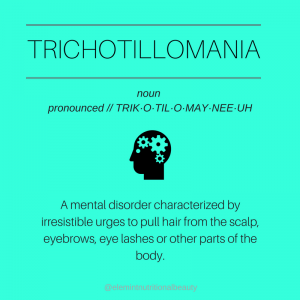
Guest Post: An Introduction to Trichotillomania- Hair Pulling Disorder by Ariel Taylor at trichstop.com

trichot
(image: eleMINT)

Trichotillomania is a hair pulling disorder that affects millions, though many are not even aware of the fact that they suffer from this condition. It’s a well-known emotional illness and if you punch in the keyword Trichotillomania on the Internet, you’ll be bombarded with blogs, journals, and, essays discussing this hair-pulling habit.

However, when it comes to analyzing this disorder, it’s more than just a case of perpetual hair-pulling. This urge to tug or pluck hair defines Trichotillomania but one needs to know the warning signs and instances that could lead to this emotional upheaval.

Trichotillomania comes under the obsessive-compulsive spectrum and is akin to Obsessive Compulsive Disorders – OCD. When it comes to OCD, Trichotillomania too is defined by compulsions i.e. the sudden need to pull or pluck out hair. Nonetheless, Trichotillomania stems more from an impulsive side while OCD is a repetition of a particular habit – more along the lines of obsession.  The main area that’s most affected is the scalp however, people don’t shy away from tearing out their eyelashes, eyebrows or other hair for that matter. A person feels at ease after hair is uprooted or successfully pulled from the skin. Chronic Trichotillomania can lead to hair loss resulting in bald patches. It’s a source of great concern to people who have family members dealing with this condition especially if they have never encountered or been familiar with an issue before.


Early Signs Of Trichotillomania


Sense Of Comfort

In times of stress and agony, individuals pull their hair inadvertently which is followed by a feeling of relief and comfort. For instance, Sally, a fifteen-year-old, starts pulling her hair when she hears her parents get into a verbal altercation with each other. For some kids, parents who quarrel often can be a reason of great discomfort. Many aren’t aware of ways to deal with such situations and resort to things or activities that give them temporary solutions. Trichotillomania happens to be one of them. The intense tugging and twisting of hair is a sign of silent suffering and pain. Somehow, that very pain turns into relief until the awkward moment of distress has passed.

Perpetual Pulling

The urge gets the better of an individual and they pull away not realizing the pain it would cause. There’s a lot of embarrassment and shame that comes with Trichotillomania. Initially, there’s denial and quite a few take a while to come to terms with accepting the fact that yes, there’s a problem. They resort to covering their bald patches by donning a hat or wearing scarves. Any unevenness on legs or hands is covered with extra layers of clothes or tattoos. People dealing with this problem either pull their hair for brief or long periods of time.  The impulsive behavior cannot be controlled and hair is pulled, no matter what.

Comparatively more than men, women are prone to get diagnosed with Trichotillomania. It brings with itself other emotional problems such as bipolar mood disorders and depression. Uneven patches of hair on the body makes many wary of social interaction since the fear of being bullied or ridiculed tends to seep in.


What Causes Trichotillomania?

There isn’t a specific reason that leads to Trichotillomania but there are several biological, psychoanalytical and behavioural theories associated with this disorder. For instance, neurochemical imbalance, as well as trauma connected with childhood or stressful events. Trichotillomania that occurs under psychoanalytic model denotes an unconscious unsettled past – an unfortunate incident of abuse by an acquaintance or a complete stranger.

The behavioural model for Trichotillomania stresses on painful events. For example, loss of a parent, or constant family skirmishes precedes the onset of hair pulling. An attempt to release tension is caused by such distressing instances and moments. This behavior becomes perpetual and later turns into a habit. The person may not even be aware of any initial triggers. However, it only has to be one event in response to what someone may perceive as the urge for pulling hair. The biological model for Trichotillomania purports neuro-chemical imbalance, mostly with serotonin. Levels of altered dopamine too play a vital role in aggravating Trichotillomania. It still isn’t sure if genetics need to be taken into consideration. Although some studies do suggest a rise in the percentage of Trichotillomania in people whose relatives suffer from different psychiatric disorders.


Plan Of Action

Continuous tugging of hair needs to be reported medically and if Trichotillomania seems an underlying cause then psychiatric as well as a medical treatment has to be initiated. Not many are aware that the earlier the intervention, the better the probability of the behavior being in control. However, it is essential to note that a person – child or an adult, sometimes do not present for treatment for Trichotillomania until two years since hair-pulling takes place. Psychological behaviour therapy and medication help with treatment for this condition. Habit reversal training as well has done wonders to people who have been suffering from this emotional ordeal.

Lastly, acceptance and patience are key factors in addressing this psychological disorder. With time along with medical help and the support and love of family and friends, Trichotillomania can surely be managed.

For more please see http://trichstop.com

Channel 4 Launches Lloyds Bank’s Mental Health Awareness Diversity in Advertising Campaign: For Time to Talk Day #GettheInsideOut

channel4
(image: Channel 4)

Channel 4 to launch Lloyds Bank’s £1m award-winning Diversity in Advertising campaign

  • Professor Green, Victoria Pendleton, Jeremy Paxman, Rachel Riley, Ade Adepitan, Alistair Campbell and Alex Brooker star in Lloyds Bank’s mental health awareness campaign
  • New research finds 75% of people believe there is a stigma in Britain attached to people with mental health conditions
  • Almost three quarters (74%) think the average person would be unwilling to discuss their own mental health issues
  • But nearly three quarters (72 per cent) think society has a better understanding of mental health conditions
  • Openness of celebrities and media coverage contributes to positive change


Lloyds Bank’s winning ad campaign of the Channel 4 £1m Diversity in Advertising Award launches exclusively on Channel 4 on mental health awareness Time To Talk Day (1.2.18).


The adverts will feature celebrities – including Professor Green, Jeremy Paxman, Rachel Riley and Alex Brooker – as well as members of the public and Lloyds Bank colleagues playing a variation of the ‘Who am I?’ sticky-note guessing game, to explore the common misconceptions about living with a non-visible disability.


And to coincide with the campaign’s launch, a new Lloyds Bank and Mental Health UK survey, reveals that although improvements have been made in how society thinks about mental health, 75 per cent of people still think there is a stigma attached to the issue.


Lloyds Bank and creative agency, adam&eveDDB, created the mental health adverts  after winning Channel 4’s Diversity in Advertising Award, set up by the broadcaster to improve diversity in advertising.


As the award winner, Lloyds Bank will receive £1m worth of advertising airtime on Channel 4. The competition invited entrants to put forward creative ideas featuring non-visible disabilities.


Channel 4’s Sales Director Jonathan Allan said: “Producing an advert that puts non-visible disabilities at its heart was a demanding brief and it’s been a real pleasure working with Lloyds and adamandeveddb as they developed a fantastic new campaign that makes people think more profoundly about mental health.


“If this campaign can encourage the public and advertisers to think a little harder about all aspects of diversity, it can help make a real difference to people’s lives.”


“The TV ad is brilliantly simple, yet hugely effective,” says Robin Bulloch, Managing Director, Lloyds Bank. “And while winning the Channel 4 Annual Diversity in Advertising Award in itself is a great achievement, the positive difference the campaign will hopefully allow us to make to so many people’s lives is the real ambition here. By raising awareness of invisible disabilities and taking action to promote healthy wellbeing, we can support our colleagues to recognise the signs and feel confident and equipped to support customers and each other.”


Lloyds Bank has been working with Mental Health UK to launch #GetTheInsideOut which will appear on the adverts. #GetTheInsideOut campaign will encourage more people to speak about mental health and aims to inspire those living with a condition to speak up about mental health.


Research from Lloyds Bank and Mental Health UK, undertaken by YouGov, found that seventy-five per cent of respondents feel there is a stigma in Britain attached to people with mental health conditions. And 88 per cent feel society needs to do more (much more (62%) or a little more (25%)) to better understand mental health issues.


The survey reveals that 67 per cent of respondents think people are more comfortable talking about mental health conditions now than they were five years ago. And people feel that the four main factors behind this change were – celebrities talking about mental health (70 per cent); media stories about mental health (70 per cent); societal change (68 per cent); and charities raising awareness (56 per cent).


But the research also reveals that 74 per cent of respondents think people would be fairly unwilling (62 per cent) or not willing at all (11 per cent), to discuss their own mental health issues.


Managing Director of Mental Health UK Brian Dow welcomed the research commissioned by Lloyds Bank and said: “We have come a long way in a short time to raise awareness. In large part thanks to the hard work of the charity sector, campaigns like Time to Change, a willingness of celebrities, notably the Royal Family, to talk about mental health and positive engagement by the media.


“Nevertheless this research shows that we cannot rest of on our laurels – there is a lot more that we need to do.”


Although the survey showed that people think significant steps have been made in the past five years on people’s awareness of mental health, more still needs to be done.


The survey discovers that compared to five years ago;

  • 72 per cent of respondents think that society  has a better understanding of mental health conditions
  • 69 per cent feel people empathise more with people with mental health conditions
  • 70 per cent think society is more aware of the everyday realities of living with a mental health condition
  • 70 per cent also feel there is more awareness of mental health issues raised in the media


In addition;

  • Fifty-six per cent of respondents said they’d feel comfortable talking to someone they don’t know very well about their mental health.
  • While 37 per cent said they’d feel uncomfortable, with over half (57%) of this group concerned that they might offend the person  and a similar proportion (56%) worried they would embarrass or upset themLloyds Bank and Mental Health UK Charity Partnership

    Lloyds Bank is proud to be working in partnership with Mental Health UK. Together the Bank and Charity aim to promote awareness of the link between mental health and money problems, encourage discussion between customers and colleagues. To date, colleagues and customers have raised over £4.8 million which has enabled Mental Health UK to design, build and launch a pioneering new service called Mental Health and Money Advice. This service is the UK’s first advice service dedicated to helping people understand, manage and improve their financial and mental health.

    For further information –

    Channel 4 –

    Tim English, Group PR Manager

    1. 020 7306 6984
    2. tenglish@channel4.co.uk


    Lloyds Bank –

    Eve Speight

    M: 07585965319

    E: eve.speight@lloydsbanking.com


Its #TimetoTalk Suicide for STOP Suicide Charity: Mental Health Feature Article

timetotalkday
Today I have been featured in STOP Suicides Campaign for Time To Talk Day, alongside other campaigners who bravely share their stories about suicide or suicidal thoughts. The full article can be read at   http://www.stopsuicidepledge.org/its-timetotalk-suicide/ 

Here I include my story from the article. Thanks to all at STOP Suicide for giving me the opportunity. Remember you can talk about mental health :

eltwitter

‘In 2013, I experienced a suicidal depression. I was incredibly low, exhausted, sleeping all day and couldn’t cope with life.

This was part of my bipolar disorder and my medications at the time were not holding my moods. My parents had recently divorced and I had moved house and finished a degree. Then, my Grandma passed away. The stress of all this tipped me over into a deep depression.

The truth is I didn’t want to die, I just couldn’t deal with the pain of living. It was incredibly difficult for my parents, because I would say to them ‘it would be better off if I wasn’t here’. I had so much emotional pain that the only way to manage it for me was to talk about how scared I felt about feeling suicidal. I was concerned that if I didn’t express it, that it could have been very dangerous for me- I didn’t want to die so talking was the only way out.

Thankfully this was hugely positive because my parents understood that the suicidal thoughts were the depression and not me inside. They let me express how I felt, provided a listening ear and used their own life experience to help me. They went with me to my psychiatrist and stayed with me during home appointments. They helped pick up my prescriptions for anti-depressants and looked after me, until I had been lifted out of the depression.

Having loved ones to talk to when I felt suicidal, to not feel alone and to have support every day was vital to my recovery.”

How I stopped Self Medicating my Post Traumatic Stress Disorder- PTSD and found Recovery by Peter Lang


hopeptsd1
(image: sayquotable.com)

Peter Lang shares his amazing story of recovery from drug and alcohol addiction, homelessness and Post Traumatic Stress Disorder.  Trigger warning: please be careful when reading, talk of drug use. 
Most people think of veterans when they think of Post-Traumatic Stress Disorder (PTSD). Unfortunately, I know all too well that PTSD can also affect civilians. PTSD is defined as the psychiatric disorder that happens following a traumatic event. While war is a common traumatic event that causes PTSD, it’s not the only kind of trauma. Traumatic events can include abuse, life-threatening illnesses, and serious accidents.

As a homeless drug addict, I experienced my share of traumatic events. I spent most of my twenties without a home: couch surfing with acquaintances and strangers all over the country, living on the streets of Philadelphia, and living on the beach in Maui. Throughout this time, I used every substance you can think of: alcohol, heroin, cocaine, meth, prescription medication. I drank so much, I developed avascular necrosis in my hips, which later led to a bilateral hip replacement after a car accident at age 30.

After I got hit by a car when crossing a street in Philadelphia, my mom asked me to come down to Georgia to stay with her. I spent the next two years in a wheelchair. Though I tried periodically to stop drinking and using drugs—with some success—I still struggled. I know now that one of the main reasons I was struggling was that I was trying to self-medicate my PTSD.

On the street, I experienced many traumatic events. There were so many times I got beaten up or taken advantage of or almost died. Once in Hawaii, I did die, and they had to revive me in the hospital. The doctor told me with the amount of alcohol I had in my bloodstream, it was a miracle I was alive.

In early 2016, I met a woman who changed my life. We fell in love almost immediately after meeting each other, and we got married a year later. We are about to celebrate our one-year wedding anniversary.

She made me see that it was okay to ask for help with my PTSD. I didn’t have to feel like I had to take care of it all the time. She made me see that a great deal of my struggles with substances was because I was just trying to numb the pain from traumatic events I hadn’t dealt with.

At one point, I was prescribed benzodiazepines, which did help my PTSD. However, I was never able to take the medication the way I was supposed to, and they became just another substance for me to abuse as opposed to a helpful tool.

It was clear that in order to stop self-medicating, I was going to have to see a counsellor and confront my traumatic events. I started seeing a therapist regularly, and she has helped me immensely. She has helped me to open my eyes and stare the traumatic memories in the face, knowing that they don’t define me.

Another tool that was incredibly helpful for me was meditation. By meditating, I could learn how to become spiritually centered and stop identifying with the painful memories. I’ve also been greatly helped by Buddhist-based 12-step meetings, which have given me a unique perspective on the 12 steps of Alcoholics Anonymous.

Now, I’m doing better than ever. My wife and I are ridiculously in love, we just moved into a nice house, and I’m working full-time as a freelance writer and marketer. I wouldn’t be where I was today if I was unable to deal with my PTSD. I would have never been able to stay clean and sober if I kept self-medicating.

I still struggle with my PTSD frequently. It hasn’t gone away. But now I have the tools to handle any episodes that do come up.

Many people suffering from a substance use disorder are also suffering from a co-occurring mental health disorder. You can treat one without also treating the other. Luckily, you don’t have to. There are plenty of resources that will help you to seek the treatment that you need. All you have to do is ask for it and be open to it.

Peter Lang is a freelance writer from Atlanta, Georgia. He occasionally writes for The Recovery Village. In recovery himself, he has dedicated himself to helping others struggling with substance abuse.


Light Beyond Self Harm by Kaitlyn W at withbeingalive.wordpress.com

selfharmselflove
(image: Dare to Live SOS) 

The author Kaitlyn blogs at www.withbeingalive.wordpress.com . Trigger warning: talks about self harm behaviours (but not graphically), please be careful when reading.

When you are curled within the cradling, spiked tentacles of self-harm – one wrapped around each wrist, and another brushing away any tears – those pesky alternatives of “holding an ice cube!” or “colour in!” can seem shallow; laughable even. You are shoulder-deep in the swampy mud that is self-harm, the goop surrounding you can feel ever-rising, and there is a stigma of wading in this particular swamp – you should be ashamed that you are.


During self-harm, it can feel impossible to have hope. A hope for a different reality can feel light years and stone barricade walls away. It can feel like the darkness (or swamp mud, whichever you would prefer to call it) is all consuming, your actions are all that you are, and the glittery, floaty wings of change have no way to weave in.


However, it is my privilege to share today that you are so much more than self-harm tells you that you are. Consequently, that there is hope beyond self-harm, and that this hope is yours. Ultimately, self-harm does not need to have a role in your life.


Despite how inherently wrongly created and badly designed for life you may feel, this is not who you truly are. Despite the mess, the exhausting racket that constantly parties too hard in your brain, remember that you are only witnessing this all from one perspective. You exist not only to yourself, right now, but also to child you and future you, to other people, and you exist beyond the darkness you feel. In all these other ways, you are who you are, and you are not the engulfing darkness. You have the potential to be who you are, to live the life you deserve to live; to be in the light beyond self-harm.


It’s safe to say that self-harm exists as a little bundle of menace, born from doubts, fears, life experiences, unhealthy coping strategies, and maybe a few other things thrown into the mix too. Although that can feel like an awful lot, or perhaps literally everything, which is an incredibly heavy load to carry, it really isn’t everything. Your doubts and fears can simply be. They inherently don’t have to control your behaviour. As for a way to cope, there are plenty of other ways to cope too. Self-harm isn’t the sole solution or the only option.


In a grumbling, gravelly voice, self-harm can mutter about how you won’t be able to survive without it. That you deserve the constricting boundaries that self-harm makes you believe you are worthy of. In these times, it can really help to recognise that this is self-harm talking. That these thoughts aren’t you, and that you don’t need to act upon them. You could imagine that self-harm is a preteen yelling at the Xbox, or maybe you like the swamp monster with tentacles idea. Either way, give self-harm an identity that’s not you. Self-harm then becomes an annoying, whining brat whose tantrums you can work on ignoring, rather than indulging. Do you really think self-harm deserves a brownie?


What also really helps to pry yourself free from self-harm’s sticky little claws, is finding out what works for you. Go to therapy or a support group and engage in professional help; they have spent several years training to help people in exactly the same situation. Find someone you can talk to; a small yarn can go a long way. Try out those alternatives (and there are so many more too) that were mentioned at the beginning; they can seem plain kooky, but give them a go! I guarantee that there will be at least one that can ease self-harm’s whinging, taking it down from a full-blown tantrum in the middle of the supermarket, to perhaps a soft snivel on the bottom step of the staircase.


To end with, there is light and hope in having a life beyond self-harm. You have the potential to exist as bigger and brighter, as vast and brilliant, than what self-harm croaks about you. Go out there and stomp and shout, and simply be – be loud, be radiant – you are greater than what self-harm tells you that you are

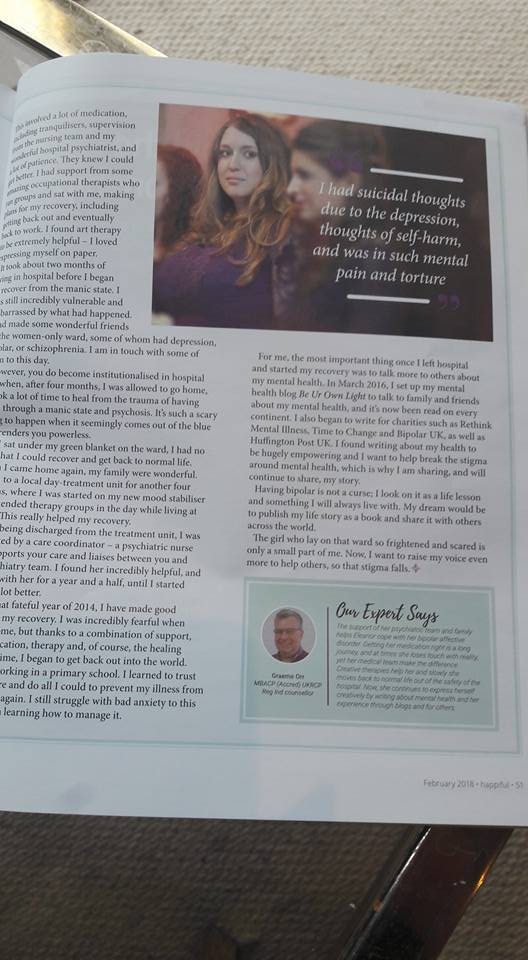
‘A Unpredictable manic episode meant I was hospitalised for my bipolar disorder’: for Happiful Magazine February 2018 Issue

happifulmag
(image: E Segall and Happiful Magazine)

Hi everyone,

I am thrilled to be able to share my story of recovery from bipolar disorder for the first time in print (!) at Happiful magazine, a UK magazine solely dedicated to mental health.

You can read it online here:  https://subscribe.happiful.com/ click read e-magazine and turn to pages 50-51. If you live in the UK, you can also order the magazine there by post or buy a copy in most major UK supermarkets!

As I say in my article,

Having bipolar is not a curse, I look on it as a life lesson and something I will always live with. My dream would be to publish my life story as a book and share it with others across the world… The girl who lay on that ward so frightened and scared is only a small part of me. Now, I want to raise my voice even more to help others, so stigma falls’   

I hope you enjoy reading it and leave a message for me in the comments if you do.