
Reflections- Being Bipolar is not the end.

hopeshines1

This blog post was prompted by a blog I had written a few months ago for Rethink Mental Illness about living with Bipolar 1 disorder. I received a message from a mother whose teenage daughter was suicidal and very unwell and was receiving treatment from CAMHS child and adolescent mental health service . This same mother has stayed in touch with me and updates me with her daughters progress.

I was the same age as her daughter is now when I became unwell. I was only 16, still a child but on the brink of adulthood, at a time where teenage life can be confusing, even without a mental illness!  Being diagnosed at 16 changed my life in many ways. I had to come to terms with having a chronic illness, with being ‘different’, with taking medication daily for the rest of my life, with not drinking alcohol, with feeling insecure about my own mind and self for a long time. Its a lot to take in, at that age in particular.

Being Bipolar is not the end. Yes it can cause havoc and play with your sense of self, cause insecurities about your mind, make you psychotic or manic/ hypomanic, make you depressed and suicidal, make you anxious and terrified and many other symptoms. But it is not the end. With help from support networks and professional medical teams, you can recover. You can get better. You can achieve.

What changed everything for me was taking Lithium. It has stabilised my moods and they don’t fluctuate as intensely, so I am not symptomatic. It was a gamble taking it, as is taking most psychiatric medication, its trial and error. But, as Bipolar runs in my family, I knew having the right chemical balance was key because my moods were all over the place.

I still have bad days and panic and anxiety from time to time. However they are no way near as bad as when I was on the wrong medication.

At 16, I had a very uncertain future. The Doctors told my family I wouldn’t get my A levels (despite having got good grades at GCSE) or go to university. I proved them wrong. I went to university and got my BA, I went travelling to India and Ghana where I volunteered and I went to drama school to do a Masters degree which I attained, despite the difficulties in my mood and the stress it did create. This wouldn’t have been possible without the support network and amazing family in my life. And of course, my need to do things despite the illness!

Achieving these things made my self esteem increase. There are times when I am not confident but having a severe mental illness is not the be all and end all. You can live with it, there are times which can be hell- but these make the sweet times better. I am back at work as well after being in hospital in 2014 and have tried to rebuild my life.

So today I am thinking of the teenage girl who is currently unwell at 16 and her family. And praying for her as we go into Shabbat (Jewish Sabbath).

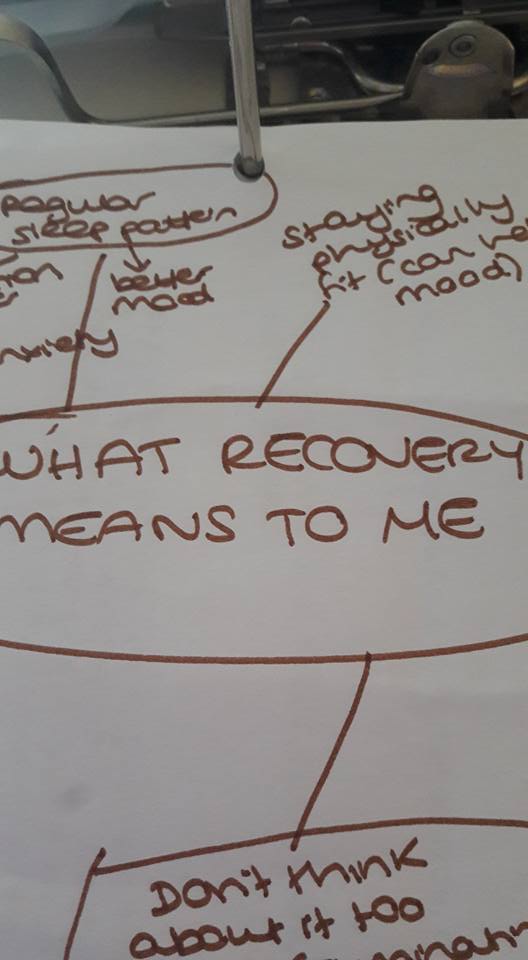
My time recovering in the Acute Day Treatment Unit

adtu3
(my art therapy)

As I have previously written, in 2014, I suffered from a very acute period of mental illness- a manic bipolar episode. I had to stay in hospital for 3 months before I began my recovery process at home. Part of that recovery process was being referred to an Acute Day Treatment Unit (ADTU).

ADTU is effectively a hospital day therapy ward- where groups are run on things like anxiety management, recovery techniques, anger management, assertiveness, relaxation/ meditation to music, arts and crafts and groups such as playing games eg table tennis or quizzes. It is there as a short stay intervention. Some like me had been in hospital already very unwell and some had been referred to ADTU to stop them having to go into hospital and to get them better through therapies.

People are referred there with all kinds of illnesses- depression, bipolar, schizophrenia, eating disorders, drug, alcohol and gambling addictions, psychosis, acute anxiety disorders eg PTSD/ OCD and more.

As well as the therapy groups with occupational therapists, the ADTU has psychiatric nurses, psychiatrist and therapists who support you during your stay. I was there largely because I had been through a very traumatic period of bipolar illness and also because I had decided to change medication to a new mood stabiliser- Lithium.

This meant that as well as the therapy sessions, I had to get used to a new medicine regime and weekly blood tests to determine my Lithium level. When you start Lithium, the level in your blood fluctuates- if it goes too high your body can have a toxic reaction. Luckily this never happened to me but there were times when I was quite low and depressed as the Lithium level was too low. So for about 8 weeks, I had regular blood tests.

In ADTU, you get given a key worker- an occupational therapist or nurse who works with you through your stay and acts a bit like a therapist- they are your support team for when you are there. At ADTU, I lived at home and went in every day 5 days a week. It was challenging as there were constantly new people coming in and out- some very poorly. However I made some incredible friends.

My first important friend I met on my first day! We both began at ADTU at the same time and started our induction. She also has bipolar disorder and we were quite similar- both loving all things girly, glittery and of course- unicorns! We got on well from the beginning, sat with each other in therapy groups, where we both regularly fell asleep in the relaxation to music sessions. She is an amazing and brave woman- who I am honoured to call a friend and we are still in touch today!

I made other friends as well, from sitting in the lounge and chatting in the mornings. One of these was my friend who loves sport and we would chat about what she was doing on her degree. She is also another amazing one who I am still in touch with!

ADTU is meant as a short stay intervention but due to my acute illness and change of medication I was there longer than almost anyone else. This became frustrating as I kept seeing people being discharged and I was still there. In the end after 12 weeks where I became used to all the staff and therapy groups and felt a bit like a veteran (some people are only there for 2 weeks) I emerged still fragile but stronger than I had been.

I owe so much to the wonderful staff- especially my occupational therapist key worker and the therapist running the arts and crafts and recovery groups. The staff were so supportive and kind.

In the UK, there are now only two ADTUs in the whole country as funding has been cut. However, I can honestly say that without the staff there and my new friends- I would have found life so much harder. I owe them so much.

Here are  some of my photos from the therapy folder I kept.

This blog is dedicated to my friends from ADTU who are making amazing strides- my 2 closest friends are now studying for Masters Degrees!

adtu1

Guest Post: How Deepdene Care helps support people with psychosis.

deepdene

by Rhona Mackenzie, Clinical Director, Deepdene Care

For more please clink link above or see http://www.deepdenecare.org.uk/

Be Ur Own Light is happy to partner with Deepdene Care,a health provider in the UK


At Deepdene  we support people with severe mental health issues such as psychosis.


As mental health problems are often complex and involve an array of factors, the best course of action for any case is structured, multi-faceted approach that is rolled out over months and possibly years with the primary objective of reducing the impact of the condition on an individual’s life.


As a service provider we have to look at the bigger picture:


Staff have a deeper understanding

A high level of staff training is an intrinsic part of any treatment and care plan.


We train staff to understand and increase their knowledge of all mental health conditions. In the case of psychosis, they are taught to be aware of what hallucinations and delusions are, so that they can act in a proper, effective manner, and are also taught how brain chemicals can affect people. This gives them an educated insight, which not only helps with treatment, but allows them to understand what an individual is going through, ensuring empathetic responses.


In addition, staff have to have an understanding of the side effects of medication. So, again, they are properly equipped to be able to help the service users and approach them with understanding.


Therapies and activities

Therapies and activities are also a key factor in the recovery process, especially occupational therapies, where service users are able to fill their time with meaningful activities. This helps individuals gain routine in their lives, bringing a sense of direction back into what they do and acting as a representation of everyday life.


Getting to know the person and their symptoms 

It is essential that anyone with psychosis under our care is supported and treated as an individual, as each case is completely different from another and symptoms can vary quite dramatically. This is why we place a great deal of focus on listening to patients, observing their behaviours and supporting them in every way possible.


We also promote therapeutic relationships between staff and service users, with the central goal being to build trust and respect among them.


Destigmatising mental illness

As a mental health provider, we have to advocate and educate people to destigmatise mental illnesses and accept the person the way they are – promoting empathy among team members and throughout the service as a whole.


If a person has had a mental illness they are usually more understanding and empathetic towards another mental health sufferer. If a service user/person is being discriminated against, we may need to support them on how to deal with that.


Outside support

We also support those with psychosis through outside professionals like psychologists.


But, and we can’t stress this enough, none of our work would be effective, if we don’t support, respect and accept the individual for the way they are.


Mental Health Recovery

Our ultimate goal is to have individuals be responsible for their own behaviours, which is why we look to educate them to self-support their own physical, emotional and social needs, while we are on hand to offer support when necessary. Almost like a safety net to cushion any falls individuals may have on their personal journey to recovery.


It’s important to dispose of any one-size-fits-all solution. This is about treating the person as an individual, accepting their illness as part of their individuality while at the same time seeing them as a whole person and not just defining them by their mental health condition.


Self-belief is a huge part of the recovery process and we’re able to help individuals develop their esteem, empowering them by educating them on relationships, finance, occupation, choices, diet, exercise and lifestyle. Placing control back into their own hands through guidance and advice.


It’s important to understand individuals so that we know when they are at their best, at which point we can work with them to develop crisis and relapse plans and find out exactly how they’d like to be treated. Essentially it’s a two-way street, and we place a great deal of importance on working with individuals to find the best path.