Today is World Bipolar Day and its a day where we raise awareness globally about living with bipolar disorder and battling social stigma
When I had my first depressive and manic episodes in 2004; I was a teenager and had no idea what was happening to me. I was helped not only by family support (my dad was diagnosed 4 years before me) but also by some amazing psychiatry health professionals (shout out to Dr Mark Berelowitz at the Royal Free and the team at the Priory North London).
Bipolar changed my life as a young person in both good and difficult ways. It made me stronger; more resilient and more empathetic. But it also made me depressed, manic; anxious and fearful. There were times where I was scared of my own brain and didn’t know where bipolar started and Eleanor ended.
20 years later, I take daily medicines and engage in therapy and I go long periods between episodes due to finding the right medications. This is my own experience and some people with bipolar rapid cycle or have more regular episodes.
Remember it’s ok not to be ok but reach for support and never give up. There is a future and a way forward. I will keep talking about bipolar to help others and raise vital awareness and funds for our condition. Please also support charities like Bipolar UK and have a read of my book Bring me to Light.
Some of you will know that I have been really quiet on this blog for a long time about certain aspects of my life.
Being mid thirties and married, I often get asked, ‘Do you have any children?’ or ‘How many kids do you have?’.
I often explain that I don’t have kids yet but I have 2 fur babies, my guineapigs Midnight and Nutmeg.
The truth is I have wanted to be a Mum since I was a young girl. Ive had lists of baby names since I was age 12. If it was up to me, I would be a mother already. Mothering is a huge part of my heart and soul. I am blessed to be an auntie, which is incredibly special.
This summer, after various symptoms including weight gain, irregular periods and a scan revealing ovarian cysts, I was diagnosed with PCOS (Polycystic ovarian syndrome). This syndrome can cause irregular periods, irregular ovulation and sometimes infertility as a result. It is a hormonal condition where your body produces too many androgens (male hormone) and its very common.
I got the diagnosis one month before I turned 35, in June this year. Why is this significant? Some will know that 35 is seen for some as a cut off point, when your eggs either start to decline or reduce in amount. There is also a greater risk as you get older for certain things like miscarriage and disabilities in the foetus. Being overweight as well with the PCOS (and other bipolar medication) means that the PCOS is worsened and my period cycle is not normal. I need to lose the weight, to help my fertility too.
I called my book ‘Bring me to Light’ because I had come to a place of light after darkness. I didn’t know a new challenge would be coming my way.
So- I have started to take supplements to help me ovulate more regularly and get my body ready (myo-inositol and folic acid, vitamin d, fish oils with omega 3). I am also trying to lose some weight and gain better health and regular ovulation, through regular exercise. Recently, I have signed up with a nutritionist and I am in process of changing my diet so less carbs, less sugar. Soon, I may need to speak to my GP to get further intervention re making sure I am regularly ovulating, but until then, I am trying to overhaul things.
This isn’t easy. I crave sugar. I crave chocolate. I love pasta. I love fruit juice. I can’t completely cut them out yet to help my health conditions but I will get there in time (reduction is key).
My nutritionist has highlighted to me that when you have raised cortisol (stress hormone) levels, your body finds it holds on to weight. I am doing a lot better with my PTSD panic attacks but when they do happen I get raised cortisol. I also take heavy medications and my metabolism is affected too.
I have been coming to terms with so much. I know one day soon, I will be a Mum and Rob and I will be parents. Its just going to take a little longer.
Just wanted to say a big shout out to all friends who have supported me with this, especially those on instagram going through their own struggles too. You have held my hand, comforted me and helped to wipe my tears. My therapist has been helpful too- and our faith and prayers keeps us going.
Being an adult really is hard and this will be an ongoing journey. People have worse things than me too, but as someone once told me, we are not given more than we can handle….
I wrote it to explain how I turned the darkness that bipolar episodes can bring, into light. And so people reading feel less alone, so stigma can fall. So important to talk about our illnesses once we are better, so that it isn’t so hard to understand.
Living with severe mental illness like bipolar psychosis. mania or suicidal depressions can be very challenging. However, they do not have to be your entire life. For me, medication and therapy over time have helped me. Its different for everyone.
If you would like to read my story or gift it to a friend to help them, please see Amazon or other well known bookshops.
And remember- we are never truly alone although being ill can feel unbearable- hold on to hope if you can:
Most people know at least a bit about bipolar disorder. It has come into the mainstream more in recent years and many people have it.
BPD treatment is available for those who want or need it. There are many clinics and doctors who are willing to help those who are showing signs of this disorder.
If you have a bipolar disorder diagnosis or you know someone who has, there are some takeaways on treatment options about which you should know.
More is Known About Bipolar Disorder than Ever Before
First, it’s crucial to know that medical science has advanced to the point where more is known about bipolar depression. The brains of individuals who have it have been studied. This has led to a wealth of information that doctors and clinicians can use when developing more advanced and effective treatments.
Those Who Have It Can Often Live Normal Lives
It’s also true that those who have received a bipolar disorder diagnosis can usually live normal lives. They can often take care of themselves. However, there is a much better chance of this if the person who has received the diagnosis is willing to communicate regularly with a medical professional or team of professionals who can help them when needed.
Refusing Treatment Can Lead to Serious Problems for the Diagnosed Individual
It’s worth mentioning that if someone who has received this diagnosis does not want to get help, they could then become unwell. Part of bipolar disorder is that sometimes, those with it can suffer from the depths of depression. They can also experience dizzying highs of a manic phase.
Mania can be quite a dangerous time for the person with bipolar and treatment such as Lithium will be needed to return them to wellness.
A Medicine Regime Can Help
Most medical doctors agree that the medications that are available now can help someone who has received a bipolar disorder diagnosis. A mix of medicines including mood stabilisers, anti psychotics and anti depressants is usually what it takes to keep such a person on an even keel.
These medicines might not be the first choice of the person who has received the diagnosis. Sometimes, those who have bipolar disorder may not want to take medication.
This World Mental Health Day, clinical experts in bipolar have today announced that successive failings in government policy could have led to a significant reduction in quality of care for those living with bipolar in the UK.
Despite vast improvements in key areas of mental health, the average age for people to get a diagnosis of bipolar is 34 if someone was diagnosed within the past five years, compared to 26 if someone was diagnosed 30 or more years ago.
“It is shocking that today people are living with undiagnosed bipolar for longer than they were when the charity was formed 40 years ago. The current average delay to diagnosis is 9.5 years. That’s nearly a lost decade where people are struggling with confusing symptoms without getting the vital bipolar-specific treatment and support they need,” said Simon Kitchen, CEO of leading charity Bipolar UK.
“This delay is having catastrophic consequences, with the Bipolar Commission finding that more than a third of the 2,458 people surveyed had attempted suicide because of this delay. This is backed up by research which shows that ‘time to treatment’ is significantly associated with hospitalisations and lifetime suicide attempts.
Tragically, global research estimates that up to 1 in 5 people will take their own life and 60% of people with bipolar will attempt suicide at least once during their lifetime.
It is well established that bipolar has the highest risk of suicide of any mental health condition, yet it is only mentioned once in the Government’s recently published national suicide prevention strategy.
CEO of Bipolar UK CEO, Simon Kitchen, said, “Since Bipolar UK was founded as a charity 40 years ago, we have never stopped campaigning on behalf of those living with bipolar and their families.
“To help prevent the high rate of suicide in those with bipolar and to reduce this unacceptable waiting time for a diagnosis, we are currently campaigning for the Government to commit to prioritising bipolar in the implementation of their national suicide prevention strategy and to commit to reducing the average delay to diagnosis to five year within five years.”
The Bipolar Commission’s Bipolar Minds Matter report launched in parliament in November 2022 includes several recommendations that experts in bipolar and clinicians believe will reduce diagnosis time, improve the quality of life and reduce the high risk of suicide for those living with bipolar.
Kitchen added; “The current care system for bipolar is broken, resulting in an ineffective and inaccurate pathway to diagnosis.
“It is shocking that diagnosis delays are worse now than when Bipolar UK was founded 40 years ago.
“Although we are providing as much support as we can, we desperately need the government to sit up and take action before we lose even more people to suicide.”
On Monday 11th September, I am looking forward to being on a webinar on Bipolar and Suicide prevention for Bipolar UK charity, with their CEO Simon Kitchen and a police officer, Ashley Brice (pictured), who specialises in suicide prevention for people in crisis in Wales. This is a difficult topic to discuss and one that will be tackled with empathy.
In 2021, I was hospitalised for the second time in my life, due to an acute psychotic episode as a result of my then-recent diagnosis of Bipolar Disorder (Type One). Hospitalisation is one of the scariest, most unsettling periods of time but – a sometimes – necessary stage to recovery. I was so deep within my psychosis for the first week of my admission that I was quite oblivious to my surroundings and the people I was sharing the space with.
However, when my psychosis started to subside and I began to return to my true self, more free from delusions and mania, I was struck with a strong feeling of not belonging. I felt truly and utterly lost.
My ward was made up of around fifteen other women, with varying diagnosis, in differing mental states and from different walks of life. Yet, somehow I still felt like an outsider.
At first I was trying to think why. Was it because I was a Northerner in a Southern hospital? Was it because I was one of few that was the same ethnicity as myself? Was it that I was younger than most? There were so many factors that could have been the result of me feeling at a loss and not finding belonging.
Ultimately, no one wants to feel like they belong inside a psychiatric hospital. However, I believe there is merit in feeling like you have a place and in finding a sense of belonging helped me to have grounding and a base that wasn’t initially there.
Here are a few factors, of which helped me to find belonging:
Acceptance – A lot of my initial struggle was the complete denial, fuelled mainly by my delusional thoughts, that I wasn’t mentally ill and I was in the wrong place. The acceptance that I was a patient in a place that was designed to help me was a key turning point within my recovery. I belonged and thus was worthy of treatment and a future.
Routine – Although I grappled with feeling like I was becoming institutionalised, I think sticking to the routine of the ward was really important. Asides from the benefits of attending meal times, having the structure meant seeing familiar faces, both staff and patients and having positive interactions.
Involvement – Attending the therapy sessions that were available were so beneficial. My ward had a brilliant occupational therapist and other specialists that would come in to do structured sessions such as music therapy, cooking or yoga classes. Again, I got to see familiar faces and it brought with it a sense of community.
Authenticity – One of my biggest struggles throughout both manic, and depressive periods, is finding it hard to connect to my true authentic self. Reconnecting to myself and allowing myself to just be me meant that I felt more relaxed and at ease.
Finding this sense of belonging in a place where no one wants to belong ultimately gave me the grounding to go forward and look forward to a brighter future.
Katie is a freelance writer who lives with bipolar disorder in recovery and has courageously shared her experiences of being hospitalised here.
She sits nervously clutching her GHD straightened hair. Its meant to look poker straight but her curly waves never seem to look like Avril Lavigne’s hair. Except for that time when her friend tried to tame it for her with straighteners and an iron!
She lives in a bedroom in the family home- half child, half adult, the wallpaper pink with pictures of little bo peep covered with music posters- Destiny’s Child (Beyonce, Kelly and Michelle in their Survivor jungle outfits peer down) and Joss Stone with her nose piercing. She looks up to these women and wishes she could be them, especially Joss, who is only a year or so older than she is. Mariah Carey is another huge influence and she listens to her Daydream and Greatest hits albums on repeat on her CD player, trying to sing like Mariah but failing to hit those notes.
At school, she loves Drama- she loves to perform as different characters and study theatre. She has a wonderful group of friends who she will remain friends with today. She dreams of going to drama school.. and she will achieve her goal!
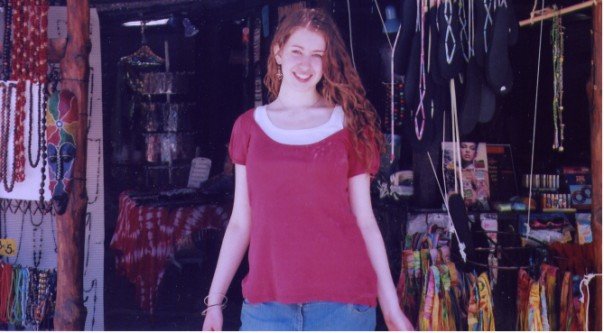
She is me, aged 16 years old in 2004.
She is ‘baby Ellie’- the teenager who had no idea what was in store for her life or to come. Who should have been free to party, make mistakes, not worry about life. Who should have been discovering life safely but enjoying teen life.
She was given the diagnosis of a severe mental illness, bipolar disorder, when she was still a child.
She struggled with depression, mania and psychosis from the age of 15.
She has been medicated for 19 years (and had changes of medication).
She has been in therapy for longer.
but she survived and thrived.
And she still loves theatre and music and friends (although the GHD’s have been relegated to the back of the cupboard!)
So dear Baby Ellie,
Whatever happens – everything is going to be OK and you will achieve things beyond your imagination- except being able to sing like Mariah Carey.
When I look back at her, I hear the lyrics of the song ‘Looking in’ on Mariah’s day dream album that I used to play….
You know a soul bird by the intention with which they live their life. Us soulbird’s are seeking to give life to our wings and wings to our dreams.
With the intention of making our world a better place.
One person at a time beginning with OURSELVES!
A soul bird can be a thinker, a dreamer, a lover, a warrior, a spiritualist, a seeker, a teacher, an adventurer, an artist, a helper, a doctor, a mom or dad. See the thing is its not WHAT you do, its WHY you do what you do.
Simply put a soulbird is a person living with the intention, growing, rising up, elevation, because we know that like Ghandi said ‘we must be the change we wish to see in the world’. Lets spread the wings of our souls and elevate.’
– India Arie.
10 years ago, I wrote this teaching by the singer and spiritualist India Arie on my old blog ‘Mirror of my World’. I was 25, just 6 months before I became really ill with my bipolar again and India was like this big sister I had never met but she spoke to my soul. I was a soulbird then and despite so much time elapsing, I feel like one now. Everything that I do (most things) are intentional and to help others- in my work life and I try to do so in my personal life too.
I am going through a lot of changes in my life right now. The pieces that came together with my career, physical health and other things (like our move) seem to be drifting apart. However, I know this is temporary and change will come. My dreams will manifest and things will get better, but it is hard when you are in an uncertain place and things can feel overwhelming.
Until I feel ready to write and open my heart fully, sometimes its good to look back and see who you were, are and who you are becoming.
Keeping dreaming, holding love in my heart and ten years later, I have the partner I need who supports me and is kind. Despite some losses that I am feeling keenly today, I know I have the support of my husband and family and good friends, as well as a supportive therapist, which means the world. I am lucky and I know that this too shall pass.






 beurownlight.com