Alcohol Abuse: How Does It Affect Women on an Emotional Level? by Maya

(image: Matthew Ball: Unsplash)

Alcohol addiction can affect every area of a person’s emotional health. They may start to feel a sense of shame with their friends and loved ones. It can also affect interpersonal relationships, as alcohol can instigate arguments with loved ones. Here are some important ways that alcohol addiction can affect your emotional health.

How Brain Affects The Brain

If you attend a women’s recovery center, you’ll learn the many ways that alcohol affects the brain. Firstly, alcohol travels to the brain through the bloodstream, where it affects the neurotransmitters (the parts of the brain responsible for sending chemical messages between brain cells). Over time and when alcohol abuse occurs, the balance of these neurotransmitters is affected, which can lead to emotional instability. It can also increase the level of dopamine, causing people to become addicted to these heightened feelings of euphoria. Sometimes, alcohol also numbs emotions as well as heightening them.

How Alcohol Affects Mental Health

When alcohol abuse occurs over a long period of time, then mental health is greatly affected especially if someone has a pre-existing condition. Symptoms can range from mild to severe, including:

● Depression

Mania

● Psychosis

● Anxiety

If these symptoms become severe, then treatment from a mental health professional might be required.

As women are also more prone to depression than men, alcohol can exacerbate the symptoms of depression they might already be experiencing.

Factors That Determine How Alcohol Affects The Brain

Drinking alcohol to excess will negatively impact your mental health. However, other factors include your overall physical and mental health, the amount of alcohol you regularly drink, how often you consume alcohol, how long you’ve been drinking alcohol, the age you started drinking, and certain background factors like if there is a family history of alcohol abuse present.

The Emotional Impact Alcohol Has On The Body

Since alcohol can damage the emotional centers of the brain, it can lead to severe mood swings and erratic behaviour. It has other effects on the brain as well:

● Anger: women who struggle with alcohol abuse tend to struggle more with anger over time. It can be directed at anyone and anything, leading to the destruction of relationships with loved ones.

● Stress: alcohol abuse tends to be the result of relieving stress; this is compounded by the instead of stress during withdrawal symptoms.

● Anxiety: alcohol can be used to ease anxiety, but this only worsens anxiety over the long run. Women who abuse alcohol tend to have more panic attacks and experience generalized anxiety disorder.

● Depression: women who drink heavily tend to be more depressed than others and the risk of suicide increases.

● PTSD: women who have experienced trauma and use alcohol as a coping mechanism are at risk for developing full symptoms of PTSD. Alcohol can make traumatic memories worse and more intense, increasing their feelings of anxiety and fear.

It can be difficult to overcome these negative emotions on your own, but the good news is that you don’t have to. If you fear that you are addicted to alcohol and that it is making your emotional health worse, speak to a mental health professional as soon as possible.

This article was written by Maya.

Finding A Sense Of Belonging, Where No One Wants To Belong: On a Psychiatric Ward by Katie

(image: Kelly Sikkema: Unsplash)

In 2021, I was hospitalised for the second time in my life, due to an acute psychotic episode as a result of my then-recent diagnosis of Bipolar Disorder (Type One). Hospitalisation is one of the scariest, most unsettling periods of time but – a sometimes – necessary stage to recovery. I was so deep within my psychosis for the first week of my admission that I was quite oblivious to my surroundings and the people I was sharing the space with.

However, when my psychosis started to subside and I began to return to my true self, more free from delusions and mania, I was struck with a strong feeling of not belonging. I felt truly and utterly lost. 

My ward was made up of around fifteen other women, with varying diagnosis, in differing mental states and from different walks of life. Yet, somehow I still felt like an outsider.

At first I was trying to think why. Was it because I was a Northerner in a Southern hospital? Was it because I was one of few that was the same ethnicity as myself? Was it that I was younger than most? There were so many factors that could have been the result of me feeling at a loss and not finding belonging.

Ultimately, no one wants to feel like they belong inside a psychiatric hospital. However, I believe there is merit in feeling like you have a place and in finding a sense of belonging helped me to have grounding and a base that wasn’t initially there. 

Here are a few factors, of which helped me to find belonging:

  1. Acceptance – A lot of my initial struggle was the complete denial, fuelled mainly by my delusional thoughts, that I wasn’t mentally ill and I was in the wrong place. The acceptance that I was a patient in a place that was designed to help me was a key turning point within my recovery. I belonged and thus was worthy of treatment and a future. 
  1. Routine – Although I grappled with feeling like I was becoming institutionalised, I think sticking to the routine of the ward was really important. Asides from the benefits of attending meal times, having the structure meant seeing familiar faces, both staff and patients and having positive interactions. 
  1. Involvement – Attending the therapy sessions that were available were so beneficial. My ward had a brilliant occupational therapist and other specialists that would come in to do structured sessions such as music therapy, cooking or yoga classes. Again, I got to see familiar faces and it brought with it a sense of community. 
  1. Authenticity – One of my biggest struggles throughout both manic, and depressive periods, is finding it hard to connect to my true authentic self. Reconnecting to myself and allowing myself to just be me meant that I felt more relaxed and at ease.

Finding this sense of belonging in a place where no one wants to belong ultimately gave me the grounding to go forward and look forward to a brighter future. 

Katie is a freelance writer who lives with bipolar disorder in recovery and has courageously shared her experiences of being hospitalised here.

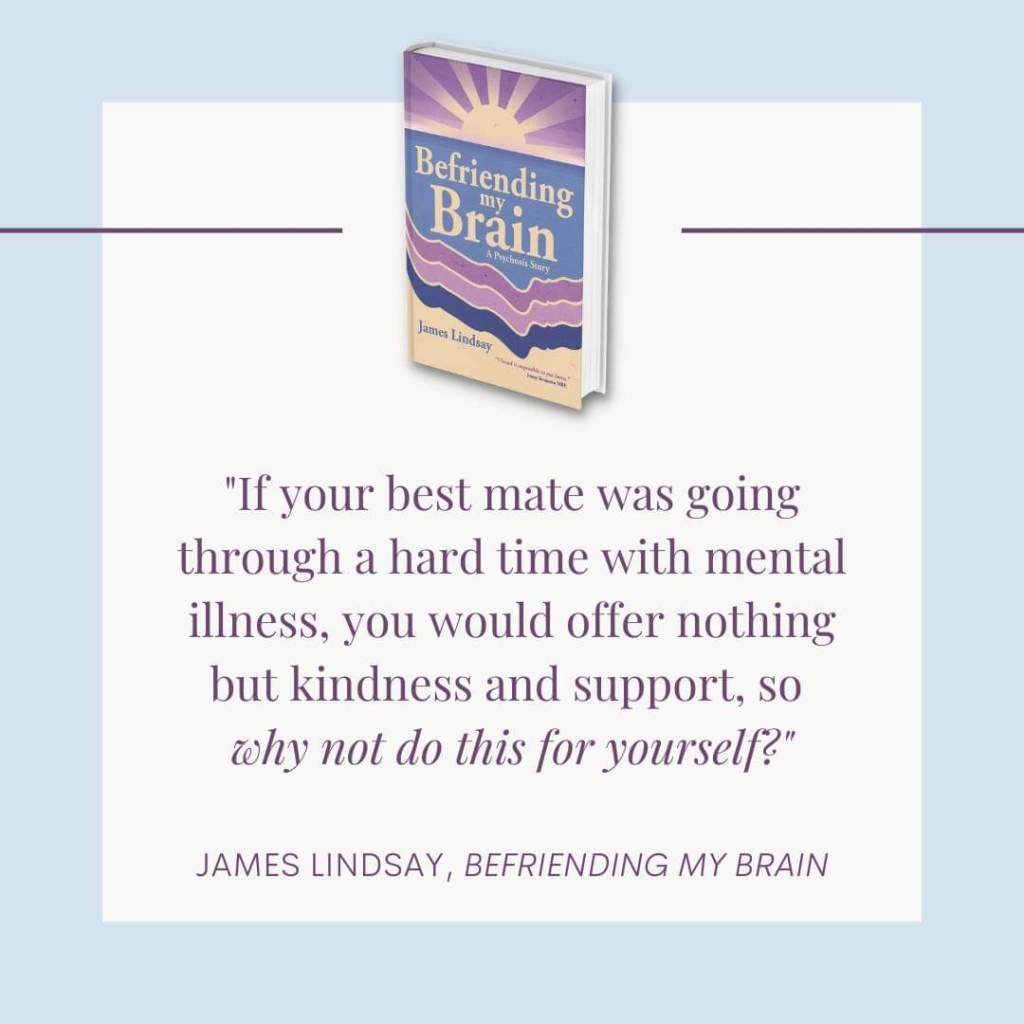
Befriending My Brain: A Psychosis Story. Exciting New Book by James Lindsay and Cherish Editions

(image: James Lindsay/Cherish Editions)

I first ‘met’ my Twitter friend James Lindsay online when he was first starting to talk about his schizoaffective disorder and psychosis. James also works for Mind doing important work in the mental health sphere and we both live locally to one another. I am really proud of James’s determination, not only in his own life, but to help others through his writing and his new book ‘Befriending My Brain’ with Cherish Editions (Trigger Publishing).

An eye-opening memoir about a young man’s descent into schizoaffective disorder– and the steps he took to regain control of his life.


It’s no secret that, in recent years, mental health has become a major topic of conversation. But just because many people feel comfortable discussing their depression, anxiety or other mental health conditions, doesn’t mean that we have removed all stigma from such diagnoses. This is especially true when it comes to psychotic disorders, which affect less than 1 in 100 people in the UK each year (Mind), thus leaving these disorders shrouded in mystery. It doesn’t help that what the media portrays as schizophrenia or psychosis is not always what the sufferer experiences in real life.


As such, it’s vital that we start to bring psychotic disorders, including psychosis, to the forefront. According to a 2016 report from Public Health England, “psychosis is one of the most life-impacting conditions in healthcare.” But with the proper treatment and understanding, it doesn’t have to be life-altering. The same report states that the sooner someone
is treated for their psychosis, the better the chances that they will recover and return to their normal
lives.


James Lindsay has experienced the ups and downs of schizoaffective disorder first-hand, and his book does the vital work of removing some of the mystery surrounding such a diagnosis. It includes the red flags he recognises in hindsight after psychosis landed him in hospital for the better part of a month, but it also retells the inspiring journey he took to recovery in all aspects of his life.

In his case, psychosis and his path to better mental health gave him a new passion in life: helping others through their own diagnoses and getting their lives back, just as he did. No matter where readers are on their journeys, James’ memoir will resonate and remind them, as he puts it, that “recovery is always possible, and hope is never far away.”

(image: Trigger Publishing/ Cherish Editions/James Lindsay)

I can’t wait to read it and review it too!

You can buy a copy of Befriending My Brain: A Psychosis Story by James Lindsay at Amazon, Trigger, Waterstones, WH Smith and all good bookshops.

MORE ABOUT THE AUTHOR
Hailing from Watford, Hertfordshire, James Lindsay works for Hertfordshire Mind Network and uses his free time to advocate for mental health care by blogging and appearing on podcasts and TV. James enjoys playing football, going to the cinema, spending time with friends and family, and exploring new places, with his partner, Holly. Befriending My Brain is his first book.


Mental Health Medication And Dangerous Side Effects In The Heatwave by Eleanor

(image: Roman Odintsov)

In the words of Motown singers Martha Reeves and the Vandellas,

‘Just like a heatwave
Burning in my heart
Can’t keep from cryin’
It’s tearing me apart’

Temperatures yesterday here in the UK reached 40 degrees celsius, the hottest day here on record ever! Some people love the heat- ‘Oh it reminds me of being on the beach on holiday’, ‘It’s not that hot- just put a cold flannel on your face’ and ‘Why are people moaning, we go abroad to get this weather?’ are things i have heard this week. However, for people like myself who take strong mental health medication, in a country not used to these temperatures, this weather is quite literally no picnic.

Firstly, my parents and sister are redheads with pale skin. I am the same and am not built for the heat or humidity. Then, we can add in the fact that I have bipolar disorder and take daily medication- which if not managed correctly can send my blood and body toxic. This has never happened as I stay indoors, don’t do strenuous exercise and drink constantly (and eat enough) in the heat. Yesterday though was a big risk as it became SO hot.

(image: Karolina Grabowska: Pexels)

The risks of Lithium, a mood stabilising medicine, in the heat are fairly well known. It is a natural salt, dehydrating the body so if you don’t drink enough water or eat enough salt, the level of Lithium in the blood saturates and becomes too high- toxic.

Signs of lithium toxicity include: nausea and vomiting, abdominal pain and diarrhea, confusion, drowsiness, slurred speech, increased thirst and lack of coordination of muscles. Severe toxicity signs are: blurred vision, severe muscle spasms, seizures and coma. It is no joke. So trying to cope with Lithium in 40 degree weather and in most places, lack of air con, meant I was confined to my home as I didn’t want to feel like I was melting or run out of water. Thankfully, I didn’t go toxic!

Additionally, I take the anti psychotic Quetaipine which stops me developing mania and psychosis. This and another such medications can impair the body’s ability to regulate it’s own temperature. I am therefore at risk of developing hyperthermia- excessive body temperature- which can be fatal. (scary right??)

So you can imagine that when I hear we are having a heatwave, I instantly think ‘stay indoors, cool showers, ice lollies, sit by air con unit, drink lots and lots’ . I worry about commuting or travelling in the heat. I still can be out in some heat- but 40 degrees was too much!

Something that has troubled me as i wrote this blog is this. My employers have been amazing and let me work from home yesterday. I am able to hydrate myself and eat and keep myself cool. But for those who are ill and unable to, I imagine many were rushed to A and E with the above symptoms yesterday. As a vulnerable adult, my GP didn’t even call to check on me or highlight the side effects of my meds… I only know all this from Dr Google!

There is still a long way to go with proper care for those of us living with (as termed by my doctor) ‘severe mental illness’ whether we live in remission/recovery or whether we have a support network…..I may be 34, not 94- but I could be at risk and they wouldn’t know.

I hope by writing this blog and highlighting these side effects that more people will be aware of this too- which affects people with bipolar, schizophrenia/ schizoaffective disorder, psychosis, depression and other illnesses where anti psychotic meds are used.

One positive- when the heat broke last night and the summer rain fell as Rob and I watched on our balcony.. it reminded me of being in India during monsoon season and in Ghana having a shower in the rain so I suppose not all bad! I admitted I cheered when I saw the rain.

Lastly, I can’t finish this blog without highlighting we had a family bereavement yesterday- a cousin (but more like an uncle) passed away after illness. I will miss him terribly but learnt so much from him- kindness, humility and faith.

Stay safe in this heat! Do your meds affect you?

Love,

Eleanor

xx

Learning to Accept and Embrace Having Schizoaffective Disorder This Mental Health Awareness Week by James Lindsay

(image: Mental Health Foundation)

I do often wonder how long I had schizoaffective disorder before my diagnosis, but I guess I will never know. Back in 2016, I had my first experience of displaying symptoms of Schizophrenia (such as delusions), when I suffered from my first psychotic episode.

Before that, I had not really heard of any of these medical terms. I used to wrongly associate schizophrenic people with characters from the film ‘One Flew Over the Cuckoo’s Nest’. I thought they were lost causes who needed constant care, I didn’t think they could be functioning members of society like everyone else, and I feel bad that I used to think that. But I had a lack of education and personal experience.

In late 2019, I suffered from a relapse and had another experience with psychosis (which can be defined as losing touch with reality with delusions and/or hallucinations).. In early 2020 I was finally diagnosed with Schizoaffective Disorder. For those who are unsure, this condition is where symptoms of both psychotic and mood disorders are present together during one episode. ‘Schizo‘ refers to psychotic symptoms and ‘affective’ refers to mood symptoms. It is often described as a cross between Bipolar Disorder and Schizophrenia, as it includes symptoms from both of those conditions.

For me, it is currently something I am able to keep at bay, mainly thanks to my medication but also through being self-aware and looking after my mental wellbeing. I take Quetiapine (200mg slow release) every single day and I am more than happy with that. I have my tablet in the evening, which then helps me fall asleep without much struggle.

Without my meds, I can tell you now that I would be in all sorts of trouble. Every now and then I might forget to take it until just before bed, which means I need much longer to fall asleep because it takes a couple of hours to kick in.

That is ok though, as long as it’s not every night. But I know for a fact that without the medication, I am much more likely to start having delusions (irrational thoughts) and have an episode. Both my 2016 and 2019 episodes happened because my sleep was terrible and at times non-existent. I used to take sleep for granted, which is easy for anyone to do, but if you don’t let the brain repair itself it can lead to all sorts of problems. Just remember that psychosis can happen to absolutely anyone, I would not wish it on my worst enemy.

I am learning new things about my Schizoaffective Disorder all the time. I have joined a few Facebook groups which are supportive communities full of people with (or supporting those with) the same condition, such as this one which has nearly 18k members. For example I discovered through this group that some people who take meds before dinner (e.g. 4/5pm), find themselves waking up around 3am when they’ve worn off. They realised taking them an hour or so after dinner can give them a better sleep.

I have read books by authors with mental illness and they really help normalise it and give me peace of mind. I recently read ‘The Stranger on the Bridge’ by Jonny Benjamin (who is also Schizoaffective) and this gave me so much comfort. When you read a story that has parallels to yours, it gives you so much more hope and confidence that you can overcome your own adversities. Podcasts are a great source of help too and there are plenty out there that cover all kinds of mental illnesses.

I am also fortunate that my job gives me more opportunities to enhance my understanding of the disorder. I am proud to work for Hertfordshire Mind Network (my local mental health charity) as Fundraising & Marketing Officer, who are really supportive and always ask if there is anything they can do to help with my condition. I would advise anyone with mental illness to make your employer aware, because that’s the first step to them being able to support you and make any adjustments you might need.

I think ever since I changed my attitude to being schizoaffective, I have been able to befriend it and realise it’s not my enemy, but part of who I am. I used to feel embarrassed and was maybe even in denial at first. When I had the shame, I was never in the right mindset to go out and learn what this illness actually is, what is it doing to me, what should I look out for, what are my triggers/warning signs, what help can I get from other people.

The reality is – millions of people are schizoaffective and they are some of the best people you can encounter. They are incredible for living through it every day and I am proud to be one of them.

I hope you found my post useful and big thank you to the wonderful Eleanor Segall for the opportunity to contribute to her fantastic blog! If you’d like to connect over mental health you can find me here –

(image: James Lindsay)

@JamesLindsay23– Twitter

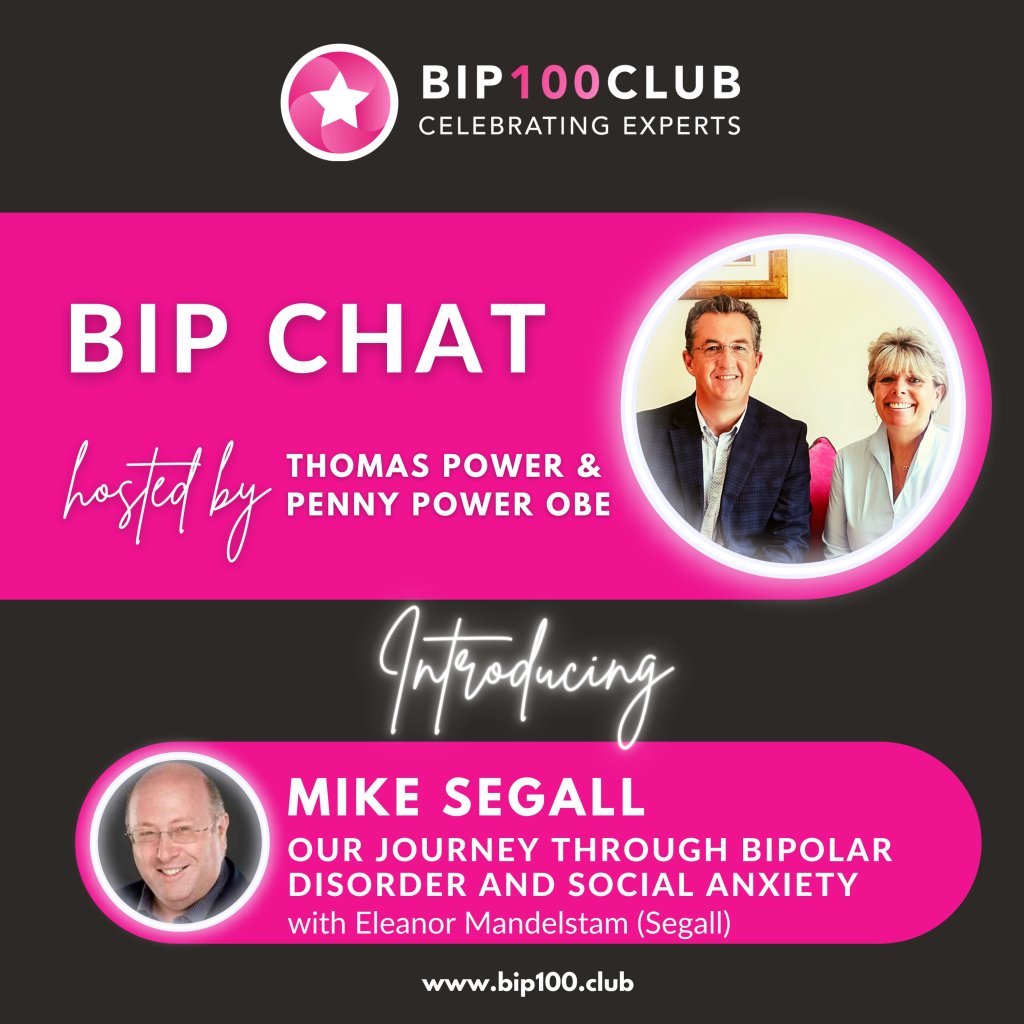
Mental Health Chat With Penny Power OBE and Thomas Power of Business Is Personal with Myself and my Dad Mike Segall. Our Journey With Bipolar Disorder and Anxiety.


Yesterday, 9th Feb, my dad Mike and I were honoured to be interviewed by his friends of many years, Penny Power OBE and Thomas Power of Business is Personal- live on Linkedin, Youtube and Facebook.

They asked us to come on their weekly show to talk about our hereditary journey with bipolar disorder and anxiety and shed light on all things mental health.

It was a real pleasure to talk all about our lives and how my Dad was diagnosed with bipolar just 4 years before me.

Trigger warning: discusses suicidal ideation and psychosis.


Thanks Penny and Thomas! We hope it battles stigma around this much misunderstood illness. Watch here:

https://www.youtube.com/watch?v=Fghp8RNTvX0

How I manage Anxiety and Psychosis : Guest post by Peter McDonnell for Time to Talk Day

socialanxi

(image: Pinterest)

For Time to Talk Day, I want to share about my experiences of mental health. Yes, I have anxiety and yes, I have psychosis.  But no, I am not unhappy. On the contrary – I had a very good 2018.  And 2017, and 2016…lucky me. You see, I have learned how to manage them.  I learned how to manage them so they don’t bother me at all any more (he wrote, hoping not to invoke some sort of ‘commentators curse’) even if they do make me think of them many times each day.   I’ve worked hard and learned so much about how to be happy and live a normal life anyway. 

My diagnosis in 2001 was “cannabis induced psychosis with delusions of a grandiose nature” as worded by my first doctor.  It is the only diagnosis I ever had. Delusions of a grandiose nature meant, for me, that I thought I was the telepathic modern day Jesus- the only son of God, and was destined for the whole world to know it quite soon.  I picked up panic attacks in about 2004, which turned into general anxiety.  The panic attacks mostly stopped in about 2006 after giving up cannabis for good and being put on Clozapine.  Clozapine is used for people who are non – responsive to other drugs, it was described as a last resort and the phrase ‘miracle cure’ even got passed around.  Genuinely.  It worked incredibly well for me and I even think fondly of it – “my favourite drug”.

I work on a mental health ward now (four to be precise) part time, and I am always getting into chats about a multitude of experiences with the mental health system and recovery with patients and often with their parents who come to visit them.  It feels almost like a duty for me to do that.

I see patients/parents on the PICU (Psychiatric Intensive Care Unit) ward that don’t know what to expect in the coming years as they are often new to being in the system and it can be scary. I remember my mum saying to me two years ago – “When you first got ill I thought you might never recover or be able to live a normal life.”  So for parents it is worrying that a future like that might be on the cards for their offspring. And not knowing makes it worse.

 So how can I not try and give some information about that sort of thing?   

In a nutshell, some people (like myself) have a tough few years then begin a steady road to recovery, for me initiated by finding a very good medication.  Others are able to spend a few weeks or months on a mental health ward and then go back to their jobs and do really rather well. We are all different. 

This is a short post with limited room, so I’ll focus on what was for me the most important thing that enabled me to get on with my psychosis and anxiety – from managing them to not even caring that I have them.  

Perseverance – but please don’t look away!  Whether it’s just me or not I don’t know, but I often find that word difficult when reading a mental health article.  Maybe it’s because it implies that hard work is coming. But it has been what works for me from 2007 – 2014 while I was learning how to manage my illness.  

I had to push myself to socialise again and again, and my mum had to do the same. She trained as a psychiatric nurse a while back and is very smart. She knew that pushing me relentlessly for a long time was the best thing.  I went to social events even though I knew I’d hate them, for about three years. The worst part of it was that I knew if I gave in to the difficulties and stayed home the anxiety of having to go out would fall away – my mum really had to drag me out of the house sometimes.

 It made it easier in the beginning going to smaller events that were closer to home – that’s what I would tell myself in the first few difficult minutes. But I did always feel a little bit proud and encouraged when I got home – a feeling that stayed with me in a tiny but growing amount.  I had learned that these things honestly do get a bit easier each time, even though my panic attacks were very unpleasant, and thinking that “everyone at the restaurant can hear my negative thoughts, won’t like me for it and I’ll stick out like a sore thumb” didn’t help either.

So honesty time – I still think I have telepathic abilities – part of my illness, a belief that I just can’t shake off.  It surfaces on occasion when I’m watching TV or even in the middle of socialising. I have learned that going back to my likely imagined telepathic ways (part of my psychosis) just opens up a can of worms.  It’s not what I want. With the TV I can always change the channel which is at worst annoying but often I find something better to watch on another channel so who cares?

I rarely get these strange ideas of telepathic communication while socialising.  It’s like thinking that someone may have just heard one of my thoughts, and then I can hear in my mind what they thought about hearing that thought.  Sometimes it happens when I’m sitting on the loo. A person doesn’t need to be the object of my visual and auditory focus, though that’s when the communication seems strongest.  If I am socialising I just take a break  and this works fine. It’s my mind now, and I tell it to work for my benefit and it usually does.

I feel so lucky to have recovered so well.  I know that some people don’t. I owe so much to the simple but also difficult element of perseverance.  


About the author

petermc.jpg

Peter is a writer who writes articles on his own website and also guest posts for other websites/ blogs.  He proudly wrote a 3500 word essay recently for The Taylor and Francis Psychosis Journal which they published in their 2018 edition.  He is also working on his book, a mental health memoir. Peter has several part time jobs.

His website is  petermcdonnellwriter.com

Twitter  @PeterMcDonnell_

https://mobile.twitter.com/PeterMcDonnell_

Facebook as Peter Edward Mcdonnell 

https://m.facebook.com/peter.e.mcdonnell

Extract from my latest Metro.co.uk article: 6 people share their experiences of friendship during Mental Illness

metrofriends

(image: Ella Byworth for Metro.co.uk)

I have bipolar disorder and four years ago I was hospitalised for a severe manic episode.

Without the love, kindness and support of my friends, I definitely would not have recovered as well.

Their support reminds me I am not alone and helps me to feel loved and safe. But mental ill health can be frightening for those who do not understand it, and sometimes friendships can be lost when one person experiences a mental health condition.

Some people may find it hard to cope with symptoms of a friend’s illness and, as such, cut ties or back away.

Jessica Valentine, psychologist at the Brighton Wellness Centre spoke to Metro.co.uk. She says: ‘Sometimes having a friend with a mental health illness can be draining. ‘On the other hand, it’s good to experience the journey of mental health; the ups and the downs, from a personal level. ‘You really get to ‘feel’ your friend come out of the depression. And, it somewhat makes you feel that you are living it too, side by side, helping them.’

The Mental Health Foundation explains that friendship can ‘play a key role in helping someone live with or recover from a mental health problem and overcome the isolation that often comes with it.

It advises that many people who manage to hold onto friendships while experiencing a mental health condition can see those friendships become stronger as a result.

I wanted to see the role of friendships in other peoples’ lives, either when they were coping with a mental health condition, or when they had witnessed a friend in crisis.

Here six people explain their experiences:

Read their experiences and rest of article: http://metro.co.uk/2018/03/01/6-people-share-their-experiences-of-friendship-during-mental-illness-7343290/?ito=cbshare

Twitter: https://twitter.com/MetroUK | Facebook: https://www.facebook.com/MetroUK/

Extract from my article for Metro UK: How to Improve on-screen depictions of Mental Illness

metrodepiction

This is an extract from an  article our founder Eleanor Segall wrote for Metro.co.uk. To read the full article click here:

http://metro.co.uk/2018/02/21/how-to-improve-on-screen-depictions-of-mental-illness-7315828/

As someone with bipolar disorder, I am often intrigued by depictions of mental illness on TV and film. For many years, mental illness has been stigmatised, and this has been reflected on screen. Thankfully, this stigma is beginning to be broken down, but it is still present.

In her award-winning article, Mental Illness in the Media, for the International Bipolar Foundation, Hosana Tagomori, who was a high school student when she worked on the piece, wrote: ‘The media often portrays characters with mental illness as incomprehensible, tortured and convoluted… the entertainment value often gets in the way of an accurate portrayal. ‘Patients are perceived as dangerous or insane, due to the inaccurate portrayals in media, where the character is almost always hopeless, deranged, and dangerous.’ ‘It is quite easy to subconsciously absorb these misconceptions.’

Indeed, this is a challenge that those of us with mental health issues face. We want our illnesses to be portrayed correctly and accurately on screen, without having to watch stereotypes. Depictions of mental health can be disappointing

Tagomori wrote: ‘In the television series Homeland, the bipolar character always seems to be the pop-eyed, insane mess who is constantly going ballistic: ranting, drinking and screaming’. While this can be true for some people with bipolar in the middle of a manic episode, it is not a balanced approach to the illness. We know that people with bipolar disorder can often be stable and well on medication and that a long time can elapse between episodes.

Portrayals of those with mental illness as ‘insane messes’ raises dangerous misconceptions, including that people with mental health problems will never get well. For me, a brilliant representation of bipolar disorder and postpartum psychosis appeared on EastEnders in 2015.

This centered around a story line for pregnant character Stacey Fowler (played by Lacey Turner), who has the disorder and experiences a psychotic episode after giving birth. Before watching the scenes in which Stacey has psychosis, I was concerned how it would be shown on screen, but I needn’t have worried. Sensitive, accurate portrayals of mental illness on screen can help to educate viewers EastEnders worked directly with the charities Mind and Bipolar UK to create the story line, so the script and performance were as accurate as possible.

In 2015, Dominic Treadwell Jones, producer of the story line spoke to the Radio Times, he said: ‘EastEnders have worked closely with Mind, Bipolar UK, other experts in the field and women with personal experience to show a story that is true and painful, while also filled with the usual twists and turns viewers have come to expect from EastEnders. Lacey is one of the most raw and intuitive actresses on TV.’

Also speaking to the Radio Times about the EastEnders story line, Clare Dolman, vice chair of Bipolar UK, said : ‘As the national charity supporting people with bipolar, we’ve been glad to work closely with the BBC on Stacey’s storyline. ‘There is a very high risk that women with bipolar will become ill when they have a child and 20-25% of them will have a postpartum psychosis, so it’s fantastic that EastEnders are raising awareness of this devastating condition.’

In the scenes where Stacey is experiencing psychosis, the character believes she is the Virgin Mary and that her baby is Jesus. She experiences delusions and auditory hallucinations. I was concerned about how I would feel watching it, but what I most felt was a sense of pride that British television was portraying bipolar correctly, sensitively and appropriately.

Read more: http://metro.co.uk/2018/02/21/how-to-improve-on-screen-depictions-of-mental-illness-7315828/?ito=cbshare

Twitter: https://twitter.com/MetroUK | Facebook: https://www.facebook.com/MetroUK/

Shame and Psychosis article for Time to Change

My latest article for Time to Change, a campaign in the UK aiming to end mental health discrimination. (name has been changed)

timechange

Three years ago last month, my mind lost touch with reality in a very rapid turn of events that culminated in an acute manic episode of bipolar affective disorder. Having been diagnosed with bipolar in 2004, I had not experienced any mania or hypomania (a lesser manic state) in ten years, although I had fallen into a suicidal depression just six months earlier. So when my brain fell into full blown psychosis – with delusions and grandiose thoughts, fearful thoughts about loved ones and being in danger and a complete change in rational perception – it ripped apart the fabric of my life and all I knew. I am writing this to explain what psychosis is really like.

I was just 25 and although I had experienced a mixed state which left me hospitalised at 16 (and had experienced some psychosis then), this was by far the most challenging, lengthy and painful bout of mania and psychosis that I had experienced. I began to believe that my step father was behind why I was in hospital and wouldn‘t let him see me, I thought that the doctors and nurses were a gang holding me hostage. I was fearful of everything, talking and singing to myself, unable to sit still and became quite agitated at times with the staff and patients, which is completely out of character for me. I simply didn’t know what was real or unreal and I was so frightened of the staff and others while my brain was in this state. Eventually, I recovered after about two months of being given anti-psychotic medication and tranquilisers to help me rest (often I was pacing around due to agitation/ mania), in combination with individual and group therapies. I left hospital after three months.

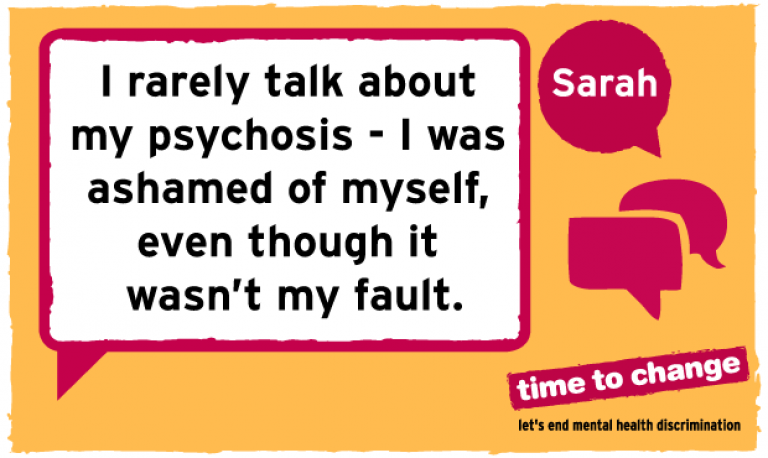
I rarely talk about my psychotic state, which led me to be sectioned under the Mental Health Act. This is due to shame: I was ashamed of myself even though it wasn’t my fault – rather down to faulty brain chemistry and my medication that had stopped working. There is still a huge amount of stigma about psychosis and anything that makes you lose your sanity. My psychosis is part of my bipolar illness and happened completely out of the blue. My mood stabiliser hadn’t been holding me for some time but no one could have predicted quite how rapid my descent into psychosis and illness could have been (it took only a number of days and escalated at a weekend, leaving me to be admitted via A&E, which proved traumatising).

The shame of losing your mind is great and also acting out of character shatters your self-esteem. When I left hospital, I sunk into a depression due to the shame of how I acted in hospital and how my brain and its chemistry could go so catastrophically wrong. Kindness goes a long way when you are feeling ashamed. If you have a friend or family member struggling with this – be calm, show kindness, and show up for them. They need your support at what is an incredibly painful time. Let the person with feelings of shame about their illness know that they are human, that they are an important friend to you, and stand by them.

What truly helped me in those dark days was the attitude of my psychiatrist in hospital and in the day recovery unit I attended after. Despite being psychotic and unwell in hospital and quite agitated at times, my doctor persevered to get me on the right medication and put up with my changing moods. She knew that if I took anti-psychotics and then agreed to go on lithium carbonate (the main mood stabilising medication for bipolar disorder) that I would recover – even if it took me months to get there. It was a slow recovery but I got there in time. Her patience, perseverance and kindness saved me from a very acute episode of illness. Similarly, the psychiatrist and all the staff at the Day Recovery Unit helped me in my down days starting on lithium and having regular blood tests, recovering from being very unwell and they treated me like a human being, when I had felt so ashamed.

If it wasn’t for the Doctors, nurses, occupational therapists and other staff who looked after me  and helped build me back up, I wouldn’t be here today.

There is no need to feel ashamed, although you may do.

Although I still find it hard to talk about my descent into a psychotic state – I am so grateful to the NHS for all the help I was given and have been well for some time. I hope this article helps others in a similar position – you are not alone and don’t let anyone make you feel ashamed.

https://www.time-to-change.org.uk/blog/there-should-be-no-shame-experiencing-psychosis