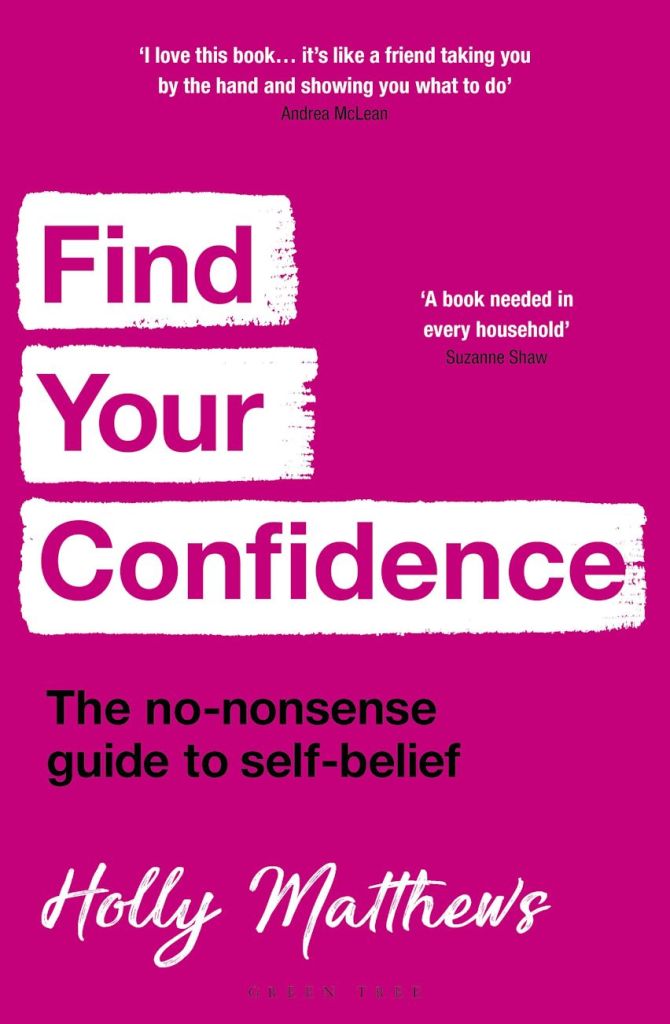
I had the pleasure of reading and reviewing Holly Matthew’s debut book ‘The Happy Me Project’ a few years ago. Holly became a friend when I met her online in 2017 and became one of the first people to sign up to her ‘Happy Me Project’ life reset, which included a workbook and online classes. Holly is one of the most inspirational people I know- not only did she decide to become a life coach and NLP practitioner after the tragic passing of her husband Ross, but she was also an award-winning TV actress and is Mum to two wonderful girls. Holly truly helps people going through difficulties in their lives and so when her new book ‘Find Your Confidence’ came out, I knew I needed to get myself a copy and review it.
The book talks about finding self belief in a wide variety of situations such as in the workplace, at job interviews, at home in every day life. The publisher says,
‘Each chapter is broken down to focus on a different everyday scenario as Holly provides simple and practical advice for tackling confidence head-on. Learn how to: – Thrive in social situations – Develop the tools to be a confident partner and parent – Ace speaking in public and being assertive in the work place.’
(image: Green Tree/ Holly Matthews)
The book’s premise is that ‘Everyone can access confidence – it’s just a case of learning how.‘ Holly says, ‘Confidence is not a skill that we’re born with or without but something that can be taught, practised and developed throughout your life. Focusing on both your inner and outer confidence, will help transform your self-belief from the inside out.’
I absolutely love this guide and tips to strengthen self belief at home and in public. Singer and actress Suzanne Shaw has said, ‘ This book is needed in every household for adults and kids. An absolute guide to help you eradicate self-doubt and give you a huge injection of confidence!
Holly breaks down each chapter into ways to find and build confidence. I truly love the book and know it will be really helpful to me (and others) in specific life situations going forward. Self belief and confidence is something so many people struggle with and having these exercises, links and resources will be invaluable. Working with Holly is very special!
Find Your Confidence: The no nonsense guide to self belief by Holly Matthews is out now in all good book shops (and online).
A new film by the charity Nip in the Bud exposes the hidden dangers of social media and smartphone use among children. A Stolen Childhood provides startling insights from children, headteachers and doctors, shedding light on the everyday harm caused by digital platforms.
Launching today, the film highlights several alarming statistics. A shocking 90% of girls and 50% of boys report receiving explicit pictures or videos they did not want to see. Additionally, 1 in 5 children have experienced online bullying, with 24% of those bullied resorting to self-harm and 22% altering their appearance as a result.
Furthermore, boys as young as 13 have been targeted for sextortion scams, and 80% of teenage girls feel pressured to provide sexual images of themselves.
Emma Robertson, co-founder of Digital Awareness UK, emphasises the hidden nature of these issues: “The thousands of children we talk to in schools tell us that their parents often don’t know how much time they’re spending on their devices overnight, or what they are doing online. This is a new and hidden world which adults can find hard to penetrate.”
MRI scans show screen time reduces brain areas responsible for visual processing, empathy, attention, memory and early reading skills.
In response to these findings, many psychologists, headteachers and GPs are advocating for stricter guidelines:
No smartphones until age 14
No social media until age 16
These recommendations aim to protect children from various online risks, including increased loneliness, exposure to harmful content, access to strangers, behavioural addiction and cyberbullying.
At Nip in the Bud we produce free, evidence-based films and other resources aimed at parents, carers and teachers of primary-aged who may be struggling with mental illness or unmet neurodiverse needs.
Our mission is to empower families and communities around our children to recognise and respond to early signs of mental illness or challenges in a neurotypical world, with resources made in conjunction with mental health experts, educationalists and families going through similar experiences – facilitating early intervention, so that problems can be “nipped in the bud”, allowing our children to blossom.
Yesterday was World Suicide Prevention Day. This awareness day is so important as the rate of suicides in the UK and globally is increasing. About 10 years ago, I devastatingly lost a family member I loved dearly to suicide 💔- mental health treatment, awareness and support is so important. Often, even with these, people are still dying. I know myself the power of medicines, therapy and kindness from loved ones.
One of the reasons I wrote my children’s picture book ‘Arabella and the Worry Cloud’ (illustrated by Shelley the Artist) is because I believe that mental health education and understanding our feelings from a young age is so important. My book focuses on teaching children the power of positive thinking to relieve anxiety. So maybe it can do a bit of good in the world! I definitely didn’t have a book like this as a child.
So, I am so thankful today for the No Panic charity team who have shared this blog about my book today.
We’ve all heard the phrase ‘change starts at the top’. And when it comes to building safe and secure work environments, this notion becomes vitally important. Employees are the ones who bear the brunt of a lack of strong, skilled leadership teams. Leaders, managers and HR teams have a duty to look after staff, and wellbeing is a crucial piece of the puzzle.
With appointing physical first aiders being a legal requirement, more and more businesses are beginning to recognise the need for mental health support to be given the same significance – and Mental Health First Aid training is the solution.
Nathan Shearman, director of training and therapy at Red Umbrella, explores the indispensable role of MHFA training for businesses’ leadership teams.
Why is Mental Health First Aid becoming indispensable to business culture?
“Mental Health First Aid is a powerful resource that allows certain individuals to become qualified with a basic understanding of how to provide mental health support – much like physical first aiders do for physical health issues,” explains Nathan.
“Overall, it’s an incredibly reliable solution to building happier and safer work environments. Most of us would hesitate to join a business without physical first aiders, so why would a lack of mental health support be any less concerning?
“Through MHFA, individuals are trained to identify early signs of mental health issues, and how to act in response. Knowledge and education are instrumental when it comes to mental health, and mental health first aiders can ensure individuals who are struggling are guided towards the right resources.
“Appointing MHFAiders can also help prevent issues from escalating, leading to individuals needing to take time off work, or experiencing a full-blown crisis.”
Why is MHFA vital for leadership teams in particular?
“Recent research shows that 31% of employees feel uncomfortable discussing mental health with their managers, which means that employees are less likely to come forward and start that discussion..We’re all familiar with the culture of stigma that dictates that if someone comes forward to voice their mental health struggles, they may be out of a job. This is extremely detrimental for a business.
“By being MHFA trained, leaders can recognise the signs that someone is not okay, and step in to start those conversations. It enables that vital early intervention that can be the difference between someone recovering to their normal levels of functioning and wellbeing quickly, and someone taking extensive time off, or suffering serious mental health issues.
“It also means leadership teams can be better equipped to manage their own mental health. There are significant pressures on leaders and managers, and often the more senior someone becomes in an organisation, the less likely they are to discuss their own wellbeing, or seek support if they need it. The more informed they are, the more equipped they are to respond.”
(image: Unsplash)
How does MHFA equip leadership teams to handle mental health issues within staff?
“Firstly, it’s about awareness. Being able to spot when someone isn’t okay, when they’re struggling, or just noticing when there are additional risks or stresses associated with a task, role or project.
“For example, having a leader say to their team ‘I know this project has tighter deadlines than usual and that might make some of us feel higher levels of stress, what can we do to support you?’ can go a long way to having employees feel seen, heard and supported.
“It also means when they do notice someone isn’t okay, that they know how to respond. They feel empowered to have those difficult conversations, they don’t worry about saying the wrong thing, and they feel confident that they can be the supportive leader they wish to be.
“Being MHFA trained doesn’t mean that issues won’t arise within a team, but if leaders know how to respond well, their team will have more confidence in them and the organisation itself.”
(image: Unsplash)
What are the short-term vs long-term benefits of implementing MHFA for leadership teams?
“Short-term benefits for leadership are greater awareness and therefore visibility of issues within their teams, which enables them to respond quicker to potential issues. It also allows them to immediately check in with their own wellbeing, and make adjustments to their lives so they are able to be the most effective and healthy version of themselves.
“In the long term, employees will feel more supported, will be more engaged and as a result more productive, creative and loyal to the organisation.
“The biggest benefit is if leaders in an organisation are MHFA trained, the culture around mental health shifts massively. It enables more people to come forward when they’re struggling and to access support, and it makes the company more attractive to current and potential employees, driving talent retention and acquisition.”
For more information on MHFA training and how it can benefit your organisation, please get in touch with Red Umbrella: https://red-umbrella.co.uk/contact
About Nathan Shearman
Nathan Shearman is the director of therapy and training at Red Umbrella, an organisation that’s improving the mental wellbeing of the UK workforce by working in partnership with large employers to deliver bespoke mental health training and support solutions.
Nathan is a qualified psychotherapist and counsellor with a background in private practice and 10+ years of experience in the field.
As the world gets more concerned and more appreciative of mental health and its impact on life, therapy has become more of a viable option for many. Whether you’re trying to cope with trauma or just work on some aspects of your personality and lifestyle, therapy is a great tool, but before you’re ready to jump in, you’ll need to know how to get the most out of your therapy.
Be open
The first and most important thing to keep in mind about therapy is that before you even sit in the office, you should have an open and comfortable attitude about the entire process. Much therapy gets stagnant as clients wait for breakthroughs just because they’re not ready for uncomfortable conversations or for sharing intimate details about your life. Withholding crucial information like that of your family members or crucial events in your life will only slow down the progress you’re able to get out of therapy. Instead, trusting the professional you’ve partnered with and really internalising their advice will allow you to get acclimated to the process much faster, and you’ll get more out of it as a result.
Get ready for uncomfortable conversations
As previously mentioned, another thing you’ll need to ensure is that you’re mentally prepared for the uncomfortable conversations you may have in the therapist’s office. This is because a lot of the trauma people carry throughout their lives is tied to a few incidents earlier in life, and talking about those incidents is the first step to truly healing. That means you’ll have to eventually vocalize your deepest fears and insecurities and the issues you’ve been going through, both to allow your therapist to better understand your psyche and to help yourself make important breakthroughs throughout your journey.
Find the right therapist
Another part of getting the most out of your therapy is finding the right therapist to guide you on your journey because the person you’re working with will eventually be entrusted with the deepest parts of your personality and subconscious. This means finding someone you’re fully comfortable with and one that is easy to visit; in your own country. Chicago residents (USA), for example, should look for an experienced therapist in Chicago. Finding a professional that you’re comfortable with and someone who’s nearby will only make it easier to regularly make your appointments and make time for therapy, pushing yourself towards more progress.
Be consistent
Consistency is the most important part of any major life goal you’re trying to achieve, and that includes therapy because of how unique the experience of therapy is for most people. If you’re not making it to your therapist’s office week after week for your regularly scheduled appointments, you won’t be able to make those important breakthroughs because each appointment will mostly be concerned with you and your therapist getting used to each other again. If you feel that your therapy isn’t working in its earliest stages, you shouldn’t let that discourage you since different people make progress over different periods.
Do the homework
Most therapists out there know the importance of daily self-improvement habits for their clients, and that includes things like journalling or keeping a dream diary. This can be tiring at first, but this homework is crucial to the entire process since your therapist will get a better idea of your underlying fears and the thoughts that take control of your unconscious mind most often. This will help your own progress, so you get the most out of therapy you possibly can. You can communicate all of your fears if you’re writing them down regularly for therapy.
Like most aspects of self-improvement, therapy has the capacity to change your life and can even cause you to have a major shift in perspective about key moments in your life. However, before you’re ready to embark on the phase of your life that will inevitably have a giant impact on you, it’s important to prepare yourself for what’s next so that you can get the most out of the therapy you’re participating in.
Elizabeth Howard is a freelance writer. (this article contains sponsored links)
As a child, I was a big worrier! I remember feeling anxious from about aged 4. I don’t know if its just my personality/ genetics or what was going on, but I was always a worrier.
So, I decided that I wanted to use my experiences to help children with their mental health too. Poor mental health often starts in childhood. For me, I was diagnosed with bipolar disorder at 16 , and was off school with intense anxiety as part of a depressive episode at 15. It runs in my family and I know there are families now who were like mine or children living in more difficult environments. Children in loving, supportive homes (like mine was) can still experience anxiety around nursery, school, after school clubs and friendship issues, bullying and something I did not have contend with.. social media bullying. Other children have special educational needs or disabilities that impact them day to day. The spectrum is huge and I wanted to create a positive book to help.
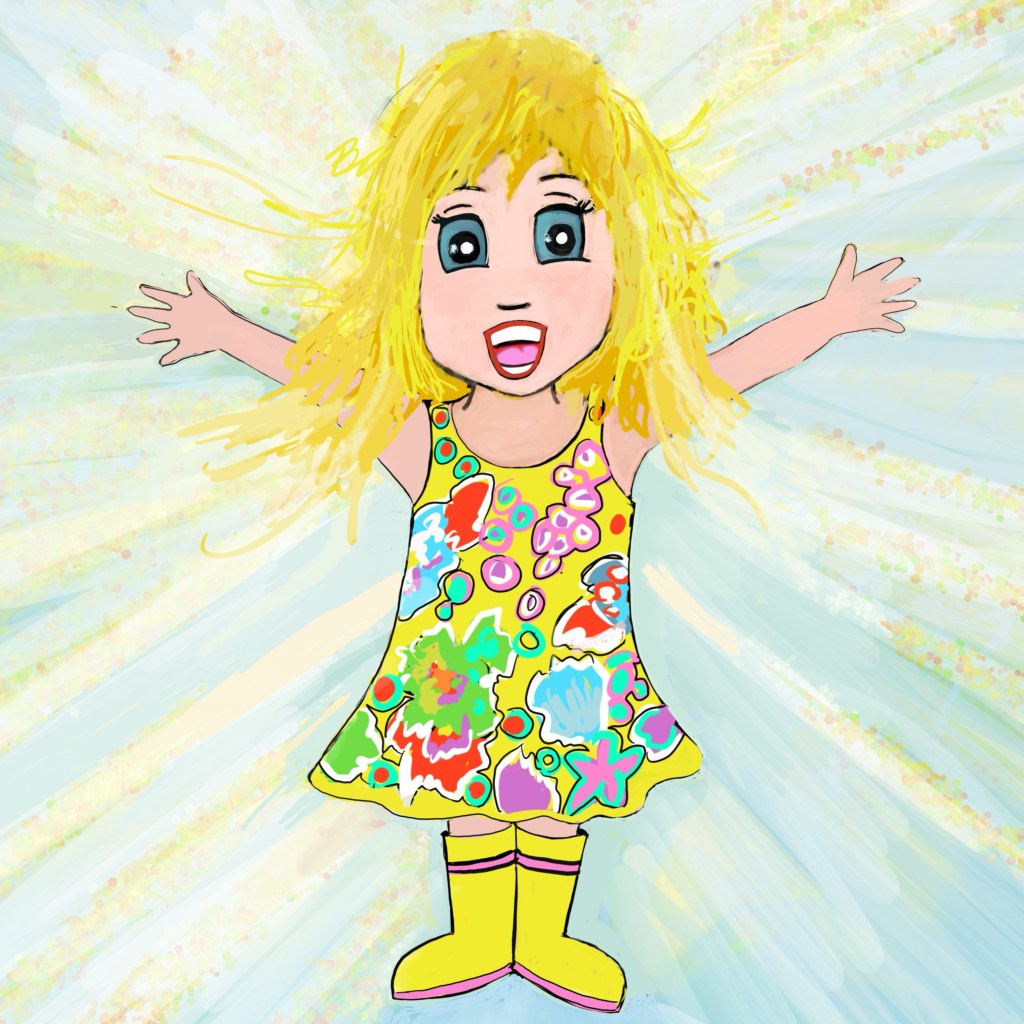
Arabella is 7 years old and her special talent is worrying. In the book, her worries are represented by a cloud, known as the Worry Cloud, who comes down to see her from the sky. He reminds her of all her worries and she tries to run away from him. However, once she begins to think of positive thoughts and memories with her family like eating ice cream at the beach or swimming with her brother, her mind becomes lighter and happier. These positive thoughts are represented as light beams of positive energy and she finds she can put her worries into perspective. The book also serves as a reminder that the storm does not last forever!
(image copyright: Eleanor Segall and Shelley the Artist)
I am very blessed that my Dad has a close friend who is a renowned artist- Shelley. Shelley’s art work and illustrations are beautifully drawn, colourful and were perfect for how I wanted Arabella to be. She is an esteemed digital artist, mural maker, painter and sketcher. She really brought Arabella to life! So the process began….
Once Shelley came on board, we met every few weeks online for about 5/6 months so she could show me the illustrations she had created and I could give my input as the author. We had lots of fun while Shelley sketched the characters on her ipad for me over Zoom and we really love working together. Shelley is super talented and I am so thankful she is the illustrator of Arabella! You can see her work at www.shelleytheartist.com
So self publishing… why did I self publish? I had sent the manuscript to agents and had meetings with my old publisher and another famous publisher I had worked with on another book. They for different reasons eg budget and having a similar type of children’s book, did not want to take it on. Submitting books to agents means constant rejections and so I felt that it was slowing down time to get the book out there and thought why not self publish through Amazon instead? I could have submitted to more places as didn’t submit to as many as I could have. I would still love to be represented one day by an agent and major publisher so I will need to send out more manuscripts- watch this space!
Once Shelley and I had finalised the illustrations and pages, she resized them for me and then (through an author friend, Joanna Gutkin) I had the recommendation to Abid Hussain via Fiverr, who formats books! Abid then formatted (laid out) the pages for me and created the PDF files for the ebook and paperback. Once this was finalised and looked at by me, he then put it on Amazon KDP for us. I also spoke to a printer friend (of my Dad again as he has an amazing network) Hak Huseyn of Absolute Print printers who helped me to size it, choose the right paper and printed copies of the paperback for us too. As I am new to self publishing, Hak reminded me I would need an ISBN, so once that was paid for and barcode put on, we were good to go! Thanks Hak and Abid!
(image copyright: Eleanor Segall and Shelley the Artist)
This entire process was not as quick as I describe… it took us 9 months .. oh and I also forgot the trip to the bookshop I took with my Dad to find the right size of children’s book when we were about to format. The bookseller even got a tape measure to size it for us in inches, so thank you to Books on the Hill St Albans.
I also want to thank author friends Joanna Gutkin , Esther Marshall, Lauren Posner and Shani Singer who answered my queries about their books and self publishing and the Empowered Author Group on Facebook too.
Thanks also go to my Dad who believed in this book and helped me so much with it! And to the friends and family who read early copies. Rob, my husband has also been so supportive. And to Shelley for working with me!
If you buy a copy for your child, niece or nephew, cousin, friend’s child or your class at school I hope you love reading it and that it helps your child to understand that worrying happens, but we can talk about it, process it and find healthy ways to cope.
Sometimes, I get emails about stories and they really stand out to me. This was one of them. A friend of mine knew about this suicide prevention charity in Israel, called Gila’s Way. The Hammer family in the Jewish community sadly lost their daughter Gila z’l to suicide when she was just 18. Gila had mental health issues and the family want to save lives in her name and make sure it doesn’t happen to another family. Rabbi Shalom Hammer, Gila’s father and a world renowned lecturer, started sharing his insights from Gila’s tragic story in order to raise awareness, teach empathy, and promote dialogue regarding suicide in order to ensure its prevention.
Gila’s Way is a non-profit organisation which implements, educates and presents programs regarding mental health awareness and suicide prevention in order to save lives.
I asked Rabbi Shalom Hammer a few questions about his life saving mission:
Your charity Gila’s Way has such an important mission. Please can you tell me more about Gila as a person, her mental health struggles and how you as a family coped in the aftermath of her tragic death/ how the charity got set up?
Gila was an unbelievable girl, vibrant, vivacious, social, hilarious and extremely sensitive. She was a leader of her peers socially and she loved to have fun. She also saw the world in a very innocent wholesome way, she was not capable of harming anyone nor did she believe that people would harm her. Tragically she experienced a sexual episode which was obviously extremely traumatising for her. She also did not wish to or know how to openly communicate the degradation she felt and the pain she was experiencing. Consequently, a swell of anxiety and depression built up inside of her and she eventually began to lose hope which ultimately lead to her passing away.
After Gila died, we decided to take the inexplicable pain and the unfathomable loss to as much of a positive place as possible. My wife and I feel that Gila should be alive and the reason she is not is largely because of the lack of knowledge with mental health and certainly suicidal ideation that we had and that so many others have as well. Gila’s Way is an organisation therefore, who’s primary concern is education via seminars, lectures, interactive workshops and presentations, understanding that the more we educate and inform the greater chance we have of lowering the numbers and preventing suicide.
(image of Gila z’l: Gila’s Way and Hammer Family)
2. What would you like people to know about teen suicide and suicide prevention in Israel and globally?
The most important vital point that I cannot emphasise enough, is that the vast majority of people who die from suicide, do NOT want to die. Particularly when we are speaking about adolescents who are experiencing so much pressures and may impulsively make a decision within a few seconds and not realising that it is finite. When people understand that most people who die from suicide, did not want to die, they also understand that this means we are capable of saving that person.
3. What is your message to other parents coping with children with mental health issues or who have also experienced bereavement?
There are a number of very crucial messages for parents. Firstly, don’t be afraid or ashamed to talk and converse, secondly don’t converse with just everyone. Dealing with mental health and a child who is challenged, is very procedural and therefore exhausting. Make sure to speak to the right people and save your energies for those people. Don’t speak to just anyone because you will grow more confused and more exhausted; make sure to find those/that people/person who can be helpful and focus on speaking to them.
In addition, pay attention to what your child is “saying”. A child (or anyone for that matter) who is dealing with mental health challenges or experiencing a crisis, will not necessarily explicitly say “I need help”, but they will often send “cries for help” and share those signs because they really want help. Some of those “warning signs” can be familial/social isolation , spending long hours in their bedrooms and refusing to join the family for activities which they normally enjoyed. In addition, they may be exhibiting exhaustion, or become physically unkempt, and they also might desist from performing normal expectations (like going to school, doing their homework, participating in events etc.)
Finally, and this is something that I consistently emphasise, trust your parental instincts. We were blessed with instincts and often a Dr or professional might suggest something and our instinct is saying “this just does not sit well with me”…trust that instinct and pay attention to it, because it is there for a reason.
(image: Gila’s Way)
4. What do you at Gila’s Way want to achieve through your charity and how are you doing this through programmes/events?
Our primary focus is on education. We don’t want any parent or any significant other, to be in situations where they “don’t know” or “didn’t know enough” because knowledge is power and empowers us with the capacity to be aware, respond and even save a life. We do so through the many programs, presentations, seminars and interactive workshops and exhibitions that we offer for diverse groups (parents, educators, adolescents, leaders, professionals, here in Israel in the army and pre-military academies). Engaging audiences in the conversations breaks stigmas and allows for knowledge and consideration.
Finally, Gila’s Way offers a consultation service (NOT a hotline). Navigating the mental health system, especially in Israel, isn’t simple. If one knows someone struggling with their mental health, they can schedule a consultation with us to help guide them through initial steps towards healing and recovery.
‘Whoever saves a single life is considered to have saved an entire world’ (the Talmud)
Creating a peaceful home environment is essential for your mental and emotional well-being. Your home should be your sanctuary, a place where you can relax, unwind, and recharge. If you’re looking to transform your living space into a peaceful oasis, look no further. This blog post will explore five simple yet effective ways to make your home a more tranquil and harmonious place.
Declutter and Organise
One of the first steps in creating a peaceful home environment is decluttering and organising your space. Clutter can lead to feelings of overwhelm and stress, so take the time to go through each room and get rid of any unnecessary items. Invest in storage solutions such as bins, baskets, and shelves to keep things organised. By decluttering and organising your space, you’ll create a sense of calm and serenity in your home.
Bring Nature Indoors
Bringing elements of nature into your home can have a calming effect on the mind and body. Consider adding houseplants to your living space, such as peace lilies, snake plants, or succulents. Not only do plants improve air quality, but they also add a touch of greenery that can help reduce stress levels. You can also incorporate natural materials such as wood, stone, or bamboo into your decor to create a soothing atmosphere.
Create Cozy Spaces
Another way to make your home a peaceful environment is by creating cozy spaces where you can relax and unwind. Invest in comfortable furniture such as plush sofas or armchairs, soft throw blankets, and fluffy pillows. Create reading nooks or meditation corners where you can escape from the hustle and bustle of daily life. By designing cozy spaces in your home, you’ll encourage relaxation and tranquility.
Take Care of Any Necessary Repairs
It’s hard to feel at peace in a home that has broken appliances or leaky faucets. Take care of any necessary repairs around your house to maintain a harmonious environment. Fixing squeaky doors, repairing cracked tiles, drain cleaning, or replacing faulty lighting fixtures can make a big difference in how you feel about your living space. By addressing these issues promptly, you’ll create a sense of order and serenity in your home.
Establish Daily Rituals
Finally, establish daily rituals that promote peace and relaxation in your home. Whether it’s enjoying a cup of tea in the morning, practicing yoga before bed, or taking evening walks around the neighborhood with your family, incorporating rituals into your daily routine can help create harmony in your living space. Set aside time each day for self-care activities that nourish the soul and bring joy into your life.
Creating a peaceful home environment is essential for your overall well-being. By decluttering and organising your space, bringing nature indoors, creating cozy spaces for relaxation, taking care of necessary repairs around the house, and establishing daily rituals that promote peace and tranquility—you can transform your living spaces into sanctuaries where you can truly thrive. Remember that small changes can make a big impact when it comes to creating a peaceful atmosphere at home—so start implementing these tips today!
Mental health is finally getting recognition in society. The NHS in the UK has appointed their first medical director for mental health and neurodiversity. Our wellbeing should come first during all stages of life.
Mental Health at Any Age
Poor mental health doesn’t discriminate, and it can affect anyone at any age. It impacts how we cope and how we relate to other people.
The Signs of Mental Health Issues
Note anything that might be a sign of poor mental health.
Carers should also look out for any of these signs early on. The faster these are acted on, the sooner the quality of life can improve.
The Role of Social Connection
As humans, we thrive around others. Our loved ones and our community give us both emotional support and a sense of belonging.
To expand connections, look at joining a club or doing some volunteering. These interactions can ease loneliness, which can be especially common in older adults.
Coping with Life Transitions
As we age, we’ll go through many transitions in life, some positive, and some not. Things like retirement, the loss of a spouse or even moving house can be difficult to navigate. Triggering negative feelings.
Reach out to a trusted friend. But if things start to become unmanageable, seek the help of a professional, like a GP or psychiatrist.
(image: Lesley Juarez, Unsplash)
Trying Mindfulness and Meditation
Lots of people find these practices useful. It helps to connect us to our feelings without judgment. Being aware of our emotions is so important and connecting with our breath.
Start with breathing exercises or guided meditation. To reduce anxiety, mindfulness should be done regularly.
Maintaining Hobbies and Interests
Make time for your hobbies- whether its sport, art, writing, gaming, music or drama. Taking time to do things we enjoy gives a sense of achievement. In some cases, it also connects us with others.
The Role of Technology in Mental Health
Many apps offer mental health support, and some of them are even free. Social media is also a great tool for staying in touch with loved ones.
Older adults might need some support for navigating new technology. Carers or loved ones might need to give them a helping hand.
Nutrition and Mental Health
When we’re not feeling great mentally, it’s easy to fall into bad eating patterns. But we need to make sure we’re getting the vitamins and minerals that keep our brains healthy. Eating well is key at any age to support a healthy mind.
Summary
As we go through life’s journey, we must focus on our mental health at every stage. Learning to test how we’re feeling and navigate changes will keep our brains healthy. If we start to notice a decline, there’s no shame in seeking the help of a professional. It can help us navigate through this tough period.
Stay connected to others and build new connections through mutual interests. For carers there’s plenty of resources online for creating a plan to help your loved one’s mental health.
(image: Arabella and the Worry Cloud by Shelley the Artist and Eleanor Segall)
Shelley the Artist and I are proud to reveal the cover to our first children’s book written by me, ‘Arabella and the Worry Cloud’.
Arabella is a little girl with lots of worries, represented by the Worry Cloud who comes to see her, taunts her and threatens to rain on her.
Can Arabella with the help of happy thoughts of her family and trusted cat Pickles push the Worry Cloud away? Or will he stay and rain on her forever as her worries grow?
As a little girl myself, I had lots of worries which led to anxiety and panic. Through our book, we aim to help children aged 5-7ish to process their emotions around worry, to talk about anxiety and to try and replace them with positive thoughts.
The book has beautiful illustrations by Shelley the Artist and we can’t wait to share the link to buy it as soon as its live! We will have an ebook and paperback version.













 beurownlight.com