4 Types of Alcohol Addiction Services You Can Turn To For Help by Rachelle Wilber

(image: free photo website)

Please note: this article relates to facilities and costs in Canada only.

For anyone struggling with alcohol addiction, many different types of addiction services can help. There are inpatient and outpatient programs and 12-step programs, and support groups.

Here are the four main types of alcohol addiction services and what they offer:

Inpatient alcohol addiction services

Inpatient services are typically offered in a hospital or rehabilitation center. Patients live at the facility and receive 24-hour care. This type of service is ideal for severe addictions or those struggling with other mental health issues.

Inpatient services offer a variety of therapies, including individual and group counseling, educational classes, and 12-step programs. Patients also have access to medical care and support 24 hours a day.

The average stay in an inpatient facility is 28 days, but some programs offer longer stays.

Cost: Ranging from $500 to $1500 per day. Many insurance companies will cover some or all of the cost of treatment.

Outpatient alcohol addiction services

The services are offered in hospitals and rehabilitation centers, but patients do not live at the facility. They visit for treatment day or evening, like a Male Alcohol Addiction Treatment Program. This service is ideal for those with mild to moderate addiction or who do not need 24-hour care.

Outpatient services offer a variety of therapies, including individual and group counseling, educational classes, and 12-step programs.

The average length of treatment is three months, but it can vary depending on the patient’s needs.

Cost: Outpatient alcohol addiction services typically cost between $50 and $200 per week.

12-step programs

12-step programs are self-help groups that offer support and guidance to those struggling with addiction. There are many different 12-step programs, but they all follow the same basic steps.

Admitting you have a problem and you need help is the first step.

The second step is finding a sponsor or someone who has been sober for a long time and can help guide you through the program.

The third step is making amends to those you have hurt due to your addiction.

The fourth step is maintaining your sobriety day by day.

12-step programs are free and open to anyone who wants to join them.

Cost: There is no cost associated with 12-step programs.

Support groups

Support groups are similar to 12-step programs, but they do not follow the same structure or steps. They are simply a place where people can come together to share their experiences and offer support to one another.

Support groups have no charges and are open to anyone who wants to join them.

There are many different alcohol addiction services available to those who need help. Inpatient and outpatient programs offer a variety of therapies, while 12-step programs and support groups provide support and guidance. Choose the service you or your loved one can benefit from and get started on the road to recovery today.

This article was written by freelance writer Rachelle Wilber and contains affiliate links.

Options for Improving Your Mental Health and Overcoming Alcohol Addiction by Rachelle Wilber

(image: R Wilber)

Alcohol addiction greatly impacts on your mental health and general wellbeing. Fighting addiction should be your ultimate goal, making it possible to take control of your life. There are numerous options available to help in overcoming addiction and improving your mental health. Here are several options.

Alcohol is extremely addictive and has the potential to ruin mental health and peoples lives. These are just a guide, please consult with professionals.


Connect with Others

A great place to start is it to get out and start meeting other people at support groups. It helps to share positive or similar experiences, which will aid your mental health and self esteem. . You can also consider others and build emotional support if able. Avoid people who want you to relapse back into addiction and who enabled it too! Seek support for you to move forward, even if slowly.

Be Active 

Exercising and getting involved in activities release the endorphin hormone, also known as the happiness hormone. This can also help your general health as you recover slowly. Get involved with community causes and help raise funds for 5k, to 10k walks once you feel able.

Learn New Skills 

Learning new skills helps connect with others and builds a sense of purpose. Try taking a responsible role when volunteering that has an immediate impact, be it at work or in the community like cooking for the homeless- as long as you are in recovery and feel able.

Be Mindful 

Getting into a male alcohol addiction treatment program (or a mixed program/ one for women) can help you in being mindful as it is one of the crucial aspects taught. It helps you consider yourself and the positive changes you have made while recovering from alcohol abuse. Being mindful helps you understand yourself better and take the necessary steps to ensure mental health is protected. 

Be Kind 

Being kind to yourself and placing your feelings first will make it easier to recover from alcohol addiction. Avoid comparing your progress with others and discard people’s opinions of your progress. Allow yourself to make mistakes while finding the right ways to be mentally free. 

Celebrate Your Small Wins 

Celebrate small wins even if you have milestone goals you want to achieve. Start with celebrating finishing the alcohol addiction treatment program. Celebrate your sober days!

Write it Down 

A great way to improve mental health and overcome addiction is by documenting everything. It helps in processing all emotions to gauge triggers to avoid them. It will also allow you to self-reflect on progress, relieve stress, and inspire creativity. 

Reach for Support

Remember to get into local support groups or even stay in touch with members of the alcohol addiction treatment program. Consult a professional (GP or psychiatrist) if the urge is unbearable to avoid relapsing into addiction and keep you on the road to your recovery.  

This article was written by Rachelle Wilber, freelance writer.

Book Review: ‘Pushing Through The Cracks: In the Darkness of Her Family’s Mental Illness She Found Light’- Emily J. Johnson by Eleanor

(image: Emily J Johnson)

Pushing Through The Cracks: In the Darkness of Her Family’s Mental Illness She Found Light by Emily J. Johnson is an incredible book. It is a story that I don’t believe has ever been written about before in such a way in the mental health space, I have certainly never come across it. Its a true memoir that occurred here in the UK during lockdown.

Emily wrote to me and kindly sent me a free copy of her book. I was hooked from the first page- this is a story of survival against the odds, of how mental illness can rip a family apart but how healing and hope are possible. Of strength through immense difficulty. Of light winning over darkness.

Four years ago, in the UK, Emily, a divorced mother of two, was living her best life with a new partner and blended family of six. But then addiction and mental illness entered her home uninvited, threatening to tear the whole family apart.

With an alcoholic husband and two teenage sons – one a depressed gambler and the other with chronic obsessive-compulsive disorder (OCD)– Emily is left to cope alone. And when the Covid pandemic hits, Emily, a ‘serial people-pleaser, enabler and born rescuer’, almost breaks too.

This true story delves into the darkest sides of mental illness and addiction with raw, often harrowing honesty. It shines a light on taboo subjects including self-harm, suicidal feelings, gambling, alcoholism, depression, severe OCD and eating disorders, all exacerbated by an unprecedented global pandemic and dwindling support services.

This is a story of remarkable strength, self-realisation and reclamation of a lost identity. This is a story of finding hope, pushing through the cracks in the darkness. It is also a story that touches on the difficulties of accessing UK NHS mental health services at times, especially CAMHS.

I found Emily’s strength through such severe adversity – dealing with a husband and two sons with severe mental illness, whilst carrying on with her own life when mental illness permeated every part, to be so inspiring. Her marriage falls apart, her children are unable to attend work and education, the family embarks on several different recovery journeys- navigating NHS mental health care and all its difficulties. Her sons addictions and acute OCD worsen and add to the pressures for Emily. How does she as a mother fix it all? She realises.. she can’t fix anyone and its not her job too.

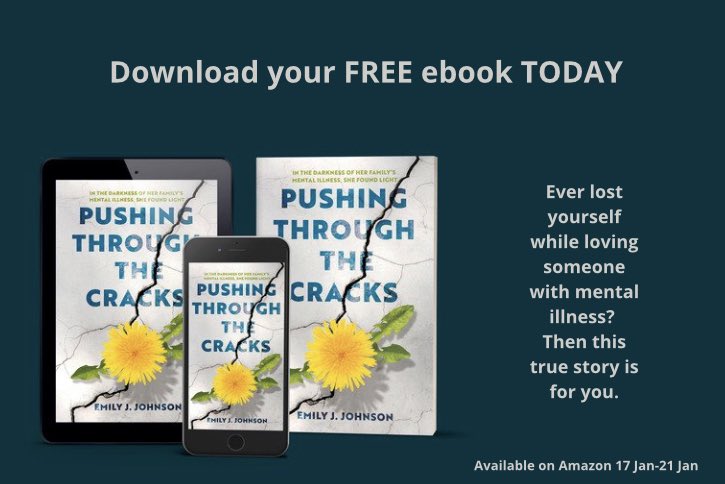
The front cover features a dandelion pushing through the cracks of the ground. Emily describes the moment she hits rock bottom but then saw a dandelion poking through- which symbolised hope and light for her,

‘(image: Emily J. Johnson)

‘I pick up my phone and call a crisis support line…I desperately want someone to listen to me, to ease my pain, to hear my stories…(of mental illness at home)

I throw my phone across the path in frustration… something catches my eye, a beautiful yellow dandelion is growing through a crack in the concrete. Its golden yellow petals cut through the greyness of the broken path and it overshadows the filth and discarded cigarette butts around it. Despite its surroundings, it has found ways to push up through that crack, to have life. it is. not complaining or giving up, it’s surviving and it will go on to finish flowering. One day soon, the wind will carry its dainty seeds somewhere else to carry on the cycle of its life.

Just like that dandelion, I have pushed through adversity and survived. …I close my eyes and raise my face to the sunshine… Even in the midst of all this chaos, this darkness, there is warmth and light. There is hope.” (from chapter Dandelion) (Emily J. Johnson)

This is also a book which exposes the difficulties and realities of living with mental illness. I will add a trigger warning- it doesn’t hold back on the reality of mental illness including self harm, addiction, alcoholism, suicidal thoughts etc- so please read with care.

Thank you Emily for letting me read and follow the journey of your family. I hope your husband and sons are able to fully battle their demons and recover or stay in remission.

Pushing Through the Cracks by Emily J. Johnson can be bought from Amazon and good book shops.


(image: Emily J. Johnson)