Channel 4 Launches Lloyds Bank’s Mental Health Awareness Diversity in Advertising Campaign: For Time to Talk Day #GettheInsideOut

channel4
(image: Channel 4)

Channel 4 to launch Lloyds Bank’s £1m award-winning Diversity in Advertising campaign

  • Professor Green, Victoria Pendleton, Jeremy Paxman, Rachel Riley, Ade Adepitan, Alistair Campbell and Alex Brooker star in Lloyds Bank’s mental health awareness campaign
  • New research finds 75% of people believe there is a stigma in Britain attached to people with mental health conditions
  • Almost three quarters (74%) think the average person would be unwilling to discuss their own mental health issues
  • But nearly three quarters (72 per cent) think society has a better understanding of mental health conditions
  • Openness of celebrities and media coverage contributes to positive change


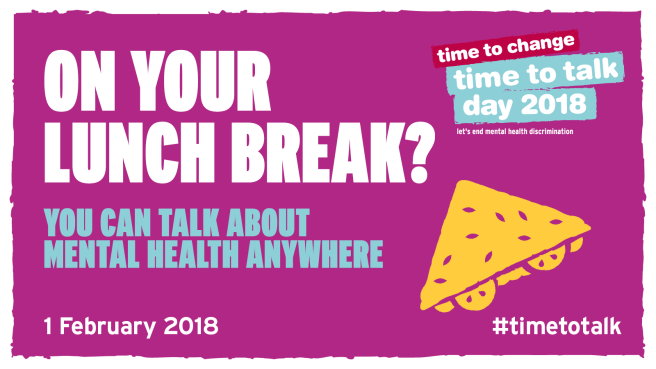
Lloyds Bank’s winning ad campaign of the Channel 4 £1m Diversity in Advertising Award launches exclusively on Channel 4 on mental health awareness Time To Talk Day (1.2.18).


The adverts will feature celebrities – including Professor Green, Jeremy Paxman, Rachel Riley and Alex Brooker – as well as members of the public and Lloyds Bank colleagues playing a variation of the ‘Who am I?’ sticky-note guessing game, to explore the common misconceptions about living with a non-visible disability.


And to coincide with the campaign’s launch, a new Lloyds Bank and Mental Health UK survey, reveals that although improvements have been made in how society thinks about mental health, 75 per cent of people still think there is a stigma attached to the issue.


Lloyds Bank and creative agency, adam&eveDDB, created the mental health adverts  after winning Channel 4’s Diversity in Advertising Award, set up by the broadcaster to improve diversity in advertising.


As the award winner, Lloyds Bank will receive £1m worth of advertising airtime on Channel 4. The competition invited entrants to put forward creative ideas featuring non-visible disabilities.


Channel 4’s Sales Director Jonathan Allan said: “Producing an advert that puts non-visible disabilities at its heart was a demanding brief and it’s been a real pleasure working with Lloyds and adamandeveddb as they developed a fantastic new campaign that makes people think more profoundly about mental health.


“If this campaign can encourage the public and advertisers to think a little harder about all aspects of diversity, it can help make a real difference to people’s lives.”


“The TV ad is brilliantly simple, yet hugely effective,” says Robin Bulloch, Managing Director, Lloyds Bank. “And while winning the Channel 4 Annual Diversity in Advertising Award in itself is a great achievement, the positive difference the campaign will hopefully allow us to make to so many people’s lives is the real ambition here. By raising awareness of invisible disabilities and taking action to promote healthy wellbeing, we can support our colleagues to recognise the signs and feel confident and equipped to support customers and each other.”


Lloyds Bank has been working with Mental Health UK to launch #GetTheInsideOut which will appear on the adverts. #GetTheInsideOut campaign will encourage more people to speak about mental health and aims to inspire those living with a condition to speak up about mental health.


Research from Lloyds Bank and Mental Health UK, undertaken by YouGov, found that seventy-five per cent of respondents feel there is a stigma in Britain attached to people with mental health conditions. And 88 per cent feel society needs to do more (much more (62%) or a little more (25%)) to better understand mental health issues.


The survey reveals that 67 per cent of respondents think people are more comfortable talking about mental health conditions now than they were five years ago. And people feel that the four main factors behind this change were – celebrities talking about mental health (70 per cent); media stories about mental health (70 per cent); societal change (68 per cent); and charities raising awareness (56 per cent).


But the research also reveals that 74 per cent of respondents think people would be fairly unwilling (62 per cent) or not willing at all (11 per cent), to discuss their own mental health issues.


Managing Director of Mental Health UK Brian Dow welcomed the research commissioned by Lloyds Bank and said: “We have come a long way in a short time to raise awareness. In large part thanks to the hard work of the charity sector, campaigns like Time to Change, a willingness of celebrities, notably the Royal Family, to talk about mental health and positive engagement by the media.


“Nevertheless this research shows that we cannot rest of on our laurels – there is a lot more that we need to do.”


Although the survey showed that people think significant steps have been made in the past five years on people’s awareness of mental health, more still needs to be done.


The survey discovers that compared to five years ago;

  • 72 per cent of respondents think that society  has a better understanding of mental health conditions
  • 69 per cent feel people empathise more with people with mental health conditions
  • 70 per cent think society is more aware of the everyday realities of living with a mental health condition
  • 70 per cent also feel there is more awareness of mental health issues raised in the media


In addition;

  • Fifty-six per cent of respondents said they’d feel comfortable talking to someone they don’t know very well about their mental health.
  • While 37 per cent said they’d feel uncomfortable, with over half (57%) of this group concerned that they might offend the person  and a similar proportion (56%) worried they would embarrass or upset themLloyds Bank and Mental Health UK Charity Partnership

    Lloyds Bank is proud to be working in partnership with Mental Health UK. Together the Bank and Charity aim to promote awareness of the link between mental health and money problems, encourage discussion between customers and colleagues. To date, colleagues and customers have raised over £4.8 million which has enabled Mental Health UK to design, build and launch a pioneering new service called Mental Health and Money Advice. This service is the UK’s first advice service dedicated to helping people understand, manage and improve their financial and mental health.

    For further information –

    Channel 4 –

    Tim English, Group PR Manager

    1. 020 7306 6984
    2. tenglish@channel4.co.uk


    Lloyds Bank –

    Eve Speight

    M: 07585965319

    E: eve.speight@lloydsbanking.com


‘Time To Talk: I hope my story can help others feel less alone’: for the Jewish News UK on Time to Talk Day

Today is Time to Talk Day, Time to Change charity’s annual day to talk about our mental health. This year, I decided I wanted to share my story with a local newspaper to my community, the Jewish community in the UK and beyond online. This is also for people who aren’t Jewish and so I am sharing it here. I havnt shared the full article due to SEO reasons but there is a link at the end to the full article!

Remember- its ok to talk about mental health… to loved ones and beyond. It took me a long time to share my story and sharing publicly is not for everyone. I hope the article helps you feel less alone:

elliejewishnews
(image: Eleanor Segall)
Time To Talk Day, marked on 1 February, gives everyone the opportunity to open up about mental health. It’s a subject close to my heart, because it took me 11 years to talk openly about the fact I have bipolar disorder and anxiety.

My story begins in 2003, when, aged 15, I experienced an episode of depression, anxiety and psychosis, where your mind loses touch with reality.

I wasn’t sleeping, my heart would suddenly race, I would cry and have regular panic attacks and couldn’t concentrate on anything. I was incredibly frightened and exhausted.

My parents, as well as teachers at Immanuel College, were hugely supportive and understanding and I sought help from a psychiatrist for the first time.

But that year, while on Israel Tour with my youth group, I also experienced a manic episode and had to come home early. I felt so ashamed, even though it was not my fault that my mind wasn’t well.

My madricha (youth leader) was an incredible support to me and I thank her to this day for all she did to make sure I was safe and well.

Months later, when I started studying for my A-levels, I had a further severe depressive episode.

For the next four months, I was kept in hospital and, aged just 16, I was finally diagnosed with bipolar affective 1 disorder (formerly known as manic depression), which causes both depressive and ‘high’ manic episodes.

The disorder can be medicated and therapy helps, but it’s about finding the right medication and support, which can take a while for each person.

For the next 10 years, I managed my condition and in that time achieved A-levels, went to university and travelled.

But when I turned 25, I again found myself spiralling into illness with a bipolar manic episode.

People suffering with this can have racing thoughts, reckless behaviour, increased activity and movement and delusions, which can, in the worst cases, turn into psychosis. This is what happened to me.

Through no fault of my own, I was back in hospital again. It was extremely frightening. Owing to the severity of the mania, I couldn’t see how ill I was and felt incredibly vulnerable.

At that time, I had no idea if I could recover and get back to some kind of normal life again. It affected everything and even when I began dating, I felt I had to hide my condition.

READ FULL ARTICLE: http://jewishnews.timesofisrael.com/time-to-talk-i-hope-my-story-can-help-others-feel-less-alone/

7 Tips for Feeling Less Lonely (for Time to Talk Day) by Eugene Farrell at AXA PPP Healthcare

lonely

Ahead of Time to Talk Day tomorrow, the concept of speaking about mental health worries and communicating rather than bottle feelings up is really important.

According to the Office for National Statistics, Britain is the loneliness capital of Europe, with many Brits unlikely to know their neighbours or feel they have friendships that they believe they can rely on in a crisis.

 Research by the charity, Relate, found that 9% of Brits of all ages don’t have a single close friend, while separately, a study by AXA PPP healthcare that British adults aged 18 to 24 are four times as likely to feel consistently lonely than those over 70.

 In addition to this, “the build-up to days like Valentine’s Day and the day itself can be quite intense, which is difficult for those who are already feeling isolated or lonely,” explains Eugene Farrell, Head of Trauma Support Services at AXA PPP healthcare.

 “Although loneliness is often associated with the elderly, it’s actually an issue which can affect the physical and mental wellbeing of people of all ages.”

 “In fact, studies have found that loneliness can increase the risk of high blood pressure, and have an impact on cognitive decline, dementia and depression. While addressing your experience of loneliness may take time, taking steps to build new and improve existing connections will help to improve your overall wellbeing.”

 Here, Eugene gives his top tips on how to overcome feelings of loneliness:

1.    Making new connections can be an obvious way to combat loneliness and yield positive results, for example joining a group or class you are interested in will increase your chances of meeting like-minded people to connect with. Increasingly too we are turning to the internet for companionship, with community groups existing in almost every niche interest group you could imagine.

2.    Be more open. If you feel that you have plenty of connections but don’t feel close to any of them, the underlying issue may be that you need to open up to them more to deepen your connection, as an example letting the friend or acquaintance in on a vulnerability felt or your honest opinion about an issue.

3.    Stop comparing yourself to others. The desire to ‘keep up with the Joneses’ is not a new one, however the rise of social media has only exacerbated the problem by giving individuals the chance to constantly compare themselves to others. If you’re already feeling lonely, the idea that everyone else’s life is more idyllic than yours can make you feel even more isolated and alone. This can lead us to ‘compare and despair’ – which further exacerbates our negative experiences. Remind yourself that people only share what they want others to see about their lives. Don’t form unrealistic expectations about life and friendship based on what you see online.

4.    Keep all lines of communication open. Having a chat with a friend or relative over the phone can be the next best thing to being with them. Or you can stay connected with loved ones online. Video chat, exchange photos and keep up to date with the latest news from friends and family with Facebook, Instagram, Snapchat or simply keep in contact by email.


5.    Volunteering is also a great way to meet new people and feel good about helping others. It will not only allow you to give something back to your community but will also help you to feel more connected, involved and needed. There are lots of volunteering roles that need your skills and experience. It can also have a positive effect upon your mental health through helping others.


6.    Pride comes before a fall. Don’t be afraid to reach out to people and ask for help, companionship or just a chat. They may be feeling lonely too!


7.    Take it slow. If you’ve felt lonely for a while, or experience anxiety around new social situations, throwing yourself in at the deep end could only act to exacerbate the problem. Instead, dip your toes into the water first by going to a local café or sports event where you are surrounded by people, and just enjoy sharing their company. Or try a class where you can dive into the activity itself to distract you from the pressure of introducing yourself to people straight away. With loneliness, slow and steady often wins the race.

  If you think you might be struggling with symptoms of loneliness, find more tips and advice at AXA PPP healthcare’s Mental Health Centre.

Its #TimetoTalk Suicide for STOP Suicide Charity: Mental Health Feature Article

timetotalkday
Today I have been featured in STOP Suicides Campaign for Time To Talk Day, alongside other campaigners who bravely share their stories about suicide or suicidal thoughts. The full article can be read at   http://www.stopsuicidepledge.org/its-timetotalk-suicide/ 

Here I include my story from the article. Thanks to all at STOP Suicide for giving me the opportunity. Remember you can talk about mental health :

eltwitter

‘In 2013, I experienced a suicidal depression. I was incredibly low, exhausted, sleeping all day and couldn’t cope with life.

This was part of my bipolar disorder and my medications at the time were not holding my moods. My parents had recently divorced and I had moved house and finished a degree. Then, my Grandma passed away. The stress of all this tipped me over into a deep depression.

The truth is I didn’t want to die, I just couldn’t deal with the pain of living. It was incredibly difficult for my parents, because I would say to them ‘it would be better off if I wasn’t here’. I had so much emotional pain that the only way to manage it for me was to talk about how scared I felt about feeling suicidal. I was concerned that if I didn’t express it, that it could have been very dangerous for me- I didn’t want to die so talking was the only way out.

Thankfully this was hugely positive because my parents understood that the suicidal thoughts were the depression and not me inside. They let me express how I felt, provided a listening ear and used their own life experience to help me. They went with me to my psychiatrist and stayed with me during home appointments. They helped pick up my prescriptions for anti-depressants and looked after me, until I had been lifted out of the depression.

Having loved ones to talk to when I felt suicidal, to not feel alone and to have support every day was vital to my recovery.”

Grey Clouds… Inspirational Lyrics by Stephen M Galloway.

This set of song lyrics/ poetry was sent to me by an amazing person on Twitter- Stephen Galloway who wanted me to share it to help others. He has his own mental health issues but wants to help readers of Be Ur Own Light. I hope you enjoy reading, please note: you may feel emotional reading, so read these beautiful words with care!

shutterstock1
(image: shutterstock)

Grey Clouds…

If you get lost along the road
Let me be the hand you hold
I swear I’ll help you bear your load
And lead you safely back to home
If this world should seem too dark
Let me show you where
To heal all of those painful scars
Make whole again that broken heart
You’ve been there for me, now please believe I won’t leave until your skies are clear
And those grey clouds have disappeared
If your words just won’t come out
Let me be the voice with which you shout
If your fragile mind is filled with doubt
I’ll hold you tight; I’ll hold you proud
If your shoulder’s sore from all the weight
If the path you walk just won’t stay straight 
Just call my name and right away
I’ll be back by your side again
You’ve been there for me, now please believe I won’t leave until your skies are clear
And those grey clouds have disappeared
I want to help for you saved me
From a loneliness like you won’t believe
I was blind until you helped me see
I was numb until you made me feel
You were there for me, now please believe I’m not leaving ’til your skies are clear
And those grey clouds have disappeared
Please believe I’ll be right here
Until those grey clouds disappear
Just like you did for me Oh, just like you did for me

© Stephen M Galloway – 11th August 2017

How I stopped Self Medicating my Post Traumatic Stress Disorder- PTSD and found Recovery by Peter Lang


hopeptsd1
(image: sayquotable.com)

Peter Lang shares his amazing story of recovery from drug and alcohol addiction, homelessness and Post Traumatic Stress Disorder.  Trigger warning: please be careful when reading, talk of drug use. 
Most people think of veterans when they think of Post-Traumatic Stress Disorder (PTSD). Unfortunately, I know all too well that PTSD can also affect civilians. PTSD is defined as the psychiatric disorder that happens following a traumatic event. While war is a common traumatic event that causes PTSD, it’s not the only kind of trauma. Traumatic events can include abuse, life-threatening illnesses, and serious accidents.

As a homeless drug addict, I experienced my share of traumatic events. I spent most of my twenties without a home: couch surfing with acquaintances and strangers all over the country, living on the streets of Philadelphia, and living on the beach in Maui. Throughout this time, I used every substance you can think of: alcohol, heroin, cocaine, meth, prescription medication. I drank so much, I developed avascular necrosis in my hips, which later led to a bilateral hip replacement after a car accident at age 30.

After I got hit by a car when crossing a street in Philadelphia, my mom asked me to come down to Georgia to stay with her. I spent the next two years in a wheelchair. Though I tried periodically to stop drinking and using drugs—with some success—I still struggled. I know now that one of the main reasons I was struggling was that I was trying to self-medicate my PTSD.

On the street, I experienced many traumatic events. There were so many times I got beaten up or taken advantage of or almost died. Once in Hawaii, I did die, and they had to revive me in the hospital. The doctor told me with the amount of alcohol I had in my bloodstream, it was a miracle I was alive.

In early 2016, I met a woman who changed my life. We fell in love almost immediately after meeting each other, and we got married a year later. We are about to celebrate our one-year wedding anniversary.

She made me see that it was okay to ask for help with my PTSD. I didn’t have to feel like I had to take care of it all the time. She made me see that a great deal of my struggles with substances was because I was just trying to numb the pain from traumatic events I hadn’t dealt with.

At one point, I was prescribed benzodiazepines, which did help my PTSD. However, I was never able to take the medication the way I was supposed to, and they became just another substance for me to abuse as opposed to a helpful tool.

It was clear that in order to stop self-medicating, I was going to have to see a counsellor and confront my traumatic events. I started seeing a therapist regularly, and she has helped me immensely. She has helped me to open my eyes and stare the traumatic memories in the face, knowing that they don’t define me.

Another tool that was incredibly helpful for me was meditation. By meditating, I could learn how to become spiritually centered and stop identifying with the painful memories. I’ve also been greatly helped by Buddhist-based 12-step meetings, which have given me a unique perspective on the 12 steps of Alcoholics Anonymous.

Now, I’m doing better than ever. My wife and I are ridiculously in love, we just moved into a nice house, and I’m working full-time as a freelance writer and marketer. I wouldn’t be where I was today if I was unable to deal with my PTSD. I would have never been able to stay clean and sober if I kept self-medicating.

I still struggle with my PTSD frequently. It hasn’t gone away. But now I have the tools to handle any episodes that do come up.

Many people suffering from a substance use disorder are also suffering from a co-occurring mental health disorder. You can treat one without also treating the other. Luckily, you don’t have to. There are plenty of resources that will help you to seek the treatment that you need. All you have to do is ask for it and be open to it.

Peter Lang is a freelance writer from Atlanta, Georgia. He occasionally writes for The Recovery Village. In recovery himself, he has dedicated himself to helping others struggling with substance abuse.


Light Beyond Self Harm by Kaitlyn W at withbeingalive.wordpress.com

selfharmselflove
(image: Dare to Live SOS) 

The author Kaitlyn blogs at www.withbeingalive.wordpress.com . Trigger warning: talks about self harm behaviours (but not graphically), please be careful when reading.

When you are curled within the cradling, spiked tentacles of self-harm – one wrapped around each wrist, and another brushing away any tears – those pesky alternatives of “holding an ice cube!” or “colour in!” can seem shallow; laughable even. You are shoulder-deep in the swampy mud that is self-harm, the goop surrounding you can feel ever-rising, and there is a stigma of wading in this particular swamp – you should be ashamed that you are.


During self-harm, it can feel impossible to have hope. A hope for a different reality can feel light years and stone barricade walls away. It can feel like the darkness (or swamp mud, whichever you would prefer to call it) is all consuming, your actions are all that you are, and the glittery, floaty wings of change have no way to weave in.


However, it is my privilege to share today that you are so much more than self-harm tells you that you are. Consequently, that there is hope beyond self-harm, and that this hope is yours. Ultimately, self-harm does not need to have a role in your life.


Despite how inherently wrongly created and badly designed for life you may feel, this is not who you truly are. Despite the mess, the exhausting racket that constantly parties too hard in your brain, remember that you are only witnessing this all from one perspective. You exist not only to yourself, right now, but also to child you and future you, to other people, and you exist beyond the darkness you feel. In all these other ways, you are who you are, and you are not the engulfing darkness. You have the potential to be who you are, to live the life you deserve to live; to be in the light beyond self-harm.


It’s safe to say that self-harm exists as a little bundle of menace, born from doubts, fears, life experiences, unhealthy coping strategies, and maybe a few other things thrown into the mix too. Although that can feel like an awful lot, or perhaps literally everything, which is an incredibly heavy load to carry, it really isn’t everything. Your doubts and fears can simply be. They inherently don’t have to control your behaviour. As for a way to cope, there are plenty of other ways to cope too. Self-harm isn’t the sole solution or the only option.


In a grumbling, gravelly voice, self-harm can mutter about how you won’t be able to survive without it. That you deserve the constricting boundaries that self-harm makes you believe you are worthy of. In these times, it can really help to recognise that this is self-harm talking. That these thoughts aren’t you, and that you don’t need to act upon them. You could imagine that self-harm is a preteen yelling at the Xbox, or maybe you like the swamp monster with tentacles idea. Either way, give self-harm an identity that’s not you. Self-harm then becomes an annoying, whining brat whose tantrums you can work on ignoring, rather than indulging. Do you really think self-harm deserves a brownie?


What also really helps to pry yourself free from self-harm’s sticky little claws, is finding out what works for you. Go to therapy or a support group and engage in professional help; they have spent several years training to help people in exactly the same situation. Find someone you can talk to; a small yarn can go a long way. Try out those alternatives (and there are so many more too) that were mentioned at the beginning; they can seem plain kooky, but give them a go! I guarantee that there will be at least one that can ease self-harm’s whinging, taking it down from a full-blown tantrum in the middle of the supermarket, to perhaps a soft snivel on the bottom step of the staircase.


To end with, there is light and hope in having a life beyond self-harm. You have the potential to exist as bigger and brighter, as vast and brilliant, than what self-harm croaks about you. Go out there and stomp and shout, and simply be – be loud, be radiant – you are greater than what self-harm tells you that you are

Words Save Lives- Jessicas Story for NHS Organ Donation: Waiting for Kev

Today is a slightly different post than normal, but just as important. My friend Jess writes a blog called Waiting for Kevin and has recorded this video to get people to sign up to the NHS Organ Donation register .

Who is Kevin I hear you ask? Kevin is the name of Jess’s new kidney, one she is waiting for in hospital while on dialysis (a machine that helps with kidney function- to keep you well). Jess was diagnosed with diabetes as a teenager and found out she would need an organ transplant last year.

She dreams of working, getting a pet, travelling, living life to the full– things most of us take for granted. Jess is only 30 and she is the most amazing, strong, wonderful human being- I am proud to be her friend.

Understandably, physical health issues can also impact on our mental health too and that is why I am sharing this. In the video, you will see that Jess’s incredible art works, help her when she is waiting around in hospital and she is incredibly talented.

So please watch and share this video and blog and if you can and live in the UK- sign up to the Organ Donation Register.

Jess is on Twitter @waitingforkev where you can find her blog too. She has previously commented on this issue on major radio stations and on BBC Breakfast TV. 

Blue Monday- a Message: Day of Mental Health Self Care

monday1
(image: Excellence Assured)

So today is apparently Blue Monday- the most miserable day of the year, according to the media. Its January, Christmas has ended, the days are still short and dark. But, today doesn’t have to be blue in the sad sense of the word. We don’t have to be down today- even if we don’t feel great or strong.

Today can be about a day of self care, recovering, healing, hoping, dreaming and positive actions that can make your day better. Feeling like you can’t get out of bed today. Try just an hour earlier. Feeling anxious, depressed, low, or wanting to harm yourself? Seek support. Seek help. Don’t feel like you have to hide this or go through it alone.

Self care is so important- whether setting small goals to do, or phoning/ texting someone you love, to doing something, eg reading books, making art or listening to music, for the pure joy of it. Maybe you like running or dancing, maybe you like bubble baths and candles? Whatever is your thing- that thing you love, that heals your mind and body? Do it.

If you like meditation, meditate. If you need to talk to someone you trust, open up. If you need to be quiet and watch a movie, do that. If you want to see a therapist or doctor- go. You may not want to talk but you will feel better to get that weight off your shoulders.

Everyone is an individual. If you are struggling on todays Blue Monday (or Blue Self Care Monday)- please seek that help. You are not strange or weird for feeling how you feel. Mental health touches everyone regardless of age, sex, race or religion.

Remember to keep shining your light… even if its a tiny candle to fight the dark. You have this today. We are all here for you.       

‘A Unpredictable manic episode meant I was hospitalised for my bipolar disorder’: for Happiful Magazine February 2018 Issue

happifulmag
(image: E Segall and Happiful Magazine)

Hi everyone,

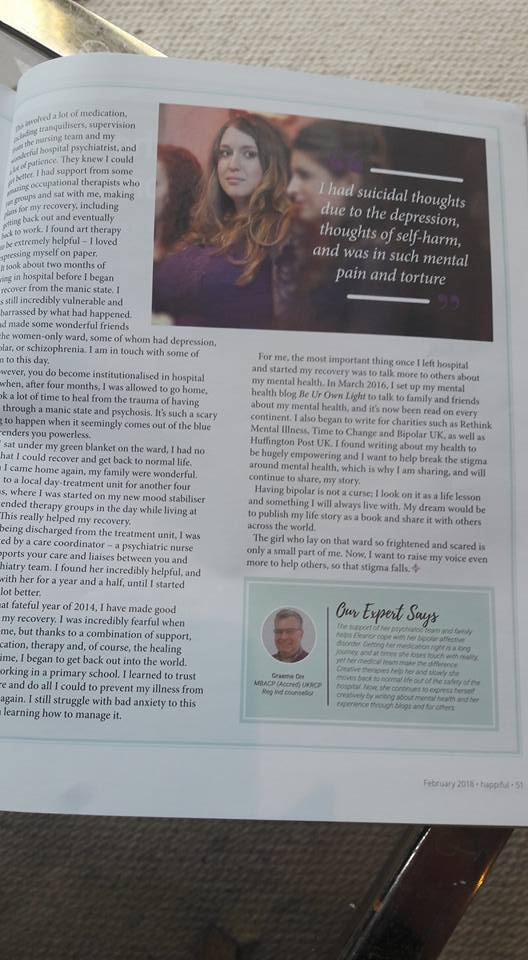
I am thrilled to be able to share my story of recovery from bipolar disorder for the first time in print (!) at Happiful magazine, a UK magazine solely dedicated to mental health.

You can read it online here:  https://subscribe.happiful.com/ click read e-magazine and turn to pages 50-51. If you live in the UK, you can also order the magazine there by post or buy a copy in most major UK supermarkets!

As I say in my article,

Having bipolar is not a curse, I look on it as a life lesson and something I will always live with. My dream would be to publish my life story as a book and share it with others across the world… The girl who lay on that ward so frightened and scared is only a small part of me. Now, I want to raise my voice even more to help others, so stigma falls’   

I hope you enjoy reading it and leave a message for me in the comments if you do.