
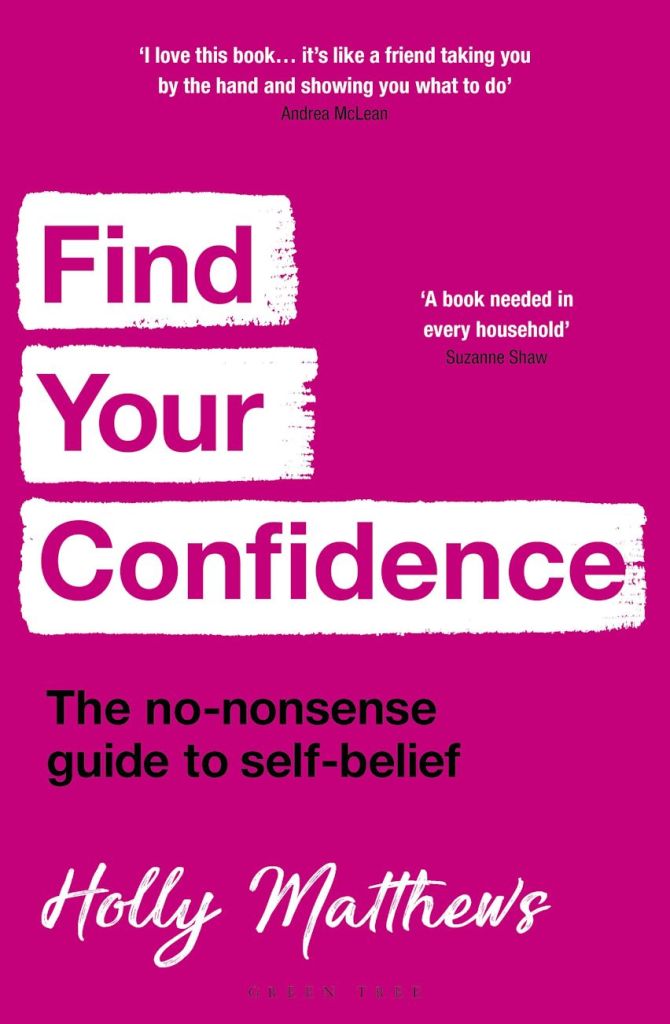
Find Your Confidence: The No Nonsense Guide To Self Belief: New book by Author and Life Coach Holly Matthews.

(image: Green Tree/Bloomsbury and Holly Matthews)

I had the pleasure of reading and reviewing Holly Matthew’s debut book ‘The Happy Me Project’ a few years ago. Holly became a friend when I met her online in 2017 and became one of the first people to sign up to her ‘Happy Me Project’ life reset, which included a workbook and online classes. Holly is one of the most inspirational people I know- not only did she decide to become a life coach and NLP practitioner after the tragic passing of her husband Ross, but she was also an award-winning TV actress and is Mum to two wonderful girls. Holly truly helps people going through difficulties in their lives and so when her new book ‘Find Your Confidence’ came out, I knew I needed to get myself a copy and review it.

The book talks about finding self belief in a wide variety of situations such as in the workplace, at job interviews, at home in every day life. The publisher says,

Each chapter is broken down to focus on a different everyday scenario as Holly provides simple and practical advice for tackling confidence head-on. Learn how to:
– Thrive in social situations
– Develop the tools to be a confident partner and parent
– Ace speaking in public and being assertive in the work place
.’

(image: Green Tree/ Holly Matthews)

The book’s premise is that ‘Everyone can access confidence – it’s just a case of learning how.‘ Holly says, ‘Confidence is not a skill that we’re born with or without but something that can be taught, practised and developed throughout your life. Focusing on both your inner and outer confidence, will help transform your self-belief from the inside out.’

I absolutely love this guide and tips to strengthen self belief at home and in public. Singer and actress Suzanne Shaw has said, ‘ This book is needed in every household for adults and kids. An absolute guide to help you eradicate self-doubt and give you a huge injection of confidence! 

Holly breaks down each chapter into ways to find and build confidence. I truly love the book and know it will be really helpful to me (and others) in specific life situations going forward. Self belief and confidence is something so many people struggle with and having these exercises, links and resources will be invaluable. Working with Holly is very special!

Find Your Confidence: The no nonsense guide to self belief by Holly Matthews is out now in all good book shops (and online).

For links and resources to help alongside the book please see Holly’s website: https://www.iamhollymatthews.com/findyourconfidence/

Soul Bird- India Arie’s Teaching and Life Changes by Eleanor

(Image: Be Ur Own Light Blog made on Canva).

So what is a soul bird?

You know a soul bird by the intention with which they live their life. Us soulbird’s are seeking to give life to our wings and wings to our dreams.

With the intention of making our world a better place.

One person at a time beginning with OURSELVES!

A soul bird can be a thinker, a dreamer, a lover, a warrior, a spiritualist, a seeker, a teacher, an adventurer, an artist, a helper, a doctor, a mom or dad. See the thing is its not WHAT you do, its WHY you do what you do.  

Simply put a soulbird is a person living with the intention, growing, rising up, elevation, because we know that like Ghandi said ‘we must be the change we wish to see in the world’. Lets spread the wings of our souls and elevate.’

– India Arie.

10 years ago, I wrote this teaching by the singer and spiritualist India Arie on my old blog ‘Mirror of my World’. I was 25, just 6 months before I became really ill with my bipolar again and India was like this big sister I had never met but she spoke to my soul. I was a soulbird then and despite so much time elapsing, I feel like one now. Everything that I do (most things) are intentional and to help others- in my work life and I try to do so in my personal life too.

I am going through a lot of changes in my life right now. The pieces that came together with my career, physical health and other things (like our move) seem to be drifting apart. However, I know this is temporary and change will come. My dreams will manifest and things will get better, but it is hard when you are in an uncertain place and things can feel overwhelming.

Until I feel ready to write and open my heart fully, sometimes its good to look back and see who you were, are and who you are becoming.

Keeping dreaming, holding love in my heart and ten years later, I have the partner I need who supports me and is kind. Despite some losses that I am feeling keenly today, I know I have the support of my husband and family and good friends, as well as a supportive therapist, which means the world. I am lucky and I know that this too shall pass.

Ellie x

How To Cope With The Big Changes Life Throws At Us By Meghan Belnap.

(image: unsplash)

No one’s life is perfect. At some point, we all face difficult challenges and struggles that can leave us feeling lost, powerless, and alone. If you’re currently dealing with a big life change, know that you’re not alone. Here are some tips for how to cope with the big changes life throws at us. 

Acknowledge that change is hard, and give yourself time to grieve the loss of what was 

Acknowledging the difficulty of coping with emotional hardships in life can be the first step toward healing. Change is never easy and it is natural to experience grief or sorrow over losing something familiar or safe. Taking the time to sit with those feelings will help give space for understanding rather than running away and pretending like everything is fine. Being compassionate to yourself throughout this process can allow you to accept the struggles you are facing, ultimately helping you venture forward. 

Lean on your support system – friends, family, therapist, etc. 

When grappling with emotional struggles in life, it is helpful to remember that you are never alone. Caring and reliable support systems of friends, family, and therapists can make a significant difference in your journey of healing. A strong foundation of accepting people will lift your spirits and provide valuable perspectives on your situation. You might find this through your community at school, going to a local group therapy meeting, or through a religious or other network.  Every individual has different needs when it comes to dealing with emotional difficulties; leaning on those around you as a source of comfort can be an extremely supportive outlet, as you navigate through trying times. 

Find healthy coping mechanisms that work for you 

When dealing with difficult emotions, it is essential to find healthy ways to cope. Each person has different needs and preferences when it comes to finding relief from emotional hardships. Luckily, there is an abundance of coping mechanisms available. Whether it’s exercise, journaling, painting, or something else entirely, identifying which coping activities work best for you can help reduce stress in your life and give you an outlet for negative emotions. Being proactive in finding techniques that bring relief is the foundation for healing. 

Create a new routine or structure for yourself to help with the transition 

When dealing with emotional struggles in life, creating a new routine or structure for yourself can provide much-needed comfort and stability. This can range from something as simple as coming up with a plan for your daily tasks or an overarching chart that breaks down what you want to accomplish each week. Furthermore, it may be beneficial to set aside time where you can focus on self-care or just unplug and take a breather from the world around you. Though this type of change may seem daunting at first, having an established plan can give us control, which is often otherwise lacking during hard times. By putting confidence in yourself and investing effort in your goals, you can take strides on the path toward healing. 

Be patient with yourself 

Making a major change in life can be traumatic, and it is important to be patient with yourself as you adjust. Healing often happens one step at a time, so allow yourself the time and space to take whatever baby steps are necessary to feel better. Finding people who understand and can offer meaningful support along your journey is important, but make sure that the people you turn to also help you focus on your sense of strength and purpose rather than simply engaging in a pity party. With patience, you will eventually discover that you’ve healed enough that growth can start to occur. 

Going through tough changes in life is never easy, but there are ways to make it more manageable. Acknowledge your feelings, reach out for support, find healthy coping mechanisms, and be patient with yourself. Give yourself time to grieve and adjust, and eventually, things will start getting better. Remember that you’re not alone – Lean on your loved ones and professionals for help when needed. You’re worth it. 


Meghan Belnap is a freelance writer who enjoys spending time with her family. She loves being outdoors and researching new topics that help to expand her horizons. You can often find her buried in a good book or out looking for an adventure. You can connect with her on Facebook right here and Twitter right here.

How To Let Go Of Hurtful Memories And Live A Happier Life.

(image: Pexels)

Do you ever feel like your past is holding you back from being happy in the present? If so, you’re not alone. Many people find it difficult to let go of hurtful memories, especially if they’ve experienced a traumatic event. However, carrying around these negative memories can be incredibly damaging to your mental health and wellbeing. That said, this blog post will discuss how to let go of hurtful memories and lead a happier life!

Acknowledge your hurtful memories

The first step to letting go of hurtful memories is acknowledging them. This may seem like a difficult task, but it’s important to face your demons head-on. Once you’ve acknowledged your hurtful memories, you can begin the process of healing. If you’re not sure how to start this process, consider talking to a therapist or counsellor. They can help you work through your feelings and start the journey to recovery.

Understand that your past does not define you

One of the most important things to remember when trying to let go of hurtful memories is that your past does not define you. Just because you’ve experienced trauma or pain in your life doesn’t mean that’s all there is to you. You are so much more than your hurtful memories! Allow yourself to see the good in yourself and know that you deserve happiness.

Also, don’t forget that your hurtful memories don’t have to control your present or future. Just because something bad happened in your past doesn’t mean it will happen again. You have the power to create a bright future for yourself, no matter what your past may hold.

Focus on the present and build a positive future

Once you’ve acknowledged your hurtful memories and accepted that they don’t define you, it’s time to focus on the present. What makes you happy right now? What are your goals for the future? Start spending your time and energy on things that make you feel good. Fill your life with positivity and watch as your hurtful memories start to fade away.

It’s also important to forgive yourself for what happened in the past. Forgiving yourself doesn’t mean forgetting what happened or downplaying its importance. It simply means letting go of the negative feelings associated with the event and moving forward with your life. Remember, you deserve happiness!

Seek professional help if needed

If you find yourself struggling to let go of hurtful memories, don’t be afraid to seek professional help. There’s no shame in admitting that you need assistance to deal with your past. A therapist or counsellor such as from The Awareness Centre, can help you work through your feelings and develop healthy coping mechanisms. They can also provide support and guidance as you begin the process of healing.

Letting go of hurtful memories is a difficult but necessary task if you want to lead a happier life. However, by following the tips outlined above, you can start on the path to recovery and begin living the life you deserve!

This article was written by a freelance writer.

The Difference Between a Therapist and a Life Coach by Lizzie Weakley.

(image: Pexels: Anthony Shkraba)

When you need help solving complex problems in your life, you turn to those who are considered to be “experts”. In this case, that may mean working with either a therapist or perhaps a life coach, which is an option gaining in popularity with more and more people. While working with either of these will be similar in many ways, there are distinct differences between a therapist and a life coach.

Licensing and Credentials

To begin with, major differences exist in terms of credentials and licensing. A life coach may have a college university degree in psychology or counselling and have many years of experience working with clients but is not a qualified therapist. On the other hand, a therapist is required in most cases to not only possess graduate-level training, but also be properly licensed where they practice.

Past or Future

When you work with a therapist, the focus usually is on past traumas that are impacting your current life, such as being abused when you were a child. But when you work with a life coach, these sessions often pinpoint specific problems that are happening right now that are impeding your ability to move forward. For example, you may work with a life coach to discover a new type of career you would find more fulfilling.

Long-Term or Short-Term

When most people begin visiting a therapist, they may continue to do so for many years, or in some cases forever. However, personal life coaching is more of a short-term commitment. In fact, the goal of the life coach is to give you the tools and skills needed to eventually coach yourself, but some therapies also aim to do this too.

Structured or Unstructured

While you may have thought therapy sessions are very structured, they are typically quite the opposite. In fact, therapy sessions are guided by the patient and the type of therapy is used to treat them. While a personal life coaching session has the coach, and you, working on developing goal-oriented strategies that let you experience personal and even professional growth along the way.

In conclusion, depending on your situation, it is always possible you may at some point in your life work with both a therapist and life coach. Whether you have sessions with a therapist to work through unresolved childhood trauma or seek out a life coach to help you achieve a better balance between your personal and professional lives, you will soon learn why these professionals and their services are so valuable to clients.

Lizzie Weakley is a freelance writer from Columbus, Ohio.