7 Ways To Care For Yourself And Your Mental Health This Autumn/ Fall.

(image: Ella Ivanescu, Unsplash)

Autumn (or if you’re in the USA, Fall) is one of my favourite seasons. Beautiful autumn leaves, the weather getting gently cooler, cosy hot chocolates and pumpkin spice, the autumn harvest of pumpkins, snuggling in blankets with a good book or TV show and for some- walks in nature with the orange and yellow trees and landscapes. However, did you know that the clocks going back and the change in light and dark, with nights drawing in, can affect your mental health? Studies have shown that when its darker, people are more prone to depression and anxiety and some (like myself at times) struggle with Seasonal Affective Disorder.

There are many ways to take care of yourself if you feel your mood dipping or you are becoming more anxious. If you feel it is affecting your daily functioning, please reach out for support from your doctor (and if you have one, a therapist or psychologist). Here I talk about a few tips to help support your mental health this Autumn.

  1. Make sure you rest as well as play and work

Work can become all consuming, but if you prioritise rest this season too, your body will thank you. Autumn is all about slowing down, recovering, resting (and for animals (and some humans) hibernating). Yes you can work and play hard if you prefer, but make sure you find that balance to support your wellbeing. In our busy lives and for those who are parents or just struggling with their mental health, self care can slip. Practising good self care- eating well, resting, gentle exercise, can really help our minds.

2. Release Control- Give Stress Over

Gabby Bernstein, my favourite spiritual teacher, often says ‘Release control to find peace, surrender it to the Universe’. Surrendering means not obsessing about what we can’t control, but giving it over to a higher power or the universe. This can really help when we feel overwhelmed and stressed, to pray and meditate or simply write down how you are feeling and then ask the universe to take it from you. Journalling thoughts and feelings can help too.

3. Nature walks

Despite the cold, this Autumn, walking in nature can help get the blood pumping and our minds to reset. Sometimes going with a friend, spouse or family member can cheer you up- there is something about the colours of nature, the soft greens that is truly calming.

(image: Erika Mendes, Unsplash)

4. Make your home cosy

Whether its getting some new cushions or blankets, fairy lights or lamps, investing in cosy and light interiors for the darker seasons is a must! I like to use lamps when the nights draw in.

5. Get enough sleep (but not too much!)

During the Autumn/ Winter period, most of us naturally want to hibernate in the evenings. Sometimes this period can make depression and anxiety worse. I know with my bipolar that sometimes I feel lower or more anxious. Getting enough daylight and if you struggle with seasonal affective disorder, use an SAD lamp, which can help you to wake up gently in the mornings. Similarly, make sure you get enough sleep for you to keep your mental and physical health at its best. Depression can cause us to sleep longer hours and hide away- I find daytime distractions can help me not to sleep too much.

6. Take your medication as prescribed

If you struggle with mental health in winter and are prescribed antidepressants or other meds, do not suddenly stop them as this can cause a relapse in your mental health. Make sure you speak to your doctor first!

7. Treat yourself

Treat yourself to a hot chocolate (or pumpkin space drink) and a good book or TV show, wrapped in a cosy hoodie or blanket. You deserve it!

Wishing you all a wonderful and well Autumn/Fall season.

Eleanor

Thriving Through Time: Prioritising Mental Health for Life’s Journey by Millie Fuller

(image: Unsplash: Denys Nevozhai)

Mental health is finally getting recognition in society. The NHS in the UK has appointed their first medical director for mental health and neurodiversity. Our wellbeing should come first during all stages of life. 

Mental Health at Any Age

Poor mental health doesn’t discriminate, and it can affect anyone at any age. It impacts how we cope and how we relate to other people.  

The Signs of Mental Health Issues

Note anything that might be a sign of poor mental health. 

This can look different depending on age. 

Some common signs include:

  • Mood changes
  • Pulling away from social activities
  • Changes in sleep habits
  • Unexplained aches and pains
  • Suicidal ideation/ self harm
  • Unexpected anger or always tearful
  • Change in eating habits

Carers should also look out for any of these signs early on. The faster these are acted on, the sooner the quality of life can improve. 

The Role of Social Connection

As humans, we thrive around others. Our loved ones and our community give us both emotional support and a sense of belonging. 

To expand connections, look at joining a club or doing some volunteering. These interactions can ease loneliness, which can be especially common in older adults. 

Coping with Life Transitions

As we age, we’ll go through many transitions in life, some positive, and some not. Things like retirement, the loss of a spouse or even moving house can be difficult to navigate. Triggering negative feelings.

Reach out to a trusted friend. But if things start to become unmanageable, seek the help of a professional, like a GP or psychiatrist.

(image: Lesley Juarez, Unsplash)

Trying Mindfulness and Meditation

Lots of people find these practices useful. It helps to connect us to our feelings without judgment. Being aware of our emotions is so important and connecting with our breath.

Start with breathing exercises or guided meditation. To reduce anxiety, mindfulness should be done regularly.

Maintaining Hobbies and Interests

Make time for your hobbies- whether its sport, art, writing, gaming, music or drama. Taking time to do things we enjoy gives a sense of achievement. In some cases, it also connects us with others.

The Role of Technology in Mental Health

Many apps offer mental health support, and some of them are even free. Social media is also a great tool for staying in touch with loved ones. 

Older adults might need some support for navigating new technology. Carers or loved ones might need to give them a helping hand.

Nutrition and Mental Health

When we’re not feeling great mentally, it’s easy to fall into bad eating patterns. But we need to make sure we’re getting the vitamins and minerals that keep our brains healthy.  Eating well is key at any age to support a healthy mind. 

Summary

As we go through life’s journey, we must focus on our mental health at every stage. Learning to test how we’re feeling and navigate changes will keep our brains healthy. If we start to notice a decline, there’s no shame in seeking the help of a professional. It can help us navigate through this tough period. 

Stay connected to others and build new connections through mutual interests. For carers there’s plenty of resources online for creating a plan to help your loved one’s mental health.

Millie Fuller is a freelance writer.

Meditation 101: Everything You Need To Know by Miranda Spears.

Photo from Unsplash

Embarking on the journey of meditation is akin to entering a profound realm of self-discovery and tranquility. This ancient practice, deeply woven into the fabric of various cultures and spiritual traditions, offers a transformative pathway to inner peace and mindfulness. In this exploration of meditation, you can delve into its fundamental principles and techniques. You may also learn about the many benefits it brings. If you are eager to embark on this contemplative journey, there is much to be gained.

Understanding the Essence of Meditation

Meditation, at its core, is a mental exercise designed to heighten awareness and cultivate a tranquil state of mind. In a world filled with incessant noise and distractions, meditation serves as a sanctuary. This is a space that is meant to silence the ceaseless chatter of the mind. Through various techniques such as focused breathing, guided visualisation, or mindful observation, individuals aim to create a profound sense of calm and presence in the current moment. There’s a reason why meditation has been a part of the human experience since as far back as 5000 BCE.

Getting Started on Your Meditation Journey

Begin by finding a quiet and comfortable space where you can sit or lie down without distractions. Creating an environment that allows you to immerse yourself in the practice is foundational. Once settled, turn your attention inward, focusing on your breath—an elemental meditation technique. Inhale deeply, feeling the air fill your lungs, and then exhale slowly, consciously releasing tension. Alternatively, engage in mindful observation by letting thoughts come and go without attachment, cultivating a non-judgmental awareness of the present moment. Don’t be surprised if a surge of energy during meditation happens — and don’t judge it if it does.

Various Types of Meditation

Meditation is a diverse tapestry, offering various techniques catering to different preferences and goals. Mindfulness meditation encourages being fully present, urging individuals to observe thoughts and sensations without attachment. Transcendental meditation involves repeating a mantra silently, guiding practitioners toward a state of relaxed awareness. Loving-kindness meditation centers around cultivating feelings of love and compassion, often achieved through the repetition of positive phrases. Body scan meditation encourages a mental exploration of the body, identifying and releasing tension to promote both physical and mental relaxation.

Benefits of Meditation

The benefits of meditation are extensive and well-documented, making it a compelling practice for those seeking holistic well-being. Stress reduction stands as one of its primary advantages, with regular practice promoting relaxation and heightened mindfulness. Improved concentration becomes a natural outcome, as meditation serves as a training ground for the mind, enhancing cognitive function and focus. Emotional well-being experiences a positive shift, marked by reduced anxiety, a more optimistic outlook, and increased emotional resilience. The calming effect of meditation often extends to sleep, contributing to improved sleep quality and overall restorative rest.

Challenges on the Meditation Path

While the benefits of meditation are profound, the journey is not without its challenges. Patience becomes a valuable companion, recognizing that meditation is a skill that matures over time. Developing a consistent practice is equally crucial; establishing a routine, even if just for a few minutes each day, allows individuals to experience benefits. Encouraging experimentation with different techniques acknowledges the uniqueness of each individual, encouraging them to discover approaches that resonate with their personal preferences. Incorporating meditation into daily life is a transformative process, one that extends beyond formal sessions. Integrating mindfulness into routine activities, such as mindful eating or walking, becomes a practical and enriching way to extend the benefits beyond the confines of just one daily meditation session.

Final Thoughts on a Transformational Process

Practicing meditation will unlock a special door to the realm of self-discovery and serenity. As one navigates the principles, techniques, and benefits, it becomes evident that the true beauty of meditation lies not solely in reaching a destination but in embracing the ongoing journey toward self-awareness and inner peace. Whether you are a novice or a seasoned practitioner, the path of meditation invites you to explore the depths of your own consciousness and find solace in the stillness of the present moment.

This article was written by writer Miranda Spears.

Empowering Homebound Parents Through Mental Health Support Strategies by Lizzie Weakley.

(image: Alexander Dummer)

Being a parent is challenging, but being a parent who is homebound can be incredibly isolating and stressful. With the added pressures of the COVID-19 pandemic, homebound parents have been struggling with their mental health more than ever before. However, it doesn’t have to be this way. There are several mental health support strategies that parents can implement to help them cope with this challenging time and help them continue to provide their children with the love and care that they deserve.

Prioritise Self-Care

Self-care practices such as mindfulness, meditation, and exercise can help homebound parents manage their stress and maintain their mental health. They can schedule regular exercise routines at home, and practice deep breathing and meditation during their downtime. It is essential for homebound parents to set boundaries and take care of their well-being to increase their capacity to address the demands of parenthood.

Seek Professional Help

Homebound parents who are struggling with their mental health should consider seeking the support and guidance of a mental health professional. They can benefit from online therapy sessions, group therapy sessions, or taking medication that might help them feel better. There are also many mental health hotlines and online resources available to parents struggling with their mental health.

Connect with a Support Network

Homebound parents can engage with online support groups where they can share their experiences, offer and receive advice, and connect with other people going through the same thing. It is also a good idea to connect with friends and family members for emotional support. Social connection is vital to maintaining good mental health.

Utilize Home Health Care Services

Home health care services can provide support and assistance for parents who are struggling with their health. These services can include anything from medication management to helping with household chores and providing much needed respite care for parents. Home health care services can also help parents navigate local resources to receive additional support.

Practice Stress-Reducing Activities with Children

Homebound parents can engage their children in various stress-reducing activities such as sensory play, guided meditation, deep breathing exercises, and yoga. These activities can help children learn how to manage their emotions and provide a calming environment for both parents and children.

Being a homebound parent is challenging, but it becomes even more challenging when mental health struggles are involved. Still, it is essential to prioritise self-care and seek professional help when needed. Engage with a support network, consider utilising home health care services, and perform stress-reducing activities with children.

These strategies will significantly empower homebound parents and help them cope with the challenges of parenthood effectively. With the proper support, homebound parents can provide the love and care their children need and deserve.

This article was written by writer Lizzie Weakley.

5 Spiritual Tips for Coping With Your Mental Health

(image: Tatiana from Pexels)

Mental health is as important as physical health. Through life’s many challenges, it is hard to maintain one’s mental health. Often, people with mental health issues are not being taken care of properly by their community. That’s where spiritual practices come in. These practices help to bring mental peace and healing to the mind and body.

Here are five spiritual wellness tips that you can use today for better mental health.

Talking with Self via Meditation

Talking and listening to oneself is an excellent spiritual practice that can be done at any time. Whether you’re sitting in meditation or listening to a guided meditation, talking with yourself in terms of listening to your thoughts and feelings, is an effective way to clear your mind of thoughts and concentrate on the present moment. You may find your mind wandering and thats OK! Just keep checking in with yourself.

Avoiding Negative Thoughts Through Gratitude

It’s important to note when negative thoughts come up, like those of anger or negativity. Negative thoughts are not good for the mind and body, so it’s important to let these thoughts pass as best you can and don’t give them energy or power. One way to do this is by practicing gratitude in your daily life. Gratitude helps you keep positive vibes going and increases happiness levels and you can do this by keeping a gratitude journal.

Being Kind to Yourself

The best way to start living a healthy and happy lifestyle is by being kind to yourself. One of the best ways you can do this is by starting your day with a positive affirmation. For example, you might tell yourself that “I am capable, this will not be difficult,” or “today I am making good decisions.”

This simple act can greatly improve your mental health and give you a boost for the rest of the day. Treat yourself with kindness and care and don’t be too hard on yourself.

Cultivating a Loving Mind

We live in a world that is constantly giving us reasons to be angry. The news, the internet, and even people in our own lives can make us feel like we are surrounded by chaos. However, it’s important to cultivate loving thoughts and feelings.

This doesn’t mean that you always have to feel happy and cheerful. Sometimes, life calls for sadness or anger. But cultivating a love-filled mind helps prepare you for these moments when they arise. It also helps to keep your mind clear of worries and helps you see the good things in life more clearly.

Maintaining a loving mind is hard work. It means turning thoughts away from fear and anger as soon as they arise and replacing them with love instead. This is done through meditation or spiritual practices such as prayer or yoga. These practices help keep your body calm while helping your mind stay peaceful and open, allowing you to channel your Psychic Lights.


Letting Go of Anger

People often try to suppress their anger. However, this is actually a bad idea. According to the researcher Dr. Robert Firestone, “Anger is an adaptive emotion that can be used as a motivating force for good.”

When we suppress anger, it can lead to many mental health issues such as anxiety and depression. That’s why it’s important to let go of your anger in ways that are physically and emotionally healthy. You might want to write it down or hit a punching bag when you’re feeling angry. Expressing your anger in a healthy manner will help you feel better and reduce stress on your body.

All of these ideas can help to keep you calmer, more positive and feeling more tuned in with your mind and body. These can be used in conjunction with attending therapy or taking (prescribed) medication if needed. Look after yourself and find a wellness spiritual practice that suits you.


This article was written by a freelance writer and contains affiliate links.

8 Tips on Managing Your Emotions for better Mental Health.

(image: Pexels)


Having emotions and expressing them is a part of the human experience. Regardless if they are positive or negative emotions, the most important things about your emotions is how you express them. The response to your emotions can help you in so many other areas of your life, it is important to know how to control your emotions well, to help your mental health.

If you know how to properly work with your emotions you will likely make better decisions, your relationships will flourish, your everyday interactions with people you pass by or coworkers will improve and you will be better equipped to take care of yourself.

If you are tired of being run by your emotions, we have practical tips that can help you manage your emotions no matter what life throws your way.

Understand The Impact Of Your Emotions

Your emotions are important. Intense emotions can remind you that you are alive. It is also common for emotions to overwhelm, whether something good happens or if something terrible happens. That is why it is important to have a strong understanding of the impact your emotions play in your life. Emotions can make life worth living or it can make things unnecessarily difficult.

Take some time to consider how your emotions impact your life. You may have a lot of conflict in your friendships or other relationships. You may have a hard time relating to other people, so you may isolate yourself. Unmanaged emotions can also lead you to have issues in your professional life at work and in your academic life in school. It is very likely that you will have emotional and physical outbursts. Spend some time with yourself and determine how your emotions are affecting your life up to this point. Where has it led you? Once you put a name to your emotions, it will be easier to keep track of your problem areas making it easy to track your progress.

Regulate Not Repress

Managing your emotions does not mean repress or suppress them. You should still be expressing your emotions. Expressing your emotions is healthy and imperative to stable mental health. If your goal is to not feel something, strongly reconsider. Sometimes you may subconsciously do it, not even realizing. Bottling up your emotions may seem like a quick fix, but it causes more problems down the line. Repressed and suppressed emotions can lead to things like anxiety, depression, lack of sleep, muscle tension and pain, stress management issues and substance abuse.

Remember that your goal is to control your emotions, not pretend they do not exist. You cannot shop it out, smoke it out, drink it out. You have to deal with your emotions head-on. That is the best way to take control of your emotions. The goal is balance.

Know What You Are Feeling

It can be difficult to control something you are unfamiliar with. Get familiar with your feelings. Constantly check in with yourself about how you are feeling. When you check in with your moods and feelings, you will be better equipped to respond to any and every emotional trigger you may face throughout the day. It could also stop you from making purely emotional decisions that may not be the best decisions to make.

Throughout your day, ask yourself how you are feeling. If you are feeling good or bad, ask yourself why you feel this way. Maybe you are having an emotional reaction to what someone did to you or for you. Before getting upset with them, consider if the inciting situation has a different explanation aside from the one you are currently telling yourself. Sometimes it is the stories we tell ourselves that are the main cause of our discomfort.

Once you have done all of that, ask yourself what is the best way to get out that emotion. Should you scream? Should you vent? Another question to ask yourself is if there is a better way to cope with your feelings. Sometimes screaming is not the best way to cope. Instead of screaming at your significant other, scream in a pillow at home instead. Maybe taking a few deep breaths is more appropriate.

As long as you are thinking about alternatives to your current situation and your feelings, it will be much easier to control your emotions instead of working off of your knee-jerk reaction.

Be Accepting Of Your Emotions

Avoid downplaying your emotions. Give yourself permission to feel those feelings. Do not feel about feeling those feelings either. Do not invalidate your experiences! If something makes you so happy you could leap into the air, do it! If something makes you feel super sad, express that. Do not tell yourself to “calm down” or “it’s not that serious.” It is serious to you and that is what matters.

Once you become more accepting of your emotions, the good ones and the bad, you will become more comfortable with them. The more comfortable you are with your emotions the less likely you will react to a triggering situation in a way that does not serve you best.

The impulse to judge your emotions is common and everyone struggles with this in different variations of difficulty. Remember that your emotions are not good or bad. They are neutral. They hold useful information that can help you improve, even if the emotion itself may feel unpleasant.

Journal

Before you cringe at the thought of keeping a journal, try it out. Writing down your emotions and the responses you have to those emotions can help you clearly see patterns. Often when something happens that triggers intense emotions, you may have the instinct to run through the situation in your mind over and over again. Take it a step further and put words on paper. Sometimes the act of writing something can help you reflect more deeply on your feelings and your triggers.

Think of journalling as a way to keep track of the things that trigger you. Once you know your triggers, you can catch yourself before falling back into those patterns that no longer serve you. If you want to truly reap all the benefits journaling has to offer, make sure that you stay consistent with it at least once a day. Make note of all your triggers and reactions to those triggers. Use your journal to explore different, more productive ways to express your emotions.

Remember To Breathe

That sounds too good to be true, but remembering to breathe can impact the way you process your emotions. Life happens fast. Sometimes it happens so fast, we barely have time to process. Taking some time to yourself to deeply breath can clear your mind in a moment of rage or it can help you fully enjoy a moment. Taking a deep breath gives you between the moment something triggered an emotion and your reaction to it. In between that breath you can check in with how you are feeling and why. You can ask yourself those questions like what is the alternative explanation that makes sense. All of that can happen in the time it takes for you to complete a few deep breaths.

If breathing deeply is not your thing, do not worry! It can be your thing! All you have to do is try. Get in a comfortable position and try deep breathing exercises before you start your day. When you take a few deep breaths, remember to breathe from your diaphragm as all deep breaths come from there. Once you have breathed in so much that your belly is rising, hold it in for three counts and release slowly. You can take it a step further and add a mantra that you say to yourself while doing your breathing exercises.

Understand That There Is A Time And A Place

Expressing your emotions is imperative to being able to control them, but you must understand that there is a proper time and place to express those emotions. There are some situations in which an emotional outburst is acceptable. Maybe you lost a loved one and are stricken with sadness and anger. Crying into your pillow, punching your mattress or screaming is a great way to express emotions.

The challenge comes when there is no space for you to do these things. You then have to determine if expressing your emotions in this way is the time and place. You cannot yell at your boss and expect to keep your job. You cannot slap the cash register because your card got declined otherwise you will go to jail. You have to be mindful of your surroundings and what the situation calls for. This can help you determine if this is the right time and place to express your emotions in this way.

Give Yourself Space To Process

Sometimes triggering emotions happen so fast, it can be overwhelming to process. That is why giving yourself space to process is so important. When you create a mental distance between yourself and your emotions by taking a walk, watching something that makes you laugh, talking to someone you love and spending a few minutes with your pet, you are better able to process those difficult emotions.

How to Protect Your Mental Health During the Pandemic: by Mary Davis

hydrangea

These days of the coronavirus pandemic are filled with anxiety and fear unlike anything else we and the world has experienced since World War II. It’s important to stay in tune with yourself and remember it is okay to not feel totally well and to be feeling more anxious. 

Here are some ideas to help your mental health during the pandemic: 


Get moving

You’d be surprised what physical activity does for you, both in terms of physical health and mental health! In terms of mental health in particular, it can help decrease anxiety and improve moods. While gyms and studio classes are closed and it is easier than ever to get an effective exercise in with guided tech at home, now is a great time to become familiar with fitness apps. There are many different ones to choose from: you could try the 30 day fitness challenge app for example to get into a new routine and find the perfect guided workouts work for you! Whether its workouts, barre, or even taking the stairs more, try to move as much as you can. 


Try meditating, mindfulness or prayer

Finding stress management techniques that resonate with you is crucial as stress is an inevitable part of life. The ideal time to start up a mindfulness practice is when times are good so that you have established a practice in times of stress, but it can still be incredibly powerful if you are starting out now!

Just remember to be patient with yourself. There are a lot of practices out there, such as meditation, mindfulness, and prayer, so you have options. If you are unsure of where to start, start with daily deep breathing exercises. 


Avoid alcohol 

Avoid or at least monitor alcohol intake in times of high stress in order to protect your mental health. Alcohol is often used to ‘self-medicate’, but while it can release endorphins in your body, it is classified as a depressant. It significantly impacts your central nervous system, and in times of stress you want to be in tune with your body and paying extra care to your nervous system rather than confusing it. 


Seek a therapist and do appointments via Skype or Zoom

Seeking help is a sign of strength! If you need help or need professional support as you work through stress and/or anxiety, seek a therapist. Many therapists do appointments via Skype or Zoom and if you find one in your area, you can transition to in-person appointments when possible. 


Practise self care

Self care looks different for everyone, and finding what makes you feel good and content is so important. Try cooking, at-home facials, taking extra time on your skincare and giving yourself a face massage, baths with Epsom salts, and quality sleep. 


selfcareself1

(image: Samantha Carbon)


All of these things can contribute to healthy living and can help us get through the pandemic. They are also great habits to incorporate into your lifestyle to continue caring for your body and mind. 

This guest blog was written by freelance writer, Mary Davis.

We are 4! On Be Ur Own Light’s Fourth Blog Anniversary by Eleanor

fourcandle

Its Today- 1st March 2020 and Be Ur Own Light is 4 years old! (cue the streamers!)

I still remember starting this blog as an outlet for my fears, thoughts and emotions dealing with my bipolar and anxiety. The blog started as a way to tell my friends and family how I was feeling and has evolved into working with guest bloggers and now brands/ partners on sponsored wellness posts too! Writing the blog and sharing thoughts has been so therapeutic and it has taken me on  a journey that I could not have imagined.

In November 2019, I published my first book Bring me to Light with Trigger Publishing which is the book of my life story with bipolar disorder, anxiety and my life in general (travelling, going to drama school, starting a career as a writer). The blog has also grown so much this year and is currently nominated in the Mental Health Blog Awards for Blogger of the Year, thank you to our nominee!

Additionally, Vuelio awarded us as a Top 10 UK Mental Health Blog for the second year running and interviewed me (Eleanor) about working as a blogger!  Thanks also to Feedspot.com and My Therapy App for listing us in their mental health blog lists too for social anxiety and bipolar!

This year, I have written about World Bipolar Day for the Centre of Mental Health, about my search for EMDR therapy on the NHS, living with depression in winter, about writing my book and new life changes (getting married) and 2020 new year round up with hopes for the future. We also promoted mental health campaigns such as Shout UK text line (founded by the Duke and Duchess of Cambridge and Prince Harry and Meghan),  Christmas 4 CAMHS, Time to Talk Day and Mental Health Awareness Week. Additionally, I spoke in Essex with my Dad about our joint story with bipolar for the Jami Mental Health Awareness Shabbat and we also spoke at Limmud Conference in Birmingham!

This winter I did some interviews for the book which can be seen on the Book tab above and also received some lovely reviews. It was amazing to appear in Happiful Magazine’s bonus wellness Mag this January (edited by campaigner Natasha Devon) and to write for Glamour and Bipolar UK. I also enjoyed being interviewed for the Jewish News and Jewish Chronicle! Hopefully at some point I will do podcasts about it too and more interviews.

From March 2019-2020, the blog has attracted wonderful and talented guest bloggers wanting to spread their messages about mental health and wellness.

We have also worked with the following brands on sponsored and gifted posts and hope to work with many more this next year :  YuLife, Nutra Tea, Essential Olie, Loveitcoverit on mental health apps, I-sopod floatation tanks, Core Wellness Maryland, Wellbeing Escapes Holidays.

My guest bloggers have written about their recovery and living with mental illnesses, as well as advice on how to improve your mental health. There a posts for whether you are going through a divorce, a bereavement, are stressed or have anxiety. We also had posts with people’s first hand experiences of mental illness including a brave post about being a sibling of someone with mental illness and one of living with an eating disorder. Furthermore, Be Ur Own Light has also covered World Mental Health Day and Time to Talk Day this year, featuring personal mental health stories as a way to raise awareness and fight misconceptions.

We have also covered new books coming out, a mental health fashion brand and a song about social anxiety, as well as posts about different therapies to help you.

bloglogo

Thank you to my amazing guest bloggers (non sponsored) March 2019-2020 for your fantastic content:   

Ashley Smith- How Massage Therapy helps Anxiety Disorders

Emily Bartels- 5 tips for a mental health emergency plan

Dale Vernor- Understanding PTSD by Gender 

Tan at Booknerd Tan- How audio books and walking has helped anxiety

Emma Sturgis- Loving yourself, tips for a body positive life

EM Training Solutions- How to maintain mental health at work

David Morin- On social anxiety and talking to others

Lyle Murphy- How equine therapy can help those with mental health issues

Charlie Waller Memorial Trust- Best of Musicals event

A Time to Change Hypnotherapy-  Hypnotherapy for self esteem

Nu View Treatment Center- The connection between anxiety and substance abuse

Shout UK- Royal family launches mental health text line

Mental Health Foundation – Mental Health Awareness Week  May 2019 Body Image

Emerson Blake- Coping with the stress of becoming a single parent

The Worsley Centre- A guide to therapies and finding the right one for you

Byron Donovan at Grey Matter – How I recovered from depression to form a fashion brand 

Luci Larkin at Wooley and Co Law- How to reduce stress and maintain mental health during a divorce

Nat Juchems- How to keep your loved ones memory alive after bereavement

Emily Ilett- on her book ‘The Girl who Lost her Shadow’

Mark Simmonds- an interview about his book ‘Breakdown and Repair’ with Trigger Publishing

Curtis Dean- 5 facts about music for stress relief

Robert Tropp- How quitting illegal drugs helps anxiety in the long term

Aaron James- the difference between psychotherapy and counselling

Dr Justine Curry- 4 ways to help a friend with bipolar disorder

Christmas 4 CAMHS campaign for children in childrens mental health wards

Ani O- 4 ways to ease the fear of doctors appointments

Katherine Myers- Ways that spending time outdoors can improve your mental health

Anita- 5 ways to lift you out the slump of seasonal depression

Chloe Walker- taking care of your child’s mental health

CBT Toronto- how to deal with social anxiety and depression

Katy- a true story with anorexia and OCD

Vanessa Hill- Life changing habits to bring into the new year

Rachel Leycroft- Expressing social anxiety through songwriting

Shira- Living with a sibling with mental illness: the meaning of normal

Capillus- 10 signs you may have an anxiety disorder

Brooke Chaplan- When therapy isn’t enough 

Jami Mental Health Awareness Shabbat 2020 

Mike Segall- Time to Talk Day- 9 years undiagnosed, my story with bipolar disorder

Jasveer Atwal- Living with PCOS and managing mental health

Leigh Adley at Set Your Mind Free- How CBT helps children with anxiety

Lizzie Weakley- How to heal and move forward when you have an eating disorder

Sofie- Living with an eating disorder

Thank you so much to all of you and I am excited to see what 2020-21 brings for the blog!

Be Ur Own Light continues to be read globally and I love receiving your messages about the blogs and finding new writers too.

Heres to a 2020 of positive mental health, of fighting the stigma against mental illness and creating a positive and supportive community here. 

Happy 4th birthday Be Ur Own Light!  ❤ May this be an enlightening year of growth for us.


Love and Light always,

Eleanor    

xxx

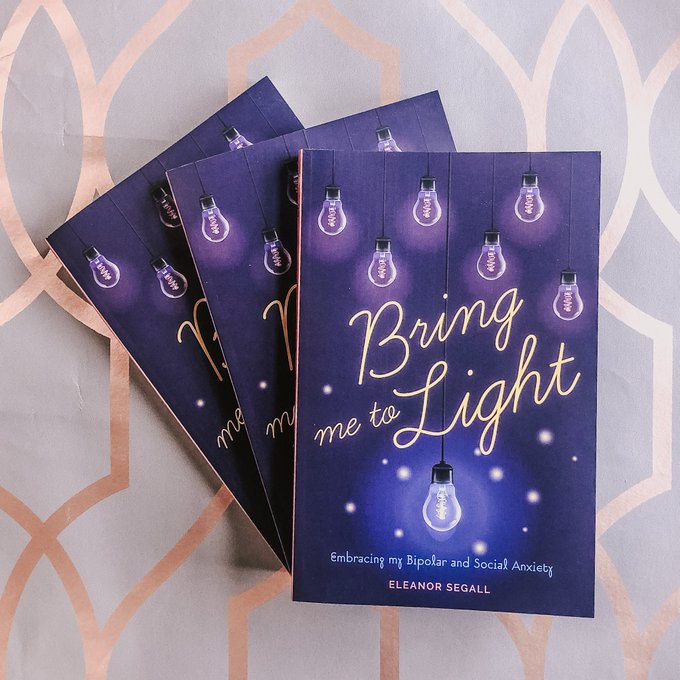
Why I wrote my book, ‘Bring me to Light: Embracing my Bipolar and Social Anxiety’ by Eleanor

bringmeinsta1

(image: Trigger Publishing)

This blog has been a long time coming. I have been so busy promoting my book on social media and in the press that I havn’t actually sat here and told you WHY I decided to write this book. So, here goes.

Firstly, can I just express so much gratitude to this here WordPress blog because without it, I would not have got commissioned at Metro.co.uk (thank you Yvette) or for other places online. This blog gave me the confidence to write and to expand my writing’s reach and for that I will be forever grateful.

In 2013/ early 2014, I sat on the couch, crying and living with a suicidal depression. My bipolar was unstable and all over the place- I felt so low and like there was no way out. However, as I sat and cried- a friend of mine’s face peered up from the newspaper. He was looking for the man that saved him from suicide and was launching a campaign called Find Mike to find him. That man was Jonny Benjamin (who now has an MBE). I had known Jonny for many years as a teenager through friends, but he became my inspiration and my hope that I too could do good things despite having mental illness. He very kindly has provided an endorsement too for my book- thank you Jonny!

With the help of my psychiatrist, I recovered temporarily from the depression but then spun very fast into mania and psychosis (possible due to a large dose of anti depressant). I was sectioned and in hospital for 4 months as an inpatient and a further 4 as an outpatient.

Throughout this time, I could not think about writing because my mind wasn’t stable enough. But as I pieced my life back together, started taking a new mood stabiliser to help control the bipolar episodes and started to recover slowly, I found the power of blogging about my social anxiety due to trauma of the bipolar, to be so helpful. I found that others would share their stories and would reach out to me about their mental health too.

Although life is not perfect and I am still living with an anxiety disorder, I have found a way to write and speak about mental illness. I was diagnosed with bipolar at 16 and there was a lot of shame for me about it back then in 2004. These days, I tell my story for other scared 16 year olds newly diagnosed but also to break down barriers and stigma against mental illness. To explain you can have bipolar or be sectioned or have psychosis but you can recover and you don’t need to spend life in hospital forever. To explain that while this cruel illness runs in families, that with the right healthcare, staying more stable is possible.

I started writing my book with Trigger Publishing because they believed in my story when I sent them my proposal. They are part of the mental health charity the Shaw Mind Foundation and royalties go towards the charity as well as some to me.

I hope that when you read my story, you won’t see it as a despairing ramble- but rather a story of hope, of life, of light triumphing over the darkness- but the darkness making the good times shine brighter. I also bring my bipolar to light, I share it with the world- as scary as this is, so that others can also tell theirs.

I wrote this book too provide a place to talk, start conversation and help heal myself through writing it but sharing that feeling of hope with others too. The book cannot change things that are so needed like urgent mental health funding of the NHS so we have parity of esteem. Yet, i hope it is a starting point about how important mental health treatment is for people to move forward in their lives.

Bring me to Light is out on 5th November 2019 in the UK and is available worldwide. It will be out in the USA in 2020. It can be purchased on Amazon, in book shops and at triggerpublishing.com

I will be sharing press articles and more about the book as it happens, but I hope this blog explains why I wrote my book. Thank you all for your ongoing love and see some of you at the book launch!

Love,

Eleanor x


How to reduce Stress and maintain Mental health during a Divorce: Guest blog by Luci Larkin at Woolley&Co

divorce1

(image: https://sasforwomen.com/divorce-quotes-inspirational/)

Going through a divorce or relationship breakdown can be one of the most stressful situations a person can find themselves in. You lose your friend, partner, confidante and have to adapt to living as a single person, often as the primary carer of children. 

This is a time of extreme and mixed emotions made more complicated by the stresses and worries of legal and financial considerations as well as having to support and counsel any children that may be involved and suffering too.

With mental health problems on the rise and divorce being listed as one of the leading contributors, Luci Larkin from Family Law Solicitors, Woolley & Co, explains how you can reduce stress during such a turbulent time in your life.

“If you have decided your marriage is over you will most probably want to make the whole process of divorce as painless as possible. Contrary to public perception not all divorces have to involve outright war leaving a trail of destruction and despair.

Every individual going through a relationship breakdown will deal with this in their own way. Some prefer to carry on as though nothing has happened, others find it cathartic to talk to someone about their problems.”

It’s fair to say that anyone going through a separation or divorce is going to experience a series of emotional stages post-breakdown. These could range from anger and depression to fear and frustration. All perfectly normal feelings and reactions to an emotionally difficult situation. It’s important to recognise these feelings but to try and stay positive. 

Sometimes the support of friends and family is enough to see a person through, others may need more help such as counselling or medical advice.

With the right divorce lawyer you should be able to resolve a divorce sensibly enabling you and your children to move on with your lives in the most amicable and constructive way.” 

So what is the secret? 

Divorce lawyers’ tips for a less stressful divorce

Luci explains, “As tempting as it is to take advice from your best friend or the “know it all guy” in the pub it’s really important to seek proper professional advice. Couple this with my 5 tips below:


  1. Talk to a family lawyer who is ideally a member of Resolution committed to resolving disputes in a non-confrontational way.
  2. Listen to the professional advice given to you and try to act upon it. Always negotiate before you litigate. Compromise is the essence of any agreement.
  3. Inevitably there will be disagreements with your spouse but try to keep emotions under control and avoid verbal abuse and threats. This will simply lead to them becoming difficult and inflexible. You do not want a war.
  4. Try to avoid involving the children or using them as a pawn. They are innocent in this situation and they will need the love and support of both parents. Ideally sit down and agree a parenting plan.
  5. Think about timing. You may have been thinking about a divorce for years whereas your partner may only have received the news a matter of weeks ago. Expecting your spouse to discuss future living arrangements at a time when they are still reeling from the news that you want to end the marriage, may be unrealistic. You might have to slow down for a while, be patient, and wait until they are ready to move things forward.”

Whilst getting a divorce is clearly not an ideal situation it does not have to be a time consuming, stressful, unpleasant money pit.

Sensible advice coupled with calm cooperation can help to ensure the experience is as painless and cost effective as possible but more importantly that you and your children can move forward with your lives in the best possible way.

Luci is an experienced and approachable divorce and family solicitor with Woolley & Co, based in Barnet, Greater London.  Her working mantra is to establish what clients want and move towards achieving that outcome as quickly and as cost-effectively as possible.