Metro article extract by Eleanor: ‘My Dad and I have helped each other through our Bipolar disorder’

Our founder Eleanor and her Dad shared their story with Metro.co.uk for Fathers Day and Dads Mental Health Day. Here is an extract:

I am the child of a father with bipolar disorder. I was diagnosed with the same condition aged 16 in 2004 – this was only four years after my dad was diagnosed at the age of 44. Our story is a special and unique one, and dad and I have a strong bond as a result.

However, it has not always been easy for me and my family.  Growing up with my mum, dad and younger sister in Hertfordshire, I didn’t fully know that my dad had serious mental health issues until my teenage years. I was largely sheltered from it by my mum and my loving grandparents as a child. My grandparents would look after us when dad was ill with depression and mum had to work.

I am the eldest, and being the child of someone with a mental illness did bring its own challenges. I have always felt a sense of duty and responsibility to look after my sister and both my parents, despite receiving a lot of love and care. This sentiment has meant that I have always felt a need to look after those around me, and make sure my dad is stable with his health.

Many children of those with serious mental health issues are exposed to a lot more than I was. My childhood was largely happy. My dad was never sectioned or hospitalised and never experienced the psychosis that I have experienced with my own bipolar. There were no alcohol or drug issues in my home but dad did experience mood fluctuations with both mania and depression.

He also experienced panic attacks that stopped him from working. Dad remembers having these when I was just four-years-old. In 1996, he had his first bout of severe depression and anxiety. His panic attacks meant that he had to stop working at his job in finance after collapsing there.

Mum became the breadwinner, with two children under seven. My sister was only five-years-old. I know this wasn’t easy for anyone though I don’t fully remember it. I have been told that dad was often not around during the day due to his depression. He would retreat into his bed and sleep, but would come and see us in the evenings, once we came home from school.

I do remember visiting him in hospital one time after his severe panic made him collapse in the street. He was having his heart monitored to rule out a heart attack and was eventually discharged home.

Dad was never referred to a psychiatrist and he believes this is why his bipolar was undiagnosed for so long. He gradually recovered with antidepressant medication and support from the GP and my mum.

He slowly coaxed himself out of bed and out the house to walk down the road to buy a paper. This would take several hours. His depression lifted and he eventually went back to work. Life was easier for our family for a while, although financially, things were tight and there was always a risk my dad might not be able to work.


Read the rest of the article : https://metro.co.uk/2018/06/17/my-dad-and-i-have-helped-each-other-through-bipolar-disorder-heres-our-story-7627817/?ito=cbshare

Twitter: https://twitter.com/MetroUK | Facebook: https://www.facebook.com/MetroUK/

How Baths, Saunas and Spas benefit mental health and relaxation: Guest post by Lori Longoria

Anything that takes care of your mental health and relaxation needs is something to give top priority in life. We are often overwhelmed by everything we have to do each day. There are deadlines at work, your family that needs attention and other commitments that can trigger stress. Therefore, it is important to be good to ourselves and do things that rejuvenate the mind and body often.

roses.jpg

(image: walkinshowers.org)


There are a lot of things you can do to relax the body and mind. You pick these things by looking at what makes you happy or brings you peace. These are things that help you defeat physical and mental fatigue. For some it is taking a walk, others love to run when they are stressed while others prefer to have a nice meal and a glass of wine. Whatever the case, everyone needs something they can do to help alleviate stress otherwise there is a risk of having a nervous breakdown.

Some good activities that promote mental health and relaxation are spa treatments, taking a bath or spending time in a sauna. These three options allow you to pamper your body and spend some quality time alone or with friends relaxing. Apart from the benefits they provide to your body, they are also excellent for mental rejuvenation and can help you improve your mental health.

What are the benefits of having a bath?

Soaking in a bathtub is a great way to treat your body. The sensation is entirely different from taking a shower. It is important to take a bath at least once a week. There are so many great things it does for your body.

–  Beat mental fatigue with a bath

Apart from cleansing and relaxing the body, a bath also helps relax the mind. It feels amazing to soak in the warm water and just let your mind go blank. Water has healing properties especially when it flows over your body, or you soak in it. As the water massages your tension away, it sends a feel-good message to the brain that causes you to let go of all anxiety. It also helps get rid of any mental stress that is caused by fatigue.

You can improve the mental benefits of your bath time by using essential oils, aromatic candles and lighting incense. There are essential oils that are great for mental relaxation such as lavender, ylang-ylang, and bergamot. Also, some aromatic candles made of citrus; rosemary and cinnamon are great for boosting your mood.

–  Clear migraines, anxiety, and depression

If you suffer from anxiety or depression and have problems with sleeping, then a warm bath is one of the solutions you need to explore. A soak in a nice, fragrant, warm bath will help you relax before you go to bed such that you will have no problem falling asleep.

If stress or anxiety is causing you to have a migraine, then you know how hard it is to go to sleep with a pounding head.

Taking a warm bath will help improve your circulation which is great for easing headaches. You can do it anytime to deal with tension headaches. All you need is to fill the bath with some warm water, pour in some relaxing bath oil and soak your tension away.


–  Baths for pain relief

If your body is in pain, then it will affect your mental state. For example when you are exhausted there are high chances that you will feel sad, stressed and in extreme cases depressed. However, when you take a relaxing bath it takes all the aches away and in many cases makes you feel like a new person. It means that your mind will  hopefully also respond well to you having a bath and washing all the fatigue away. So anytime you are feeling down consider taking a warm or cold bath to kick away the blues.

If you don’t feel able to do this, be kind to yourself.

Can time in a sauna help with depression?

Saunas are another way to pamper your body and improve your mood. It involves having a steam bath which helps you sweat out toxins. Apart from detoxing the body by opening the pores and promoting sweating, saunas can be good for your mind.

When you are in the sauna, it causes your blood circulation to improve which promotes sweating. The increase in blood circulation can invigorate you and help you feel refreshed so that if you are feeling tired or low, you come out feeling fresh and recharged. After a day of having a steam bath, you can be sure that you will sleep well.

Why do spas help with stress?

One place you can go to for a leisurely bath or time in the sauna is the spa. A spa is a great place to visit for mental health and relaxation. It’s created to make sure that your body and mind get pampered in all ways possible.

–  Great treatments for the body and mind

There are so many treatments to choose from in a spa such as massages, body scrubs, body wraps, aromatherapy, and others. It’s a great place to take someone dealing with fatigue and low mood and even chronic ailments- if they are able.  

–  Get away from all the pressure

One good reason that the spa is good for rest and rejuvenation, as well as mental relaxation. You get to take some time away from your regular life to go somewhere for  quality rest time. Most of these places are tucked away in quiet areas far away from the hassle and bustle of our daily lives.

Just the act of getting away from your work, family and other stressful commitments and going away to this place where you can rest can help to calm an anxious mind.


–  Expert therapists

The therapists in spas are trained to handle their clients in a way that will help them overcome stress or exhaustion. When giving a massage, they know just how to do it so that your fatigue goes away and your whole body gets relaxed. If you tell them you have a migraine or a tension headache, they know the pressure points in the body to manouvre so that you get relief.

Taking a bath, having a steam bath or visiting the sauna are great ways to pamper your body. However, the best thing about doing these things is the positive effect on your mental health. It’s important to invest in activities that promote mental health and relaxation often to avoid burnout.

The next time you feel stressed why not take a bath, visit a spa or spend time in the sauna to promote relaxation!

This post was written by Lori Longoria of walkinshowers.org

How Love Island helps my mental health.

I first discovered the reality dating show Love Island back in 2016, when it returned for its second series.

At first, I didn’t expect a great amount of entertainment, but what I found is that among the frivolity and fake tans, there’s a wonderful exploration of human relationships. Each night at 9pm, you can lose yourself in the dating lives of others.

I suffer from anxiety and have bipolar disorder, and this element of escapism has helped with my mental health issues.

In the past I’ve suffered from panic attacks linked to social anxiety and, at times, stress in the workplace. A distracting outlet like Love Island allows me to shake off the adrenaline highs and the depressive lows that follow.

Instead of feeling anxious or having negative thoughts swirling around in my brain, I can watch Love Island and occupy my mind, while also connecting with other fans online.

Whether its watching someone get ‘pied off’ (rejected) or couples getting together, there is always something going on.

That’s what makes Love Island so addictive and calming, I often feel less anxious once I’ve watched an episode.

There are many humourous elements on the show including bromances (last years one between Kem and Chris and their rapping was a sight to behold) and people form tight friendship groups and attachments very quickly.

Instead of thinking about my daily worries, I’m wondering what’s going on in the contestants’ lives. Whether like last year we followed the ups and downs of Chris and Olivia, or Camilla finally finding her man, watching them build relationships, go on dates and play games is truly fascinating.

Of course, escapism doesn’t replace the support you get from a doctor, counsellor or family and friends.

While personally I’ve had a positive experience watching Love Island, the show has been criticised for exacerbating mental health issues for viewers and for its contestants, too.

Where vulnerability is concerned, all reality TV can influence people, for good or for bad,’ explains Jo Hemmings, a behavioural media and celebrity psychologist.

While it is very often real people in real time, it isn’t in fact a reflection of true reality at all and so it’s important to distinguish that what we are watching is a made-for-entertainment TV series, which may or may not bear any similarity to real life as we live it.

‘My advice would be if it brings you pleasure, enjoy it – but if it makes you feel uncomfortable or unhappy, it’s best to watch something else.

‘The Love Island contestants are well-cared for psychologically – assessed before the show and supported throughout. As a reality TV series, it is known for a few enduring relationships and friendships, so again I think they are treated with care and compassion off screen.’

At times, the show promotes a body image that can feel unrealistic, especially for someone like myself, having had a lot of therapy to improve my self-esteem.

Due to the perfect body image presented in can impact peoples self esteem especially if they have an eating disorder.

I asked my Twitter followers whether Love Island was good for our mental health? The most striking issue they presented to me was body image.

Edward Clements  ‘ I can see how it will maybe affect people who are less confident with their body image and cause them to feel worse. This is mainly because most of the men are always shirt less and very fit’.

Sarah TDefinitely makes me body check & compare myself to girls on programme. I wouldnt want to eat whilst watching. I am in a good place at the moment in terms of my eating disorder but if I wasn’t could be triggering. The show encourages placing value of the person in the way they look rather than their personality values too.’

So, body image is a real concern for many watching the show. This state of perfection promotes a negative body image and could harm self esteem.

Ben Edwards, relationship coach and self confidence expert agrees with this,

Reality TV shows like Love Island can of course affect our mental health both positively or negatively. Some people may find that this reignites their belief in love as unlikely couples find romance on screen, providing hope. Reality TV does not always reflect reality. It  might seem like harmless, light entertainment, we often compare ourselves because we feel something is missing. Confide in a loved one or seek professional advice if needed.’

The Love Island team said to us in a statement,
The duty of care towards all of our Islanders is always of paramount importance. Our islanders have ongoing access to an on site psychologist as well as show producers should they need it.’

I can’t wait for the next eight weeks of Love Island 2018.

It brings me joy each summer and I hope it will for you, too.

With thanks to Jo Hemmings, Ben Edwards, Love Island Press Team, Edward Clements and Sarah Tayleur for their expert comments.

We’ve won awards- Top 10 UK Depression Blog and Top 10 UK Anxiety Blog from Feedspot.com

We are delighted to have won some more awards from Anuj and his team at Feedspot.com!

Be Ur Own Light has been named as a Top 10 UK Depression Blog and Top 10 UK Anxiety blog alongside some amazing mental health bloggers and charities. It is a true honour.

Anuj has said: CONGRATULATIONS to every blogger that has made this Top UK Anxiety Blogs list! This is the most comprehensive list of best UK Anxiety and Depression blogs on the internet and I’m honoured to have you as part of this! I personally give you a high-five and want to thank you for your contribution to this world.

You can see us in the lists here. Thank you Feedspot!

awardanx

https://blog.feedspot.com/uk_anxiety_blogs/


awarddep

https://blog.feedspot.com/uk_depression_blogs/


Taking a Mental Health Day: Retriggering the Anxiety Cycle by Eleanor

‘Sometimes you’ve got to face the darkness to step into the Light again’– James Arthur ‘Sermon’

mentalhealthday.png

(image: rockonruby.co.uk)
I just want to start this post by saying that I am doing alright- I just have moments of bad anxiety or panic when triggered by specific issues. This week, I have been feeling more anxious than normal and when this happens I often have to take a step back, take a mental health day to rest and relax and recover.

As many of you know, I have social anxiety and this manifests in various ways. At the moment, I have issues with body image as I have put on a lot of weight over the past 5 years- partly due to medication and partly to lifestyle (I love sugar and don’t move as much). However, this means that in some situations,  my anxiety gets a bit heightened.

Early mornings are also the worst time for me in terms of anxiety so I try and do things later in the day now.

So what do my mental health days look like?

Sometimes they can involve:

– Sleeping or resting if needed for a few hours
– Watching something funny- today I watched the Windsors Royal Wedding special
– Speaking to a friend
– Eat something healthy that I love (and sometimes eating chocolate.. which I am trying to stop)
– Taking space and time from work to breathe. As I am self employed, I make my own hours so I know this isn’t the same for everyone.

Listening to relaxing music, taking a bath, doing something mindful eg colouring or going for a walk if I feel able are also good.

I am looking forward to a more restful weekend and taking care of my mental health. Once I’ve had a mental health day I usually feel better, more rested, calmer and centred.

Overwhelm is hard but it doesnt have to rule everything.

I’d love to hear about what you do when overwhelm sets in, to help ease the tension?

Love,

Eleanor x 

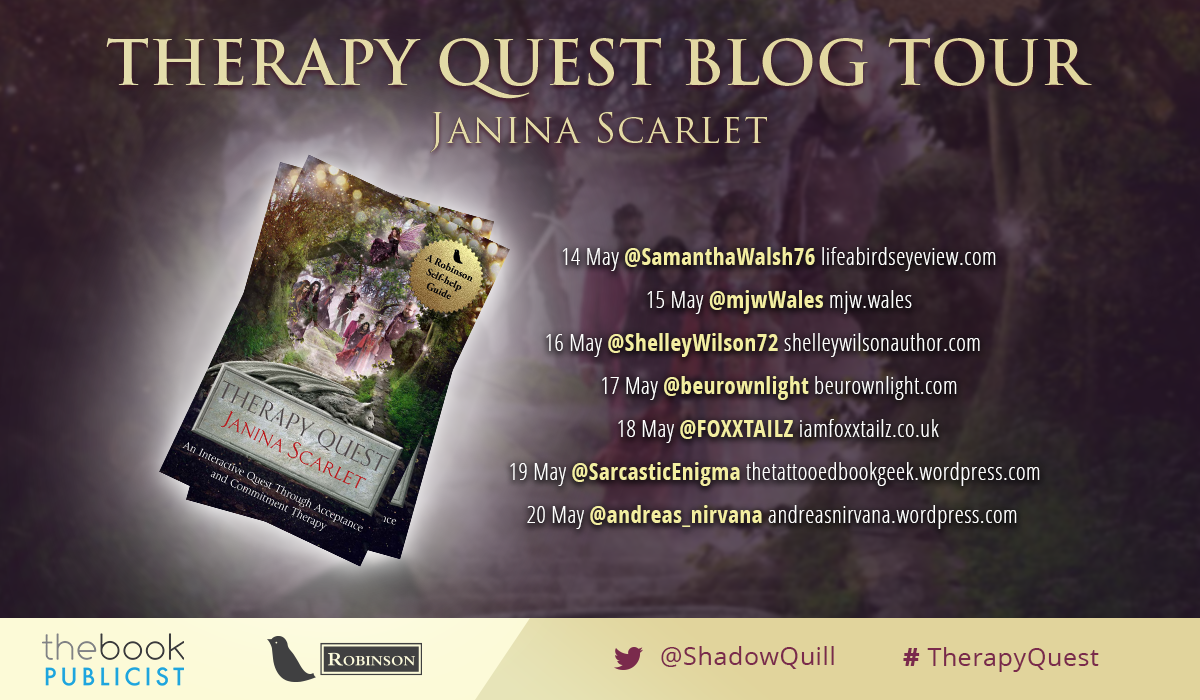
Guest Post: Interview with Dr Janina Scarlet, author of new book ‘Therapy Quest’

I have got to know Dr Janina Scarlet, psychologist as I have written more across the media. Janina writes about therapy and mental health in an approachable and meaningful way. She also loves superheroes and fantasy and incorporates them into her work!

This week for Mental Health Awareness Week, I spoke to her as she launches her  new book ‘Therapy Quest’.

bloggertour.png
(image: The Book Publicist/ Dr Janina Scarlet)


What is your new book Therapy Quest about?

Therapy Quest is an interactive fantasy book in which YOU (the reader) are the main character. You are transported to a magical world of Here and are the Chosen One to stop an evil sorceress, Mallena, from destroying the world. Only you don’t feel like a hero. Not at all. Your anxieties and insecurities nearly lead you to abandon your quest altogether. However, if you decide to partner up with some new friends, such as a vampire with an eating disorder, and an Ogre who struggles with obsessive-compulsive disorder, you just might be able to become a hero after all.

The book is written in a game-like format, which allows you to make choices along the way. Each choice you make will change the rest of your journey and can either allow you to earn or lose points. Some choices can kill your friends or your character, so you have to be careful.

Each time you make a choice, you will also learn a mental health skill, and you will need all the skills you can learn along the way to help you in your final battle.

What was your inspiration for writing it?

I knew I wanted to write a fantasy book with self-help elements in it, in which the reader could learn these skills through the characters they were reading about. My editor, Andrew McAleer, had the brilliant idea of having a similar format to “Choose Your Own Adventure” fighting fantasy books. This sounded like a very interesting challenge to me, and I am extremely honoured to have been able to work on it.

Could you explain a bit about what Superhero Therapy is and how it works in the book?

Superhero Therapy refers to incorporating elements of popular culture, such as fantasy and science fiction books, movies, TV shows, as well as video games, comic books (Superhero or otherwise) into evidence-based (research-supported) therapy to help clients to become their own version of a superhero in real life (IRL).

In Therapy Quest, the reader is the Chosen One, the Hero of their own journey even if they question their ability to do so. Through learning skills such as mindfulness, self-compassion, acceptance, and following their own core values, the readers are invited to take their own superhero journey and develop their own superhero skills, which can be utilized in their every day life as well.

Who could you recommend the book to?

I would recommend this book to anyone age 12 and up who might enjoy fantasy books and would like to learn skills to manage depression, anxiety, trauma, or other mental health struggles.

drjanina

Dr Janina Scarlet is a clinical psychologist and the author of Therapy Quest, a revolutionary self-help book which combines therapy with an interactive fantasy quest.

What UK Charities are doing for Mental Health Awareness Week and helping to break stigma by Eleanor for Metro.co.uk (Extract)

Today my article for Mental Health Awareness Week (by the mental health foundation) went live on the Metro.co.uk website. I worked with the Foundation, Samaritans, Young Minds and Time to Change to discuss their initiatives to help break stigma against mental illness and do something active in our communities.

Here is an extract of the article link to the full piece: http://metro.co.uk/2018/05/15/its-mental-health-awareness-week-how-are-charities-fighting-the-stigma-surrounding-the-subject-7533330/

mentalhealthaweek
(image: Eleanor Segall)

This week is Mental Health Awareness Week,  The event run by the Mental Health Foundation, has been running for 18 years. ‘Admitting it was shameful and embarrassing’ – what it’s really like to have kleptomania This year’s theme for Mental Health Week is: ‘Stress: Are We Coping?’.

Tackling stress, The Mental Health Foundation says, can go a long way to prevent anxiety, depression, self-harm and suicide, and it has commissioned the biggest ever survey into stress-related issues in the UK.

The survey, of 6,000 people across the UK, found some startling findings: in the last year almost three-quarters of people have at some point felt so stressed they felt overwhelmed or unable to cope.

It revealed that 74% of UK adults have felt so stressed at some point over the last year they felt overwhelmed or unable to cope, and that 83% of 18- to 24 year-olds said this, compared to 65% of people aged 55 and over.

Mental Health Foundation director Isabella Goldie says: ‘Millions of us around the UK are experiencing high levels of stress and it is damaging our health. ‘Stress is one of the great public health challenges of our time, but it still isn’t being taken as seriously as physical health concerns.’

Talking and breaking the stigma that surrounds mental illness is also hugely important So how are charities working to break down this stigma? We spoke to a number of them to find out.

The Mental Health Foundation

It is hoped that Mental Health Awareness Week will educate on stress and mental health, and start to open the conversation on coping methods and support, such as therapies, support networks and medication. The foundation is running the Green Ribbon scheme, a charity pin that can be bought.  Worn during Mental Health Awareness Week, It allows people to show support for good mental health for all, with all proceeds going to support the work of the foundation. Actor David Harewood posted a photo on Instagram about the campaign as he is an ambassador.

He says: ‘This year I am supporting MHAW. I am putting my face to the campaign and making a BBC documentary on the subject because 30 years ago I had a breakdown myself.

‘I am not sure why it has taken so long for me to go public with it, but, to be honest, I’ve been so busy over the past seven to eight years I haven’t really had the time. ‘Ever since I did last year, I have been astonished by the number of people who have come to me with their own experiences of mental health, encouraged by my frank admission.’

The Foundation wants the green ribbon to be the international symbol for mental health awareness. It is encouraging family and friends or colleagues to get together and have a chat about mental health over a curry. There are quiz ideas and  competitions to keep your guests engaged and to raise money for the Foundations work in mental health. To learn more, visit mentalhealth.org.uk.

To read more about the other charities and see the full article click the link below.

Read more: http://metro.co.uk/2018/05/15/its-mental-health-awareness-week-how-are-charities-fighting-the-stigma-surrounding-the-subject-7533330/?ito=cbshare

Twitter: https://twitter.com/MetroUK | Facebook: https://www.facebook.com/MetroUK/

5 Tips to Manage Stress: Guest post by Cloe Matheson

stressfree1

(image: Healthy Today Club)

With research increasingly demonstrating the correlation between prolonged stress and a shorter lifespan, we would all like to avoid the spectres of stress and anxiety.  But since chances are the vast majority of us have been confronted with both at some point and will be again in the future, what does it take to manage pressure yourself – or even better, to build a lifestyle which doesn’t allow stress a look in?

Check out our 5 simple tips to get started on your journey to calm.


  • Avoid triggering substances or habits


We hear it all the time, but it’s true: the things you fuel your body with significantly affect how you feel. Particularly if you’ve been diagnosed with a gut condition such as IBS (which has been shown to worsen in times of stress), you’ll want to ensure your diet is full of colourful, digestible wholefoods. In times of stress, a salad is often the last thing most of us want to reach for – but even if your current best move is reducing your caffeine intake, that is a step in the right direction.

If you’re currently using other substances to self-medicate during or after a long day – we’re talking nicotine (a stimulant) and alcohol (a depressant) – then let this be the push you need to give up those bad habits.


  • Anticipate and respond


Particularly for perfectionists and people who experience social anxiety, stress is unavoidable in daily life.  Although easier said than done, try to embrace this inevitability as best you can – as our fears often lose their power if we are prepared for them to manifest.  When you are in the midst of responding to stress directly, keep these coping mechanisms in mind:

  • Exercise – put those fight-or-flight hormones to good use and have a workout while restoring yourself to calm. This doesn’t have to be an hour-long run at peak intensity: it can be as simple as walking around your office block when you need a workload break.


  • Breathe – if you’re delayed in a waiting room or have just received challenging news, don’t panic.  Sit or stand somewhere comfortable, close your eyes, visualise a serene place in your mind, slowly breathe in and out, and relax to the sound of your exhalations until your heartbeat slows and you can figure out your next step.


  • Sleep


Even for those of us who believe we need no more than 5 hours of sleep per night, humans just aren’t built to withstand such short stints of shut-eye on a regular basis.  

The proper functioning of both body and mind rely on essential processes that occur during sleep, including the renewal of skin cells and the retention of information in the hippocampus – the main memory-processing section of the brain.  Since these processes can only be completed in a state of sleep, it’s best to take your zzz’s seriously.


But since stress may be the exact thing keeping you up at night, here are some rituals to build into your bedtime routine:

  • Stop work at least an hour before bed
  • Have a warm bath or shower at night
  • Put some lavender oil on your pillow
  • Read (a book, rather than a screen!) before you turn off the light
  • In the dark, focus on relaxing every separate limb and muscle of your body before going to sleep.


  • Get talking


John Donne was right: no man is an island. Bottling up your stress and trying to manage alone may work in the short-term, but not forever. To avoid building up pressure that leads to breakdowns, consider chatting to a counsellor or a grounded friend about how you’re feeling, or join a club or society which will allow you to talk with like-minded people who may struggle with similar problems. If you are internet savvy, even online discussion boards and forums can be a safe place to air your woes.


  • Prioritise and identify


Are you staring down a hectic month of appointments, task-juggling, and trying to perfectly fulfil a different role for everyone in your life?  Compartmentalise to deal with the mayhem.

What do you need to prepare for your next move?  Tackle your tasks individually and avoid thinking about your myriad other tasks until you are finished working on each one.  Stress often peaks when we consider all our problems or tasks in their monstrous sum, whereas they are much more manageable taken alone.

If you struggle through every month, you need to identify what causes your stress. No one can do everything, and you may find that you have overcommitted to tasks. What can you say No to? At times like this, it’s worth remembering that you are the only person in control of your life: so put your wellbeing first.

Cloe Matheson, the author of this article is a writer and blogger. She can be contacted here:  https://cloewrites.tumblr.com/

Fitness and how it can help Depression: Guest Post by Paul Matthews

fortaleza

(image: Fortaleza Fitness Center)

Dark times can come. When you reach your darkest days, the ones in which your thoughts are controlling you and you can barely do anything, you should try and keep yourself busy, if this is possible. Its not always possible for people who are unwell- but distractions and exercise are always helpful, especially if they benefit your overall health.

These are the top 3 reasons why taking exercise could help you if you’re suffering from depression:

1: Engage your mind and keep it busy

Last year was one of the worst periods of my life: I broke up with my girlfriend, changed my job and lost one of my best friends. I was that sad and my mind was not properly functioning, all my thoughts were invading me all day and I was barely able to do anything.

One day, I went for a 5 mile run, because it was sunny, right after work. During this time, no negative thought hit me. That was when I opened my eyes: if you don’t dwell on depressive thoughts, then you will be able to see the light at the end of the tunnel. I decided to get a gym membership and I started working out for an hour after work. It has really helped me manage my depression. I am happy right now: my life is busy, but I have plenty of energy every day and less dark clouds.

Keep active and you should hopefully see the benefit!


2: Your lifestyle can affect your mental health

One of my friends who had depression loved junk food. He was constantly sad and depressed. He also did hardly any exercise. I encouraged him to exercise more and go to the gym if possible. The exercise helped him feel more positive and like he was taking good steps back to wellness. 
3. Help Your Self Esteem and Do it for you 

Many people told me that they were embarrassed to do exercise and particularly going to the gym as they felt “ugly, insecure, overweight and not fit” and so on. The best advice I can give is: get yourself some good fitness clothing you feel comfortable in. This might sound a bit weird, but properly fitting exercise wear can boost confidence and promote positive mental health.

Its also important to note that you aren’t the only one feeling this way and most people feel the same about themselves. Take that leap today.

When you are approaching fitness, whether if it’s in the gym or outside, or even at home, you must not forget about why you are doing it, why it’s important for you and how this could help you with your mindset.

Gentle exercise includes swimming, walking and yoga. There is something for everyone.

Try and see over the wall and remember: after the storm, the sun will rise again. Keep it up!


paulm

Paul Matthews is a freelance business writer in Manchester, who has headed up several campaigns. His aim is to better inform business owners and professionals on the hidden dangers of the workplace. You can often find him mountain biking or at the local library.

You can contact him at : https://twitter.com/paulwritesalot

Guest Post: 5 Steps to control Anxiety and help Panic attacks by Katie Rose

katierose
(image: Kate Rose/ internet)

My name is Kate and just over 2 years ago I had my first panic attack. It was without a doubt, the scariest moment in my life and to think I’m at the point where now I can somewhat control my anxiety, feels like a miracle. Anxiety is not something that you can “just get over” which I’ve often heard those who don’t suffer from it, say. (So don’t worry if you’re struggling!) Though I’m a lot more stable now, I still experience mild anxiety every now and again. This post will tell you how I managed to tame my anxiety and help prevent my panic attacks.

#1 Stop Drinking Alcohol

Whether you agree alcohol is the reason for your panic attacks or not, it’s a proven cause to why people suffer from anxiety. Sadly for me, alcohol is the number one cause of why I would experience panic attacks and get myself into such an unstable state. As a result, I will no longer drink even a drop of alcohol and since, I haven’t experienced a panic attack. This is not the same for everyone- some people don’t drink but still experience high panic. It’s not that I don’t want to drink alcohol or that I don’t enjoy myself when I am drinking because I really do. However, the aftermath of it all just isn’t worth it.

In spite of that, it doesn’t mean I haven’t felt anxious since stopping drinking because I have and it’s still an ongoing battle. I’ve quite simply stopped having major panic attacks.

What Happens When I Drink Alcohol?

When I drink alcohol I end up going to bed with a racing mind (how on earth I end up sleeping I have no idea) and wake up in the early hours of the morning with major heart palpitations and breathlessness. It makes me feel like I’m about to die. Due to being tired from waking up early, I always feel extremely frustrated that my body has woken me up. No doubt that makes my anxiety worse and stops me from relaxing and calming down. So, what do I do?

Solution: Talk To Someone

Instead of going on my phone and surfing the internet to try and distract myself, I’m lucky enough to be able to wake my dad and sit and talk to him. I find that it helps me get back to sleep so much quicker than staring at a bright screen which actually makes me feel more awake. After all, it’s unlikely you want to be awake at 4 AM watching YouTube or scrolling through Instagram, instead of sleeping. By closing my eyes, yet having someone there to talk to, I’m able to slowly drift off back to sleep and thankfully not wake up again until the morning. It takes me an hour or two  to fall back asleep but compared to trying to cope alone, it’s a lot shorter. Try it – it might just work for you.

Don’t have someone at home to talk to? Perhaps you live alone and I assume for sufferers in an empty home it will feel a million times worse. Maybe it is time to take out your phone but instead of staring at the screen, call someone, even if its a helpline. That way you can lie with your eyes closed making you more likely to fall asleep and still be able to talk to someone for help.


#2 Breathe Using Your Stomach

It may sound slightly strange but after having the ambulance out to me on several occasions, I’ve learn that it’s my breathing that plays a huge part in being able to calm down or not. Breathing quickly and inhaling small amounts of air at a time can cause you to hyperventilate. Stop. Sit back and assess your situation. Think about how you’re breathing:

Are you breathing quickly? Are you breathing in through your nose? When I’m feeling breathless, instead of trying to take lots of little breaths that cause my chest and shoulders to move quickly, I take big, deeper breaths that’ll push my stomach out.

By concentrating on feeling my stomach move, I can focus my attention elsewhere from my racing heart and help me calm down. Use the below ‘calm breathing’ technique from Anxieties for more help:


  • Take a long, slow breath in through your nose, first filling your lower lungs, then your upper lungs. (You should feel your stomach push out slightly before your chest starts feeling full of air.)
  • Hold your breath to the count of “three.”
  • Exhale slowly, while you relax the muscles in your face, jaw, shoulders and stomach.


Remember: Listen to your body and analyse what you’re doing. Are your teeth clenched? How are you sitting? Give your body a little shake to relax yourself and even close your eyes if you wish and practice your breathing.

(image: Kate Rose/ internet)

katierose2

#3 Thought Journal

I think one of the main things that has helped me to conquer my anxiety was analysing the potential cause and the feelings I had, during the panic attacks. Sometimes it was going to bed with too much on my mind, sometimes eating too late. Even from doing absolutely nothing and other times from being rushed off my feet. It’s hard when there are so many different factors that can trigger panic attacks but trying to figure out what that cause is can help you to overcome your negative feelings.

Write them down. Making a note of the time you had your panic attack, what you were doing before, perhaps the foods you ate that day and so on, will help you to figure out if there is a pattern. Over time I began to learn that the main cause of mine was from alcohol and going to bed when I still had things to do. Ensuring I made time for cleaning my room, making my dinner for work and sorting my outfit for the following day, meant I could go to bed without worrying. I wouldn’t feel rushed and I gave myself peace of mind to improve my sleep which is so important for coping with anxiety.

#4 Do Some Exercise

One of the key factors in helping me beat my anxiety was a lifestyle change that involved getting active and eating healthy. By going to a fitness class or doing a home workout, I was able to relieve all of my built up stress and found trying to get to sleep or relax, a lot easier. I started by going the gym 2-3 days a week and currently go 3-4 times a week. I also realised that since getting a FitBit back in July 2017, it’s helped push past my panic attacks even further, by distracting me from feeling anxious with fun fitness challenges with my friends and family. What’s great with having a FitBit is, even if you don’t have friends or family who have one, there’s a whole community you can get involved with.

Not Interested In Exercise?

If you’re not into doing full-on fitness classes, why not aim to do a certain number of steps a day? My goal is 8,000 and find that whilst working 7AM to 4PM Monday to Friday, this is pretty achievable as long as I go for a stroll at dinner and again in the evenings. Doing this every day is keeping both me and my brain active and it’s these small changes that have helped me to channel my anxious thoughts, elsewhere. Here are some more tips on exercising to beat anxiety.

#5 Don’t Feel Ashamed

No matter how hard it is, you must not feel like a failure. Anxiety can affect anyone and everyone and when you least expect it. Before my panic attacks I was out partying all of the time, drinking copious amounts of alcohol and not having a care in the world. As unfortunate as they were, having panic attacks helped to show me that my body needed to be taken care of. Yet, for the troubles I have gone through, I wish I knew that sooner. I realised that during the time my anxiety was at its worst, I had an extremely negative approach to everything and often found myself using negative words a lot.

Solution: Take a time out to evaluate your attitude. As much as you may think you’re world is coming to an end, I found changing my mindset to try and think of even the worst times in a positive way, made me channel a stronger side to myself. This has been a major contributor to helping me get over my panic attacks. Replace words and phrases like “bad”, “I can’t”, “never” and “not now”, with “good”, “I can”, “always” and “yes”. You never know what good could come from it.

Alternatively, The Calm Clinic suggest something similar to a thoughts journal: a positivity journal. Fill it with positive things that have happened to you that day. Aim for at least 10 things so that no matter how bad the day may seem, you always have 10 great things to reflect back on.

Here’s their example:

Examples of good entries:


  • The barista gave me my coffee for free today because I was nice to her.
  • My boss complimented me on the project I finished.
  • I received a phone call from an old friend just because she wanted to catch up.


Examples of the types of entries you should avoid:


  • I woke up.
  • My mum didn’t call me which is good because I didn’t want to hear from her.
  • I didn’t screw anything up too badly.


Remember: If this seems too much of a chore to do, stop. Put the pen down and try something else instead, like yoga, listening to music or an audio book or reading a book yourself. If you feel pressure to write in the journal, it may make your anxiety worse. Yet by trying different methods of coping with anxiety you can find what works for you.

Why Medication Isn’t Always Right For You

I ended up being consumed by my anxiety and fears and feeling like the only way to get through it was to take medication. The doctors weren’t keen on prescribing me with any tablets at the time and I didn’t really want to take them anyway. Though, after a while I felt it all became too much. Me and my boyfriend went to Holland & Barrett to buy some calming pills.

I don’t want to promote the tablets I took in this post because I only used them once or twice. I think that trying to control my anxiety without medicine was a better solution for me and although was a challenge, made me feel strong and as though I was capable of anything. For others, taking medicine may work best for them and it really is down to the individual.

No matter how you deal with anxiety, just remember not to give up. I felt like my world was collapsing and I was so scared. Though with perseverance and time, I can now say I’m coping well with my anxiety, though the battle is still on.

This article is by Katie Rose, Lifestyle Blogger at ok Kate

ok Kate is a lifestyle blog about my life as a “normal”, young adult and the steps I’m taking to try and change my life from being boring and rather basic, to make the most of the world around me.