‘A Unpredictable manic episode meant I was hospitalised for my bipolar disorder’: for Happiful Magazine February 2018 Issue

happifulmag
(image: E Segall and Happiful Magazine)

Hi everyone,

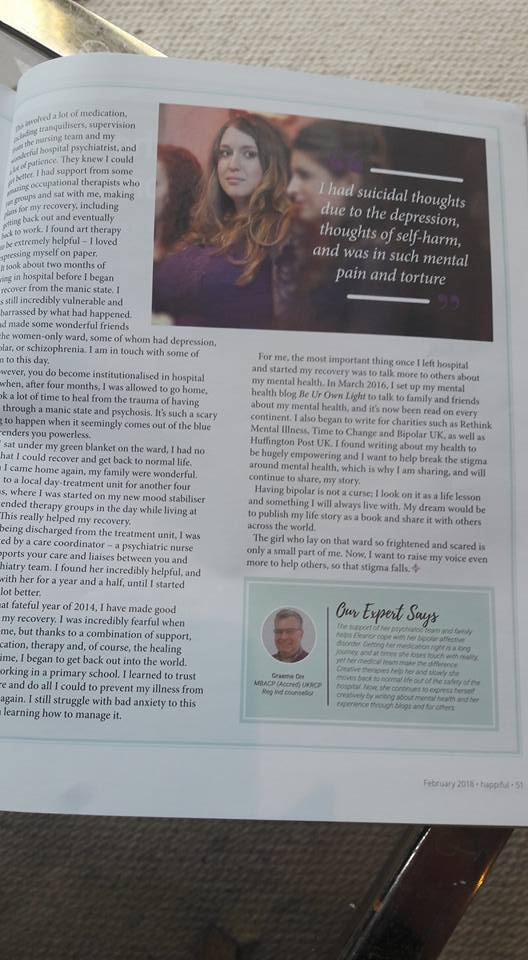
I am thrilled to be able to share my story of recovery from bipolar disorder for the first time in print (!) at Happiful magazine, a UK magazine solely dedicated to mental health.

You can read it online here:  https://subscribe.happiful.com/ click read e-magazine and turn to pages 50-51. If you live in the UK, you can also order the magazine there by post or buy a copy in most major UK supermarkets!

As I say in my article,

Having bipolar is not a curse, I look on it as a life lesson and something I will always live with. My dream would be to publish my life story as a book and share it with others across the world… The girl who lay on that ward so frightened and scared is only a small part of me. Now, I want to raise my voice even more to help others, so stigma falls’   

I hope you enjoy reading it and leave a message for me in the comments if you do.

Recovery from Bipolar and Achieving despite the odds: Sam

Sam shares her incredible story of living with bipolar disorder and how she recovered and now helps others as a student mental health nurse. As a student, Sam has worked on a child and adolescent unit, has volunteered for Mind with a theatre project for people with mental health issues and shares her amazing story with us here.

Trigger Warning: Piece speaks about self harm and suicide, please read with care.


hopefloats1

(image: bphope.com)

I started to experience anxiety at the age of 10. I remember feeling extremely overwhelmed at the thought of moving to secondary school and although I was very bright in other areas, I struggled with maths and this often reduced me to tears. At the age of 11, I started to struggle to fit in with my peers and became increasingly socially anxious. By the age of 13, I began to experience severe emotional bullying within my school. I had many friends and I was a talented dancer but the effects of the bullying eventually led to feelings of low self-esteem and self-worth. I wish I had had the confidence to speak to my parents about the bullying at the time but I felt ashamed and ultimately believed that there was something wrong with me as a person.

Additionally, I was a high achiever in a high achieving school, in a good area, so I felt the pressure of  these expectations. I had big expectations of myself too, which added to my stress and made life difficult. As I turned 14, I had already had three episodes of what I now know to be depression. I would go for weeks without eating and felt physically unable to speak. I would spend hours in bed and did not feel able to attend school. One day, I decided that I could not cope any longer, I felt suicidal and alone, taking an overdose. My parents took me to hospital and I later saw a psychiatrist at the child and adolescent mental health outpatient’s facility.

The attempt on my life made me feel really ashamed but I did not know why I felt that way and had those thoughts. I couldn’t explain everything to the doctor. I continued to have periods of depression and at age 15, I experienced my first manic episode following a break up with my boyfriend and a significant life trauma. I also had my first episode of psychosis (when your mind loses touch with reality) following this. I was taken into hospital and then sent to a psychiatric unit. Here I received a diagnosis of bipolar disorder (type 1) and was prescribed Lithium to stabilise my mood and anti-psychotics to treat the mania and psychosis. I found this diagnosis really difficult to accept but I was relieved to finally know why I had felt the way I did- and what was causing the depression and mania. It would have been very helpful to have someone tell me at this point that recovery is possible. It is possible to have a fulfilling life despite my condition, but I didn’t know it then.

I returned to school for my last year and I had to drop one of my GCSE subjects to catch up on the work that I had missed. I felt ashamed of my situation- I found school and socialising really hard and because of the greater stigma that was attached to mental health back then, many of my school peers were not very understanding or supportive. I failed most of my exams and felt like a failure. I had aspirations to go to university but due to my grades this was not possible so I had to do an NVQ instead.

I decided to study counselling as my experiences had given me an interest in this area. Unfortunately, I found life with my new diagnosis increasingly difficult and fell into the wrong crowd and turned to substances, alcohol and self-harm as a way of coping. I did not take my medication as prescribed- so consequently had another manic episode at age 17. I became so unwell that I was sent to a psychiatric hospital out of area and sectioned under the mental health act. Here I had high doses of rapid tranquilisation to treat my mania and psychosis.

I recovered from this episode and went back to work. At 18, I was working in a call centre and moved out of home into a shared house. I spent large amounts of money maxing out credit cards. I began to sleep around and had unhealthy relationships, putting myself in dangerous situations. Unfortunately, the people I moved in with were also using substances and this exacerbated my mental health symptoms further. I moved onto using harder drugs. I really didn’t care about myself and felt like my life was over before it had begun- I felt like I had nothing to live for. I started to harm myself again – culminating in an overdose. Then, I was admitted to an adult psychiatric unit on a section 3 (a longer hold in hospital).

By the age of 23, I had had several admissions into this hospital and had also lived in supported accommodation. I had many traumatic experiences in hospital as some of the care I received was not positive. Each episode of mania followed an episode of depression.

At 24, I met a boyfriend who did not use substances and he also had had his own mental health experiences, I fell pregnant and we decided to keep the baby. I then stopped taking substances and began to take care of myself for the first time as I realised my actions would now not only affect my life but another’s too. This was a big turning point in my life. I had a baby girl and came off all my medication. I had an emergency caesarean which was traumatic and I tried to breast feed which was unsuccessful.

However, being a mother with bipolar has its own challenges. I became very low after the birth and had an episode of postpartum psychosis, where you can suffer from delusions and/ or hallucinations. I had to spend time in a psychiatric unit for three months to be cared for and to get well again. Fortunately, my family took care of my daughter during this time. I recovered from this episode and my daughter, my boyfriend and I moved into a two bedroomed flat to make a fresh start.

I had some difficult news that year that spurred me in in my recovery and to make positive change for those of us with bipolar and mental health issues. My close friend that I met whilst living in supportive housing, who also had bipolar disorder, passed away from suicide. This inspired me to then start volunteer work within the mental health services and try to use my own experiences to help other people. My support worker at the time put me in contact with MIND and a local theatre group.

At the theatre group, I met many people who became a positive influence on my life. I started a course in mental health at college in the evenings and helped run the hearing voices group at MIND. I also volunteered in secondary schools educating young people about mental health, the effects of bullying and substance misuse. I also took A level psychology at evening school and completed a year’s social science course at university. My mental health improved and so had my self-esteem and confidence. I finally had purpose in my life as a mum and volunteer with positive friends and family around me. I also had a stable prescribing routine of medicaion- Sodium Valproate,  to help keep my moods stable and no longer going between depression and mania.

This spurred me on to apply for a job on the National Health Service (UK) Nursing bank as a Nursing assistant. I worked in different mental health settings including the hospital that I spent time in as a patient. This felt awkward at first but a Nursing assistant who had cared for me in the past took me under her wing. I really enjoyed the work and realised that this was the career for me as I loved working with people and helping them through their distress. When my daughter started pre-school I applied for a permanent job in one of the hospitals that I did agency shifts in.

That year, my boyfriend and I got married. After working in low secure unit, I moved on to working in a recovery unit and eventually applied for a job in a child and adolescent unit. I continued to have an interest in performance arts and my friend told me about a local theatre project which aimed to challenge stigma and discrimination surrounding mental health. This seemed to be right up my street so I volunteered! We devised two plays during the time that I worked with them. I enjoyed acting and spending time with others that had experience of mental health. We also wrote a book with stories and poems related to mental health which was later published. It felt great to be back challenging stigma and using the arts as a way of doing this.

I spent five years working at the child and adolescent unit and really enjoyed working in early intervention with young people. I had my son during this time and although I had another caesarean and a low period post natal, the overall experience was much more positive as I had stability and a good insight into my mental health.

As my son grew up, I decided to start my access to nursing and maths GCSE at evening school. It was hard to look after two children, work and attend college but I passed and gained a place on the mental health nursing degree at University. My manager also advised me to apply for the nursing scholarship and I was successful. My trust is paying for my training and I will have a job as a mental health nurse on qualifying.

15 years ago,  I really didn’t think I would be where I am in my life today. It really does show that with the right support, lifestyle and for some, medication that recovery is possible. Remember your diagnosis is just one small part of you it doesn’t define you and unlike some people in society mental illness does not discriminate – it could happen to anyone of us.

7 Reasons for Alcohol and Drug Addiction Stigma: By Ryan Jackson

albert
(image: Pinterest)

Stigma is a set of pre-conceived false beliefs that people have against a particular group of people. According to the World Health Organization’s website, stigma is a major cause leading to discrimination and exclusion. Not only does it disturb the personal life of a person, stigma can also limit their chances of obtaining proper jobs and housing. The unfortunate thing about stigma is that it’s not based on facts, but rather on assumptions and generalizations that have been embedded into society.

7 reasons addiction carries a stigma

The American Society of Addiction Medicine characterises addiction as a “primary, chronic disease of brain reward, motivation, memory and related circuitry.” The National Institute on Drug Abuse defines addiction as a ‘chronic, relapsing brain disease” that changes the structure and functionality of the brain.

So, why do so many people still think of addiction as a moral failing? Why do they still refer to victims of substance misuse disorders as meth freaks, alcoholics, junkies, crackheads and garden-variety drunks?

The answer is simple as it is depressing: because that’s the way it’s always been.

Addicts are scorned by communities, and celebrities with addictions are exploited or hounded by paparazzi. And, while the government purports to view addiction as a disease, it often works in opposition to that position through the “War on Drugs,” which counts most drug users as criminals. Even those of us in the treatment community still—consciously or unconsciously—employ stigmatising programming and language—such as when we focus on “dirty” urine.

So despite widespread agreement that addiction is best understood as a complicated behavioural-biological scenario that requires treatment, the system is hard-wired to prolong stigmatisation, and stigma contributes to addiction’s lethality.

Of course, there is a long history of mental illness being misunderstood and stigmatised,  in state hospitals or prisons, which was beautifully captured by the director Lucy Winer in her recent highly-acclaimed documentary, Kings Park. Addiction and mental health problems are still spoken of in hushed tones, and patients and their families are still blamed. This is changing, but there is still stigma. 

The idea that those with addictive disorders are weak, deserving of their fate and less worthy of care is so inextricably tied to our zeitgeist that it’s impossible to separate addiction from shame and guilt. Addiction comes with a second punch in the gut: the burden of being treated like a second-class citizen and expected to act accordingly. Stigma impacts us all, both consciously and unconsciously, and is perhaps the single largest contributor to the mortality rate. Consider these eight points:

  1. People fail to seek treatment.

Most people who struggle with an addictive disorder fail to seek treatment, in part because of their concern that they will be labeled an “addict” and that the stigma will stick. 

Often, a crisis precipitates treatment, so the problem is already well-advanced. If we removed the stigma, guilt and shame from the equation, people would find it easier to make a realistic, objective assessment of their substance misuse and discuss it openly with a health care provider.

  1. The medical profession fails to treat addicts properly.

Can you think of other situations in which the health care system abdicated responsibility for dealing with a health care issue that afflicts such a huge segment of the population? For far too long, those people who did seek treatment, often following a crisis, found no appropriate reception from the medical community. Doctors were slow to recognize addiction as treatable, and so patients were encouraged to find help outside of the medical community, in 12-step programs that based on non-scientific practices, normally anathema to physicians.

12-step programs helped many, but those that did not succeed there found themselves in the unenviable position of having been directed to a place by their doctor, having the recommended solution ineffective and being reluctant to return to their physician for further help. A better paradigm? The medical community should recognize addictive behavior as part of its purview and would apply evidence-based approaches in their practices.


  1. The mental health profession ostracizes people with addictive disorders.

It is routine in some mental health settings for persons with substance misuse problems to be discharged from treatment when substance misuse is revealed. They’re told that the drinking or drug use renders them “unavailable” for the work of psychotherapy and that they need to “get clean” first by going to a chemical dependency or substance abuse treatment program. They are told that whatever issues seem pressing and paramount to them are “just the drugs talking’

It’s common for clinicians to believe that before they can help a patient with the various traumas, interpersonal conflicts, intrapsychic issues and other problems that other people are  helped with in psychotherapy (and which are, of course, related to their use of substances) the patient needs to first become abstinent from substances. Many patients who are sent to traditional drug treatment programs that are abstinence-focused end up neither “clean and sober” nor receiving good psychotherapy.

  1. Funding for addiction treatment is discriminatory.

In spite of the huge impact and cost of addictive disorders on society, the way that addiction treatment is funded (in America) is disproportionately low. Despite passage of Federal Mental Health Parity legislation, mental health and substance use disorders continue to be treated differently—and often poorly—compared to “medical” illnesses.

What if there was no stigma in addiction? Given its huge cost to society, addiction should be funded and paid for on a level playing field with medical problems.


  1. Addicts get sent to jail.

Where substances are concerned, people go to jail for the possession of something that is part and parcel of their addiction. Most of the money that governments spend on “drug control” is spent on criminal justice interdiction rather than treatment and prevention.

Here again, clearly, is a system with stigmatisation at its roots: blaming, punishing and making moral judgements instead of providing treatment and other help that would change behavior. The more of a stigmatising stance one takes towards substance misuse the more likely one is to support criminalisation of drug offenses and the less likely is to support insurance coverage and treatment for drug addiction. Taking the stigma out of addiction argues for prevention and treatment as opposed to prosecution and incarceration.


  1. Even when people do get to treatment, stigmatization can continue and contribute to poor treatment outcomes.

It is critical to recovery that treatment programs not send messages to patients that are blaming (for relapse) and shaming (for being weak). People enter treatment at a vulnerable moment, psychologically and in terms of their brain chemistry. Addiction comes with a hard-to-escape sense of failure that recapitulates prior disappointments and works in opposition to growth.

Patients have spent a lifetime trying to silence the “inner critic” that repeats “I’m-not-good-enough” messages, so it’s critical that the culture and language of treatment provide a healthy soil in which patients can grow seeds of hope that are vital to recovery. In an optimal treatment setting, patients aren’t expected to play the role of one-who-should-be-ashamed. Instead, they are intrinsically involved in planning their own treatment, helping to choose the goals and techniques of treatment.

  1. They confront stigma-based roadblocks constantly.

Those in recovery from addiction face ongoing stigma and discrimination. People in recovery are faced with obstacles, especially those who have been in treatment or in the criminal justice system for chemical dependency. Employment, education, insurance and the ability to vote are all fraught with uncertainty and discrimination for those in recovery.

People in recovery have a harder time finding and keeping jobs, getting licenses, food stamps, benefits that help their children.  In other words, important aspects of living that are so critical to a stable recovery for persons who have been treated for addiction, such as employment, housing and providing for one’s family are that much harder to get. Things need to change. Having struggled with addiction in the past should not make life that much more difficult now. End the stigma.


 

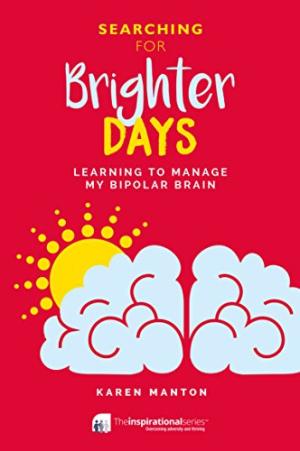
Book Review: Searching for Brighter Days Learning to Manage my Bipolar Brain- Karen Manton (Trigger Press)

karenmanton1

I bought this amazing book, because I very much wanted to read about another womans experience of bipolar disorder, living in the UK like me. It is also published by the great mental health publisher Trigger Press as part of their Inspirational Series. Their aim is to educate and battle stigma. I had previously read Hope Virgos book about anorexia published by them and I felt that this would be a challenging but good read.

Karen writes very eloquently about her life living with undiagnosed bipolar disorder. For many years she was in and out of hospital, with no proper diagnosis or understanding from the medical profession of her illness. She was sectioned multiple times due to mania and depression and although she healed from her episodes, they kept coming back with a vengeance. This was largely because she did not have a name for what she was experiencing and many times was discharged from hospital without proper support.

Growing up in the North East of England, Karen went on to work, marry and have children but had to balance this with the ever increasing and erratic episodes of her bipolar. This included psychosis, hallucinations and delusions as well as deep depression. However, during one hospitalisation, Karen met a new psychiatrist who finally diagnosed her and set her on the bright path that she is on. She began taking medication and engaging with therapy and support. She had a name for the illness and what she was going through. As she writes, she was searching for brighter days and eventually found them, despite many losses in her life.

For me, this book is a must read. You can buy it on Amazon and other book stores online as well as on the Trigger Press website. It is a really important work about succeeding against the odds and gives a comprehensive glimpse into life with bipolar disorder.

Thank you Karen for your bravery in writing this and sharing your story with the world!


Reflections on 2017 and Festive Greetings from Be Ur Own Light!

Here at Be Ur Own Light, it has been a brilliant year in terms of writing, getting the message out there, engagement and gaining a new following. As well as regular blog posts on her life with bipolar and anxiety, I (founder, Eleanor) have written this year for other charities and media outlets. These include : Mind, Rethink Mental Illness, Time to Change,  Self Harm UK/ Youthscape, Brighton Wellness Centre, The Counselling Directory, Counsellors Cafe, ISMA, World Union of Jewish Students, Equilibrium Magazine and Happiful Magazine. There are upcoming collaborations to be published soon so stay tuned! I also hope to publish more for the Huffington Post in the new year.

The blog has grown into a strong following and particularly we have seen the growth from fellow bloggers on WordPress and Twitter which has been brilliant! Not to mention my loyal following on Facebook and other social media (and email). I have loved doing some Facebook Live videos and discussions too. Thank you everyone who regularly reads, comments, shares and for the awards given this year from fellow bloggers (Liebster, Sunshine, Mystery and of course being a Top 30 Social Anxiety blog and Top 100 Bipolar blog by Feedspot.com). I have also entered the blog into the UK Blog Awards and thank you to everyone who has voted so far.

I have hosted many incredible guest bloggers this year and thank you to all who have submitted high quality and excellent articles (in brackets is what they wrote about:

Lucy Boyle (Burnout Syndrome)
Quite Great and Helen Brice (Music Psychotherapy)
Bailey Chauner at Redfin (Seasonal affective disorder)
UnitedMind Laughter Yoga (Jobs and wellbeing)
Christina Hendricks at mentalhealthzen.com (PTSD and veterans)
Reviews Bee (Child Mental Health)
Mental Health and Money Worries  (Mental health and money)
Stephen Smith nOCD App (OCD)
Arslan Butt (Mental health)
Tony Weekes Unity MHS (his story)
Ellie Miles (Health anxiety)
Hope Virgo (Anorexia recovery/ book by Trigger Press)
Ann Heathcote Worsley Centre of Psychotherapy
Adar (PTSD and relationship abuse)
Marcus (Bipolar disorder)
Diamond E Health Informer (Mental Health and Technology)   
Lystia Putranto and Karina Ramos (Anxiety)
Paradigm San Francisco (Internet and teen mental health)
Juno Medical (Anxiety infographic)
Jasmine Burns (Binge eating disorder)
Bill Weiss (Opiate withdrawal)
Jessica Flores (Bipolar 2)
Jimmy Vick (Meditation)
Jay Pignatiello (Mindfulness and Meditation)
David Baum (365 Challenge for PTSD and Mind)
Karen (Anxiety as a mental health professional)
Dr Stacey Leibowitz-Levy (Online CBT) 

I have also written a lot about my journey with bipolar disorder and anxiety and hope to continue to do so in the new year!

Be Ur Own Light will be celebrating its second birthday in March 2018 and we can’t wait to see what next year holds.

We wish you all a very happy Christmas and New Year period- Festive Greetings to all!

Guest Post by Redfin.com: How to Alter Your Home to Treat and Prevent Seasonal Affective Disorder

Each summer, we become accustomed to sunshine and days that never seem to end. We are outside, being active, and absorbing plenty of Vitamin D. It’s no wonder we feel so good! When fall starts to set in and daylight savings comes, our bodies receive less sunlight and we are often confined to indoor activities to combat the cold. With such a dramatic change, it’s easy to slip into a state of feeling hopeless, distracted, or even depressed. These feelings alone could be symptoms of seasonal affective disorder (SAD).

Seasonal affective disorder is a type of depression that occurs when the seasons change, primarily in winter. Everyone reacts differently, but the warning signs sometimes include:

  • Depressed mood
  • A sense of hopelessness
  • Difficulty concentrating
  • Decreased energy
  • Changes in appetite
  • Altered sleep patterns
  • Lack of interest in activities you typically enjoy
  • In some cases, people with SAD experience suicidal ideation. If you have felt any of these symptoms, talk to your doctor as soon as possible.

But don’t worry, you’re not alone! Roughly 10 million US residents suffer from SAD each year, and another 20 percent suffer with a milder form of it. There are many more sufferers around the world. In fact, it’s very treatable. So while you’re huddled inside keeping warm, we are going to discuss ways you can treat or prevent SAD this winter simply by altering a few things inside your home.

Switch up your Lights

Using light therapy boxes can provide relief from SAD. Sitting near a light box for around 30 minutes a day, typically after waking up, provides similar light to a bright, sunny day. Keep your eyes open but don’t look directly in the light box. It’s perfect for sitting on your desk, makeup table, or where you eat breakfast.

Secondly, using a full spectrum bulb or daylight bulb helps some people find relief from darkness. Although it’s not powerful enough to mimic daylight, it’s a great way to reduce darkness in your house. Utilize bright lights to create a reading nook or inspirational space in your home. You can also purchase a treadmill or stationary bike and place it near these mood-enhancing lights, surrounded by plants. These ideas can help give you your “outside” fix even in winter, and can go a long way in fighting seasonal depression.

Add Greenery to Your Home

Bringing more plant life into your home is a great technique for managing SAD. You can fill the rooms you visit often with green, colorful, blooming plants, or set up a room or area in your home that can be a sadness-free retreat. Set up a yoga mat to practice mindfulness next to an exercise area; adding movement to your day will help produce endorphins and serotonin that can improve mood.

If you’re all about gardening, building a DIY greenhouse in your backyard is a great fall/autumn activity that can help you get ready for the winter months. You’ll be able to grow vegetables and fruits year-round, which can help improve your mood since you won’t have to miss your favorite summer treats.

Bring in Some Colour

Take a look around you and ask yourself, do the colours in my home make me feel good? If the answer isn’t “yes,” then it might be time to switch up your home’s colour scheme.

If you’re surrounded by dull or dark colours outside, you might feel the tug of depression more deeply if those are the same colours you’re surrounded by inside. A fresh coat of paint might be just what you need! Paint your walls colours that inspire warmth and joy, like a cosy sunrise or warm, light blue water. Plus, adding a home improvement project to your to-do list can help boost your energy and creativity during a time when laziness lurks around the corner. Studies have shown that setting, working toward and achieving goals can be a big mood booster any time of the year.

If painting is too much work, you can also swap out your throw pillows or blankets for brighter colours. Duvets and pillow case covers are an easy way to change the appearance of your home without throwing out your current décor and or having to commit to a new style long-term.

Finally, hang up some of your favorite photos of you and your friends, family, or pets. Research shows that recalling times of happiness can provide a dose of happiness in a blue moment.

Don’t forget the kitchen

Eating more fruits and vegetables is a proven method for tackling many kinds of depression, including seasonal affective disorder. An easy and fast way to consume more fruits and vegetables is to make a morning smoothie. Embrace daily healthy eating by exploring new recipes online and from your friends. Cold months lend themselves perfectly to soups, stews and crockpot recipes. Try new ingredients, and invite your friends over to taste the results. Not only will the food feel good, but your company will, too! Even when your instinct is to avoid social situations, having friends and family over can be the push you need to feel more upbeat and happy.

And while you’re in the kitchen, check out your surroundings. If the room is highlighted with grey, steel appliances, consider adding pops of upbeat color and warm touches to brighten your mood. Paint the backsplash behind your sink a warm butter or khaki shade, add pops of green alongside wispy plants, or add bright coloured appliances like a teapot, coffee maker, or mug display. Even if you aren’t noticing the colors in a room at every moment, they can still impact your thoughts and emotions.

Put Some Soul into Your Surroundings

Customize your home to give off positive vibes that boost your mood year-round. Surround yourself with things that inspire you like your favorite music, art you love, or quotes from authors.

Consider how music makes you feel. You can purchase and install a surround sound or multi-room music system to pipe in your favorite tunes whether you’re in the bathroom or the bedroom. A simple Bluetooth speaker works wonders too!

If you enjoy the outdoors but the lack of sun and warmth are keeping you indoors, bring the outside in. Set up a room or a corner where you can experience similar activities, like a trainer for your bicycle, yoga mat, or some free weights to keep you in-shape.

Last but not least, consider design schemes that will inspire a positive attitude. Put some soul into your surroundings. Choose decor that will help you build confidence, feel happy, or bring back memories. Start by making a list of things that you know make you smile, and then find ways to create an environment that replicates those same feelings.

While experts are still unsure the exact cause of seasonal affective disorder, whenever changes come around the corner (big or small) humans have an emotional response. You don’t have to be diagnosed with SAD to feel a bit of the blues during the colder, darker months. Luckily, SAD is very treatable and these home tips for managing feelings of depression can help anyone, any time of the year.

Post courtesy of Redfin

As a reminder, our tips are only suggestions and if your feeling of sadness persists, contact a therapist near you.

I Am Learning: Gratitude and Self Care for my Mental Health

Today on this cold, dark ,rainy, wintery day and past few weeks I am learning:

To be gracious

-To be more positive and to give thanks every day- either in my head to God
and the Universe or verbally through prayer. I also appreciate more and write down things I am grateful for. My friend Holly Matthews taught me this but I had also learnt it and felt it from various Jewish  and self development teachings.

To be kind to myself if I have a bad day and practise self care

If I am having a bad day with my anxiety or I am feeling low and tired because of the dark, cold weather, to feel better, depending on my mood I make sure I:

1)  Drink lots of water because my medications dehydrate me and so does the central heating  – and my skin gets all oily from the heating/ hair dries. So then I feel worse. Very important to keep drinking and try and get as much fresh air as possible.

2)  Take time to have a bubble bath or put on some facial or body moisturiser due to the above but pampering is also so important to self care when you are needing some.

3)  Nap, rest and take time to relax without feeling guilty. I have my go to blanket for this. Also, am learning how to practise good sleep at night because I often go to bed with my worries! I understand that for some people eg parents that this is harder. Grab rest when you can eg when your baby is resting.

4) Sometimes, writing or working on various projects can help as long as I don’t stress myself out. If I do feel overwhelmed then I have to cut back on things.

Today I am learning it is OK to feel anxious and overwhelmed but what is most important is to work on my mindset, work on positivity and embrace change. As well as following what I love and practising my passions.

What do you do for self care?

Last few days: UK Blog Award Voting, Aftermath of Mind Article and Working on my Anxiety

ukblogaward

Its been a really busy few days on Be Ur Own Light blog. My first blog for Mind Charity on living with bipolar disorder was posted (you can read it in the below post) and I had the most amazing, positive reaction to it. I had emails and Twitter messages, some from people who are struggling and who wanted advice, others with bipolar who just wanted to chat because they didn’t know anyone else with the illness and some who wanted to help me to fight stigma via writing on the blog. Others merely expressed dissatisfaction with their own care. I’ve heard every single voice on all the different platforms and want to thank all of you for responding to my article in such a wonderful and important way. I have tried to respond to everyone who has written to me, liked or commented. I write to fight stigma and to break those barriers down and thank Isobel at Mind for helping me to share my story.

Then, in true Eleanor style, this week would be the week too that the voting for the UK Blog Awards 2018 opened! I have been nominated in the Health and Social Care Individual Category and need you all to VOTE for me to be shortlisted and get to go to the awards as a top 10 blog in my category (or a potential winner).

So please click here  https://www.blogawardsuk.co.uk/ukba2018/entries/be-ur-own-light-mental-health-recovery-blog    

Then type in your name, email and the health and social care category. Voting closes on December 22nd so thank you so much! I appreciate any votes. Thank you too to everyone on my Facebook (and my Dads), Whatsapp, LinkedIn, Instagram and Twitter who have voted for Be Ur Own Light, it means the world.

Lastly, I am still job hunting but still experiencing some anxiety around work situations. I know that things will improve if I just do as much as I can. I am also working with a therapist to tackle this. I am now on Day 9 of Holly Matthews 21 Day Smile Happy Me Project and it helps me to look at things more positively, so will keep up with that.

Have a great weekend friends- new guest blogs are being posted next week 🙂

Eleanor x

‘Bipolar Disorder: What I wish someone had told me’- my first blog for Mind Charity

MindEleanor
(image by Mind Charity)

Original post at Mind website: https://www.mind.org.uk/information-support/your-stories/bipolar-disorder-what-i-wish-someone-had-told-me/#.WiUudVVl-M-

When I was 15, I started suffering from depression and anxiety. My heart would race, I couldn’t sleep and it was so debilitating I had to take six weeks off school in my GCSE year. I still got my GCSEs and I recovered for a while. However the following months were filled with a manic, high episode and then a depressive episode featuring psychosis which led me to be hospitalised voluntarily on an adolescent mental health unit. It was there, aged just 16 years old, that a psychiatrist diagnosed me with bipolar affective disorder, which runs in my family.

Bipolar is a serious mood disorder where sufferers can experience depression and low phases lasting for months and manic, high phases which can make sufferers feel out of control due to the symptoms.

I am now 29, but when diagnosed at 16, this felt like a life sentence. I was a shy teenager, always wanting to fit in and now I was told I would have a chronic mental illness, have to take constant medication to keep well and keep regular tabs on my moods. What I didn’t know was that due to the severity of my illness, the doctors told my parents they didn’t know if I would be well enough to go to university. I proved them wrong, but this is what I wish I had been told when first diagnosed

Not everyone with Bipolar rapid cycles

I go for months between episodes and on my medication sometimes have no Bipolar episodes at all. In society, people think being bipolar means your mood changes a hundred times a day. This is not the case. Often months and years pass between episodes because everyone with the illness is different.

Some people do rapid cycle with their moods and for others it’s much slower. Let’s change that stigma.

You can do whatever you want to do, just make sure you set realistic goals

Whether it’s going to University, starting a new job, travelling around the world- you can do it if you are feeling well. Make sure you look after yourself and ask for reasonable adjustments in the work place, if need be. It’s ok to disclose a disability- but as long as your episodes are fairly under control (and in this everyone is different) you can still achieve. Small achievements are just as important, just make sure it’s achievable and realistic for you at the time.

Medication can help keep your moods on an even keel, but it is trial and error

It took me almost 11 years of living with the disorder before I found the right medication to keep my episodes at bay, and my moods properly stabilised. I experienced severe depressive and manic episodes when on the wrong medication for me.

Mood stabilisers, such as Lithium, really can help. When I changed from a teenager into a woman, my previous mood stabiliser Carbamazepine stopped holding me and I became unwell. Make sure you chat with your psychiatrist about the right medicine for you, and don’t be afraid of drugs like Lithium- it has saved my life.

Everything is trial and error and you may also need to be on a combination of anti-depressants or anti-psychotics. These medications all have side effects but if it helps your mental health significantly it can be worth it, just make sure you do it under the guidance of a psychiatrist.

You can live and live well

In 2014, I was hospitalised for a severe manic episode and was very unwell. It took me the best part of a year and a half to recover from the affect. However, since recovery I have worked for mental health charities, started a blog Be Ur Own Light (www.beurownlight.com) to tackle mental health stigma and blogged for Rethink Mental Illness, Time to Change, Bipolar UK and other publications such as the Huffington Post UK. Living with bipolar disorder means you have to be resilient. You can live. Yes, you may have other mental health challenges (I suffer from anxiety) but you can still achieve what you want, however big or small. Live your dreams.

When you are first diagnosed with bipolar disorder or suspect you may have it due to your moods and symptoms, you can feel incredibly out of control and overwhelmed. The most important thing to do is to take it day by day and get the right support. You don’t have to live a miserable, reduced life, rather with the right help and combination of medication, therapy and support networks – including a good medical team- you can thrive.

Things may feel bleak and scary. However, you can move forward into the light. Be kind to yourself. Your illness is not your fault and you can recover again. That’s what I wish I had known when my journey began and what I want to share with you.

Guest Post: ‘Don’t count the days it may take for Recovery, make the days count’- On PTSD by Christina Hendricks at www.mentalhealthzen.com

Ptsd
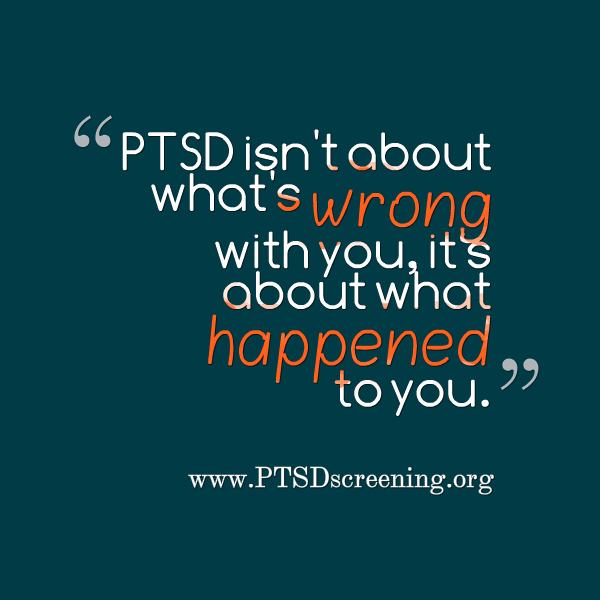
(image: PTSDscreening.org)

Trigger warning: contains descriptions of PTSD symptoms

“Don’t count the days it may take for recovery, make the days count. Seeking timely professional help boosts healing, instills hope and ensures recovery,” said 51-year-old Michael Hughes (name changed), a highly decorated firefighting veteran from New York as he stepped out of the therapy room after an intense session of trauma-focused psychotherapy. “Mental health issues are just like any other disease where recovery takes time. You need to have faith, be positive and stay strong,” he said with a smile.

Michael revealed that his job gave him post-traumatic stress disorder (PTSD) and that he got the problem from what he had seen. His 25-year stint as a firefighter with the Homeland Security and Emergency Services fetched him multiple laurels, but at a great price, which he continued to pay for years. After 22 illustrious years of service, he was diagnosed with PTSD because of which he was discharged from service.

Years of attending innumerable incidents of horrendous fire and fatal high-rise blazes gave him nightmares later. Frequent flashbacks of infernal flames engulfing entire blocks of buildings, scenes of the injured and dying being pulled out of the debris, and thick, choking clouds of black smoke adding to the mayhem became an inevitable part of his life. The impact of his job was so powerful that even watching television shows involving fire accidents would send shudders down his spine, waking him up in either cold or hot sweats.

Soon the mental agony made him feel as though the entire world was crashing down on him. Moreover, the fear of becoming an object of scorn and ridicule was so overpowering that he hesitated to express what was going on in his mind. He feared what seemed very real to him, may seem illogical or unreal to others around him. He knew that each traumatic experience of the past was gradually taking its toll on his mental health. The truth was the post-traumatic stress was wreaking havoc on the inside, while he still managed to look seemingly fine on the outside.

But it was a matter of time that he reached a stage when he completely lost all control over his emotions. Even the smallest of fire sparks or the sight of someone hurt or injured would make him upset and depressed. Nevertheless, what was controllable once, had become uncontrollable. Even the smoke coming from a cigarette would trigger a series of vivid flashbacks of a major fire accident, evoking painful memories of the past.

However, it was one ear-deafening Fourth of July, which blew the lid off. The non-stop pompous bright flashes and earth-shattering aerial fireworks all around him became unbearable. The petrifying sounds brought gut-wrenching scenes repeatedly to his mind. The ghastly flashbacks unleashed chronic unrest and panic attacks. He felt so low he contemplated his own life and what it meant. But as fate had ordered it otherwise, a well-timed intervention by his wife Amy (name changed) made him rethink his decision. “Sometimes it’s okay not to feel okay,” were the precise words she used. Her comforting words encouraged him to fight his condition by seeking support. He finally felt assured that his wife wouldn’t view his vulnerability as a disgrace.

Michael’s involvement with numerous emergency situations in both natural and man-made disasters during the course of his career compelled him to bottle up an ocean of emotions, anger, sadness, losses and grief. Finally, on hitting rock-bottom, it was in the mental health rehab that he was diagnosed with depression and anxiety, in addition to PTSD. Besides, the most important lesson which he learnt was to speak his mind. He realized that his family needed to know what he was going through so that they could help in some way or the other. Secondly, he realized that any mental problem should be viewed as a chronic mental health condition, requiring regular visits and check-ups, monitoring of treatment adherence, effectiveness and tolerability, and spreading awareness about the disorder.

The mental health specialists at the rehab, recommended Prolonged Exposure (PE), Cognitive Processing Therapy (CPT) and Eye-Movement Desensitization and Reprocessing (EMDR), in addition to a PTSD K9, to help Michael cope with his condition. Additionally, he was advised to workout with a personal trainer six days a week. Michael knew that it would take a long time to heal the scars of more than two decades, but he was confident that soon the damage will no longer be able to control his life.

Factors that prevent individuals from seeking help

“The brave men and women, who serve their country and as a result, live constantly with the war inside them, exist in a world of chaos. But the turmoil they experience isn’t who they are; the PTSD invades their minds and bodies” – this excerpt from Robert Koger’s 2013 bestseller Death’s Revenge is probably what Michael experienced during a significant chunk of his firefighting years. Apart from the existing confusion and lack of awareness, other reasons that force most individuals employed in emergency services battling similar mental conditions to not seek professional help are:

  • Seeking help could lead to undesirable consequences: The fear of being denied promotions or being ignored due to the stigma surrounding mental health could be a major reason for many to keep quiet.
  • Avoiding any form of discreditable dismissals: Studies suggest that being branded as mentally ill could lead to dismissal, negatively impacting the benefits of such individuals, including their chance to secure employment elsewhere.
  • Being cut off from access to treatment: Postings of emergency services staff across isolated locations worldwide could be another reason.
  • Screening for mental health is viewed in poor light: Popular notions of stigma, guilt and shame that surround mental disorders can prevent many individuals from seeking the required support.
  • Facing problems is a manly thing: “PTSD affects only non manly men,” is one of the biggest misconceptions nurtured by most men in uniform. This attitude need to change completely or else things could blow up to devastating proportions.

Acknowledging mental disorders is the first step to recovery

Living in a socio-cultural set-up where any symptom of mental problem is viewed as a sign of weakness often tends to reinforce the stigma surrounding mental ailments. In fact, even near and dear ones, including family members, don’t seem to prioritise mental health disorders as they would other physical illnesses. According to the National Alliance on Mental Illness (NAMI), around one in five adults (approximately 43.8 million people) in the United States experiences mental health disorders in a given year. Moreover, one in 25 American adults (approximately 9.8 million) is also known to experience a chronic mental health problem, interfering with major life activities.

But the support of family members can work wonders in eradicating the stigma linked to mental health. In fact, studies suggest mental health disorders, such as depression and anxiety, have their own way of hoodwinking even the most cheerful of people into believing that their existence is good for nothing and disgraceful. It can drain energy and happiness, shatter sleep patterns, eat up vigour and vitality, disrupt concentration and hamper functioning, leaving the individual in a constant state of dejection.

Mental health professionals insist on managing mental illness just like other chronic physical health ailments like hypertension and diabetes. The need of the hour is to encourage family members to stand with their loved one’s in providing the support and strength. Acknowledging the truth that there is a serious problem, and that their loved one is fighting a battle within is the first step to recovery. In fact, it is another way to direct people to professional mental health care services.

This article was written by mental health blogger Christina Hendricks at www.mentalhealthzen.com . Featuring case studies of real people with Post Traumatic Stress Disorder.