I don’t really know where to start with this blog except I have needed to write this one for several weeks. As many of you know, I struggle with an anxiety disorder (alongside/ part of the bipolar) which when triggered can make life quite difficult. This includes things that anyone would find anxiety provoking, such as job interviews.
I have had to dig deep, leave the house and use every ounce of strength to attend face to face job interviews in the past few weeks. This is not an exaggeration. My body floods with adrenaline and cortisol (stress hormones) and I feel overwhelmed. All my energy becomes consumed around preparing for the interview, attending the interview or NOT attending the interview because I wake up in a panic not wanting to go out- and having to try and reschedule it. Which just adds more stress as I fear I will lose the chance to interview.
This is really hard for me. There is still such a stigma to mental health issues that disclosing it early on without someone knowing you fully, means you are still less likely to be hired. Having to reschedule an interview also floods me with fear that the employers will think I am just flaky, even if I say I am unwell.
I am very proud of my achievements in the past month. Last week, I went to an interview and did well- travelled alone, was fine throughout. I even got a second interview. However, I woke this morning at 7am in anxiety and am seeing if I can reschedule it.
Essentially, this is one big test of exposure therapy. Reaching outside my comfort zone and going out into the world to use my skills. Its scary and exhausting. But it can also be validating and exhilarating too.
Today I feel a bit of an exhausted, worried mess. However, I refuse to let my panic disorder beat me. Next week, I have some positive things happening too re work.
For anyone else going through this- you aren’t alone. I take medication on time, I have had years of therapy and I still have panic attacks at times and struggle with the debilitating anxiety. I am searching for a new form of therapy (maybe EMDR- rapid eye movement) as I am concerned that my disorder mimics some PTSD symptoms, although that will need to be determined by a psychiatrist . I went through a lot in 2014 when in hospital and just before in a manic state and when I came home after and got back to work. I wonder if this is what is behind the panic.
This is an honest assessment of whats going on. Despite the anxiety attacks, I have been able to see some friends. I am also still writing my book – deadline fast approaching.
Thank you to all my online twitter ‘cheerleader’ friends who sent me so many messages of love and support, of cute animals and inspiring quotes. You helped give me the strength to go to my interview and be ok. And to my friends and family in ‘real life’ too.
If you are also struggling, keep fighting. I am always here for you to talk too.
When it comes to emergency plans, usually we think in a more physical sense, but did you know that mental health emergency plans are important?
Mental health emergencies can be quite stressful, and if you’re in a mental health industry or have any personal concerns about your own health, providing the right help is important. Here, we will outline important tips to help you create a mental health emergency plan that will suffice.
Have a Support system
If you tend to get overwhelmed when an emergency happens, a big way to help reduce the trauma from it is to have a support system. Whoever you are and whereever you work, your own personal triggers and issues are still there. If you’re having issues coping, find a support system- a friend, family member or therapist that can help.
You may want to come up with a plan to help your responses to situations, especially when disaster strikes. If you do have anxiety and depression, do make sure that you have people that can help around you or reach out for help from a doctor or therapist.
Prepare For Emotional Reactions
Another big thing that emergency evacuation plan Melbourne (in Australia) does point out, is you need to make sure that you have the right idea of what might happen. You should know when you have chaotic reactions, and what you struggle with when disaster strikes.
Focus on what will help, what might happen when you do suffer from an incident, and make sure to communicate it to others.
Processing information is quite hard in a stressful situation, such as fear, anxiety, depression, or even a panic attack, and you should make sure that, with the group of people you trust or the medical profession, you do speak about what happens. It’s also important to make sure that you properly communicate to others. While panic attacks and sad emotions do happen, you should know that you probably will be upset about whatever will transpire. But that its OK to feel this way.
Be Prepared to communicate
A large part of a mental health plan is to make sure that you communicate your needs. If you need to, make sure that you explain any mental health needs, such as medication you might need, in an emergency, with loved ones. Its vital to your wellbeing even when stressful to communicate. Letting others know can help them and you prepare for the worst and take action if needed. You aren’t alone.
Keep Contact information on hand
Pharmacies can help you get emergency medication, but making sure that you have the contact information for your provider, any diagnoses, and dosages of medication are important. Make sure to let some people in your support system know, and also keep those phone numbers on hand in case if the emergency lines are overloaded.
Create a Recovery Bag
If you have extra medications, a comfort item, and anything that you can use to help in the case of an emergency or crisis, put it in a small emergency kit, which you can use if you need to attend hospital or appointments. Remember, emergency kits aren’t just for physical health aspects, but also for mental health. You need to make sure you’re prepared both physically and mentally for any issues that might transpire so that you’re not suffering.
Mental health during an emergency often isn’t focused on as much as say other aspects of your health. Depression, anxiety, and even suicidal thoughts don’t always go away, and you need to be prepared for that, and reach out for help so you can recover well.
Creating a plan to try and prevent or reduce this from happening with your medical team will help if a mental health emergency comes about. From there, you can get the help that you need in order to stabilise yourself, look after yourself and recover again.
This blog was written by Emily Bartels, freelance writer with an interest in mental health and wellbeing.
Massage therapy, which is often sought by people for relaxation, is not only offered by luxurious spas but it’s also becoming a mainstream treatment technique for boosting mental and physical health. Nowadays, healthcare professionals especially physical (physio) therapists are using this age-old and unique healing technique to relieve pain that stems from a wide range of physical and mental health issues.
Yes, massage therapy is not only essential for improving the mood and offering relaxation to those who live an utterly busy life where they have to deal with tight deadlines all the time, but it’s also beneficial for people struggling with conditions like stress, anxiety disorders, depression and post-traumatic stress disorder apart from musculoskeletal injuries and illnesses.
Yes, the mental health benefits of massage therapy are endless, so you shouldn’t hesitate to seek it. Divided into several sub-categories such as Swedish massage, deep tissue massage, sports massage, prenatal massage, and infant massage, etc., massage therapy is one of the most crucial techniques that make it easier for you to live a pain-free and fulfilling life.
If you talk specifically about anxiety disorders which include generalized anxiety disorder, phobias, social anxiety disorder, panic disorder, separation anxiety disorder, and selective mutism, they can interrupt your life completely.
Characterised by common symptoms like sweating, trembling, sadness, restlessness, excessive worry, fatigue, insomnia, fear, and nausea, etc., an anxiety disorder makes it difficult for you to focus on both your personal and professional life. For example, if you are struggling with a panic disorder, you will keep on experiencing frequent episodes of intense anxiety and fear that prevent you from concentrating on your work. And when your fear reaches a peak, you encounter a panic attack.
Similarly, if you talk about Generalised Anxiety Disorder, you will keep on worrying about day-to-day activities.
According to The National Institute of Mental Health (NIMH), people who suffer from Generalised Anxiety Disorder (GAD) experience excessive worry for a minimum of 6 months about various areas of their life like activities of daily living, interacting with people, and personal health, etc. And this fear makes it difficult for them to do good in these areas.
Experiencing anxiety is normal; the problem comes when you suffer from an anxiety disorder. Yes, there is a vast difference between experiencing anxiety and suffering from an anxiety disorder; the former is quite healthy for you, but the later is a mental illness. That’s true. Normal anxiety helps you prepare for future events and situations, whereas an anxiety disorder like panic disorder and social anxiety disorder, make it difficult for you to face those events.
The fear that stems from normal anxiety disappears soon; however, the worry that attacks you due to an anxiety disorder stays with you until you recover from your problem. And what’s concerning is it can worsen with the passage of time in the absence of professional help.
Yes, seeking professional help is the only way to recover from this mental illness.
According to Anxiety and Depression Association of America (ADAA), “Anxiety disorders are the most common mental illness in the U.S., affecting 40 million adults in the United States age 18 and older, or 18.1% of the population every year.” It further states that “Anxiety disorders are highly treatable, yet only 36.9% of those suffering receive treatment.“
So, here is how massage therapy can help you battle an anxiety disorder.
In Reducing Stress
The stress that stems from facing tough situations can lead to further health complications if you fail to take professional help for it at the right time. You should take corrective steps to minimise your stress levels if you can. Consulting a licensed physical (physio) therapist to seek massage therapy can bring tremendous change in your health.
I believe that since people struggling with an anxiety disorder also experience high-level of stress, they should seek massage therapy to address anxiety, alongside other methods.
When you are stressed out, your body releases a hormone called Cortisol, which affects several areas in your life such as public speaking, social interactions, performance at work, and happiness.
Since you always feel stressed out, you can’t experience happiness in your life. Therefore, to deal with the problems that you face in different areas of your life, it’s essential that you work on improving your mental health, and one of the best ways to start in this direction is to control your stress levels and promote relaxation by seeking massage therapy.
Your therapist might use Swedish massage to reduce your stress level. According to Gulf Shore Physical Therapy Center, “Swedish massage is more gentle and targets more superficial tissues, perfect for anyone looking to relax and relieve mental as well as physical stress. As the best-known type of bodywork performed today, one of the primary goals of the Swedish massage technique is to relax the entire body.“
In Minimising Muscle Tension
Muscle tension and muscle pain are the symptoms of elevated stress level, and hence, people living with an anxiety disorder also experience them. Seeking massage therapy, wherein your massage therapist uses hand techniques to reduce muscle tension and pain, can have significant benefits for your mental health.
Since it offers relaxation, it not only helps in improving your performance at work but also allows you to spend quality time with your loved ones at home.
In Improving Sleep
Sleep problems are one of the most common signs of an anxiety disorder, and massage therapy is in our opinion, the best way to address it. Whether you stay awake the whole night because you find it difficult to fall asleep or you are someone who wakes up frequently from your sleep, massage therapy will deal with these issues by offering relaxation and addressing the problem of muscle tension and pain.
When you enjoy a good night’s sleep, you will wake up feeling fresh and energetic in the morning, which plays a crucial role in improving your entire day.
In Enhancing Your Emotional Well-Being
People with an anxiety disorder often struggle with their mental health and some have depression alongside it. Massage therapy can promote relaxation and boost wellbeing. Experts believe that it has several benefits for mental health, you shouldn’t underestimate its potential to improve your emotional well-being.
Since it reduces stress and anxiety, it eventually stabilises your mind which improves your emotional well-being.
In Reducing Chronic Pain
If you are also living with pain due to an injury or illness apart from an anxiety disorder, massage therapy can help reduce your pain. Since it helps in enhancing circulation, you will see a tremendous improvement in the reduction of pain after a massage therapy session.
It will also accelerate the natural healing process by supplying nutrients to injured tissues.
Massage therapy will also help in enhancing your mind-body connection, which is extremely useful for your overall well-being. It can be used alongside conventional therapies, to support relaxation and good mental health. Try it today.
This article was written by Ashley Smith, freelance writer in the USA
Earlier this week, on the 1st March, Be Ur Own Light turned 3 years old! I still remember starting this blog as an outlet for my fears, thoughts and emotions after leaving a job in 2016 due to acute anxiety and panic ( part of my bipolar) . Writing the blog and sharing thoughts has been so therapeutic and it has taken me on a journey that I could not have imagined when I started writing. As many of you know, this blog led to me writing for big media outlets and to my book deal (book hopefully will be out in November) and I am so grateful for the confidence it has given me too- and the chance to connect with people all over the world.
However, this year (as with the past 2), the blog has attracted a horde of talented writers wanting to spread their messages about mental health and wellness. Some have shared their personal stories of hope and recovery, others have given useful tips on health and wellness and we have covered topics as wide ranging as Borderline Personality Disorder (BPD), Post Traumatic Stress Disorder (PTSD) and addictions to drugs and alcohol. We have talked about pet therapy, writing therapy, mindfulness and yoga, amongst other therapies.
My guest bloggers have written about their recovery from mental illnesses like anorexia and bipolar disorder. National campaigns like the Diana Award also got in touch with us to discuss bullying and LGBT issues too and Jami charity asked us to cover their mental health awareness campaign (which I helped set up). Furthermore, Be Ur Own Light has also covered World Mental Health Day and Time to Talk Day this year, featuring personal mental health stories as a way to raise awareness and fight misconceptions.
Thank you to my amazing guest bloggers March 2018-2019 for your fantastic content:
Donna at Wildwoman Book Club for Self care
Lynn Crilly- Hope with eating disorders (book)
Cordelia Moor- Living with Quiet BPD for Time to Talk Day
Sarah- On Depression for Time to Talk Day
Peter McDonnell- Managing anxiety and psychosis for TTD
Cara Lisette- Recovery from anorexia and bipolar disorder for TTD
David Welham- Depression and Recovery/ Being a parent of children taking exams
Rachelle Wilber- Treatment for PTSD (post traumatic stress disorder)
Brandon Christensen- What is mental health stigma?
Charlotte Underwood- Overcoming Adversity/ The Saviour Complex
Ralph Macey- Managing Bipolar in the workplace
Manmohan Singh- Benefits of Yoga
Alex Sabin- Enjoying the Holidays after Addiction
Spela Kranjec- How to Accept Yourself/ My Journey in surviving Anorexia
Jami charity- Mental Health Awareness Shabbat campaign
Brookman- Avoiding a relationship crisis at Christmas
Sarah Cardwell- Womens health awareness
Anti Bullying Week, the Diana Award and Everyones Talking about Jamie
Allen- Recovery from alcoholism and mental illness
Lizzie Weakley- How to combat your eating disorder
Posy and Posy- Flowers for wellness
N- Poem on depression- Copy of my Mask
Dan Brown at My Therapy- Suicide prevention on social media- World MH Day
Lydia- On complex PTSD and recovery
Ashley Smith- how Physiotherapy helps with stress and anxiety
Amy Hutson- How Writing Therapy helps
Christine H- What family therapy is really like
Meera Watts- How Yoga enhances your lifestyle
Dawn Prime- How can Animal and Pet therapy help
Bill Weiss- Mental Health Stigma and Drug addiction
Dr Nancy Irwin- Signs your loved one is abusing drugs
Eve Crabtree- The MIND diet for Dementia
James Kenneth- Overcoming mental health challenges
Ellie Willis- A guide to mood disorders
AXA PPP- is social media bad for our health?
Lori Longoria- How baths and spas help relaxation
Tomas Sanchez- can alcohol raise stress levels and affect mental health
Dr Janina Scarlet- Therapy quest book
Cloe Matheson- tips to reduce stress
Paul Matthews- fitness and how it helps depression
Katie Rose- How to help anxiety and panic attacks
Anonymous- on sexual abuse
Kayla Clough- coping with post partum depression
Kara Masterson- 4 tips to begin the fight against drug addiction
Michelle Hannan- 5 tips to boost your immune system
Kevin Morley- Satori Mind- Tips to boost mindfulness
Sara Whitehouse at Stadia Sports-How sport can help mental health
Amy Boyington- How holistic medicine helps mental health
Thank you so much to all of you and I am excited to see what 2019 brings for the blog!
2018 was a very special year for me and my writing- being published in Metro.co.uk, Glamour, The Telegraph, Happiful magazine, the Jewish News and several other media outlets. I was featured in articles in Cosmopolitan, Elle, Prima, Yahoo News, Prevention magazine and Refinery29 and guest blogged on other mental health blogs too.
This year on the blog I wrote about my life with social anxiety and work anxiety, winter blues and SAD/ depression, I shared my articles about being plus size and a bride and about my recovery from bipolar disorder. Furthermore, I wrote about the Twitter hashtags I started #mydepressionmeans and #myanxietymeans, to help people feel less alone and share their own experiences online.
On the blog I also reviewed the brilliant book ‘Love and Remission‘ by Annie Belasco by Trigger Publishing, about breast cancer and mental health. Triggers mental health books are great and I read so many that I was unable to review due to time constraints including Depression in a Digital Age by Fiona Thomas and books by Paul McGregor and Ruth Fox.
This year we were given the accolade of being a Top 10 UK Mental Health Blog by Vuelio and were a shortlisted finalist in the 2018 UK Blog Awards (Health and Social Care category). I was also invited to the Mind Media Awards which was an incredible experience and this year, we have been nominated for Blogger of the Year in the Mental Health Blog Awards.
Be Ur Own Light continues to be read globally and I love receiving your messages about the blogs and finding new writers too. Blogging makes me happy and I hope it helps so many of you too and you love what we do here.
Heres to a productive, wonderful, fun and exciting year of educating and battling mental health stigma too 🙂
Happy 3rd birthday Be Ur Own Light! ❤ May this be a special year for us
WILDWOMAN is a subscription box for every woman who cares about her wellbeing and strives to live the best life possible.
Every month, the WILDWOMAN subscription box will remind you to take an hour or two just for yourself. It aims to reconnect each WILDWOMAN to themselves through reading an inspiring book whilst indulging in a regular self care routine.
Each box contains gorgeous gifts including a chosen book of the month and items such as stationery, crystals, affirmation cards, sweet treats and more, plus a journalling worksheet based on the contents of the book so that readers can make the most of the lessons within each book – thats the real beauty of non-fiction books!
Subscribers of WILDWOMEN will also be invited to join the worldwide book club, GozenGirls and encouraged to connect to other women online through the growing community to talk about the book of the month and their own journeys of self-discovery.
For women who want to take a little bit of time each month to slow down, check-in with themselves, regain control of life, and reconnect with mind, body and soul.’
Review and 10% off!
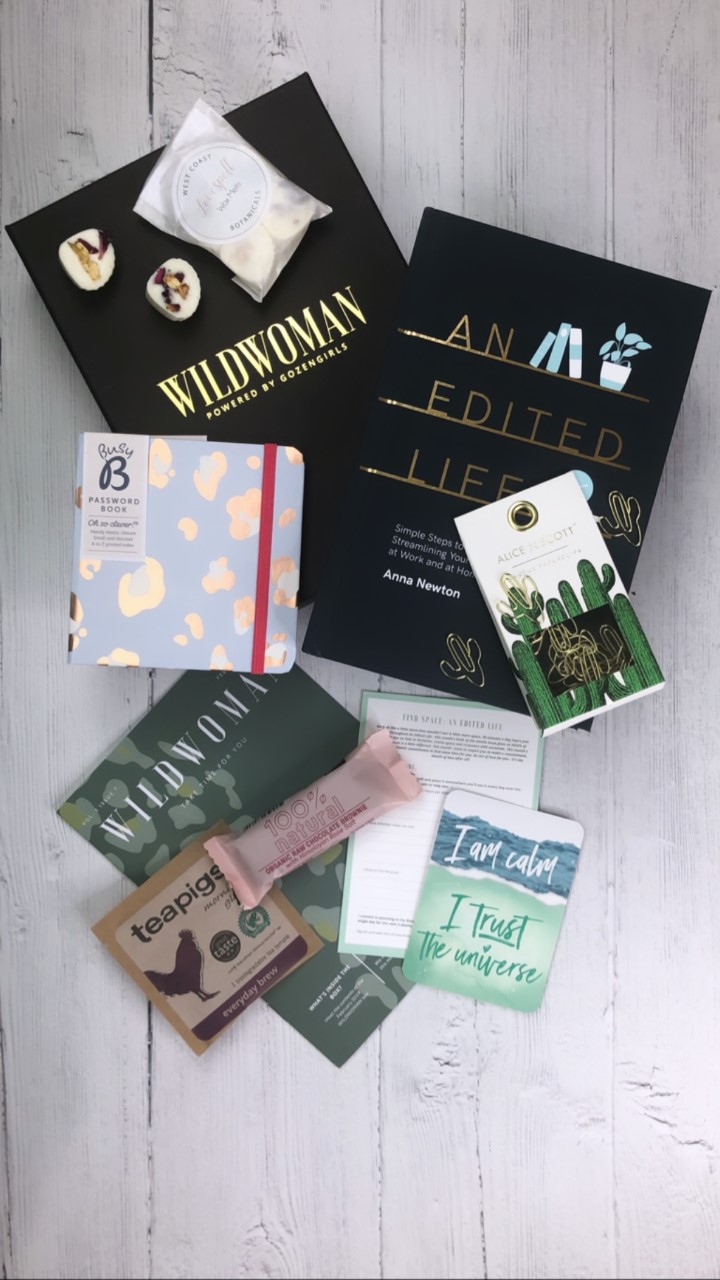
My beautiful self care box contained what you see in the photo above. The book is ‘An Edited Life‘ by Anna Newton which is a fascinating read about streamlining your life for the better, decluttering your home and mind . There were also cactus paper clips, a notebook, a card with an inspirational quote and affirmation ‘I am calm‘, teapigs tea, a vegan chocolate bar and some beautifully smelling wax melts to burn.
I loved the way it was a packaged in a sleek black box and the whole box felt luxurious, and perfect for self care.
I definitely would advise subscribing if you want to treat yourself to some self care, a good book and a positive boost each month! Wildwoman is based in the UK but ships abroad so check the website for your country. You can also buy a one off box to try!
Donna has very kindly given all my readers a 10% discount code so add WILDWOMAN10 to receive 10% off.
Writer of Hope with Eating Disorders : A Self Help Guide is Lynn Crilly, a trained counsellor and also a carer to her daughter who developed Anorexia and OCD at aged 13.
Conventional treatment didn’t help her daughter and so Lynn did all she could to learn about eating disorders and mental illness, in order to help her daughter recover. She trained in NLP techniques and became a counsellor, slowly assisting her daughter back to health.
Lynn has said,
‘I have experienced and learnt first-hand how hard it is to support a loved-one through to recovery from Anorexia Nervosa and OCD, and the effect living with mental illness can have on not only the sufferer but everyone involved, particularly the rest of the family.
I was keen to go on to give others the benefit and support of my knowledge and experience both personally and as a counsellor. Over the years I have had the privilege of working with some wonderful people and their families, each and every one unique, whilst I have been able to support them through their journeys. I too have learnt from them.’
I found the book very easy to read and incredibly informative. The first edition of Hope with Eating Disorders was published in 2012. Since that time, awareness of eating disorders have grown. Lynns website says about the book,
In this second edition, which maintains Lynn Crilly’s warm, non-judgemental, family-friendly approach, the more recently recognised eating disorders have been included, the range of treatment options – both mainstream and alternative – has been fully reviewed and revised, and the impact of social and technological change has been fully accommodated, with the role of social media for good and ill to the fore. New case histories highlight key issues, and throughout all references to research and stats have been reviewed and updated. Men’s eating disorders are now addressed by contributing author Dr Russell Delderfield. Since originally writing Hope with Eating Disorders, Lynn has experienced seven years of counselling practice and seven years of her own daughter’s recovery from an eating disorder and Obsessive Compulsive Disorder, underpinning her realistic insight into what recovery actually is and means.
Hope with Eating Disorders is a practical, supportive guide for anyone helping someone with an eating disorder be they a family member, teacher, sports coach, workplace colleague or friend.
Last year, a remake of the film A Star is Born was released; starring Lady Gaga as aspiring singer Ally who falls in love with veteran rock musician Jackson Maine (Bradley Cooper). I won’t ruin the film but it explores Jacksons drug and alcohol addiction and depression / suicidal thoughts- which is often prevalent in the music industry. Its also a love story- with Ally trying to save Jackson from himself and failing, despite him going to rehab, his depression and feelings of inadequacy take over.
It is a film so beautifully acted with such stunning music, that it won a Grammy this week for the original song Shallow (I believe written by Gaga and sung with Bradley Cooper). In Lady Gagas acceptance speech yesterday, she said that she was happy the film highlighted mental health issues and that it effects many artists out there in the industry and beyond. She asked us to reach out to people who are hurting and for those who have mental illness to also reach for support as so many struggle. An incredible thing to do on such a platform- thank you Gaga.
I saw the film twice at the cinema and both times it moved me so much I cried my eyes out- it touched my heart. He wont mind me mentioning, but my Dad, like myself has bipolar disorder and has had very severe depression in the past. I am grateful that he recovered and is still here to tell the tale- and me too. In 2013, I had a depression where I too wanted to give up on life. But i found a treatment to help me and I recovered with good medicine, therapy and support.
So this is a thank you to Lady Gaga, Bradley Cooper and all who made A Star is Born for challenging the stigma around mental health and using art to be a beacon of hope in a difficult world. The Grammy is so well deserved!
There are many misconceptions about having Borderline Personality Disorder/Emotionally Unstable Personality Disorder.
I do not say that lightly, and I am more than a little convinced that most people who have BPD would agree with me. Personality disorders in general suffer under the stigma of being completely misunderstood by the majority of the general public. Hell, I completely misunderstood personality disorders until being told that I had one.
‘Ah’, said I. ‘That explains a lot. But not everything.’
And it did explain a lot. I thoroughly enjoy (in a very, very weird way) telling people that I am emotionally unstable. Diagnosed. Got the paperwork. Makes them quite uncomfortable, makes me cackle like a little pixie. Obviously, I don’t just go around telling strangers that, it’s always in context of the situation. But for some reason, although the people I love are more than happy to discuss depression and anxiety, when it comes to personality disorders they start ‘shuffling’.
But I’m not about to shy away from talking about BPD and my lived experience of it, because it’s only through understanding other people’s experiences that we learn anything.
I came here today to bust through one misconception in particular. One that I definitely held for a long time, and one that I only dropped when I read more about Borderline Personality Disorder and how it can manifest in different people.
Most people think of BPD as the person ‘acting out’.
They think of the disorder as being very outwards and visible. There’s horror story after horror story sensationalising the ‘classic’ borderline personality disorder on the internet – all written from the perspective of someone who doesn’t actually have it. But knows someone who does. It’s horrendous, and it’s awful, and it taints many people’s perceptions of what BPD actually is.
My lived experience is very different, and it wasn’t until I came across somearticles on The Mighty detailing what ‘quiet’ BPD is that I truly began to understand how my brain works, and how my BPD manifests. This is not to say that it’s any ‘better’ than classic BPD.
This is just to say that nobody has the same lived experience as everyone else, and that’s why we need a mix of stories and voices all telling their own unique stories about the same disorders. That new coat of fresh paint on the same topic adds something to the narrative.
This is my lived experience.
For me, my BPD manifests itself internally. On the outside, I look reasonably ‘sane’ and ‘put together’. The inside is a maelstrom of thoughts and emotions that are hard to understand, hard to deal with, and consistent. Honestly, if I could crack my head open and let all the thoughts that are constantly throwing themselves around my brain out, everyone I know would be shocked.
I still have the same impulsivity, self-injurious behaviours, fears of being abandoned, mood swings, and black and white feeling that people with classic BPD have. But instead of ‘acting out’, I ‘act in’.
I often describe BPD as having no emotional skin. Where something might affect you slightly, it affects me completely. Like touching an exposed nerve ending, every feeling is intensely strong and always too much. It’s exhausting to always feel everything to such an intense level.
It does make relationships hard. But I don’t lash out at the person, I lash out at myself. It’s self-destructive in a way that nothing else really is. I’ve had to work very hard to keep my thoughts and feelings internal in the fear that if the people I love knew how I truly felt, they’d leave me immediately. My life is a constant whirlwind of convincing myself that everyone hates me, that everyone is going to leave, and then finding a rational moment and remembering that people don’t hate me.
I’ve been told enough times.
I want to believe I am a good person, but I don’t yet know if it’s true. Quiet BPD is just as hard to deal with as classic BPD, but you probably wouldn’t know it from the outside. I would never take out my feelings on people I know, because that’s just not me. I will, however, take them out on myself. I will distance myself from people without them realising why. I will be trying, 90% of the time, to please people to make them like me.
It’s hard to admit what’s going on in my head. But it’s because it’s so hard that I do it, and I continue to push through and talk about the really difficult bits of mental illness. Without these conversations, none of us would know what people go through – and then we’ve got a problem.
This article was written by Cordelia Moor for Time to Talk Day 2019. Cordelia can be found at www.cordeliamoor.com
Note : Please read with care- Trigger warning (suicidal thoughts)
When a topic of conversation hits the mainstream, it becomes easier to understand and it spawns more conversations. It snowballs.
Right now, we’re living in a time when society is more open than ever about mental health. Issues are not swept under the rug (as much as they used to be, at least), and life-changing conversations are being had. For me, these conversations on Time To Talk day tend to be amongst friends. It feels…easier, to be open with them.
But what about having a discussion with your parents? What is it like to talk about mental health with a mother or father who has struggled, or currently is struggling with their mental health?
It’s tough. I will tell you that now. But it is important.
I know this because my mum has had depression for 12 years. The best way that I can describe her depression, whilst remembering that every experience is unique, is that it is like a cloud. Some days it can be lighter, and almost brighter, though still casting some shade.
Other days it can be dark, foreboding, and cast its shadow over any and all. The darkest time for her, and for our family, was at the beginning of her depression. It was during that time that I nearly lost my mum at 14.
I could almost say that she actually was lost to our family, if only for a while. I lived with a woman who looked like her, and sounded like her. But her words and actions were foreign and strange to me. Her drive and her energy seemed to vanish overnight, and a woman sitting in the dark, who felt like she had nothing to give, took her place.
I remember going to school, walking past her open bedroom door and saying goodbye to her as she lay in bed. At that time, when I asked her if she would be getting up that day, the only response I heard was:
“No.”
Those conversations were short. They definitely weren’t sweet.
She struggled. I struggled. My brother struggled. My dad struggled. We were desperate for her to get better, and feared that she’d never make it out of the dark. Eventually, with help though, she did. But, while she is now in a better place, there are still highs and lows.
Because I was so young at the time, I never really spoke to my mum about her illness. Life carried on for me, and a new status quo emerged. But over time, we began to talk.
They still weren’t nice conversations, but they were a start. My mum told me how she felt suicidal, as she lay there in bed. At the time, she said it so matter-of-factly that it sounded blasé to my teenage ears. This revelation stung, and I couldn’t understand a simple question. Why?
Why would she want to do this to me? Why would she want to leave her two children without a mother? Why would she want to leave behind a husband who loved, cared for and adored her? These questions swam in my head for years, and I was incredibly angry with her as I saw it as some form of maternal betrayal. I thought she was selfish.
As I’ve gotten older and talked to her even more about this, my views have changed. I realised that my response was selfish. She explained to me that her depression made her feel so worthless, and so useless, that she would in fact be doing us all a favour by leaving our lives.
I’ve also realised that I’m incredibly lucky, because a lot of parents sadly succumb to this insidious disease. This needs to change.
That’s why I’m writing about this today.
That’s why I still talk to my mum about how she’s feeling. That’s why my brother calls me and lets me know when she’s feeling low, which is a common occurrence in winter for a lot of people with depression. As I live far from home, he reminds me that a quick conversation to ask about her day, tell her about mine, and maybe even make her laugh makes all the difference.
If you are, or have been in my situation, I urge you to talk to your mum or dad. I urge you to talk to your friends and family, because it can be a huge burden to carry alone. It’s like I said, when more people talk about something, it becomes easier to understand. When we understand the problem, we can start to treat it.
If you’d like to find out more about having these conversations, you can do so by visiting the Time To Talk website. They have a range of materials that can help you take that first step, and start talking.
This article was written by Sarah, a mental health writer for Time to Talk Day 2019. You can find her at :
Hi, I’m Mallory and today I am sharing my story for Time to Talk Day .
From the ages of 15 to 17 I didn’t speak very often, and when I did, my voice came out stifled. With the onset of a depressive episode, one of the first things to go is my ability to speak. I find it difficult to form sentences, and utterly draining to have to speak out loud. Even writing becomes increasingly more difficult. My illness robs me of words, the tool I most often turn to when attempting to write and claim my story. I’m quick to shut down when I feel the rumbling of inner turmoil.
It makes it awfully difficult to communicate with me; friends and family often feel left on the outskirts, unsure of what to say or do. And even with improved coping mechanisms, and countless therapy sessions under my belt, I find that even a whiff of depression causes a knee-jerk reaction to shut the blinds, so nobody can see through me.
When I was in my first diagnosed year of depression, my brother started sending me a “song of the day”. He would email me a link to a YouTube video, with a song he hoped would tap into my inner workings. He believed that even muted by hopelessness and despair, there was one language that would break down my emotional barriers: music.
Each day I looked forward to the songs he would send, always carefully selected to reflect my struggle. We had created an emotional connection through lyrics and the kick of a bass.
Music has always been something that speaks to me on a level that feels deeper than some of my peers. I’m one of those people who wants you to be quiet when I’m showing you a new song, so as to fully appreciate its beauty. I’m one of those people who can feel goosebumps prick the surface of their skin, when the perfect note is sung. And I’m most certainly one of those people who can be propelled out of bed with a beat that you can actually feel in your veins. Music has always made sense to me, and I loved how my brother was able to tap into that piece of my identity, and speak to me when I didn’t have any words of my own to offer.
Fast forward to the present day, and I still find myself trapped in the thick brick walls that I have painstakingly built around myself. Knocking down walls that thick requires effort, and even if I want to let a person in, I can barely push the walls open wide enough for them to slip in. It has put a strain on many friendships, but one in particular really struggled from a lack of open communication. We came to what felt like a dead end in our discussion to improve communication. And that’s when I looked back and found a detour that would lead straight into my heart and mind. Music.
Most people have songs that spark an emotional reaction within. For me, music is strongly intertwined with memory and emotional energy. If I could pick one song each day to send to my friend, perhaps it would shed some light on my state of being. If she sent one back, maybe I would better understand where her mind was in that moment. It was a way to have intimate communication when words were difficult to find. I texted her my idea, hoping this would be enough to show her I was committed to growing, without having to emerge from my fortress too quickly.
We have sent each other songs back and forth, learning about one another from every track selected and played. We ask each other questions about what the song means to us in general, or at that specific point in time. We talk about how it may be the beat or the lyrics that drive that particular song home for us. We discuss topics we wouldn’t breath otherwise. It’s an invitation that says, “Hey, I want you to come closer. I want you to hear me and know me”. And there aren’t any rules. You can send multiple songs if that better captures your day. It’s an open process that lacks structure, empowering us to communicate freely, with love and understanding.
My walls still remain intact, but their structure is starting to weaken a bit. Some days I’ll still add more bricks, and others days I’ll knock a whole bunch loose. When robbed of my ability to use words, I lose all sense of connection to the world around me. Music throws a line of connection my way, and it’s helping me find healthy communication in my every day. If you ever meet me someday, I’d love to exchange songs, so we can really get to know one another.
Mallory told us: ‘I have had a diagnosis of Major Depressive Disorder, and Generalized Anxiety Disorder for 9 years. I was given both diagnoses at the age of 15. I have also more recently been given tentative diagnoses of disordered eating and OCD tendencies. I currently take medication for my anxiety, but no longer take antidepressants after years of painful side effects. I currently engage in therapy once a week, and follow a treatment plan that focuses on nutrition, exercise, meditation, DBT skills, and creative coping. I also want to acknowledge that I do not see anything wrong with medication, and it absolutely has a wonderful place in treating mental illness.’




 beurownlight.com