Expert Advice On Bipolar And Staying Well During The Summer With Bipolar UK

(image: Angelo Pantazis, Unsplash)

More than one million people (including myself) are living with bipolar in the UK and, despite the summer meaning excitement and positivity for most, for many living with bipolar this is not always the case.

Common challenges in summer can impact people living with the condition- including high temperatures which can interfere with certain medications (including Lithium and anti psychotics or anti depressants), the longer daylight hours which can disrupt mood stability, and travelling which can sometimes trigger symptoms.

There are ways to manage seasonal challenges, and Bipolar UK is now sharing its top tips to help people navigate the summer months!

Top tips for navigating the next few summer months if you have bipolar from Bipolar UK:

  1. Sleep

Maintaining a regular sleep routine is an important way to support mood stability. Lighter nights can make it more difficult to switch off and wind down; and early sunrises can cause disruptions to sleep. Blackout curtains or an eye mask might help.

  1. Heat

Hot weather can affect both physical and mental wellbeing. Certain medications used to treat bipolar can make it harder for the body to regulate its own temperature, leading to overheating. Staying cool, drinking plenty of water and staying out of the sun during the hottest parts of the day can help reduce the risk of overheating and becoming dehydrated. Rest is important so communicate with friends and family about how you’re feeling and if you need to rearrange plans.

  1. Travel

Be mindful when travelling to different time zones. Jetlag can have an impact on bipolar symptoms. Try to make time to sleep and rest whilst on the plane and when you arrive so you can acclimatise. Set a reminder on your phone of when you need to take your medication so you can stick to your schedule. 

  1. Sensitivity

Some bipolar medications can increase sensitivity to sunlight so protecting your skin with a high factor suncream when outside is important, as well as seeking shade when possible. Continue to take your medication as prescribed but do speak to your medical professional if you have any concerns.

  1. Socialising

There are often more social activities during the summer, with people wanting to make the most of the better weather. If it all feels too much, learn to say “no” and preserve your energy. Pick and choose which activities you’d like to do, but don’t feel obliged to do them all.

  1. Routine

Longer days can lead to changes in routine which can trigger shifts in mood. Some people with bipolar feel their mood can shift more easily into hypomania and mania during the summer months, whereas others notice their mood dips into depression. Noticing the signs early and speaking to your mental health team, family or other support network can ensure you get help when you need it and potentially avoid a relapse.

(image: Link Hoang, Unsplash)

Bipolar UK offers support to anyone affected by bipolar with their free UK-wide services – peer support line, peer support groups and eCommunity – and resources, including their Could it be bipolar?  campaign and Mood Tracker app.

Heston Blumenthal OBE: My Life With Bipolar BBC Documentary Review by Eleanor

(image: Melanie Blumenthal)

Last week, acclaimed chef, restauranteur and mental health advocate, Heston Blumenthal OBE starred in the BBC documentary ‘Heston: My Life with Bipolar’ which explored his fairly recent bipolar disorder diagnosis. Heston subsequently became an ambassador for national charity Bipolar UK, and has been actively supporting the charity’s mission to help reduce the average 9.5 year delay to diagnosis and end the stigma surrounding the condition.

In 2023, Heston began experiencing both depressive and manic episodes, hearing voices and seeing hallucinations, as well as depression with suicidal thoughts. Mania can also cause you to have intense creativity, speak faster and not listen to others as well as causing delusions and psychosis. Heston’s wife Melanie could see that his health was deteriorating rapidly and that he was a danger to himself. Despite the trauma of sectioning and hospitalisation, this set Heston on the path of not only a bipolar diagnosis, but medicine, therapy and ongoing treatment to help him live a healthy and happy life again.

Heston said to Bipolar UK, “I was living with undiagnosed bipolar for many years, so it’s been an extraordinary journey to get where I am today, and I’m delighted to have had the opportunity to talk to others living with the condition and find out more about their experiences.

“There is still a lot of stigma regarding bipolar, and mental health support is still lacking, but it is vital to be able to talk openly about the condition. I know this isn’t always easy, but I hope by sharing my experience, people will gain a greater understanding of bipolar and an insight into how I’m managing it.”

The documentary was extremely powerful to watch and sad in places, but inspiring. As someone who faced a similar situation to Heston in terms of a manic episode with psychosis/delusions that led to being sedated, sectioned by psychiatrists and hospitalised, my heart went out to him as I know how traumatising this can be. I found the needle being shown as a reenactment for sedation quite challenging to watch! However, the documentary was more than just showing what happened to Heston, who didn’t know he had bipolar til 2023, when he was in his 50s.

I found the discussion that Heston had with his son Jack, about how he was during a manic episode to be really enlightening. A lot of children of parents with bipolar find it challenging when their parents personality is almost hijacked by the episodes. Mania can lead to quickened speech, manic and grandiose ideas, lack of sleep and risky behaviour. You could see how much love Heston and Jack had for each other and how special is family is to support him through this and appear on camera. This includes his wife Melanie, who has been Heston’s rock!

The documentary ended with Heston visiting the mother of Rebecca McLellan, a young woman with bipolar who died by suicide due to neglect from mental health services. Rebecca had raised the alarm with the crisis team at her local hospital various times but was not treated with respect and dignity. The pressure of her illness and lack of support led her to take her own life.

Heston wants to highlight the suicide risk that bipolar brings and how much more mental health support is needed from the government. He is now working as an ambassador with Bipolar UK to raise awareness. Bipolar UK is on a mission to ensure people with bipolar get a quicker diagnosis so they can access effective treatment, support, and self-management, enabling them to live well and fulfil their potential.

Simon Kitchen, Bipolar UK CEO, added: “Heston is such an incredible ambassador for everyone in the UK living with, or affected by, bipolar. We could not be prouder to be working with him. His willingness to be so vulnerable on camera and to share such personal details about his experiences has resonated with many people in our community – and will help people who don’t know much about bipolar to begin to understand this complex and much-misunderstood condition. Heston is living proof that despite the sometimes severe and fluctuating nature of the condition, living with bipolar should not be a barrier to following your ambitions”

As one of the million people in the UK living with bipolar, I know how much more funding is needed in the NHS and a new bipolar pathway with more mental health support needs to be set up. Early prevention and support is key to stop bipolar escalating into suicide or mania.

Although it was a very personal watch for me, due to having been diagnosed with bipolar since aged 16 and my Dad having bipolar too, I thought that Heston’s documentary was so inspiring. He has only been living with the condition for two years and is using his platform for the good. Heston is now on Lithium medication to stabilise his moods as well as an anti psychotic medication.

Bipolar UK say that according to the stats, someone with bipolar takes their own life every day. Hopefully Heston’s documentary will act as a reminder and catalyst to our government to begin change. Thank you Heston and Melanie for being vulnerable and sharing your important story.

(image: Bipolar UK)

Heston: Life with Bipolar is out now on BBC Iplayer.

Doctor’s Insights: Navigating Life With Bipolar Disorder By Dr Antti Rintanen MD Of The Internet Doctor

(image: Emily Underworld: Unsplash)

Living with bipolar disorder can often feel like your emotions are swinging between two extremes. The highs (mania) can be energising but risky, and the lows (depression) can be draining and isolating. As a doctor, I’ve worked with many patients who face this condition—and I’ve seen firsthand how the right tools, treatments, and habits can lead to a more stable and fulfilling life.

What Is Bipolar Disorder?

Bipolar disorder is a mental health condition marked by episodes of depression and mania or hypomania. These mood shifts can affect how a person thinks, feels, and acts. It’s more than just having a bad day or being in a good mood—it can seriously impact relationships, work, and daily functioning.

According to the World Health Organisation, bipolar disorder is one of the top causes of disability for people between 15 and 44 years old.

Medications: The Backbone of Treatment

Most people with bipolar disorder need medication to help manage their symptoms. Lithium, for example, has been used for decades and is one of the most reliable treatments to prevent manic episodes and reduce the risk of suicide. Other options include other mood stabilisers and certain antipsychotic medications.

It’s really important to stick with your medication plan. Stopping suddenly—even if you feel better—can cause serious setbacks. Never adjust or stop medications without medical supervision—even if you’re feeling better, as this significantly increases the risk of relapse, especially into mania. If you have side effects, don’t stop on your own—talk to your doctor about switching or adjusting your dose.

How Therapy Helps

Therapy can help you understand your thoughts, manage emotions, and build better habits. One helpful option is Cognitive Behavioural Therapy (CBT). It teaches people to recognise unhelpful thought patterns and replace them with healthier ones. CBT is especially useful for managing depression and maintaining stability between episodes, though it is less effective during manic phases.

Another type of therapy, called Interpersonal and Social Rhythm Therapy (IPSRT), focuses on keeping your daily schedule steady—especially your sleep and social routines. Why does this matter? Because disruptions to your daily rhythm can trigger mood episodes.

Family-focused therapy also makes a big difference. When your loved ones understand your condition and know how to respond, you’re more likely to stay on track. If you face trauma around your condition, then EMDR therapy can also help with any PTSD or anxiety symptoms.

These therapies don’t replace medication, but they add valuable tools for coping, improving communication, and building resilience.

Everyday Habits That Make a Difference

Beyond medication and therapy, lifestyle habits have a huge effect on mood. Here are a few evidence-based strategies:

  • Stick to a regular sleep schedule. Going to bed and waking up at the same time helps stabilize your mood.

  • Get moving. Exercise—even walking—has been shown to lift mood and reduce stress.

  • Eat well. Omega-3 fats (like those found in fish or flaxseed) may support brain health. While the evidence is mixed, some studies suggest they could help support mood as part of a healthy diet.

  • Manage stress. Mindfulness, breathing exercises, or journaling can help you stay grounded.

  • Avoid alcohol and drugs. These can interfere with treatment and trigger episodes.

It’s worth remembering that lifestyle changes work best alongside—not in place of—medication and therapy. These small, daily actions help support long-term stability and overall well-being.

Pay Attention to Early Warning Signs

Everyone’s symptoms are different, but common early signs of mania include less need for sleep, racing thoughts, and impulsive decisions. Signs of depression may include feeling hopeless, withdrawing from others, or sleeping too much.

Keeping a mood diary or using an app can help track how you’re doing. You might also ask a trusted friend or family member to gently point out changes you might not notice.

Build a Strong Support System

Having a support system—whether friends, family, or a support group—makes a real difference. Research shows that people with strong social support tend to manage bipolar disorder better and have fewer hospitalisations.

It also helps when your loved ones are informed and involved. When people understand what you’re going through, it’s easier for them to support you in ways that actually help.

Final Thoughts

Living with bipolar disorder isn’t easy, but it’s manageable. With the right treatment, daily routines, emotional awareness, and a good support network, it’s absolutely possible to live a meaningful and empowered life.

You are more than your diagnosis. And there are tools—backed by science—that can help you thrive.

About the Author

Dr. Antti Rintanen is a licensed physician from Finland and founder of The Internet Doctor, where he shares reliable, accessible health advice. He writes about both physical and mental well-being with a focus on evidence-based care.

Alcohol Abuse: How Does It Affect Women on an Emotional Level? by Maya

(image: Matthew Ball: Unsplash)

Alcohol addiction can affect every area of a person’s emotional health. They may start to feel a sense of shame with their friends and loved ones. It can also affect interpersonal relationships, as alcohol can instigate arguments with loved ones. Here are some important ways that alcohol addiction can affect your emotional health.

How Brain Affects The Brain

If you attend a women’s recovery center, you’ll learn the many ways that alcohol affects the brain. Firstly, alcohol travels to the brain through the bloodstream, where it affects the neurotransmitters (the parts of the brain responsible for sending chemical messages between brain cells). Over time and when alcohol abuse occurs, the balance of these neurotransmitters is affected, which can lead to emotional instability. It can also increase the level of dopamine, causing people to become addicted to these heightened feelings of euphoria. Sometimes, alcohol also numbs emotions as well as heightening them.

How Alcohol Affects Mental Health

When alcohol abuse occurs over a long period of time, then mental health is greatly affected especially if someone has a pre-existing condition. Symptoms can range from mild to severe, including:

● Depression

Mania

● Psychosis

● Anxiety

If these symptoms become severe, then treatment from a mental health professional might be required.

As women are also more prone to depression than men, alcohol can exacerbate the symptoms of depression they might already be experiencing.

Factors That Determine How Alcohol Affects The Brain

Drinking alcohol to excess will negatively impact your mental health. However, other factors include your overall physical and mental health, the amount of alcohol you regularly drink, how often you consume alcohol, how long you’ve been drinking alcohol, the age you started drinking, and certain background factors like if there is a family history of alcohol abuse present.

The Emotional Impact Alcohol Has On The Body

Since alcohol can damage the emotional centers of the brain, it can lead to severe mood swings and erratic behaviour. It has other effects on the brain as well:

● Anger: women who struggle with alcohol abuse tend to struggle more with anger over time. It can be directed at anyone and anything, leading to the destruction of relationships with loved ones.

● Stress: alcohol abuse tends to be the result of relieving stress; this is compounded by the instead of stress during withdrawal symptoms.

● Anxiety: alcohol can be used to ease anxiety, but this only worsens anxiety over the long run. Women who abuse alcohol tend to have more panic attacks and experience generalized anxiety disorder.

● Depression: women who drink heavily tend to be more depressed than others and the risk of suicide increases.

● PTSD: women who have experienced trauma and use alcohol as a coping mechanism are at risk for developing full symptoms of PTSD. Alcohol can make traumatic memories worse and more intense, increasing their feelings of anxiety and fear.

It can be difficult to overcome these negative emotions on your own, but the good news is that you don’t have to. If you fear that you are addicted to alcohol and that it is making your emotional health worse, speak to a mental health professional as soon as possible.

This article was written by Maya.

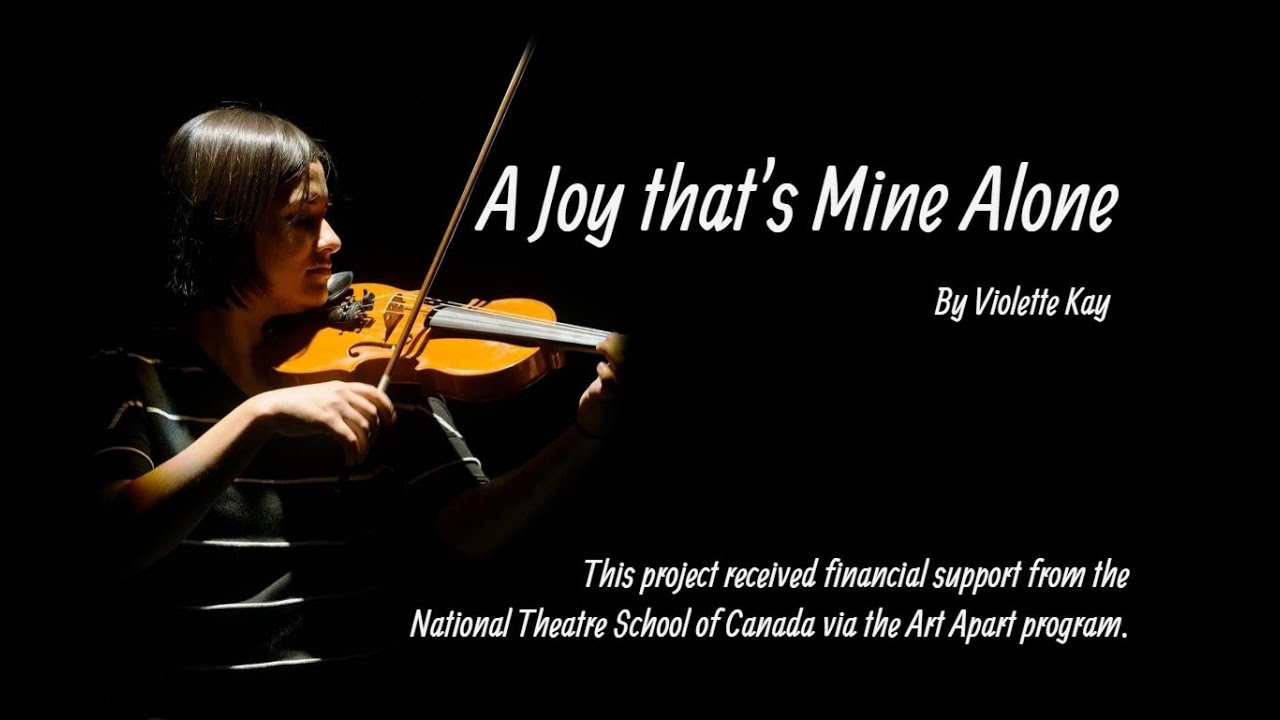
On DBT, Art and Healing: A Joy That’s Mine Alone: Guest post by Violette Kay

violettekay1
When I was little I wanted to become a violinist when I grew up. And I could have done it, I was actually really good, but unfortunately mental illness robbed me of that dream. I had my first bipolar episodes right when I started studying music in college, failed a bunch of classes, wronged a bunch of people, and watched my music career crash and burn before it had even begun.
It’s been almost a decade now, and I have a whole new life in which I’m stable and happy, yet I still can’t help but wonder if I could have done it. If I wasn’t bipolar, would I be a professional musician? This question haunts me, it follows me wherever I go, and no matter how far I run it always brings me back. A few years ago I bought a music school in a hypomania-fueled delusion that it would bring me closer to my childhood dream. It did not.
I’ve also written a play about violin teachers and nostalgia/regret, it was very therapeutic, but it didn’t fully heal the wound of my failed music career. Perhaps nothing ever will.
The first thing they teach you in Dialectical Behavioural Therapy is called the “Wise Mind”. It’s supposed to be this balance between your reasonable mind and your emotional mind, and that’s the place you want to be making decisions from. You want to consider both the facts and your emotions, and not ignore one or the other. For example, let’s say you have coworker who is making you angry, and you want to yell at them, throw things and storm out, that’s just what your emotional mind wants. So if you bring in a bit of reason and use your wise mind, you can probably come up with a better solution.
When I was learning this in DBT group I noticed that all the examples we were given involved using the Wise Mind to avoid acting on our emotional mind, so I asked the instructors if they could give me a situation where it’s the other way around, an example where your reasonable mind is what’s leading you astray. They gave some roundabout unclear speech about… something, I don’t remember. Basically they didn’t have an answer for me.
Well, it’s been over a year now and I think I finally found one: I should quit music. I should completely cut it out of my life, sell my violin, recycle all my sheet music, unfollow/unfriend everyone I met through music, and stop self-identifying as a musician. Music has caused me so much pain, and landed me in some impossible situations. So logically, if I want to stop feeling that pain I should just quit, right?
That’s my reasonable mind talking. But if I did quit music I would be ignoring my emotional mind, who likes music and has a lot of very meaningful music-related memories both good and bad, memories I wouldn’t want to lose.
So what’s the middle ground? I still play sometimes. I’ve gone busking during periods of unemployment. I record backing tracks for my singer friends. I take on background music gigs sometimes. And I bring music into my theatre and writing practice all the time.
I’m still shocked every time I get paid to play music, and though I do on occasion mourn the violinist I could have been, I’m also incredibly grateful that I still get to live out my childhood dream in small ways. It’s not what I wanted, but it’s still a good life.
My latest project is a film inspired by my experience of having bipolar disorder and buying a music school, and a first for me: a project born entirely out of self-love, rather than pain. I am so grateful I got the opportunity to make it and to share it with others.
I’ll always have bipolar disorder, it will always be a part of me, but it’s just one part. And I’ll always be a musician. That’s also just one part of me. Maybe they’re the same part.

violette1

This guest blog was written by film maker and musician Violette Kay. Her film the Joy thats Mine Alone about life with art and bipolar disorder, can be viewed at : 

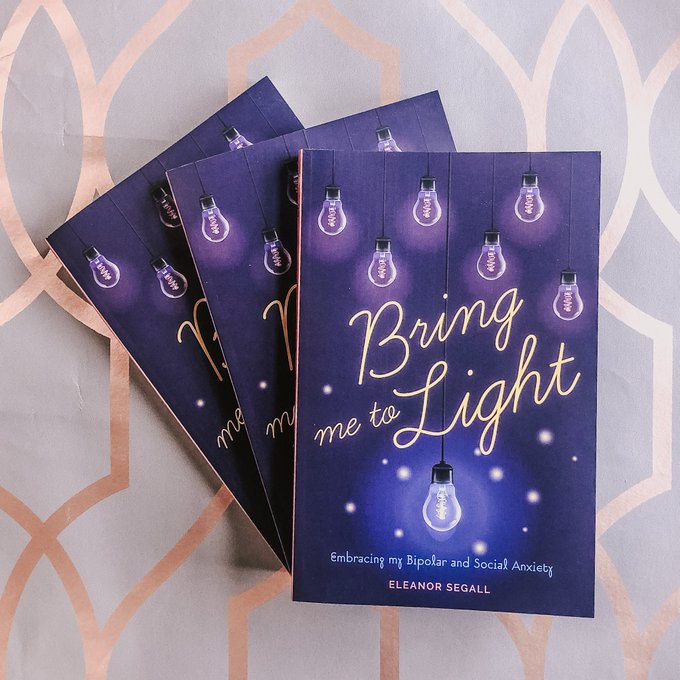
Why I wrote my book, ‘Bring me to Light: Embracing my Bipolar and Social Anxiety’ by Eleanor

bringmeinsta1

(image: Trigger Publishing)

This blog has been a long time coming. I have been so busy promoting my book on social media and in the press that I havn’t actually sat here and told you WHY I decided to write this book. So, here goes.

Firstly, can I just express so much gratitude to this here WordPress blog because without it, I would not have got commissioned at Metro.co.uk (thank you Yvette) or for other places online. This blog gave me the confidence to write and to expand my writing’s reach and for that I will be forever grateful.

In 2013/ early 2014, I sat on the couch, crying and living with a suicidal depression. My bipolar was unstable and all over the place- I felt so low and like there was no way out. However, as I sat and cried- a friend of mine’s face peered up from the newspaper. He was looking for the man that saved him from suicide and was launching a campaign called Find Mike to find him. That man was Jonny Benjamin (who now has an MBE). I had known Jonny for many years as a teenager through friends, but he became my inspiration and my hope that I too could do good things despite having mental illness. He very kindly has provided an endorsement too for my book- thank you Jonny!

With the help of my psychiatrist, I recovered temporarily from the depression but then spun very fast into mania and psychosis (possible due to a large dose of anti depressant). I was sectioned and in hospital for 4 months as an inpatient and a further 4 as an outpatient.

Throughout this time, I could not think about writing because my mind wasn’t stable enough. But as I pieced my life back together, started taking a new mood stabiliser to help control the bipolar episodes and started to recover slowly, I found the power of blogging about my social anxiety due to trauma of the bipolar, to be so helpful. I found that others would share their stories and would reach out to me about their mental health too.

Although life is not perfect and I am still living with an anxiety disorder, I have found a way to write and speak about mental illness. I was diagnosed with bipolar at 16 and there was a lot of shame for me about it back then in 2004. These days, I tell my story for other scared 16 year olds newly diagnosed but also to break down barriers and stigma against mental illness. To explain you can have bipolar or be sectioned or have psychosis but you can recover and you don’t need to spend life in hospital forever. To explain that while this cruel illness runs in families, that with the right healthcare, staying more stable is possible.

I started writing my book with Trigger Publishing because they believed in my story when I sent them my proposal. They are part of the mental health charity the Shaw Mind Foundation and royalties go towards the charity as well as some to me.

I hope that when you read my story, you won’t see it as a despairing ramble- but rather a story of hope, of life, of light triumphing over the darkness- but the darkness making the good times shine brighter. I also bring my bipolar to light, I share it with the world- as scary as this is, so that others can also tell theirs.

I wrote this book too provide a place to talk, start conversation and help heal myself through writing it but sharing that feeling of hope with others too. The book cannot change things that are so needed like urgent mental health funding of the NHS so we have parity of esteem. Yet, i hope it is a starting point about how important mental health treatment is for people to move forward in their lives.

Bring me to Light is out on 5th November 2019 in the UK and is available worldwide. It will be out in the USA in 2020. It can be purchased on Amazon, in book shops and at triggerpublishing.com

I will be sharing press articles and more about the book as it happens, but I hope this blog explains why I wrote my book. Thank you all for your ongoing love and see some of you at the book launch!

Love,

Eleanor x


You can pre order Bring me to Light, my book on mental health, now!

bringmetolight1
Hi friends, its now August and my book is out in the UK on October 30th and November 5th in the USA! I tell my life story with being hospitalised for bipolar disorder episodes twice, most recently in 2014 and how I found a form of recovery and have become a writer on mental health.
My book is called ‘Bring Me to Light’ because I found light in the darkness, hope where there was none. It took many years and this time was a challenge. I hope that reading my book will make you feel less alone. It talks about bipolar, psychosis, depression, anxiety and mania.
It also talks about my wonderful family and friends who have helped me along the way and teachers, doctors, psychiatrists and nurses. Team effort.
the Trigger website (my publisher). USA people you can order it on your Amazon too.
Book launches to follow later in the year, stay tuned for details!

World Bipolar Day: Extract from my blog for the Centre for Mental Health by Eleanor


worldbipolar1

(image: Centre for Mental Health)

‘Like so many sharing their stories this World Bipolar Day, I have lived experience of bipolar disorder. I am now 30, but was just 16 when I was diagnosed with bipolar 1 (the most severe form of the mood disorder) as an inpatient at the Priory Hospital North London. It was hard to deal with this diagnosis at such a young age and I didn’t know then what my future would hold. I was hospitalised due to having three episodes of illness: mania and depression in one year, which led to psychosis, where my mind lost touch with reality.

Bipolar is a serious mental illness that causes a change in mood states to either big manic highs or devastating depressive lows, with a normal state of functioning between episodes. As someone living with this, I also have experienced psychosis during my mania which needs quick hospitalisation as my mind spirals wildly out of control. I have been hospitalised twice for my bipolar (in 2004 and 2014), both times due to an extreme episode of mania and psychosis.

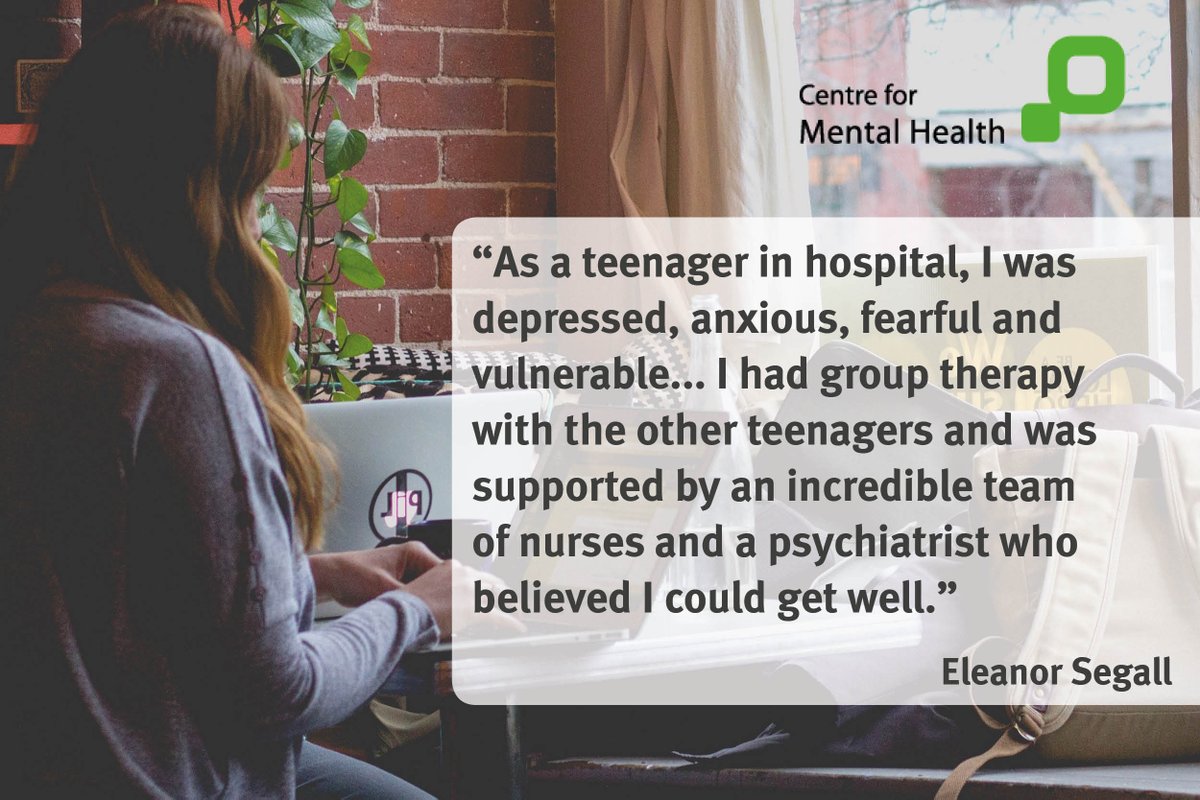
As a teenager in hospital, I was depressed, anxious, fearful and vulnerable. I believed (falsely) that I had been sexually abused and my reality became based on this false belief (delusions). The doctors got me back to full health through a combination of starting on new medicine (mood stabilisers) and giving me anti-psychotic medication to bring me down from the mania. Over four months I also had one to one therapy, group therapy with the other teenagers in the adolescent unit and was supported by an incredible team of nurses and a psychiatrist who believed I could get well. I eventually went home once my mind was stable and started a long process of counselling and recovery.

I was able to go to university and get my degrees, travel, make friends, date and live my life. However, in 2013, after some life stressors, I began to experience a depression which featured suicidal thinking. It was very scary and we believe it is because my medicine Carbamazepine wasn’t working any more as I got older.

Depression of this kind is incredibly hard to deal with. I stayed in bed all day most days with breaks for meals. I had no energy, no hope, no reason to get up. I was unmotivated and couldn’t cope with life. I barely washed or spoke to friends. Luckily, due to my fears about the suicidal thoughts, I shared this with my family and medical team. I didn’t want to act on it, just escape from the pain my mind was in.

Unfortunately, a few months later, the depression turned into a period of mania, possibly caused by my mood stabiliser not working and taking anti-depressants. This is always a risk with bipolar, that medicine can send you high. I was agitated, speaking very fast, with racing thoughts, raised libido and was vulnerable as a result. The psychosis then started, with my mind starting to believe falsely that I was being held by a criminal gang orchestrated by my family. It was so scary. I was sectioned, treated with medication again and over several months engaged with therapy in hospital, while they tried to bring my mood and mind back to lucidity.’

Read full blog here: 

https://www.centreformentalhealth.org.uk/blog/centre-mental-health-blog/bipolar-disorder-eleanor


World Bipolar Day is Tomorrow!

worldbpday

Tomorrow, join in and learn what you can about bipolar disorder.

As many of you know, I have bipolar 1 disorder and when not on medication, have episodes of high mood- mania/ psychosis and low mood- severe depression. Thankfully I am in recovery but it affects so many people and is thought to run in families.

Remember you are not alone.

Bipolar UK-  https://www.bipolaruk.org/

Bipolar in USA: http://www.mentalhealthamerica.net/conditions/bipolar-disorder

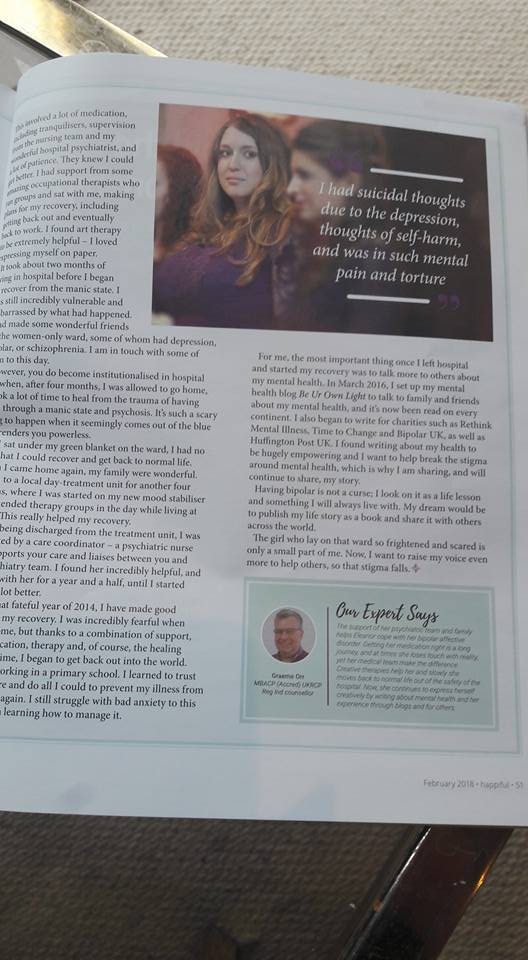
‘A Unpredictable manic episode meant I was hospitalised for my bipolar disorder’: for Happiful Magazine February 2018 Issue

happifulmag
(image: E Segall and Happiful Magazine)

Hi everyone,

I am thrilled to be able to share my story of recovery from bipolar disorder for the first time in print (!) at Happiful magazine, a UK magazine solely dedicated to mental health.

You can read it online here:  https://subscribe.happiful.com/ click read e-magazine and turn to pages 50-51. If you live in the UK, you can also order the magazine there by post or buy a copy in most major UK supermarkets!

As I say in my article,

Having bipolar is not a curse, I look on it as a life lesson and something I will always live with. My dream would be to publish my life story as a book and share it with others across the world… The girl who lay on that ward so frightened and scared is only a small part of me. Now, I want to raise my voice even more to help others, so stigma falls’   

I hope you enjoy reading it and leave a message for me in the comments if you do.