Life is often a rollercoaster of positive and negative experiences, interspersed by the normal every day that we can take for granted. But what happens when life throws a curveball that you hadn’t foreseen- health worries, financial stress or maybe a relationship breakdown? Sometimes, all of these can happen at once. Heres some ideas that can help when life gets tough.
Don’t bottle up your feelings and keep it to yourself. Make sure you talk about your feelings with a trusted loved one, therapist or helpline. You can also journal your feelings as writing can be really healing.
2. Nourish yourself daily with healthy food and do gentle exercise. Some delicious protein, healthy carbs and a little walk, yoga or a swim can really help.
3. Treat yourself to some self care or do something creative that you love- whether its creating art, writing, vlogging. performing- if it makes you smile and distracts you from troubles then do it! I find that washing my face and using my favourite skincare products also helps with self care.
4. Scale back the difficult demands on you if you can and be kind to yourself- Don’t punish yourself or try to do too much when things are challenging. Reach for support around you especially if you are a parent, pet parent or have caring responsibilities.
5. Watch something comforting or funny- a good movie or TV show is distracting and can work wonders.
Most importantly- if you feel yourself spiralling into anxiety, depression or crisis point please reach for help from mental health services . Call NHS 111 for help in a crisis.
Coping when life gets difficult isnt easy. These are just a few tips to help. If you are facing worsening or severe mental health issues, please reach out to professionals to help you- GP, psychiatry or a therapist. In an emergency in UK, dial 999.
This weekend was World Mental Health Day, an important day to shine a light on mental health and people with lived experience of depression, anxiety disorders, bipolar, psychosis, eating disorders, schizophrenia, OCD, PTSD, BPD, EUPD and many other conditions.
Today I want to tell you- do not suffer in silence. If you are struggling please tell a loved one, a therapist or a trusted GP. There are also incredible helplines including Samaritans (116 123 in UK), JTeen, SHOUT and UK charities running services including Noa Girls UK, Jami, SANE, Mind Charity, Bipolar UK and Rethink Mental Illness.
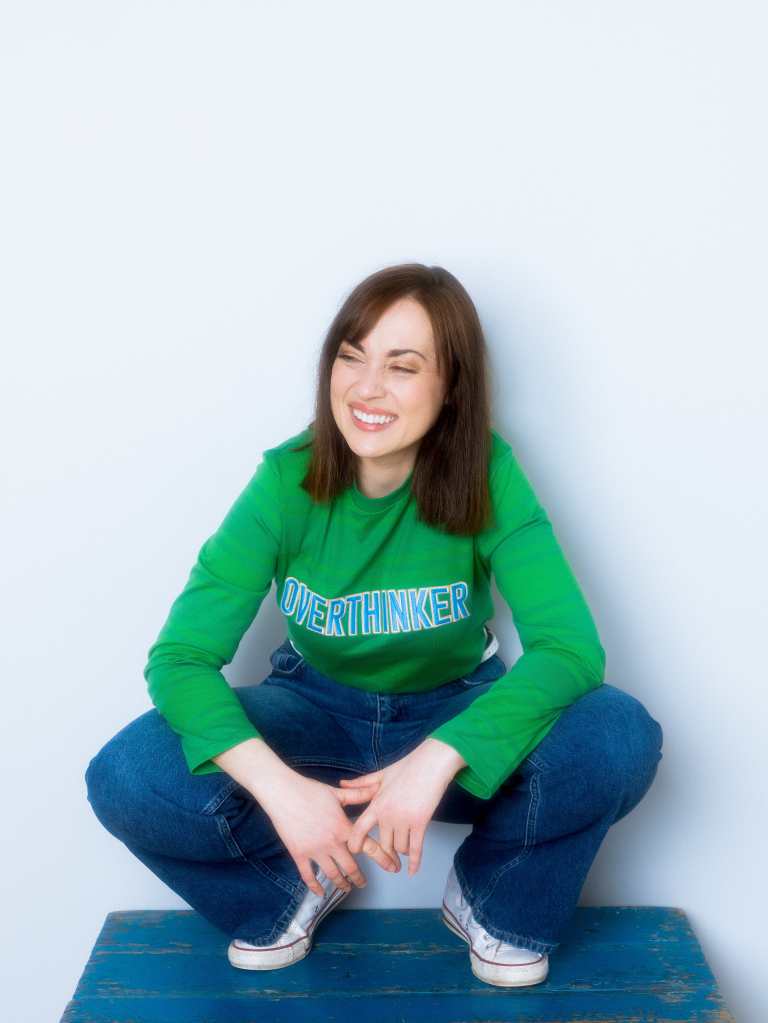
(image: E Mandelstam)
Ive written about my journey with Bipolar 1 and PTSD/Panic disorder. Please make sure you do not suffer with painful feelings or dark thoughts alone. Talking saved my life and I hope it will help you on the road to recovery. You matter and you are not alone.
You can also call NHS 111 option 2 for urgent mental health support and call 999 for emergencies.
Remember the theme this year is for those of us with lived experience to talk safely and make change where we can.
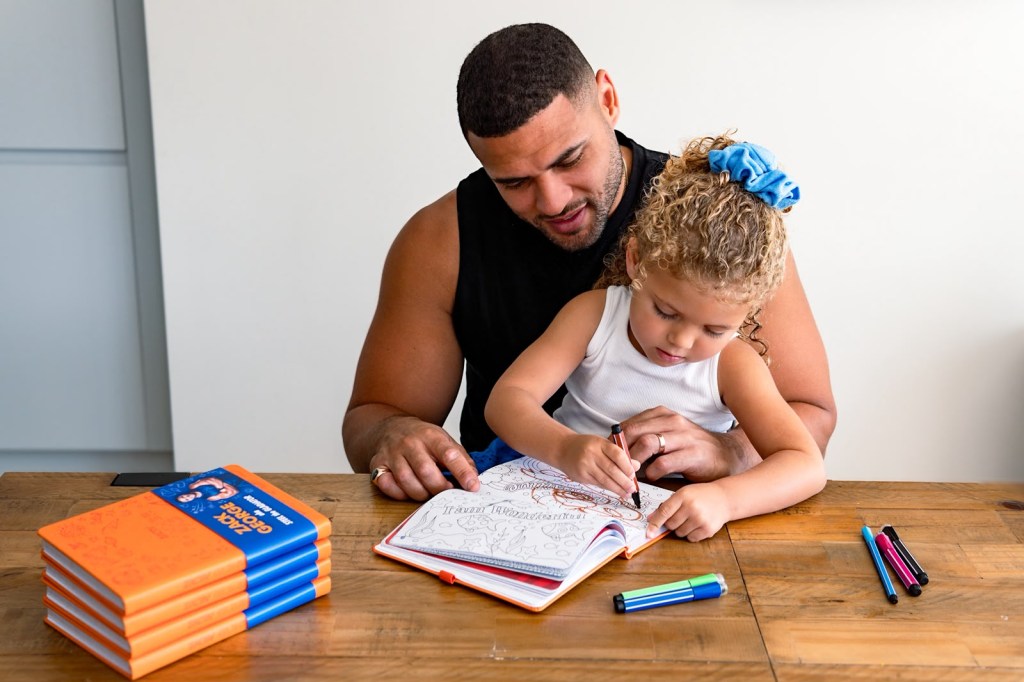
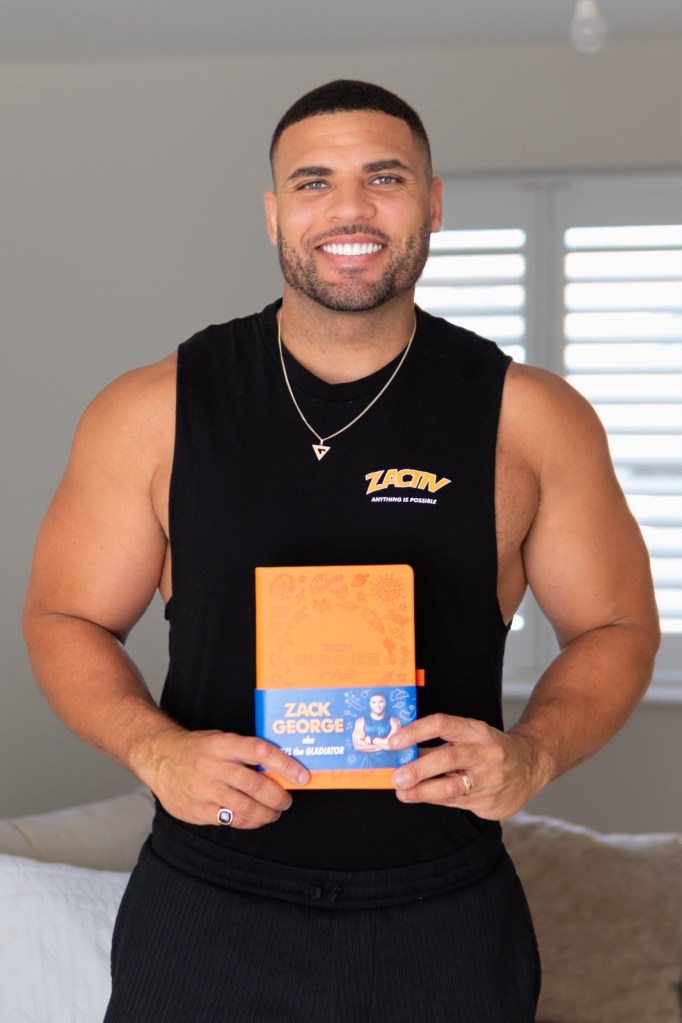
Recently, I received an email about an incredible project by ‘Steel from Gladiators’ star Zack George who has launched the Zactiv Glimmer Pad. This is a brand new tool designed to support children’s overall health and wellbeing.
I was told that ‘Taking a holistic approach, the Glimmer Pad combines journalling, creative activities, and positive habit building to support both mental and physical health.’
The product builds on the success of Zactiv, Zack George’s children’s wellbeing programme, which is already booked through to February 2028 and reaches over 5,000 children aged 5 to 11 each month in schools. Known for combining movement, confidence building, and mindset coaching, Zactiv has rapidly become a trusted name in children’s development, with the Glimmer Pad extending that experience into children’s everyday routines at home.
Children are guided to reflect on their day, explore their emotions, and build healthy routines through structured diary pages. The introduction of “glimmers” encourages them to focus on small positive moments, helping to reduce stress and build a more balanced outlook. There are also beautiful colouring pages with positive motivational words and stories about healthy eating and fitness, suitable for kids.
The Glimmer Pad has been shaped by Zack’s work with teachers in schools and by coaching tools from Happy Confident Kids. As a Dad himself, Zack has seen first-hand how important it is to create simple, positive activities that children genuinely enjoy engaging with away from screens.
Zack said, “Health is not just about being active. It is about how you think, how you feel, and the habits you build every day. The Glimmer Pad is designed to support the whole child, inside and out.”
(image: Zack George)
The launch comes as concerns around children’s screen time and wellbeing continue to grow. By encouraging reduced screen time and more mindful activities, the Glimmer Pad helps children create healthier daily patterns while building confidence and emotional awareness. Built around the message Strong Body, Calm Mind, Happy Heart, the Zactiv Glimmer Pad offers a simple yet effective way to support children’s long-term wellbeing.
From a personal view, I was honoured to be sent a Zactiv Glimmer Pad to review. It has a vibrant orange colour with motivational messages. This pad teaches children how to use their journal pages to describe their feelings and defines what glimmers are and a growth mindset. It also helps children to understand healthy eating and to be aware of their emotions daily. I particularly loved the positive colouring pages and stories at the back and I would recommend the Glimmer Pad to parents and carers of children, to help teach about emotions and healthy living.
The Zactiv Glimmer Pad is available now from www.glimmerpad.co.uk and Amazon UK, priced at £24.99.
I received a gifted Glimmer Pad in exchange for an honest review, all views my own.
This week I was on a call with a very special friend, the talented illustrator of Arabella and the Worry Cloud (our kids book on anxiety)- Shelley. I was speaking to her about the challenges of being a self-employed independent writer- financial and as a founder, everything being on you. She told me to believe in myself and my writing and not give up! Those kind words have meant everything during a challenging time.
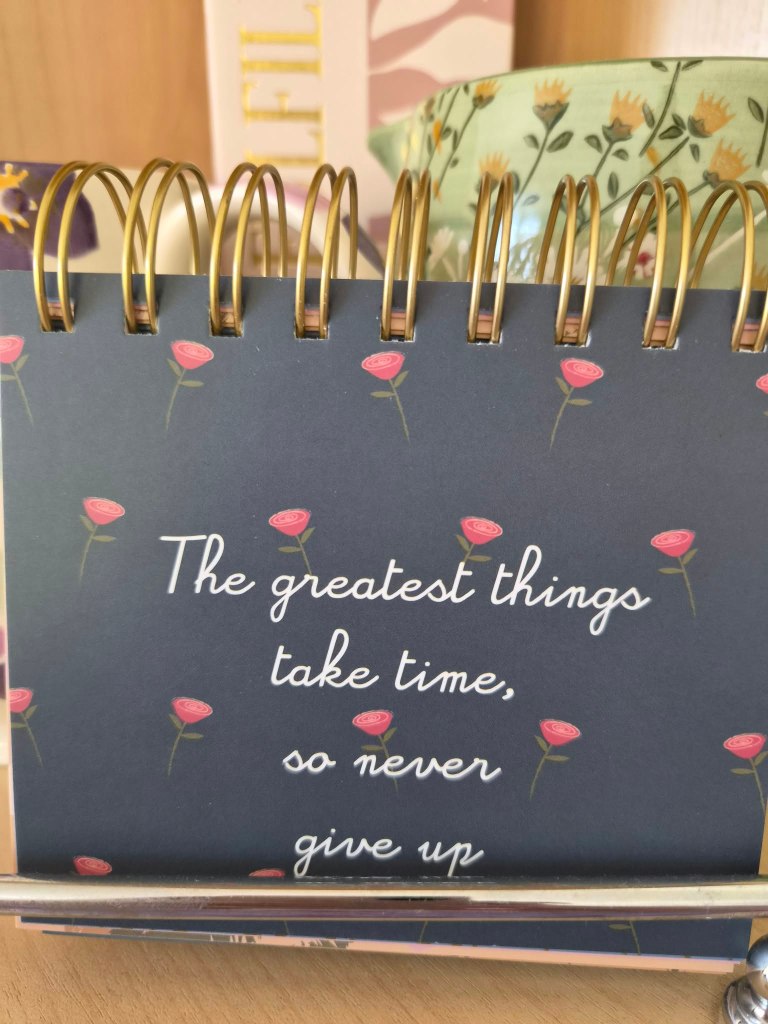
Then, today, I decided to pick an affirmation from my flip chart (that another lovely friend had got me for my birthday) without looking. I flipped the chart over and not only does it have pink roses (a special flower to me that is a positive sign I asked for) but I received the message,
‘The greatest things take time so never give up.’
And so, even though being a writer, a creative can be exhausting when you aren’t famous with lots of money coming in- I remember why I wrote Arabella, the children I wrote for and who need to hear its message. And because I have had this message twice this week, I will not give up. On my writing, on my journey through life and its ups and downs. I won’t give up on my first book either.
Most people first meet cognitive behavioural therapy as a single sentence. CBT, the sentence goes, is about challenging negative thoughts. True, in the way that a driving lesson is about pressing pedals. I am a CBT therapist, so I have an obvious bias here. I also know it does not suit everybody, and it is not the only route out of anxiety. What I can do is tell you what the work actually looks like from the inside, week by week, so that if you are weighing it up you know what you would be signing up for.
Before the first session: what you want to be different ?
Therapy starts with a goal, and “I want to stop feeling anxious” is not a workable one. Anxiety is not the enemy. It is your body doing something it evolved to do, and nobody switches it off for good. The useful question is smaller and more concrete. What is the anxiety stopping you doing? Where does it show up in a normal week? Then we make the target a behaviour rather than a feeling. Getting back on the train. Going to the meal without rehearsing an exit. Speaking in the meeting without scripting it twice in the shower first. Feelings are the last thing to move. Behaviour moves first.
Session one: the map, not the lecture
A first session is not a taught lecture on the cognitive model. I ask for one recent moment when the anxiety turned up, and I ask for it in detail. Where were you? Who else was there? What went through your mind, in the words it actually used? What did you do? What did your body do? Then we draw that single episode out on paper together. It still surprises me how much of the whole difficulty is already sitting inside one moment. Nothing is general and nothing is theoretical, which matters, because vague questions get vague answers, and vague answers change nothing.
Sessions two to four: the part people don’t expect
Popular writing talks almost entirely about thoughts, because thoughts are the easiest corner to describe. But the cognitive model has three corners, and the corner that keeps anxiety topped up is behaviour. Safety behaviours are the ones I mean. They rarely look dramatic. Arriving early so you can pick a seat near the door. Checking the route three times. Preparing a story in case anyone asks what you do. Taking one drink to take the edge off. These are sensible, understandable things to do, and they work in the short term, which is exactly the trap. Every time you get through something with the crutch, you learn nothing about what would have happened without it. The frightening prediction never gets tested, so it never has to face the evidence. Safe, and stuck.That is why the beginning of the work often looks like doing, not thinking. It is the harder place to start and it is the reason the rest of it holds together.
The middle sessions: exposure, built like a ladder
If there is one active ingredient in CBT for anxiety, it is exposure. That means approaching what you are afraid of, on purpose, in a planned and graded way. It does not mean gritting your teeth and flooding yourself until something breaks. Think of a ladder. The bottom rung should feel uncomfortable, and only mildly so. Take someone frightened of driving on motorways. They do not begin by joining the M25 motorway at rush hour. They sit in the parked car and imagine the drive. Then they ride along as a passenger. Then they drive a short stretch of dual carriageway at a quiet time of day. Then further, at a busier time. Every step has to be uncomfortable enough to count and small enough that it actually gets done, and calibrating that is where most of the clinical judgement lives, because too small means nothing is learned and too big means the person is set up to fail, which teaches them something worse than they started with. Safety behaviours come out of the plan deliberately, one or two at a time, not all at once. Ladders, not leaps. That is the bit people are surprised by.
Later sessions: the therapist does less
A good course of therapy should make itself unnecessary. The aim is not to feel better for one hour a week, it is to leave with a method you can run on your own. By the later sessions I am deliberately doing less and the client is doing more. They set their own tasks. They spot their own unhelpful predictions, in their own words, before I have noticed them. When that starts happening, the work is nearly finished, and the last session feels less like an ending than a handover. Part of that handover is a relapse plan, written down, because anxiety does come back at stressful points. Coming back is not failure. It is weather. When it doesn’t work CBT is a doing therapy. Most of the change happens between sessions, and that means it asks something of you at a point when you are already tired.
That is a real cost and it is worth knowing before you start. It is also not the right shape of help for everyone, and it is not the right time for everyone. If the main difficulty is grief that has not been given room, or a trauma that is still too raw to approach, or a situation that is genuinely unsafe rather than misread, then the work needs to be something else first. A poor fit with the therapist does the same damage. You can do everything asked of you and get nowhere if the person in the room is not the person you can talk to.
Having CBT once and finding it didn’t help is not evidence about you. It may have been the wrong moment, the wrong shape of support, or a room where you couldn’t be honest. All three are fixable.
What to ask before you see a therapist
Four questions, and the answers tell you a lot.
How much will I be expected to do between sessions, and what does that look like in a normal week?
What would you be working on with my particular problem, specifically?
How will we both know it is working, and what happens if it isn’t?
And do they have a fixed number of sessions in mind before they have actually met you, which is the one that should make you cautious, because the work takes the time it takes.
Anxiety responds to evidence gathered in your own life, not to being told to relax. That is the whole idea. It is slower than people expect and more ordinary, and it works. Guidance for generalised anxiety usually puts a course at around 12 to 15 weekly sessions of an hour, so a number in that range is a fair planning figure. It is not a promise, and no one should be making promises before they have met you.
Peter Klein is a CBT therapist who works with anxiety and OCD, in person in Richmond, UK and through online CBT therapy across the UK.
The intrusive thoughts. The compulsions. The shame. The reality of living with OCD.
“It’s not about having all the answers. It’s about making you feel less alone.”
Rose Ellen Dix, one half of YouTube couple Rose & Rosie, is getting more personal than ever in RoseCD, a new podcast exploring her lifelong experience of living with Obsessive Compulsive Disorder (OCD).
Rose has lived with OCD throughout her life and was diagnosed aged 17. She is now exploring her experience of the condition in depth through RoseCD, sharing what it feels like to live with OCD in her own words, with honesty, humour and warmth. Now, in her first podcast dedicated entirely to her own experience, she is talking openly about the parts of OCD that are often misunderstood or left unsaid — from intrusive thoughts and compulsions to health anxiety, shame, perfectionism, panic spirals and the impact it can have on relationships.
RoseCD is a ten-episode first season .The podcast is entirely self-produced by Rose, with episodes based on her own lived experience rather than a clinical or expert perspective.
“I live with OCD. Not as an expert and not as a clinician. As someone who’s spent almost twenty years trying to understand their own brain. RoseCD isn’t about teaching people what OCD is. It’s about showing them what it feels like.”
“I wanted to make something that I would have wanted when I was younger — something that made me feel less weird, less ashamed and less alone,” says Rose. “OCD can make you think you’re the only person in the world having a particular thought. Sometimes just hearing someone else say, ‘I’ve thought that too,’ can make a huge difference.”
Rose says the aim is simple: to talk honestly about what OCD actually feels like from the inside, share what she has learned about living with it, and create a space where people can recognise thoughts they may have been too frightened, embarrassed or ashamed to say out loud.
RoseCD is available on Spotify and digital platforms. If you have been affected by anything discussed in this release, Samaritans are available free, day or night, on 116 123.
Living with bipolar 1 from the age of 16 meant living with deep depressions, of which suicidal thoughts were a part. Being able to safely share these with family and psychiatrists in the past saved my life and helped me hold on in the dark moments of bipolar episodes. I am not alone in feeling this way- millions are struggling now, today. Medication, therapy and support keep me well.
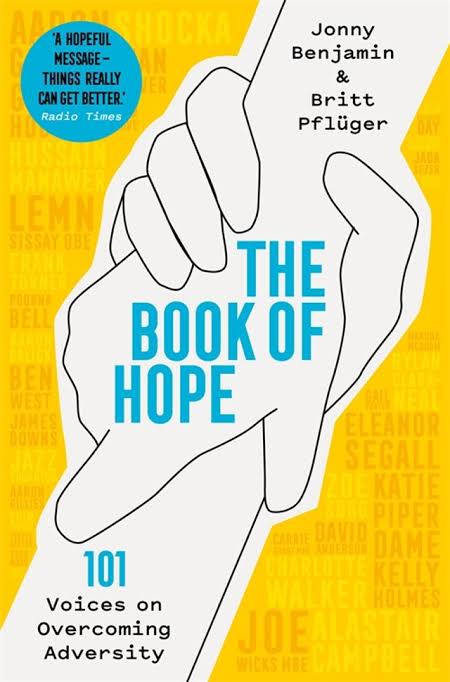
So today I read from my essay in this very special book to tell you- ‘You will feel the sun and smell the rain again, even after suicidal depressions when you lay in bed wanting to disappear. ‘
Please reach for help when you start getting these thoughts and hold on- a better day is coming. Helpline numbers includingSamaritans at 116 123 are available if you need to talk and feel in crisis.
I also know the devastation of losing a loved one to suicide and conversely, to help people through these thoughts. Their stories are not my own so I am not sharing them today but I hope that today and every day we focus on suicide prevention and support for all who are struggling.
Shana Tova U’Metuka, a happy and sweet new Jewish year to everyone celebrating and marking Rosh Hashana this weekend. Rosh Hashana is an important Jewish festival where we gather with family and friends, pray at synagogue or home and reflect on our relationship with G-d and what we need to change in the coming year ahead. It’s also time to ask for things, to dream and to plan- oh and to eat honey cake or apple and honey for a sweet year too!
This year has had many blessings but also many difficult moments that I will reveal at the right time. So, I pray for a happy, healthy, sweet, prosperous, joyous New Year with all dreams manifesting if meant to be. I am grateful to still be running this blog after a decade and to be able to share my thoughts and emotions here. I am grateful for all my blessings- 2016 me who set up this blog would not quite have believed what happened in the past 10 years!
Thank you all for reading this blog and for supporting it. We are here to help people feel less alone, to promote recovery and healing and good treatment for all who live with mental illness or are in remission from episodes.
If you are struggling with your mental health this Rosh Hashana (or feeling at risk of harm)-to save your life, please reach out to mental health services or helplines like Samaritans (116 123)
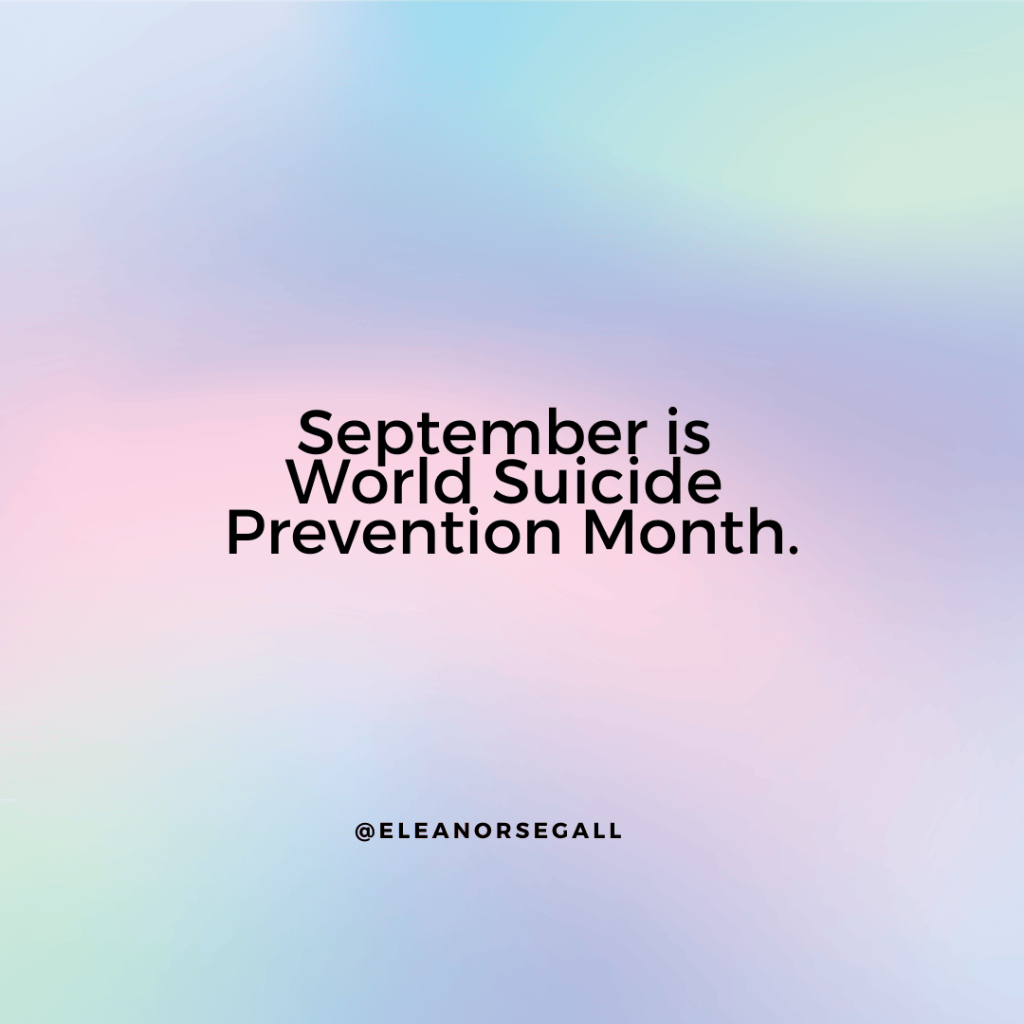
Many people die every day and every hour from suicide in the UK and globally. 7000 lives lost a year on average in the UK to suicide and 75% of these are men according to research by CALM charity.
Taking their own lives is often the only way they can see to end their own deep pain and suffering- whether as a result of trauma, mental health issues and life circumstances (abuse, addiction, divorce, parenting struggles being just a few).
If you feel suicidal or very low, please tell a trusted person or if in the UK call Samaritans on 116 123.
If you’ve ever tried to get mental health support, you’ll know that it can feel like watching a game of ping-pong. You call one service, and they refer you to another. They point you to a helpline, which suggests a group. And at the end of it all is the bottom of a waiting list.
There’s a big shortage of mental health support out there. Whether you’re one of the millions struggling with a severe mental health illness, or simply going through a difficult time in your life, it’s never been harder to find care.
It’s not good enough, and everyone deserves access to the support they need – whether that’s a therapist, a diagnosis, a helpline, a support group.
But the truth is that no service, however good, can give us everything we need, all of the time. The toughest moments in life don’t wait for a therapy appointment. There will always be moments where you’re on your own with it.
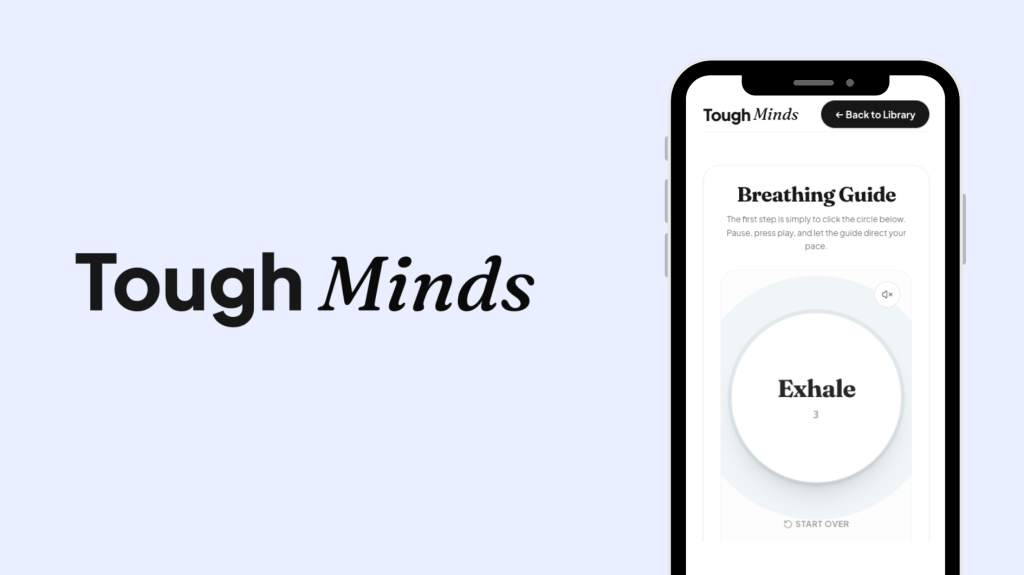
That gap is what I built Tough Minds for.
Tough Minds is a completely free, online toolkit to help you go from a difficult moment into a lighter one. There are breathing exercises, guided meditations, an urge-surfing timer, and calming soundscapes to help you relax or decompress.
These are exactly the sort of exercises that a therapist or counsellor might recommend you try – but the ones that are so hard to remember at 2am when you’re in a crisis, or when you’re trying to fight off a difficult urge, or when you just need five minutes to breathe before a job interview.
That’s why Tough Minds has no sign-up, no app to download, nothing to pay for, no ads. Whenever you need it, you can just go to Tough Minds.
(image: Mediensturmer: Unsplash)
Building emotional resilience
Those in-the-moment tools are only half of the reason I created Tough Minds. The other half is about building the underlying skills that can make those difficult moments less frequent and less severe.
We are less likely to be taught how to look after our mental health in school – and that’s a problem. We only ever learn how to look after our minds once we hit a crisis point – which is a bit like taking your first driving lesson when you’re already halfway round the M25 (UK motorway).
It doesn’t have to work that way.
Building Emotional Resilience
Tough Minds also has tools, games and exercises to help you build emotional resilience – the sort of skills you might learn in therapy. There are skills that help people manage emotionally difficult moments and even help with some mental illnesses. Skills like having a wide vocabulary for your own emotions, or knowing how to catch and reframe a spiralling thought before it takes hold.
These are skills like any other – they can be built so they’re there when you need them. That’s the part of Tough Minds I’m most excited to keep building: to improve and steady mental health.
None of this is about pretending that a website or an app can do the job of real support services, or the human-to-human support that so many of us benefit from.
However, what Tough Minds can do is help all of us take care of ourselves. Not instead of support, but around it: when you’re on a waiting list, the days between sessions, the stretch of life after a course of treatment ends, and for the times life is just a little hard.
If that sounds useful to you, you can find Tough Minds at toughminds.org. It’s free, and it’s there whenever you need it.