Guest Post: Charlotte Underwoods Story: How I lost my loved one to Suicide and Recovery from my own Mental Health Issues.

Charlotte Underwood, writer and mental health campaigner, shares her courageous story with us. Trigger warning: discussions of suicide and substance abuse.

bekind1

(image: Pinterest)

Life has not been especially easy for me. I’ve got more layers than an onion due to this, though my mental health really took a turn for the worst when my father went missing for over a month. He was found, suicide was confirmed.

It was hard to process, suicide was supposed to be for movies, not for real life, right? I went through a lot of things after that, blaming others, blaming myself, creating conspiracy theories, just so I didn’t have to accept that my best friend, my daddy, was gone.

Losing a loved one to suicide is so hard because it’s often sudden and leaves a lot of questions and nuclear damage that domino effects into every single person who knew and loved the victim. I’m all reality, it is no ones fault for a suicide, not even the victims.

There are so many possible causes and things that can trigger a suicidal episode that it is impossible to always know that someone is at risk, we often miss signs even when they are right in front of us.

My dads death led me to substance abuse and my own suicide attempt, I didn’t want to live without him, I was a daddy’s girl and he was the only one who helped me with my own mental health. For three years I refused to grieve and my life was looking to be pretty similar to my fathers demise, a life of hiding my feelings because I didn’t want to upset anyone or cause a problem.

It wasn’t until I met my husband and learnt to think about myself that I realised through it all, I had lost track of who I was. I decided then and there to start being selfish (without being mean) and to love myself and fight back and work with my own mind.

It’s been a rollercoaster since, recovery isn’t linear, my mood changes in seconds and each day is a battle, I may look fine but there’s always so much going on inside my head and body (mental health has physical effects too!).

What I have learnt though is to not be ashamed of who I am, to demand the help and support I need and to not let my mental health limit me because it does not define me, I am Charlotte, plain and simple.

It’s important to remember that all your feelings are valid, it’s ok to hurt and be angry and to have all this going on because it’s your body responding to trauma or something in your environment eg stressors.

That’s why it’s so important to talk and to be reminded that it’s ok not to be ok and that you are not alone!

Charlotte is an author, is on Twitter and can be found at https://charlotteunderwoodauthor.wordpress.com/

Tips to Relieve Social Anxiety for Happiful Magazine (March 2018 Issue)

happifulmarch.jpg

Our founder Eleanor is published in this months Happiful Magazine, talking about social anxiety and tips to help. Below is a short part of the article- you can read the full article in the link:   https://happiful.com/tips-to-relieve-social-anxiety/

For some of us, it’s butterflies in the stomach. But for others, it’s a crippling fear of even leaving the house. Social anxiety can feel overwhelming, but you can take back control. Here, Eleanor Segall (founder of this blog) gives advice on overcoming social anxiety:

I have bipolar disorder – a mood disorder – and experience anxiety as part of this. When I was about 20, I started to have intense anxiety and panic attacks before social situations – so much so they would stop me from leaving the house.Anxiety has a large impact on so many people’s daily lives. Whether it’s anxiety about a job interview, dating, meeting new people, travelling, health, work or whether you suffer from a diagnosed anxiety disorder and have panic attacks, it can be incredibly overwhelming.

I was fearful of being judged negatively by other people, and this caused the physical symptoms of social anxiety – a racing heart, clammy and sweaty skin, negative and fearful thoughts, low mood and wanting to hide from situations by cancelling them to stay at home. The result was that I’d then feel guilty about upsetting others.

The difficulty is that anxiety can often be triggered by something you’re not conscious of. It took time for me to realise that my limiting beliefs about social situations were due to my reaction to being diagnosed with a mental illness as a teenager. Although I still have to work with anxiety in my life, together with my family and friends, I’ve found how to make the social anxiety more manageable – here are my four top tips to hopefully help you too:

I’ve learned that anxiety does pass, if you sit with it and let it be – for me, it takes about 45 minutes. Even five minutes of sitting with it can be incredibly difficult and takes practice, but knowing it will pass and can’t harm you is important. The anxiety symptoms are often worse than the event itself. I’ve learnt with social anxiety that if I can face the event, I can lean on my support network to help me through it.Remember it will pass

Use your support network – exposure therapy:

READ FULL ARTICLE:  https://happiful.com/tips-to-relieve-social-anxiety/

What to do if you think you have Depression: a Guide.

christy
(image: Christy Ann Martine)

This blog was voted for in my  Facebook group online poll and so I have decided to write it, with my advice from personal experience and more.

So firstly- what is Depression? Depression is more than just low mood. It can affect your entire ability to function. Depression symptoms include your mind slowing down, poor concentration, lack of sleep or too much sleep (when depressed I sleep too much), more tearful than normal/ prolonged low mood, loss of motivation and ability to go to work/ socialise, not wanting to do activities you enjoy, feeling lost and/or hopeless about life.

Some people who are depressed will self medicate with alcohol, drugs, food, gambling, spending money- anything to make them feel a bit better. Some may start expressing suicidal thinking and ideation or make plans to end their own lives. For others, depression can be part of a wider mental health disorder. I have bipolar disorder for example and depressive episodes are part of my illness. So its a big topic and one which is different for each person (due to brain chemistry and environment).  Anxiety and self harm can also be part of depression.

So what to do if you think you are depressed?

1) Make an appointment to see your GP/ Doctor immediately. If you can get an urgent appointment, do. Tell them how you are feeling and they may suggest medication such as anti depressants which help lift mood and get you back to normal functioning and/or recommend you to a therapist. NHS waiting lists in the UK are ridiculously long for therapy, but just speaking to a doctor and taking medicine should help. Note that anti depressants do have a side effect- and can make you more anxious/ depressed within the first two weeks so talk about this with your doctor. If you have a psychiatrist and medical team (like I do), go and see them and discuss how they can help your care.

Getting better can take months and is a combination of factors. If your depression was triggered by an event, it may be good to go and see a counsellor to discuss any trauma.

2) If you are feeling suicidal and feel like self harming, disclose this to someone you trust. You may not need to be in hospital if you have a good support network, but if you are really really ill, you may need to be. However, do not be afraid for asking for help from medical professionals- especially your GP and/or psychiatrist. They are there to help you get well.

3) If you get a first time psychiatry referral- this is what will happen. You will get asked lots of questions so the doctor can ascertain what is going on. I found that being as honest as I could was more helpful. Take a loved one with you to the appointment. They may ask you to complete questionnaires on your health too and/or refer you to psychology.

4) Use your support network- friends, family, partner. If you have a loving person who understands depression in your life- lean on them. Support from others is very helpful. Depression can be stressful for all involved and some may not understand or may tell you to ‘pull yourself together’. This is just stigma and remember depression is an illness that needs treatment.

If you feel able, see friends you love and trust. When I am depressed, I find it hard to leave the house.. but love and support from others is vital- even if theyre just bringing you chocolate and magazines. Acts of kindness really help.

5) Other holistic methods can really help depression. Whether its:

*Gentle exercise
*Meditation
*Prayer if you want to pray
*Journalling and writing down your achievements however small (eg I washed the dishes)
*Colouring a picture and making something beautiful
* Good sleep regime (when depressed this can be harder)
*Eating healthy food/ foods you love
* Taking care of yourself
*Watching a funny film
* Texting a friend
This can be hard when you are depressed but I would recommend Yoga Nidra meditation for anxiety as well as Headspace meditations….

6) Be Kind to Yourself

Depression is not your fault. Its an illness and a natural part of life. You don’t have to deal with it alone and you don’t have to beat yourself up because you are feeling lower than normal.

Reach out for help but ultimately be kind to yourself. 

Eleanor Segall is the blogger and editor behind this blog Be Ur Own Light.

Guest Post: An Introduction to Trichotillomania- Hair Pulling Disorder by Ariel Taylor at trichstop.com

trichot
(image: eleMINT)

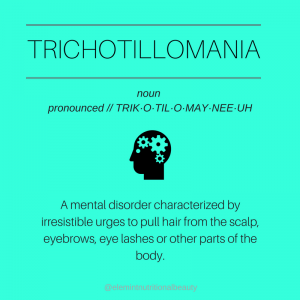
Trichotillomania is a hair pulling disorder that affects millions, though many are not even aware of the fact that they suffer from this condition. It’s a well-known emotional illness and if you punch in the keyword Trichotillomania on the Internet, you’ll be bombarded with blogs, journals, and, essays discussing this hair-pulling habit.

However, when it comes to analyzing this disorder, it’s more than just a case of perpetual hair-pulling. This urge to tug or pluck hair defines Trichotillomania but one needs to know the warning signs and instances that could lead to this emotional upheaval.

Trichotillomania comes under the obsessive-compulsive spectrum and is akin to Obsessive Compulsive Disorders – OCD. When it comes to OCD, Trichotillomania too is defined by compulsions i.e. the sudden need to pull or pluck out hair. Nonetheless, Trichotillomania stems more from an impulsive side while OCD is a repetition of a particular habit – more along the lines of obsession.  The main area that’s most affected is the scalp however, people don’t shy away from tearing out their eyelashes, eyebrows or other hair for that matter. A person feels at ease after hair is uprooted or successfully pulled from the skin. Chronic Trichotillomania can lead to hair loss resulting in bald patches. It’s a source of great concern to people who have family members dealing with this condition especially if they have never encountered or been familiar with an issue before.


Early Signs Of Trichotillomania


Sense Of Comfort

In times of stress and agony, individuals pull their hair inadvertently which is followed by a feeling of relief and comfort. For instance, Sally, a fifteen-year-old, starts pulling her hair when she hears her parents get into a verbal altercation with each other. For some kids, parents who quarrel often can be a reason of great discomfort. Many aren’t aware of ways to deal with such situations and resort to things or activities that give them temporary solutions. Trichotillomania happens to be one of them. The intense tugging and twisting of hair is a sign of silent suffering and pain. Somehow, that very pain turns into relief until the awkward moment of distress has passed.

Perpetual Pulling

The urge gets the better of an individual and they pull away not realizing the pain it would cause. There’s a lot of embarrassment and shame that comes with Trichotillomania. Initially, there’s denial and quite a few take a while to come to terms with accepting the fact that yes, there’s a problem. They resort to covering their bald patches by donning a hat or wearing scarves. Any unevenness on legs or hands is covered with extra layers of clothes or tattoos. People dealing with this problem either pull their hair for brief or long periods of time.  The impulsive behavior cannot be controlled and hair is pulled, no matter what.

Comparatively more than men, women are prone to get diagnosed with Trichotillomania. It brings with itself other emotional problems such as bipolar mood disorders and depression. Uneven patches of hair on the body makes many wary of social interaction since the fear of being bullied or ridiculed tends to seep in.


What Causes Trichotillomania?

There isn’t a specific reason that leads to Trichotillomania but there are several biological, psychoanalytical and behavioural theories associated with this disorder. For instance, neurochemical imbalance, as well as trauma connected with childhood or stressful events. Trichotillomania that occurs under psychoanalytic model denotes an unconscious unsettled past – an unfortunate incident of abuse by an acquaintance or a complete stranger.

The behavioural model for Trichotillomania stresses on painful events. For example, loss of a parent, or constant family skirmishes precedes the onset of hair pulling. An attempt to release tension is caused by such distressing instances and moments. This behavior becomes perpetual and later turns into a habit. The person may not even be aware of any initial triggers. However, it only has to be one event in response to what someone may perceive as the urge for pulling hair. The biological model for Trichotillomania purports neuro-chemical imbalance, mostly with serotonin. Levels of altered dopamine too play a vital role in aggravating Trichotillomania. It still isn’t sure if genetics need to be taken into consideration. Although some studies do suggest a rise in the percentage of Trichotillomania in people whose relatives suffer from different psychiatric disorders.


Plan Of Action

Continuous tugging of hair needs to be reported medically and if Trichotillomania seems an underlying cause then psychiatric as well as a medical treatment has to be initiated. Not many are aware that the earlier the intervention, the better the probability of the behavior being in control. However, it is essential to note that a person – child or an adult, sometimes do not present for treatment for Trichotillomania until two years since hair-pulling takes place. Psychological behaviour therapy and medication help with treatment for this condition. Habit reversal training as well has done wonders to people who have been suffering from this emotional ordeal.

Lastly, acceptance and patience are key factors in addressing this psychological disorder. With time along with medical help and the support and love of family and friends, Trichotillomania can surely be managed.

For more please see http://trichstop.com

‘Time To Talk: I hope my story can help others feel less alone’: for the Jewish News UK on Time to Talk Day

Today is Time to Talk Day, Time to Change charity’s annual day to talk about our mental health. This year, I decided I wanted to share my story with a local newspaper to my community, the Jewish community in the UK and beyond online. This is also for people who aren’t Jewish and so I am sharing it here. I havnt shared the full article due to SEO reasons but there is a link at the end to the full article!

Remember- its ok to talk about mental health… to loved ones and beyond. It took me a long time to share my story and sharing publicly is not for everyone. I hope the article helps you feel less alone:

elliejewishnews
(image: Eleanor Segall)
Time To Talk Day, marked on 1 February, gives everyone the opportunity to open up about mental health. It’s a subject close to my heart, because it took me 11 years to talk openly about the fact I have bipolar disorder and anxiety.

My story begins in 2003, when, aged 15, I experienced an episode of depression, anxiety and psychosis, where your mind loses touch with reality.

I wasn’t sleeping, my heart would suddenly race, I would cry and have regular panic attacks and couldn’t concentrate on anything. I was incredibly frightened and exhausted.

My parents, as well as teachers at Immanuel College, were hugely supportive and understanding and I sought help from a psychiatrist for the first time.

But that year, while on Israel Tour with my youth group, I also experienced a manic episode and had to come home early. I felt so ashamed, even though it was not my fault that my mind wasn’t well.

My madricha (youth leader) was an incredible support to me and I thank her to this day for all she did to make sure I was safe and well.

Months later, when I started studying for my A-levels, I had a further severe depressive episode.

For the next four months, I was kept in hospital and, aged just 16, I was finally diagnosed with bipolar affective 1 disorder (formerly known as manic depression), which causes both depressive and ‘high’ manic episodes.

The disorder can be medicated and therapy helps, but it’s about finding the right medication and support, which can take a while for each person.

For the next 10 years, I managed my condition and in that time achieved A-levels, went to university and travelled.

But when I turned 25, I again found myself spiralling into illness with a bipolar manic episode.

People suffering with this can have racing thoughts, reckless behaviour, increased activity and movement and delusions, which can, in the worst cases, turn into psychosis. This is what happened to me.

Through no fault of my own, I was back in hospital again. It was extremely frightening. Owing to the severity of the mania, I couldn’t see how ill I was and felt incredibly vulnerable.

At that time, I had no idea if I could recover and get back to some kind of normal life again. It affected everything and even when I began dating, I felt I had to hide my condition.

READ FULL ARTICLE: http://jewishnews.timesofisrael.com/time-to-talk-i-hope-my-story-can-help-others-feel-less-alone/

Grey Clouds… Inspirational Lyrics by Stephen M Galloway.

This set of song lyrics/ poetry was sent to me by an amazing person on Twitter- Stephen Galloway who wanted me to share it to help others. He has his own mental health issues but wants to help readers of Be Ur Own Light. I hope you enjoy reading, please note: you may feel emotional reading, so read these beautiful words with care!

shutterstock1
(image: shutterstock)

Grey Clouds…

If you get lost along the road
Let me be the hand you hold
I swear I’ll help you bear your load
And lead you safely back to home
If this world should seem too dark
Let me show you where
To heal all of those painful scars
Make whole again that broken heart
You’ve been there for me, now please believe I won’t leave until your skies are clear
And those grey clouds have disappeared
If your words just won’t come out
Let me be the voice with which you shout
If your fragile mind is filled with doubt
I’ll hold you tight; I’ll hold you proud
If your shoulder’s sore from all the weight
If the path you walk just won’t stay straight 
Just call my name and right away
I’ll be back by your side again
You’ve been there for me, now please believe I won’t leave until your skies are clear
And those grey clouds have disappeared
I want to help for you saved me
From a loneliness like you won’t believe
I was blind until you helped me see
I was numb until you made me feel
You were there for me, now please believe I’m not leaving ’til your skies are clear
And those grey clouds have disappeared
Please believe I’ll be right here
Until those grey clouds disappear
Just like you did for me Oh, just like you did for me

© Stephen M Galloway – 11th August 2017

UK Blog Awards 2018: We are a shortlisted Finalist!

UKblogaward
Some incredibly exciting news– Thanks to all your votes and support, we have been shortlisted as a Finalist in the Health and Social care category of the UK Blog Awards 2018! This means out of 4,000 entries, we are a top 6 blog in our category.

This is such wonderful recognition of our work here at Be Ur Own Light and thank you again to all who have contributed, shared, voted and commented! It means the world.

The awards ceremony is in April in London and winners are announced end of February.
We are so excited to be shortlisted and look forward to meeting the other bloggers in the different categories. Well done to everyone else who was shortlisted.

Have a look at all the shortlisted Individuals here: https://blogawardsuk.co.uk/shortlisted-bloggers-individuals/

Much love and Happy New Year ,

Eleanor   x

Mystery Blogger Award- Thank you and Nominations.

mysteryblog1

Thank you so much to Ashley Leia at Mental Health at Home who writes amazing articles about her experience of mental health and beyond, for nominating me for the Mystery Blogger Award.  I love reading your blog Ashley!

The Rules of the award:

1. Put the award logo/image on your blog

2. List the rules.

3. Thank whoever nominated you and provide a link to their blog.

4. Tell your readers 3 things about yourself

5. Answer the questions you were asked

6. Nominate 10 – 20 people & notify

7. Ask your nominees any 5 questions of your choice; with one weird or funny question (specify)

8. Share a link to your best post(s)

My Nominations:  All of these blogs have amazing stories about mental health and I’ve learned a lot from them, many I interact with on an almost daily basis. I love being a part of our mental health blogging community.

  1. Beckie’s Mental Mess
  2. Casey Elizabeth at This Bipolar Brat  
    Kimberly at This Girls Got Curves 
  3. Kathi at Its OK not to be OK
  4. Alexis Rose at Untangled
    5.Tina at A Journey of a Lifetime   

6.The Catalysts for Change
7. It’s Good to be Crazy Sometimes
8. Mental Health Guru
9. Social Worker Angela at I am my Own Island


3 Things about me:

I went to drama school for my Masters degree (grad school)
I have travelled to India and volunteered in Ghana in a school and NGO.
I love writing and blogging… my first blog was on Blogger!


My answers to Ashley’s 5 questions:

  1. As a one line euology- ‘ she gave to others with kindness’
  2.  My most funny toilet experience was in Ghana… with a wooden shed, no plumbing and no toilet roll or flush….
    3. My favourite farm animal are baby lambs or piglets
    4. I would really like to visit America, particularly New York
    5. Strangest food item would be an African dish called teazet… which is savoury  porridge and meat.

5 questions for my nominees:

  1. What motivated you to blog about mental health?
    2. If you could be one book character who would you be?
    3.What makes you laugh uncontrollably?
    4. If you could ask someone to act as you in the film of your life- who would you choose?
    5. Whats at the top of your bucket list?

    My Favourite Post Link:

    https://beurownlight.com/2017/10/27/starting-therapy-and-nhs-mental-health-under-funding/

Guest Post by Redfin.com: How to Alter Your Home to Treat and Prevent Seasonal Affective Disorder

Ice storm (2).jpg

(image: Redfin.com)

Each summer, we become accustomed to sunshine and days that never seem to end. We are outside, being active, and absorbing plenty of Vitamin D. It’s no wonder we feel so good! When fall starts to set in and daylight savings comes, our bodies receive less sunlight and we are often confined to indoor activities to combat the cold. With such a dramatic change, it’s easy to slip into a state of feeling hopeless, distracted, or even depressed. These feelings alone could be symptoms of seasonal affective disorder (SAD).

Seasonal affective disorder is a type of depression that occurs when the seasons change, primarily in winter. Everyone reacts differently, but the warning signs sometimes include:

  • Depressed mood
  • A sense of hopelessness
  • Difficulty concentrating
  • Decreased energy
  • Changes in appetite
  • Altered sleep patterns
  • Lack of interest in activities you typically enjoy
  • In some cases, people with SAD experience suicidal ideation. If you have felt any of these symptoms, talk to your doctor as soon as possible.

But don’t worry, you’re not alone! Roughly 10 million US residents suffer from SAD each year, and another 20 percent suffer with a milder form of it. There are many more sufferers around the world. In fact, it’s very treatable. So while you’re huddled inside keeping warm, we are going to discuss ways you can treat or prevent SAD this winter simply by altering a few things inside your home.

Switch up your Lights

Using light therapy boxes can provide relief from SAD. Sitting near a light box for around 30 minutes a day, typically after waking up, provides similar light to a bright, sunny day. Keep your eyes open but don’t look directly in the light box. It’s perfect for sitting on your desk, makeup table, or where you eat breakfast.

Secondly, using a full spectrum bulb or daylight bulb helps some people find relief from darkness. Although it’s not powerful enough to mimic daylight, it’s a great way to reduce darkness in your house. Utilize bright lights to create a reading nook or inspirational space in your home. You can also purchase a treadmill or stationary bike and place it near these mood-enhancing lights, surrounded by plants. These ideas can help give you your “outside” fix even in winter, and can go a long way in fighting seasonal depression.

Add Greenery to Your Home

Bringing more plant life into your home is a great technique for managing SAD. You can fill the rooms you visit often with green, colorful, blooming plants, or set up a room or area in your home that can be a sadness-free retreat. Set up a yoga mat to practice mindfulness next to an exercise area; adding movement to your day will help produce endorphins and serotonin that can improve mood.

If you’re all about gardening, building a DIY greenhouse in your backyard is a great fall/autumn activity that can help you get ready for the winter months. You’ll be able to grow vegetables and fruits year-round, which can help improve your mood since you won’t have to miss your favorite summer treats.

Bring in Some Colour

Take a look around you and ask yourself, do the colours in my home make me feel good? If the answer isn’t “yes,” then it might be time to switch up your home’s colour scheme.

If you’re surrounded by dull or dark colours outside, you might feel the tug of depression more deeply if those are the same colours you’re surrounded by inside. A fresh coat of paint might be just what you need! Paint your walls colours that inspire warmth and joy, like a cosy sunrise or warm, light blue water. Plus, adding a home improvement project to your to-do list can help boost your energy and creativity during a time when laziness lurks around the corner. Studies have shown that setting, working toward and achieving goals can be a big mood booster any time of the year.

If painting is too much work, you can also swap out your throw pillows or blankets for brighter colours. Duvets and pillow case covers are an easy way to change the appearance of your home without throwing out your current décor and or having to commit to a new style long-term.

Finally, hang up some of your favorite photos of you and your friends, family, or pets. Research shows that recalling times of happiness can provide a dose of happiness in a blue moment.

Don’t forget the kitchen

Eating more fruits and vegetables is a proven method for tackling many kinds of depression, including seasonal affective disorder. An easy and fast way to consume more fruits and vegetables is to make a morning smoothie. Embrace daily healthy eating by exploring new recipes online and from your friends. Cold months lend themselves perfectly to soups, stews and crockpot recipes. Try new ingredients, and invite your friends over to taste the results. Not only will the food feel good, but your company will, too! Even when your instinct is to avoid social situations, having friends and family over can be the push you need to feel more upbeat and happy.

And while you’re in the kitchen, check out your surroundings. If the room is highlighted with grey, steel appliances, consider adding pops of upbeat color and warm touches to brighten your mood. Paint the backsplash behind your sink a warm butter or khaki shade, add pops of green alongside wispy plants, or add bright coloured appliances like a teapot, coffee maker, or mug display. Even if you aren’t noticing the colors in a room at every moment, they can still impact your thoughts and emotions.

Put Some Soul into Your Surroundings

SADroom.jpg

Customize your home to give off positive vibes that boost your mood year-round. Surround yourself with things that inspire you like your favorite music, art you love, or quotes from authors.

Consider how music makes you feel. You can purchase and install a surround sound or multi-room music system to pipe in your favorite tunes whether you’re in the bathroom or the bedroom. A simple Bluetooth speaker works wonders too!

If you enjoy the outdoors but the lack of sun and warmth are keeping you indoors, bring the outside in. Set up a room or a corner where you can experience similar activities, like a trainer for your bicycle, yoga mat, or some free weights to keep you in-shape.

Last but not least, consider design schemes that will inspire a positive attitude. Put some soul into your surroundings. Choose decor that will help you build confidence, feel happy, or bring back memories. Start by making a list of things that you know make you smile, and then find ways to create an environment that replicates those same feelings.

While experts are still unsure the exact cause of seasonal affective disorder, whenever changes come around the corner (big or small) humans have an emotional response. You don’t have to be diagnosed with SAD to feel a bit of the blues during the colder, darker months. Luckily, SAD is very treatable and these home tips for managing feelings of depression can help anyone, any time of the year.

Post courtesy of Redfin

As a reminder, our tips are only suggestions and if your feeling of sadness persists, contact a therapist near you.

I Am Learning: Gratitude and Self Care for my Mental Health

hope3

(image: mindsetofgreatness)

Today on this cold, dark ,rainy, wintery day and past few weeks I am learning:

To be gracious

-To be more positive and to give thanks every day- either in my head to God
and the Universe or verbally through prayer. I also appreciate more and write down things I am grateful for. My friend Holly Matthews taught me this but I had also learnt it and felt it from various Jewish  and self development teachings.

To be kind to myself if I have a bad day and practise self care

If I am having a bad day with my anxiety or I am feeling low and tired because of the dark, cold weather, to feel better, depending on my mood I make sure I:

1)  Drink lots of water because my medications dehydrate me and so does the central heating  – and my skin gets all oily from the heating/ hair dries. So then I feel worse. Very important to keep drinking and try and get as much fresh air as possible.

2)  Take time to have a bubble bath or put on some facial or body moisturiser due to the above but pampering is also so important to self care when you are needing some.

3)  Nap, rest and take time to relax without feeling guilty. I have my go to blanket for this. Also, am learning how to practise good sleep at night because I often go to bed with my worries! I understand that for some people eg parents that this is harder. Grab rest when you can eg when your baby is resting.

4) Sometimes, writing or working on various projects can help as long as I don’t stress myself out. If I do feel overwhelmed then I have to cut back on things.

Today I am learning it is OK to feel anxious and overwhelmed but what is most important is to work on my mindset, work on positivity and embrace change. As well as following what I love and practising my passions.

What do you do for self care?