
Dealing with my mental health on holiday abroad: Trip to Israel

recharge
(image: GoThinkBig)

On Monday, I returned from a wonderful holiday to Israel with my fiance Rob, seeing friends and family. I hadn’t been to Israel in 9 years for various reasons and he hadn’t been for 13 years (!) so we were determined to make the most of our trip. We definitely don’t want to leave it so long next time.

We travelled around the country staying with family and in hotels too. If anything, we almost packed in too much trying to see everyone- and I still didn’t get to see everyone I wanted to as we were only there for a week. I was also very conscious of the fact that it was very hot and it became apparent that I couldn’t cope with walking  in 36 degree heat for too long!

I made sure that I had lots of water on me as my medication, Lithium,  dehydrates my body quickly so I have to intake more water than most. I found that through heat and dehydration, I would get tired quite quickly so if we had spent a morning travelling, I would need to spend a few hours either resting in air conditioning or sleeping.

In general, my anxiety is better when I am abroad, though there were a few days where morning anxiety did overwhelm  and I chose to rest and sleep and then go out later in the day. My fiance was very understanding of this and went for a wander some mornings. However, once I was rested and had eaten breakfast/ drunk lots of water, I was able to enjoy and do lots of fun things.

On our trip we went to visit my best friend/ cousin and her family in a place called Tel Mond, near Netanya and we went for a day trip to Netanya- which is a beach side resort. They also made a barbeque for us when we arrived which was lovely and we saw other friends who live there. We met their newest arrival – gorgeous baby girl- and I had lots of cuddles with my new cousin!

We then went to Jerusalem for a few days- to the Western Wall to pray, walking in the Old City, seeing my other cousins and catching up over ice cream and meeting friends for dinner in the evening. We spent time in the Jerusalem First station near our hotel, which has restaurants and stalls as well as live music- a bit like Covent Garden! Rob and I went shopping and bought things for our future home as well as for family in England.

After this, we travelled to spend Jewish sabbath- shabbat with my other cousins who moved to Israel last year- and spent time walking around where they live and meeting their friends. It was restful and lovely to catch up with them, eat delicious food and rest.

Our final day was spent in Tel Aviv, going in the swimming pool,  walking around the streets by the beach, drinking iced coffee and going out for dinner with another cousin who happened to be travelling there with her friends. Rob and I also had time to ourselves which was important and we didn’t want to leave!

I am lucky that my medication very much helps my bipolar and so I was able to do all of the above.

For me when abroad, my main concerns are taking my medication on time and each day, getting enough sleep, eat well, staying out the sun at hot times and making sure I rest and drink enough. If I follow that, I can largely function.

Sometimes my anxiety  about being in a new place can kick in upon waking- so I was thankful my fiance understood it took me a bit longer to adjust to the day, but once I was rested, I was able to really enjoy the holiday.

Its important to note that everyone is different on holiday. However, it is vital to cut yourself slack, take rest days (or rest half days) and also take medication on time. I don’t drink alcohol on my meds- but keeping hydrated if you are is so important too.

Also make sure you declare your condition on travel insurance so you are covered if you become unwell abroad! This will make it more expensive but worth it. You don’t want to get sick abroad and have no cover.

I am pleased too that I stayed well- despite being very tired on my return. I made sure I caught up on sleep and didn’t go straight in to work – although I am now back at work.

I am missing my trip already and so thankful to my fiance, friends and family for making it so special.
The Saviour Complex: Guest blog by Charlotte Underwood

saviour1
(image: picturequotes.com)


For so many years, I was told that I have this so-called saviour complex. I never knew the actual definition of this, because, like most things, it’s all down to perspective. To me, the saviour complex is the desire and compulsion to help others at little regard for the cost that it comes with.

This, in my case, means I am attracted, like a cosmic magnet almost, towards people that need helping or that I feel I can ‘fix’ – though this is never my intention, as no one needs to be fixed.

The cost has always been at my own expense, it’s been my own mental health and wellbeing but for a decade, I didn’t mind. I would always rather suffer so another can succeed.

I believe it falls back to my overwhelming urge to constantly help people, being the textbook people pleaser I am. I just want to do good and make everyone else happy, and never myself.

I used to laugh when people would tell me that I had this saviour complex, it just sounded silly to me. I would think that I liked who I liked and I just didn’t care what ‘ailment’ they had. Chemistry is not about biology, they are two very separate things, understand?

I saw my ability to look past the cover as a strength. I could look past anything that may be an ‘issue’ because honestly it never bothered me as long as they were a good person. For this, I still believe it is a strength, though empathy is not the problem here.

It wasn’t until I was around 19 and I had left a particularly hard relationship, I was reminiscing over the last four years or so of my life. I thought about the people I had dated and of whom were my closest friends.

Like a lightbulb, I could see the pattern, each person needed someone to talk to, to listen to them and that may have been a huge part to my attraction towards them.

It is possible that my compulsion to help people had warped into a sense of a ‘turn on’, though not in a sexual way. It could be that I felt like I could relate to those who were hurting, like wounded animals helping each other survive, there is romance in that I think.

However, I believe that maybe everyone needs saving a little, isn’t that what love is?

It’s not about fixing each other or changing who you are. It’s about having a person who you can talk to about anything, who will lift you up and help you past that finish line, even if you fall flat on the ground.

Maybe the ‘saviour complex’ isn’t about wanting to become a saint, it could just be that you have an understanding of a person’s needs and you are willing to help them through their trials, I don’t think that is a bad thing at all.

So yes, maybe I do have this ‘saviour complex’ and an extensive history of relationships and friendships with people who needed help in a variety of ways. I like to support people and make them smile, to feel loved and wanted because everyone needs that. I would like to think that I cannot fix people but for the brief time that I spent with said persons, they healed a little bit.

There is nothing wrong with wanting to save people or to give them freedom but what we need to remember is not to forget ourselves.

I feel that natural empaths are the ones known to have the ‘saviour complex’ and empaths, like myself, are often guilty of not giving ourselves respect, love and care.

So by all means, do good in this world, it really needs it but be sure to remember to look after number one, that’s you.

Charlotte Underwood is a writer, author and mental health blogger. Check out her work here: https://charlotteunderwoodauthor.com/

Why you can overcome mental health challenges and anxiety to succeed in life: Guest post by James Kenneth

kennethblog
(image: OMG Quotes)

Hi, I’m James. I’m 25. I’m a regular person just like you.

I suffer from clinical anxiety. I’ve had anxiety for as long as I can remember.

I’ll take you on a journey through my life experience and perhaps this, in turn, will help you on your life path.

As a child, I was rather timid – not the most sociable. I spent a lot of my time reading (which I still do). And, I was rather anxious too.

Every week, several times a week, I would wet my underwear at school because I was scared to tell the teacher that I needed the toilet. Every week without fail, several times a week, I would wet the bed at night because I was afraid to go to the toilet by myself in the night-time. All this wetting myself only stopped when I reached the age of 11, and boy was that a relief. Not just for me, but for my Mum as well – the laundry pile reduced massively.

By the time I went to secondary school, it was clear that something really wasn’t right. I wasn’t making friends, and I just felt downright awful.

My Mum, to whom I am eternally grateful, decided to put me in talking therapy. And it helped. I actually ended up being in therapy, on and off, for ten years. I’ll talk more about my experience with therapy a bit later.

At aged 14, I had a major positive breakthrough. I was on a school trip with 30 other teens. We were outside the country, in a totally different environment, away from home.

At first, I was how I’d always been – shy, worried, quiet. But then something big happened. I opened my mouth. Not only that, but people liked what I had to say. People found me fun and humorous, and  liked me. That gave me a major confidence boost. It was one of the biggest turning points in my life.

It’s all because I was determined to change, to grow. I, of my own volition, opened my mouth, took a leap, and overcame a big emotional obstacle.It wasn’t easy but it was needed.

When I was 19, I moved to a different country. Was I ready to? I was still an emotional wreck to be honest. Much more mentally healthy than I had been at age 11, but an emotional wreck nonetheless. But, thank G-d, really big positive transformation began from this point on.

The main reason – because I am, and always have been, 100% determined to totally manage and overcome my anxiety and I know I will. I was ready to make big changes.

With G-d’s grace, I searched for and acquired some fabulous mentors to help me. They aided me to deepen my self-awareness and hence overcome more emotional obstacles. It is known that awareness is often the first step towards change.

At age 21, I decided it would be a good idea to see a doctor. I was prescibed with Venlafaxine. It took 6 weeks to kick in and then wow – life changed dramatically. I was still James Kenneth, but I was calmer, more content, and level-headed. I’m not saying the medicine totally removed the anxiety, but it helped – big time.

While on the Venlafaxine, since I had a calmer mind, I was able to work even more on overcoming my emotional obstacles. And I did. I was on that medicine for a total of three years and it worked me wonders. And then I came off it when I no longer needed it.

Let’s talk more about my therapy. As the many years of therapy went by, I spoke out what was on my mind and I became increasingly self-aware. With the new self-awareness I had and the support, I was able to gradually change my way of thinking to a healthier one.

It’s funny, the reason I actually stopped therapy after 10 years of it, was because I now understood myself and what I had to work on, far better than the therapist did. It definitely gave me more insight.

Another thing that’s help me in more recent years is reading self-help books. Some of these books have really helped me on my journey of growth. I very much recommend. “The Road Less Travelled” by Dr. Scott Peck, “The Wisdom of the Enneagram” co-written by Richard Don Riso and Russ Hudson, and “The Power of Now” by Eckhart Tolle.  I recommend having a browse online and finding out more. I think they’re great!

To end, I’d like to tell you how things are now, in my current life situation. Not only am I no longer an emotional wreck – I’m a happy, self-aware individual who lives a great life. I’ve been happily married now for a year and a half. I’m not saying I no longer have any anxiety. I do. But I’m not the same person I was at age 11.

Heck, I’m not the same person I was even one year ago.

Every year I’m making leaps and bounds in managing my mental illness because I am determined to overcome it and live my best life. I believe that you can get better to, just reach out for help from others- be it medical teams, mentors, doctors or counsellors . With this help, we can recover and it is ESSENTIAL to reach for help and practise self care, kindness and compassion.

James Kenneth is a writer who has had  clinical anxiety and writes on self help. 

Metro article extract by Eleanor: ‘My Dad and I have helped each other through our Bipolar disorder’

Our founder Eleanor and her Dad shared their story with Metro.co.uk for Fathers Day and Dads Mental Health Day. Here is an extract:

I am the child of a father with bipolar disorder. I was diagnosed with the same condition aged 16 in 2004 – this was only four years after my dad was diagnosed at the age of 44. Our story is a special and unique one, and dad and I have a strong bond as a result.

However, it has not always been easy for me and my family.  Growing up with my mum, dad and younger sister in Hertfordshire, I didn’t fully know that my dad had serious mental health issues until my teenage years. I was largely sheltered from it by my mum and my loving grandparents as a child. My grandparents would look after us when dad was ill with depression and mum had to work.

I am the eldest, and being the child of someone with a mental illness did bring its own challenges. I have always felt a sense of duty and responsibility to look after my sister and both my parents, despite receiving a lot of love and care. This sentiment has meant that I have always felt a need to look after those around me, and make sure my dad is stable with his health.

Many children of those with serious mental health issues are exposed to a lot more than I was. My childhood was largely happy. My dad was never sectioned or hospitalised and never experienced the psychosis that I have experienced with my own bipolar. There were no alcohol or drug issues in my home but dad did experience mood fluctuations with both mania and depression.

He also experienced panic attacks that stopped him from working. Dad remembers having these when I was just four-years-old. In 1996, he had his first bout of severe depression and anxiety. His panic attacks meant that he had to stop working at his job in finance after collapsing there.

Mum became the breadwinner, with two children under seven. My sister was only five-years-old. I know this wasn’t easy for anyone though I don’t fully remember it. I have been told that dad was often not around during the day due to his depression. He would retreat into his bed and sleep, but would come and see us in the evenings, once we came home from school.

I do remember visiting him in hospital one time after his severe panic made him collapse in the street. He was having his heart monitored to rule out a heart attack and was eventually discharged home.

Dad was never referred to a psychiatrist and he believes this is why his bipolar was undiagnosed for so long. He gradually recovered with antidepressant medication and support from the GP and my mum.

He slowly coaxed himself out of bed and out the house to walk down the road to buy a paper. This would take several hours. His depression lifted and he eventually went back to work. Life was easier for our family for a while, although financially, things were tight and there was always a risk my dad might not be able to work.


Read the rest of the article : https://metro.co.uk/2018/06/17/my-dad-and-i-have-helped-each-other-through-bipolar-disorder-heres-our-story-7627817/?ito=cbshare

Twitter: https://twitter.com/MetroUK | Facebook: https://www.facebook.com/MetroUK/

Can Alcohol raise stress levels and affect our mental health?: Guest post by Tomas Sanchez

This guest post was written by Tomas Sanchez and talks about Drinkaware, the UKs top alcohol education charity. For more and help and support, view their website at : https://www.drinkaware.co.uk/

Highly demanding jobs, family duties, money worries, relationships issues, they can all add up to make our stress levels go through the roof. The truth is, it can sometimes feel like we’re sat on a roller coaster, led by a high-pressure lifestyle that is ruining our health and happiness.

According to the Mental Health Foundation, 16 million people experience a mental health problem each year, and stress is a key factor in this. Which is why this year’s Mental Health Awareness Week is focused on understanding the impact stress has on our lives and how to tackle it effectively. The week took place last week between 14th and 20th May.

When it comes to coping with stress, reaching for booze might seem like a good idea to help you lift your spirits and relax. However, in the long run, alcohol can have the opposite effect and contribute towards raising your stress, affecting your mental health and wellbeing.

Wine, beer, cider or spirits, whatever your tipple of choice, the alcohol in your drink is a depressant, which means it can disrupt the delicate balance of chemicals your brain relies on for good mental health – especially when you drink above the alcohol unit guidelines.

In fact, while a pint or two may cheer you up, this is only a short-lived effect that will quickly wear off. But, in the long run, drinking too much too often can exacerbate your stress and contribute towards the development of mental health issues such as anxiety and depression.

Alcohol can also impact your sleep. You might think that drinking can help you nod off a stressful day at work, but in reality, alcohol can alter your sleep cycle and make it harder for you to get the rest you need to tackle the stress in your life.

If you’re struggling to deal with stress, there are more effective ways to cope with it than reaching for alcohol, such as:

Exercise, a great way to de-stress. Go for a run, swim or to a yoga class – or even a brisk walk can help clear your head of the day’s worries.

Talk to a friend about what’s worrying you. If you don’t feel comfortable talking to your friends or family, look for professional help – talk to your GP or an accredited counsellor. They will be able to help you manage your feelings and point you to the right resources to help you restore your wellbeing.

Take a hot bath or do some gentle stretches to relieve tension from your body.

If you do decide to have a drink, follow the UK Chief Medical Officers’ (CMO) advice – it’s safest not to drink more than 14 units of alcohol a week and spread your drinking evenly over three or more days.

If you’re drinking too much too often, cut back on it by:


  • Keeping track of what you’re drinking – use Drinkaware’s App to help you monitor your alcohol intake and change the way you drink.


  • Choosing low-alcohol drinks or mocktails.


  • Giving alcohol-free days a go. If you drink regularly, your body starts to build up a tolerance to alcohol. This is why many medical experts recommend taking regular days off from drinking to ensure you don’t become dependent on alcohol.

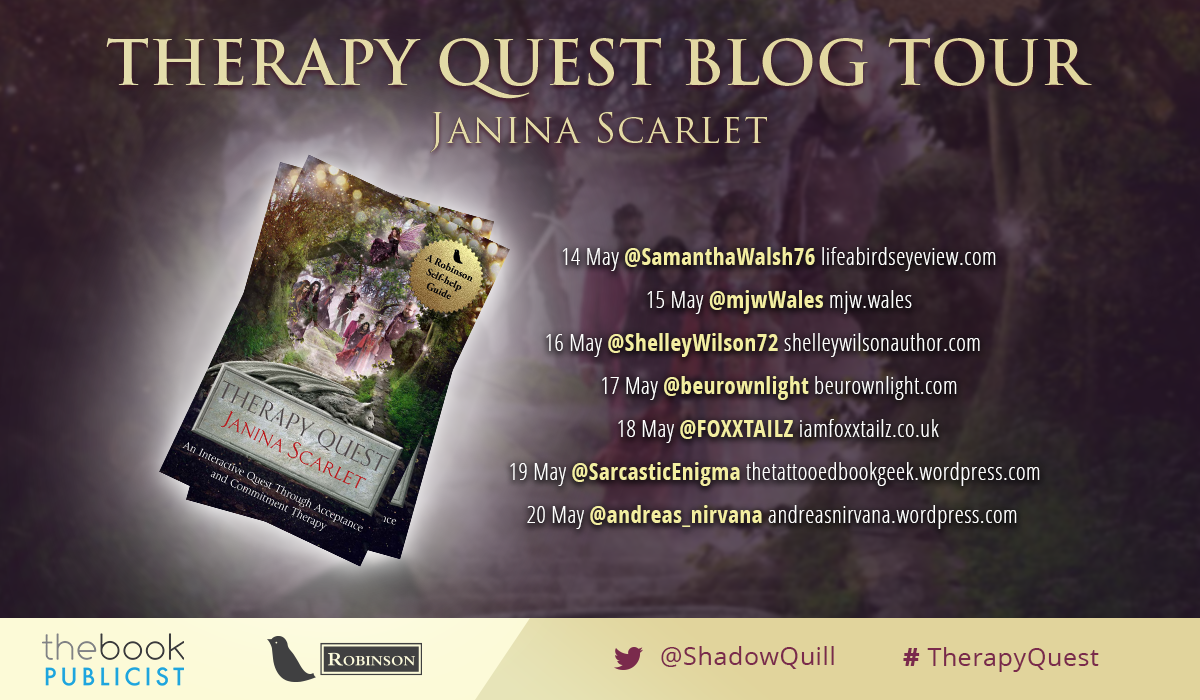
Guest Post: Interview with Dr Janina Scarlet, author of new book ‘Therapy Quest’

I have got to know Dr Janina Scarlet, psychologist as I have written more across the media. Janina writes about therapy and mental health in an approachable and meaningful way. She also loves superheroes and fantasy and incorporates them into her work!

This week for Mental Health Awareness Week, I spoke to her as she launches her  new book ‘Therapy Quest’.

bloggertour.png
(image: The Book Publicist/ Dr Janina Scarlet)


What is your new book Therapy Quest about?

Therapy Quest is an interactive fantasy book in which YOU (the reader) are the main character. You are transported to a magical world of Here and are the Chosen One to stop an evil sorceress, Mallena, from destroying the world. Only you don’t feel like a hero. Not at all. Your anxieties and insecurities nearly lead you to abandon your quest altogether. However, if you decide to partner up with some new friends, such as a vampire with an eating disorder, and an Ogre who struggles with obsessive-compulsive disorder, you just might be able to become a hero after all.

The book is written in a game-like format, which allows you to make choices along the way. Each choice you make will change the rest of your journey and can either allow you to earn or lose points. Some choices can kill your friends or your character, so you have to be careful.

Each time you make a choice, you will also learn a mental health skill, and you will need all the skills you can learn along the way to help you in your final battle.

What was your inspiration for writing it?

I knew I wanted to write a fantasy book with self-help elements in it, in which the reader could learn these skills through the characters they were reading about. My editor, Andrew McAleer, had the brilliant idea of having a similar format to “Choose Your Own Adventure” fighting fantasy books. This sounded like a very interesting challenge to me, and I am extremely honoured to have been able to work on it.

Could you explain a bit about what Superhero Therapy is and how it works in the book?

Superhero Therapy refers to incorporating elements of popular culture, such as fantasy and science fiction books, movies, TV shows, as well as video games, comic books (Superhero or otherwise) into evidence-based (research-supported) therapy to help clients to become their own version of a superhero in real life (IRL).

In Therapy Quest, the reader is the Chosen One, the Hero of their own journey even if they question their ability to do so. Through learning skills such as mindfulness, self-compassion, acceptance, and following their own core values, the readers are invited to take their own superhero journey and develop their own superhero skills, which can be utilized in their every day life as well.

Who could you recommend the book to?

I would recommend this book to anyone age 12 and up who might enjoy fantasy books and would like to learn skills to manage depression, anxiety, trauma, or other mental health struggles.

drjanina

Dr Janina Scarlet is a clinical psychologist and the author of Therapy Quest, a revolutionary self-help book which combines therapy with an interactive fantasy quest.

What UK Charities are doing for Mental Health Awareness Week and helping to break stigma by Eleanor for Metro.co.uk (Extract)

Today my article for Mental Health Awareness Week (by the mental health foundation) went live on the Metro.co.uk website. I worked with the Foundation, Samaritans, Young Minds and Time to Change to discuss their initiatives to help break stigma against mental illness and do something active in our communities.

Here is an extract of the article link to the full piece: http://metro.co.uk/2018/05/15/its-mental-health-awareness-week-how-are-charities-fighting-the-stigma-surrounding-the-subject-7533330/

mentalhealthaweek
(image: Eleanor Segall)

This week is Mental Health Awareness Week,  The event run by the Mental Health Foundation, has been running for 18 years. ‘Admitting it was shameful and embarrassing’ – what it’s really like to have kleptomania This year’s theme for Mental Health Week is: ‘Stress: Are We Coping?’.

Tackling stress, The Mental Health Foundation says, can go a long way to prevent anxiety, depression, self-harm and suicide, and it has commissioned the biggest ever survey into stress-related issues in the UK.

The survey, of 6,000 people across the UK, found some startling findings: in the last year almost three-quarters of people have at some point felt so stressed they felt overwhelmed or unable to cope.

It revealed that 74% of UK adults have felt so stressed at some point over the last year they felt overwhelmed or unable to cope, and that 83% of 18- to 24 year-olds said this, compared to 65% of people aged 55 and over.

Mental Health Foundation director Isabella Goldie says: ‘Millions of us around the UK are experiencing high levels of stress and it is damaging our health. ‘Stress is one of the great public health challenges of our time, but it still isn’t being taken as seriously as physical health concerns.’

Talking and breaking the stigma that surrounds mental illness is also hugely important So how are charities working to break down this stigma? We spoke to a number of them to find out.

The Mental Health Foundation

It is hoped that Mental Health Awareness Week will educate on stress and mental health, and start to open the conversation on coping methods and support, such as therapies, support networks and medication. The foundation is running the Green Ribbon scheme, a charity pin that can be bought.  Worn during Mental Health Awareness Week, It allows people to show support for good mental health for all, with all proceeds going to support the work of the foundation. Actor David Harewood posted a photo on Instagram about the campaign as he is an ambassador.

He says: ‘This year I am supporting MHAW. I am putting my face to the campaign and making a BBC documentary on the subject because 30 years ago I had a breakdown myself.

‘I am not sure why it has taken so long for me to go public with it, but, to be honest, I’ve been so busy over the past seven to eight years I haven’t really had the time. ‘Ever since I did last year, I have been astonished by the number of people who have come to me with their own experiences of mental health, encouraged by my frank admission.’

The Foundation wants the green ribbon to be the international symbol for mental health awareness. It is encouraging family and friends or colleagues to get together and have a chat about mental health over a curry. There are quiz ideas and  competitions to keep your guests engaged and to raise money for the Foundations work in mental health. To learn more, visit mentalhealth.org.uk.

To read more about the other charities and see the full article click the link below.

Read more: http://metro.co.uk/2018/05/15/its-mental-health-awareness-week-how-are-charities-fighting-the-stigma-surrounding-the-subject-7533330/?ito=cbshare

Twitter: https://twitter.com/MetroUK | Facebook: https://www.facebook.com/MetroUK/

5 Tips to Manage Stress: Guest post by Cloe Matheson

stressfree1

(image: Healthy Today Club)

With research increasingly demonstrating the correlation between prolonged stress and a shorter lifespan, we would all like to avoid the spectres of stress and anxiety.  But since chances are the vast majority of us have been confronted with both at some point and will be again in the future, what does it take to manage pressure yourself – or even better, to build a lifestyle which doesn’t allow stress a look in?

Check out our 5 simple tips to get started on your journey to calm.


  • Avoid triggering substances or habits


We hear it all the time, but it’s true: the things you fuel your body with significantly affect how you feel. Particularly if you’ve been diagnosed with a gut condition such as IBS (which has been shown to worsen in times of stress), you’ll want to ensure your diet is full of colourful, digestible wholefoods. In times of stress, a salad is often the last thing most of us want to reach for – but even if your current best move is reducing your caffeine intake, that is a step in the right direction.

If you’re currently using other substances to self-medicate during or after a long day – we’re talking nicotine (a stimulant) and alcohol (a depressant) – then let this be the push you need to give up those bad habits.


  • Anticipate and respond


Particularly for perfectionists and people who experience social anxiety, stress is unavoidable in daily life.  Although easier said than done, try to embrace this inevitability as best you can – as our fears often lose their power if we are prepared for them to manifest.  When you are in the midst of responding to stress directly, keep these coping mechanisms in mind:

  • Exercise – put those fight-or-flight hormones to good use and have a workout while restoring yourself to calm. This doesn’t have to be an hour-long run at peak intensity: it can be as simple as walking around your office block when you need a workload break.


  • Breathe – if you’re delayed in a waiting room or have just received challenging news, don’t panic.  Sit or stand somewhere comfortable, close your eyes, visualise a serene place in your mind, slowly breathe in and out, and relax to the sound of your exhalations until your heartbeat slows and you can figure out your next step.


  • Sleep


Even for those of us who believe we need no more than 5 hours of sleep per night, humans just aren’t built to withstand such short stints of shut-eye on a regular basis.  

The proper functioning of both body and mind rely on essential processes that occur during sleep, including the renewal of skin cells and the retention of information in the hippocampus – the main memory-processing section of the brain.  Since these processes can only be completed in a state of sleep, it’s best to take your zzz’s seriously.


But since stress may be the exact thing keeping you up at night, here are some rituals to build into your bedtime routine:

  • Stop work at least an hour before bed
  • Have a warm bath or shower at night
  • Put some lavender oil on your pillow
  • Read (a book, rather than a screen!) before you turn off the light
  • In the dark, focus on relaxing every separate limb and muscle of your body before going to sleep.


  • Get talking


John Donne was right: no man is an island. Bottling up your stress and trying to manage alone may work in the short-term, but not forever. To avoid building up pressure that leads to breakdowns, consider chatting to a counsellor or a grounded friend about how you’re feeling, or join a club or society which will allow you to talk with like-minded people who may struggle with similar problems. If you are internet savvy, even online discussion boards and forums can be a safe place to air your woes.


  • Prioritise and identify


Are you staring down a hectic month of appointments, task-juggling, and trying to perfectly fulfil a different role for everyone in your life?  Compartmentalise to deal with the mayhem.

What do you need to prepare for your next move?  Tackle your tasks individually and avoid thinking about your myriad other tasks until you are finished working on each one.  Stress often peaks when we consider all our problems or tasks in their monstrous sum, whereas they are much more manageable taken alone.

If you struggle through every month, you need to identify what causes your stress. No one can do everything, and you may find that you have overcommitted to tasks. What can you say No to? At times like this, it’s worth remembering that you are the only person in control of your life: so put your wellbeing first.

Cloe Matheson, the author of this article is a writer and blogger. She can be contacted here:  https://cloewrites.tumblr.com/

Fitness and how it can help Depression: Guest Post by Paul Matthews

fortaleza

(image: Fortaleza Fitness Center)

Dark times can come. When you reach your darkest days, the ones in which your thoughts are controlling you and you can barely do anything, you should try and keep yourself busy, if this is possible. Its not always possible for people who are unwell- but distractions and exercise are always helpful, especially if they benefit your overall health.

These are the top 3 reasons why taking exercise could help you if you’re suffering from depression:

1: Engage your mind and keep it busy

Last year was one of the worst periods of my life: I broke up with my girlfriend, changed my job and lost one of my best friends. I was that sad and my mind was not properly functioning, all my thoughts were invading me all day and I was barely able to do anything.

One day, I went for a 5 mile run, because it was sunny, right after work. During this time, no negative thought hit me. That was when I opened my eyes: if you don’t dwell on depressive thoughts, then you will be able to see the light at the end of the tunnel. I decided to get a gym membership and I started working out for an hour after work. It has really helped me manage my depression. I am happy right now: my life is busy, but I have plenty of energy every day and less dark clouds.

Keep active and you should hopefully see the benefit!


2: Your lifestyle can affect your mental health

One of my friends who had depression loved junk food. He was constantly sad and depressed. He also did hardly any exercise. I encouraged him to exercise more and go to the gym if possible. The exercise helped him feel more positive and like he was taking good steps back to wellness. 
3. Help Your Self Esteem and Do it for you 

Many people told me that they were embarrassed to do exercise and particularly going to the gym as they felt “ugly, insecure, overweight and not fit” and so on. The best advice I can give is: get yourself some good fitness clothing you feel comfortable in. This might sound a bit weird, but properly fitting exercise wear can boost confidence and promote positive mental health.

Its also important to note that you aren’t the only one feeling this way and most people feel the same about themselves. Take that leap today.

When you are approaching fitness, whether if it’s in the gym or outside, or even at home, you must not forget about why you are doing it, why it’s important for you and how this could help you with your mindset.

Gentle exercise includes swimming, walking and yoga. There is something for everyone.

Try and see over the wall and remember: after the storm, the sun will rise again. Keep it up!


paulm

Paul Matthews is a freelance business writer in Manchester, who has headed up several campaigns. His aim is to better inform business owners and professionals on the hidden dangers of the workplace. You can often find him mountain biking or at the local library.

You can contact him at : https://twitter.com/paulwritesalot

Guest Post: On Sexual Abuse by Anonymous Woman

childab.jpg

(image: JPMS Medical blogs)


The writer of this article is an anonymous woman who wanted to speak out to share her story of being sexually abused as a child and teen. She also has mental health issues as a result.

Trigger warning: please read with care 


I have been abused twice, both times were at the hands of people I knew and respected, once when I was 8 and once at around age 17/18.

A lot of the memories were lost due to the extent of the trauma, but having EMDR has opened up the box, broken the chain that was firmly fixed around it and let all the memories out.

It has been horrendous, reliving the abuse, the detail of my memory, almost physically feeling I am back, as a child in that bed, remembering the details .  The family friend was a women, who was so trusted by all of us, growing up I adored her, admired her, almost wanted to be her, and now, all of those feelings have vanished replaced by to many emotions to specify one.

When I was a teenager I was abused by a well known Rabbi, thankfully the abuse this man carried out has come out in to the community.

I have written this letter in the hope that more people in the community may feel more able to step forward to talk about this.

If someone would like my e mail address please ask the blog owner for it.  

Dear my abuser (s) 

This letter will never get sent , but I want you to know what impact you had on my life, how those actions which may have only lasted 15 -30 minutes , actions which you probably have forgotten about, shaped the person I have become. 

In a strange way I am grateful for the memories of what you did, as not having the memory, yet knowing that something happened was worse. When the memories savaged my brain, invading my mind with your face, your hands and your body I believed that the shock and horror would never pass, everything I had ever thought of you, all my memories of you changed from seeing you as a positive, supportive influence to a monster who had harmed me in the worst way possible.

Your actions, made me aware from such a young age of my body .For years I knew, that from the age of around 9 my body was an immensely complicated thing in my mind, at such a young age being so aware of my body affected my confidence, self esteem and self love . 

At age 8 you took away the most precious thing, you helped yourself to my innocence, you took away from the person I could have become and began my journey to becoming the person I have been.

That knowledge made me in to a pretty messed up person.

My child is around that age . I look at my child  and see a happy future, a future filled with love and self confidence. The thought of something similar happening to my child  is to painful to contemplate.

By the time I was in my teens, my journey of self destruction was well on its way. I had learned by that time how to hide things, how to keep secrets, how to come across as confident and well adjusted and to this day my public persona and the person I am inside are two very different people. My life, for so many years was about seeking physical pleasure in order to reassure myself that I was a loveable, attractive person, that having sex was the self affirmation I needed to survive, lowering myself, giving my body freely, whilst hating myself for doing it, gave me the tools to breath, to live. Even today, if I do not feel my husband desires me it destroys me for days.

There were so many questions, mostly WHY, and HOW, how could I have let this happen to me twice, and why did it happen twice ( I know now that is was BECAUSE it happened once it happened again ) , how could I have stood as an older teen -when I let the pictures overtake my mind I am screaming silently why, why, why.

It is like being at a movie, a never ending movie, you can not leave the screening, you are on the screen, you try to yell, you try to reach out to the girl in the movie, but she can not hear you, you see her at 8, you see her at 17 you see her life unravelling, and you can not do anything to stop it, you want to beg her to tell, you want to beg her to be strong.

You see the girl grow, you see the way she lived her life, and you understand how the girls journey began, it makes sense to you that the girl ends up with severe mental health issues , you see how mental health issues are worsened by no self esteem, how other tragic events  could tip her over the edge and compel her to seek comfort in the arms of any man who would take her, and you understand her.  

 I understand now that cause and effect would dictate that the reason I ended up in your office, was a direct result of what she did to me at age 8, that she was the one who started the chain of events.

You taught me, you guided me to the mind-set that “the way to get love and care is to do what a man wants”.

My whole self worth was wrapped up in a package labelled, please sleep with me.

I feel so much sadness, sadness for the girl you both violated, sadness that the girl whose body you choose to fulfil your sick desires was mine, sadness that I am constantly questioning everything, why was I there, how could I have let you, why didn’t I tell anyone, when will I be able to go a day, an hour, 10 minutes without one of you pushing your way in to my thoughts.

There is nothing I can do to turn back time, there is no way I can ask you why, or sit with you and show you the movie of my life, the one which you started, I pray that there will come a time I can accept what you both did, I hope with all my heart a day will come when you will not mean anything to me.

All I can do is wait, sit with these constant overwhelming thoughts, trying to untangle them like a necklace with those annoying knots in the chain that are impossible to open, yet I will persevere.

I will continue to pick at the chain until all those knots have gone and you both become dust that is blown away from my mind


If you need support with sexual abuse and you live in the UK please contact:

The Survivors Trust

https://migdalemunah.org.uk/

Safe Line