

(Image: Tough Minds/ Michael Mander)
If you’ve ever tried to get mental health support, you’ll know that it can feel like watching a game of ping-pong. You call one service, and they refer you to another. They point you to a helpline, which suggests a group. And at the end of it all is the bottom of a waiting list.
There’s a big shortage of mental health support out there. Whether you’re one of the millions struggling with a severe mental health illness, or simply going through a difficult time in your life, it’s never been harder to find care.
It’s not good enough, and everyone deserves access to the support they need – whether that’s a therapist, a diagnosis, a helpline, a support group.
But the truth is that no service, however good, can give us everything we need, all of the time. The toughest moments in life don’t wait for a therapy appointment. There will always be moments where you’re on your own with it.
That gap is what I built Tough Minds for.
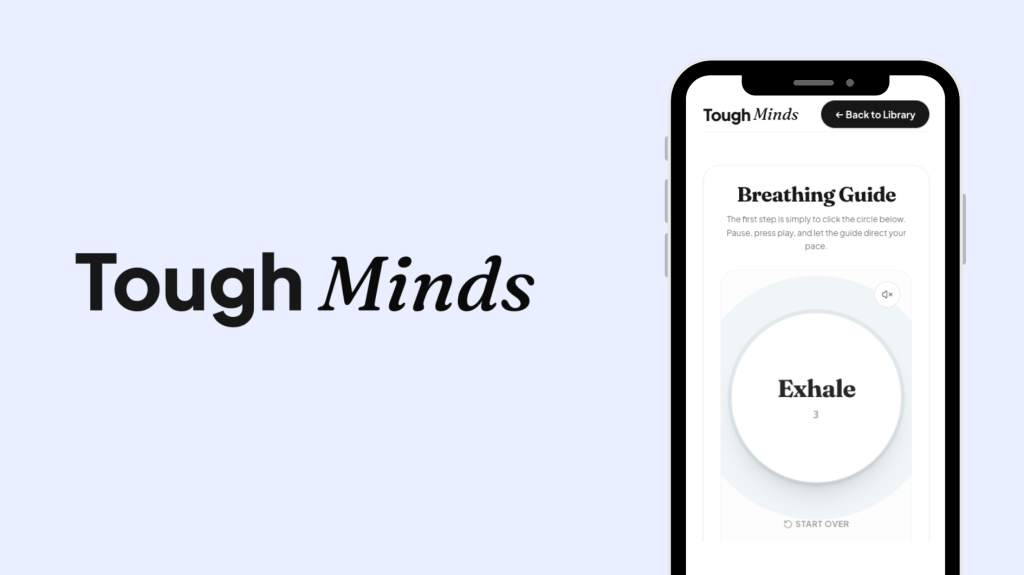
Tough Minds is a completely free, online toolkit to help you go from a difficult moment into a lighter one. There are breathing exercises, guided meditations, an urge-surfing timer, and calming soundscapes to help you relax or decompress.
These are exactly the sort of exercises that a therapist or counsellor might recommend you try – but the ones that are so hard to remember at 2am when you’re in a crisis, or when you’re trying to fight off a difficult urge, or when you just need five minutes to breathe before a job interview.
That’s why Tough Minds has no sign-up, no app to download, nothing to pay for, no ads. Whenever you need it, you can just go to Tough Minds.

(image: Mediensturmer: Unsplash)
Building emotional resilience
Those in-the-moment tools are only half of the reason I created Tough Minds. The other half is about building the underlying skills that can make those difficult moments less frequent and less severe.
We are less likely to be taught how to look after our mental health in school – and that’s a problem. We only ever learn how to look after our minds once we hit a crisis point – which is a bit like taking your first driving lesson when you’re already halfway round the M25 (UK motorway).
It doesn’t have to work that way.
Building Emotional Resilience
Tough Minds also has tools, games and exercises to help you build emotional resilience – the sort of skills you might learn in therapy. There are skills that help people manage emotionally difficult moments and even help with some mental illnesses. Skills like having a wide vocabulary for your own emotions, or knowing how to catch and reframe a spiralling thought before it takes hold.
These are skills like any other – they can be built so they’re there when you need them. That’s the part of Tough Minds I’m most excited to keep building: to improve and steady mental health.
None of this is about pretending that a website or an app can do the job of real support services, or the human-to-human support that so many of us benefit from.
However, what Tough Minds can do is help all of us take care of ourselves. Not instead of support, but around it: when you’re on a waiting list, the days between sessions, the stretch of life after a course of treatment ends, and for the times life is just a little hard.
If that sounds useful to you, you can find Tough Minds at toughminds.org. It’s free, and it’s there whenever you need it.
Michael Mander, founder of Tough Minds

