9 Years Undiagnosed: My Life with Bipolar Disorder, for Time to Talk Day: Guest blog by Mike Segall

timetotalkdaydad1

(image: Time to Change)

*Trigger warning: discusses thoughts of suicide and mania, please read with care *

This blog has been courageously written by my Dad, Mike, about his journey with bipolar disorder and the hurdles he faced in getting a diagnosis. For those of you who have read my book, you’ll know some of this. This is the first blog that Mike has written for us and I want to share it on today, Time to Talk Day by the charity Time to Change.  So here is Mike’s story….


My experience of Bipolar 1 Disorder was that I was undiagnosed for 9 years. I was never sent to a psychiatrist and was put on the wrong medication (I hadn’t heard of mood stabilisers and seemingly neither had my doctor).

So- What is Bipolar Disorder? (formerly known as Manic Depression)

To me, Bipolar symbolises the two extreme poles of mood- mania and depression. The North Pole is Mania. Mania is wonderful for me- you think you can be anyone, you think you can do anything, achieve anything, You are flying. You think ‘why can’t everyone be like this and experience everything?’. You are much more uninhibited. You may shop more, you spend more money, You think you can FLY!

But you can’t fly and you fall, you fall off a cliff into varying degrees of  deep, dark depression, which can last for months.

Bipolar disorder is  a chemical imbalance in the brain that causes periods of depression and periods of abnormally elevated mood, mania. The elevated mood is significant, known as mania or hypomania depending on its severity and whether symptoms of psychosis are present. Psychosis means when your mind lose touch with reality, with delusions or hallucinations.

During mania, someone feels abnormally, happy, energetic, irritable and not requiring sleep they often appear to be bouncing off the walls, starting new projects, trying to achieve too much. In some cases, addictions during mania may also present.

During depression, someone with bipolar disorder may be crying, experiencing negative thoughts and giving poor eye contact. You will notice this if you ever have a conversation with someone who is depressed. They may also be suicidal or talk about self harm.

My Story:

My first manic episode occurred in 1991 and I went to the doctor and was prescribed Valium (an anti anxiety calming medication), which was handed out like sweets in those days.

The Valium didn’t do me any harm but they certainly didn’t do me any good. In the next 9 years, I had three manic episodes followed by three increasingly devastating depressive and suicidal episodes, the last of which lasted 5 months.

In my first manic episode I was going out a lot late at night to clubs and bars and spending too much money. My second and third manic episodes were much more controlled as I recognized what was going on but I was still much more outgoing than usual and spending too much money.

My depressive episodes were serious and eventually suicidal and lasted 3, 4 and 5 months respectively. I often stood on the edge of a London Tube platform thinking about ending it all. I would drive down the motorway at speed not turning the corners until the last possible moment. I would stand in the bathroom with hands full of tablets thinking about overdosing and ending my life. Mostly, I was at home in bed doing nothing but sleeping , eating and surviving.

The person you would meet today is not the person you would have come across at that time.

Looking back there was no real connection made between these episodes and I wonder 1. Why I was never hospitalised and 2. Why I wasn’t diagnosed more quickly.

First of all, 30 years ago far less was known about Bipolar Disorder so the doctors weren’t quick to diagnose it. Secondly, it was only after 9 years that my GP reviewed my file and noticed that I had never been referred to a psychiatrist.

This was the breakthrough that changed and saved my life.

I went to The Priory hospital to see a psychiatrist, describing my episodes. Within 45 minutes I had a diagnosis,

”You have a mental illness. It has a name, It is Bipolar 1 Affective Disorder. You have it for life and it is treatable with the drug Lithium.”

Lithium balances out the chemical imbalance so you end up between the poles and mood is then stabilised. I am pleased to say that in the past 20 years, the medication has worked for me and has stabilised my bipolar disorder, so I no longer get episodes of mania or depression.

I am also pleased to say that as quite an emotional person I still experience the normal feelings and emotions that come with everyday life.

Starting on Lithium is not easy as you have to be weaned onto it. There are side effects, the most common being weight gain and you have to have regular blood tests to make sure the level of Lithium in your bloodstream is correct (non toxic) and it is not affecting your kidneys.

I do wish that I had been diagnosed earlier and not had to suffer manic and depressive episodes as I did.

These are the 4 takeaways I would like you to have from reading this, this Time to Talk Day:

1. With mental health it’s good to talk about it , It’s good to fight stigma and it’s good for your own healing.

My journey started in 1991 and I would hear things like ”you’ve got a weakness. Why don’t you pull yourself together?”, which were unhelpful

2. Think about how you can help people in your community by recognizing the signs that someone has depression or mania.

3.  Live a positive life- I am an example of a bipolar sufferer who can maintain a positive life. Bipolar is an illness that needs treating. It is treated with medication but it can take time for the medication to be right as each person has individual brain chemistry.

4. Listen to those who are struggling. Most of us listen to reply. If you watch two people deep in a conversation or you are in one yourself your focus will be very much on the other person and you will be listening at 90%.

But if you are listening to understand and you are feeling and sharing their emotions then you are truly listening at 100%. Check out the Samaritans help line too.


mikesegall

(image: Mike Segall)

Mike Segall is a professional speaker and mental health advocate, sharing his lived experience with bipolar disorder to groups in the UK. He is also the father of the founder of this blog, Eleanor.

Talking for the Jami Mental Health Awareness Shabbat 2020 by Eleanor

jamimhas1

As some of you will be aware, back in 2017-2018, I helped as a volunteer with fellow volunteers (Lisa Coffman and others) to found the Mental Health Awareness Shabbat (Jewish sabbath) in our communities across the country here in the UK. The initiative, led by the mental health charity Jami and conceived by Rabbi Daniel Epstein, now runs in 150 Jewish communities.

This year, my dad Mike and I were delighted to be asked to share our father and daughter journey with bipolar disorder to Chigwell and Hainault Synagogue.

I have social anxiety- which includes at times a fear of public speaking. In December, I had a breakthrough, where I spoke for a short time at a conference called Limmud alongside my Dad and read from my book Bring me to Light. So, when we were asked to do this talk at Chigwell, I felt it could be possible.

I armed myself with the fact that I knew kind people in the community including the Rabbi and his wife and friends of my husband Rob (its the community he grew up in). I also wanted to share my story to help other people.

So, we stayed with a lovely lady in the community and had friday night dinner with the Rabbi and his family. On Saturday morning, I woke up feeling a little nervous but took my trusted anxiety medication for when I need it- Propranolol, and walked to the synagogue with Dad.

I managed not to have a panic attack and the thought of speaking to help others got me through (as did distraction, deep breathing and drinking a glass of water).

So, at the end of the service, we were called up to speak. Dad went first and talked about his journey with bipolar disorder from when it started for him in 1991 to finding recovery. Then, it was my turn.

I stood up there in the pulpit speaking to a packed audience with a prepared speech. I felt scared but also empowered and began to relax into the talk. I knew that by sharing what happened to me, being sectioned and so ill and talking openly, that I could break stigma and touch others. I was also so proud of my Dad for speaking so openly.

It was only after, when talking to people after the service, that we realised that about 150 people came to listen to our talk! We had some important conversations with people after our talk including someone very newly diagnosed and someone else whose niece had bipolar and is currently very ill.

I couldn’t and still can’t believe I was able to do that. However, since I have been very tired so trying to de-stress and rest as much as I can!

We just want to thank everyone who came to hear our talk and supported us, to every person who thanked us for coming and shared their stories with us. We are so grateful for such a positive reception and thank Rabbi Davis and the Chigwell community for having us.

The Mental Health Awareness Shabbat has had events in communities all across the country. It runs yearly and you can find out more here 

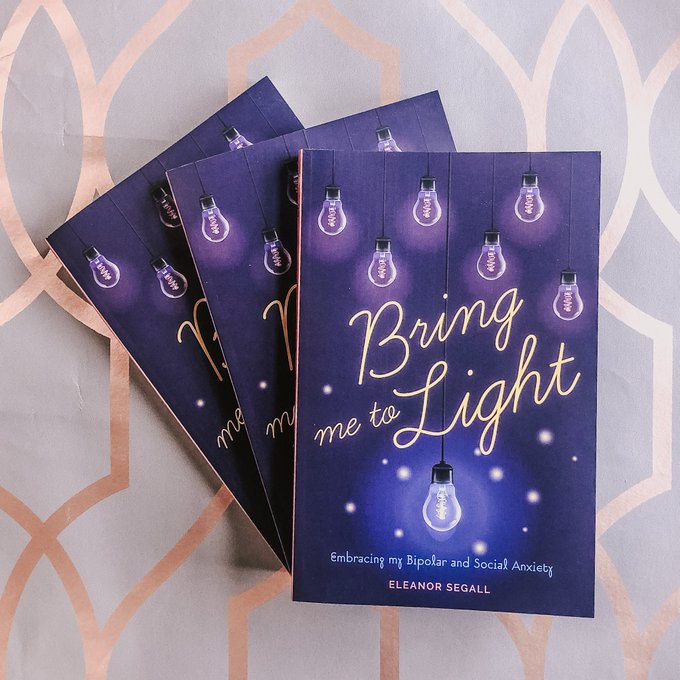
Why I wrote my book, ‘Bring me to Light: Embracing my Bipolar and Social Anxiety’ by Eleanor

bringmeinsta1

(image: Trigger Publishing)

This blog has been a long time coming. I have been so busy promoting my book on social media and in the press that I havn’t actually sat here and told you WHY I decided to write this book. So, here goes.

Firstly, can I just express so much gratitude to this here WordPress blog because without it, I would not have got commissioned at Metro.co.uk (thank you Yvette) or for other places online. This blog gave me the confidence to write and to expand my writing’s reach and for that I will be forever grateful.

In 2013/ early 2014, I sat on the couch, crying and living with a suicidal depression. My bipolar was unstable and all over the place- I felt so low and like there was no way out. However, as I sat and cried- a friend of mine’s face peered up from the newspaper. He was looking for the man that saved him from suicide and was launching a campaign called Find Mike to find him. That man was Jonny Benjamin (who now has an MBE). I had known Jonny for many years as a teenager through friends, but he became my inspiration and my hope that I too could do good things despite having mental illness. He very kindly has provided an endorsement too for my book- thank you Jonny!

With the help of my psychiatrist, I recovered temporarily from the depression but then spun very fast into mania and psychosis (possible due to a large dose of anti depressant). I was sectioned and in hospital for 4 months as an inpatient and a further 4 as an outpatient.

Throughout this time, I could not think about writing because my mind wasn’t stable enough. But as I pieced my life back together, started taking a new mood stabiliser to help control the bipolar episodes and started to recover slowly, I found the power of blogging about my social anxiety due to trauma of the bipolar, to be so helpful. I found that others would share their stories and would reach out to me about their mental health too.

Although life is not perfect and I am still living with an anxiety disorder, I have found a way to write and speak about mental illness. I was diagnosed with bipolar at 16 and there was a lot of shame for me about it back then in 2004. These days, I tell my story for other scared 16 year olds newly diagnosed but also to break down barriers and stigma against mental illness. To explain you can have bipolar or be sectioned or have psychosis but you can recover and you don’t need to spend life in hospital forever. To explain that while this cruel illness runs in families, that with the right healthcare, staying more stable is possible.

I started writing my book with Trigger Publishing because they believed in my story when I sent them my proposal. They are part of the mental health charity the Shaw Mind Foundation and royalties go towards the charity as well as some to me.

I hope that when you read my story, you won’t see it as a despairing ramble- but rather a story of hope, of life, of light triumphing over the darkness- but the darkness making the good times shine brighter. I also bring my bipolar to light, I share it with the world- as scary as this is, so that others can also tell theirs.

I wrote this book too provide a place to talk, start conversation and help heal myself through writing it but sharing that feeling of hope with others too. The book cannot change things that are so needed like urgent mental health funding of the NHS so we have parity of esteem. Yet, i hope it is a starting point about how important mental health treatment is for people to move forward in their lives.

Bring me to Light is out on 5th November 2019 in the UK and is available worldwide. It will be out in the USA in 2020. It can be purchased on Amazon, in book shops and at triggerpublishing.com

I will be sharing press articles and more about the book as it happens, but I hope this blog explains why I wrote my book. Thank you all for your ongoing love and see some of you at the book launch!

Love,

Eleanor x


How to reduce Stress and maintain Mental health during a Divorce: Guest blog by Luci Larkin at Woolley&Co

Going through a divorce or relationship breakdown can be one of the most stressful situations a person can find themselves in. You lose your friend, partner, confidante and have to adapt to living as a single person, often as the primary carer of children. 

This is a time of extreme and mixed emotions made more complicated by the stresses and worries of legal and financial considerations as well as having to support and counsel any children that may be involved and suffering too.

With mental health problems on the rise and divorce being listed as one of the leading contributors, Luci Larkin from Family Law Solicitors, Woolley & Co, explains how you can reduce stress during such a turbulent time in your life.

“If you have decided your marriage is over you will most probably want to make the whole process of divorce as painless as possible. Contrary to public perception not all divorces have to involve outright war leaving a trail of destruction and despair.

Every individual going through a relationship breakdown will deal with this in their own way. Some prefer to carry on as though nothing has happened, others find it cathartic to talk to someone about their problems.”

It’s fair to say that anyone going through a separation or divorce is going to experience a series of emotional stages post-breakdown. These could range from anger and depression to fear and frustration. All perfectly normal feelings and reactions to an emotionally difficult situation. It’s important to recognise these feelings but to try and stay positive. 

Sometimes the support of friends and family is enough to see a person through, others may need more help such as counselling or medical advice.

With the right divorce lawyer you should be able to resolve a divorce sensibly enabling you and your children to move on with your lives in the most amicable and constructive way.” 

So what is the secret? 

Divorce lawyers’ tips for a less stressful divorce

Luci explains, “As tempting as it is to take advice from your best friend or the “know it all guy” in the pub it’s really important to seek proper professional advice. Couple this with my 5 tips below:


  1. Talk to a family lawyer who is ideally a member of Resolution committed to resolving disputes in a non-confrontational way.
  2. Listen to the professional advice given to you and try to act upon it. Always negotiate before you litigate. Compromise is the essence of any agreement.
  3. Inevitably there will be disagreements with your spouse but try to keep emotions under control and avoid verbal abuse and threats. This will simply lead to them becoming difficult and inflexible. You do not want a war.
  4. Try to avoid involving the children or using them as a pawn. They are innocent in this situation and they will need the love and support of both parents. Ideally sit down and agree a parenting plan.
  5. Think about timing. You may have been thinking about a divorce for years whereas your partner may only have received the news a matter of weeks ago. Expecting your spouse to discuss future living arrangements at a time when they are still reeling from the news that you want to end the marriage, may be unrealistic. You might have to slow down for a while, be patient, and wait until they are ready to move things forward.”

Whilst getting a divorce is clearly not an ideal situation it does not have to be a time consuming, stressful, unpleasant money pit.

Sensible advice coupled with calm cooperation can help to ensure the experience is as painless and cost effective as possible but more importantly that you and your children can move forward with your lives in the best possible way.

Luci is an experienced and approachable divorce and family solicitor with Woolley & Co, based in Barnet, Greater London.  Her working mantra is to establish what clients want and move towards achieving that outcome as quickly and as cost-effectively as possible. 


How stressed are UK Students in 2019? Guest post by the Natwest Student Living Index


natwest1

(Image: Natwest Student Living Index)

The NatWest Student Living Index 2019 has launched recently,  delving into both stress and mental health for students at university.
https://personal.natwest.com/personal/life-moments/students-and-graduates/student-living-index.html

University-age students are more engaged with mental health and wellbeing than ever, and the study found that 1 in 4 students are very satisfied with their university’s mental health support.

Other noteworthy findings from the survey include:
• 71% of students say that their university offers affordable health and wellbeing programs (gym classes, yoga, meditation, mindfulness)
• 40% of students are concerned about their financial situation following university
• 45% of students find their university degree stressful
• 1 in 4 UK students find managing money stressful

The 2019 NatWest Student Living Index revealed that close to half of all UK students feel
extremely stressed by their degree studies. 1 in 4 students in the UK described managing their money as extremely stressful, while only 6% felt they received sufficient money management support from their university on average.

NatWest’s Student Living Index 2019 asked students from 35 top university cities about all aspects of student life, including the amount of wellbeing and mental health support on offer for students at university in 2019.

Is their degree the cause of the stress? On average, 45% of students in the UK feel extremely stressed by their degree  Cambridge (60%) and Durham (57%) students are the most stressed by their degree studies.
Have Universities supported students with mental health resources?

1 in 4 students are very satisfied with their university’s mental health resources, while 71% said that their university offers affordable health and wellbeing programs.
Interestingly, while students in Poole feel the most stressed by money management, the city also came last when students were asked about the availability of affordable well-being programs:

 53% of students in Poole said their university offers affordable well-being programs, this is the lowest ranked city and 18% below national average.

 Less than 1% of Students in Reading and Stirling feel supported by their university when managing their finances.

 94% of students in Aberystwyth feel their university offers affordable well-being programs

Are you a student in the UK? Read more about the findings here:  https://personal.natwest.com/personal/life-moments/students-and-graduates/student-living-index.html

Mental Health Awareness Week: The Mental Health Foundation: Body Image 13th-19th May 2019

mentalhealthawarenessweek

(image: Mental Health Foundation)

This week, starting today is the Mental Health Awareness Week by the UK charity the Mental Health Foundation. Its theme is looking at Body Image, how we think and feel about our bodies.

Mental Health Foundation say ‘Body Image can affect us all at any age- during this week we are publishing new research and campaigning for change’    .

They continued,

Last year we found that 30% of all adults have felt so stressed by body image and appearance that they felt overwhelmed or unable to cope. That’s almost 1 in every 3 people.

Body image issues can affect all of us at any age and directly impact our mental health.

However there is still a lack of much-needed research and understanding around this.

As part of Mental Health Awareness Week:

  • We will be publishing the results of a UK-wide survey on body image and mental health.
  • We will look at body image issues across a lifetime – including how it affects children and young people, adults and people in later life.
  • We will also highlight how people can experience body image issues differently, including people of different ages, genders, ethnicities and sexualities.
  • We will use our research to continue campaigning for positive change and publish practical tools to help improve the nation’s relationship with their bodies.’
  • The good news is that we can tackle body image through what children are taught in schools, by the way we talk about our bodies on a daily basis and through policy change by governments across the UK.’

For more on how you can get involved see : https://www.mentalhealth.org.uk/campaigns/mental-health-awareness-week


Royal family launches Shout UK- a Mental health crisis text line: Guest blog

Be Ur Own Light is supporting the incredible initiative from the Duke and Duchess of Cambridge and Sussex- Shout UK, a new text support line in the UK for people in mental health crisis- anyone who is struggling. They have teamed up with Crisis Text line to reach vulnerable people.

I feel privileged to live in a country where stigma is beginning to fall and where mental health issues are beginning to be understood better. Texting would have helped me as an ill teenager with bipolar!

Shout are looking for volunteers too to man the text lines as crisis counsellors.

Thank you to the Duke and Duchesses for the incredible profile they are giving mental health. #GiveUsAShout

The Connection Between Anxiety and Substance Abuse: Guest blog by Nu View Treatment Center

When people abuse drugs and alcohol, it is often the sign of a deeper underlying issue. For many people struggling with addiction, the source of their addiction is due to mental illness that often has gone undiagnosed. One of the most common co-occurring disorders seen with substance abuse is anxiety. The following article will outline what defines anxiety, and the connection between anxiety and substance abuse.

What is Anxiety?

In general, anxiety is an important emotion to have. While it may be normal to feel fear, apprehension, and nervousness from time to time, it becomes an issue when people experience these emotions at excessive levels. When anxiety takes over a person’s thought process, it manifests itself into physical symptoms such as the following:

  •    Increased and constant restlessness
  •    Increased and uncontrollable feelings of worry
  •    Irritability
  •    concentration difficulties
  •    sleep problems


Anxiety can be grouped into several types of disorders. These can include generalized anxiety disorder (GAD), panic disorder, post-traumatic stress disorder (PTSD), phobias, social anxiety disorder, and selective mutism among others. The leading causes of anxiety include work and family stresses, financial worries as well as underlying medical issues. The roots of anxiety can also be traced to past traumatic events that are unresolved.


How Anxiety and Substance Abuse Connect

When people suffer from anxiety, mental and physical symptoms can be very intense and can wear on the body and mind. To get some form of relief, people may turn to substances that stimulate dopamine in the brain to help numb the feelings of discomfort. Self-medicating oneself to take the edge of off anxiety only works in the short-term and can have a rebound effect that makes anxiety worse over time. Without addressing the roots of anxiety, their condition will worsen over time—along with their substance use.

The connection between anxiety and substance abuse can also trace back to the teenage and young adult years. During adolescence, the brain is still developing and forming. If people used drugs as a teenager, it could alter the development of the parts of the brain that govern reasoning and impulse control. Drug and alcohol use early in life can increase the likelihood of anxiety and substance abuse as that person gets older.

Another reason for anxiety disorders and substance abuse connection is because of one’s genetics. Some people may be more predisposed to both anxiety and drug and alcohol dependence through genetic factors shaped by one’s environment.


Getting Help

For those dealing with co-occurring disorders, they must seek specialised help from a dual diagnosis treatment facility specializing in mental health and addiction disorders. The first step in getting help is undergoing medical detoxification. During detox, patients will undergo medication-assisted therapy to help better tolerate the physical and psychological symptoms associated with withdrawal. Additionally, staff will perform physical and mental health evaluations to pinpoint any underlying issues that may impact recovery.

For those suffering from dual diagnosis, treatment will include mental health services in addition to addiction treatment services. Dual diagnosis facilities feature mental health professionals working alongside addiction treatment personnel in creating an individual treatment plan that fits each client’s specific needs.

In addition to therapy, 12-step counselling, life, and coping skills training and other forms of treatment, patients will receive mental health treatment with a focus on ongoing counselling and medication-based therapies that will give them the tools to handle anxiety.


This guest blog was written by Nu View Treatment Center

Dealing with Life Stress: For Mental Health by Eleanor

Hi friends,

I have needed to write this blog for a while, where do I begin?

A few weeks ago, my father in law to be was taken to hospital with a rare form of pneumonia, caused by a weak immune system due to his cancer treatment. He was very ill and on oxygen as he couldn’t breathe. Thankfully very strong antibiotics were pumped into him and the infection is going and hes now off the oxygen . However, he is still in hospital on a feeding tube and slowly recovering from a bout of confusion (caused by low sodium levels).

This has been really upsetting and stressful for all involved, but we’ve had an amazing amount of support- with food, prayers, charity donations and hospital visits. Its been hard for me as the hospital is not near my home too.

We now have 2 months to go to the wedding and I am super excited but also worried- we really want my father in law to be there with us and well on the day so praying hard.

I start a new job on Tuesday in PR and Communications but will still write and blog on the side. I am also writing my book currently and am on deadline, so its all go here!

My anxiety levels are high in the mornings at the moment, I had chest pains this morning from stress and I am needing to take time for me and relax when I can. I think its because of everything happening all at once and so much to do for the book, wedding and so much change happening.

I do not like change but sometimes change is vital for us to grow.

I could do with a spa day though and some deep breathing exercises, meditation and general management of life stress. I am juggling a lot- and needing a break really.

How do you manage when life stressors become too much?

Love,

Eleanor xxx


How to Maintain Mental Health at Work: Guest blog by EM Training Solutions

workplacementalhealth1

(image: EM Training Solutions)

This article written by EM Training Solutions introduces some simple yet effective steps you can take in order to ensure your health and wellbeing remain a priority in the workplace.

There’s no ignoring the fact that as adults, we spend the majority of our time and lives at work. It’s where we make friends, earn our income and spend day to day so it’s no surprise that a massive 89% of workers with mental health problems reported an impact on their working life and nearly half of the people surveyed also admitted that they had considered leaving a job role because it negatively impacted their mental health.

These shocking statistics show that there is a clear correlation between mental health and our working lives, making it crucial that we take the necessary steps to maintain our mental health and wellbeing in the workplace. Here are some tips on keeping a positive and healthy mental attitude in work:

Keep Organised

One of the simplest things you can do to help you remain focused and stress-free in work is to try and be as organised as possible. When you feel on top of your tasks and are working in an organised environment, this make you feel calm and in control.

When you’re in control, you’re much less likely to panic or feel overwhelmed. Keeping your diary up to date with commitments and important reminders will allow for your days to run smoothly. Also try taking small steps such as arriving to work 15 minutes early to give yourself plenty of time to set up for the day ahead, make yourself a hot drink and tidy your email inbox.  Having this head start can help you clearly plan out your day and it also gives you a few extra minutes to yourself.

Speak up

Communication is key in any working environment. Whether it’s voicing your opinion on a situation that is negatively impacting you, or admitting when your workload is too much; speaking up to someone that is able to offer help and support is a great way to deal with any form of stress before it builds up into an even bigger issue. Although this may be daunting, especially if you suffer from anxiety it will bring a great sense of relief once you have got your feelings and thoughts off your chest. Your employer should also respect you for your honesty and will be able to come up with a plan on how to help you.

Practise Self Care

Self care comes in many different forms, and it can be something as little as taking your full lunch break and spending it alone in your favourite coffee shop in order to get some time to yourself. If you suffer from anxiety or depression in general, then recognising your limits and when you need a day off is also incredibly important.

Having a day off work to focus on your mental health is just as valid as having a day off when you have a sickness bug. Both require time to rest and recover and you don’t need to feel guilty for putting yourself and your mental health first.

Be Realistic

Constant demands, deadlines and pressure in the workplace can leave us feeling overwhelmed and stressed to say the least. Try your best to be realistic about the work you can cope with and don’t try and take on more than you can handle.

If your boss is giving you ridiculous amounts of work to do in a short space of time, or is asking too much from you then try and speak with them, or if they aren’t approachable book in a chat with a member of the HR team to explain and try to find a solution. You will feel better for being honest and getting the extra support you need.


This article was written by: 

EM Training Solutions are a Pearson Vue approved training provider for a number of different compliance and health and safety courses. They boast over 10 years of experience within the industry and specialise in first aid training as well as traffic and fire marshal courses.