Guest Post: Learn How to cope with Postpartum Depression by Kayla Clough at ourstart.com

After having a baby, there are many women who find themselves suffering from postpartum depression. Postpartum depression can cause feelings of sadness, lethargy, anxiety, and hopelessness. It’s important to do everything that you can to treat the symptoms of postpartum depression as much as you can so that you can build an amazing bond with your baby and rest assured that you are being the best mother that you can possibly be. The following guide walks you through a few ways you can handle postpartum depression effectively.

kayla2.jpg

(image: Kayla Clough)

Talk About the Way That You Are Feeling

There are many women who feel ashamed of the way that they are feeling and try to hide it from their friends and family. This is not a good idea because it can lead to isolation and cause the sadness and feelings of hopelessness to become exasperated. It’s best to be upfront and honest with your friends and family about the way that you are feeling so that they can help you battle the feelings as much as possible.


Take a Break from Time to Time

Being a new mother can be overwhelming. There is so much to do, and it often feels as though everything you do is not good enough. Take a break from time to time to unwind and allow your emotions to reset. Taking a long bath or simply enjoying a cup of tea alone on the porch while reading a great book can help you to be able to feel less anxious and allow your body and mind time to relax so that you can go back to caring for your baby with less stress.


Get Plenty of Sleep

When you are not getting enough sleep, it can be hard to regulate your emotions. It’s best to get as much sleep as you can when you have a little one. Take naps when they take naps and realize that the house, laundry, and the dishes can all be taken care of during the day. You can lay your baby down next to while you fold clothes or carry them against your chest in a carrier while you wash dishes or clean the house.


Get Up and Move

After having a baby many women feel lethargic and do not realize that they need to get up and move around to make themselves feel better. Getting regular exercise has been shown to lift moods and can help you to lose some of the weight that you may have put on during your pregnancy. It’s important to realize that the better you feel about yourself, the better mother you can be with your little one.


Don’t Be Afraid to Get Professional Help

There are times when overcoming postpartum depression on your own is too difficult to do. You can seek professional help from a psychiatrist to get advice and medication to help treat the symptoms that you are experiencing. Being able to be less stressed, anxious, and sad can help you to be able to live a more fulfilling life.

Postpartum depression does usually go away over time. If you have suffered from postpartum depression before, there is a good chance that you will suffer from it with future pregnancies. Be sure to properly prepare for the situation so that you can treat it from the start so that you do not have to suffer from the feelings associated with postpartum depression for any longer than you have to.

 

kayla

Kayla Clough is the email specialist at OurStart. Kayla is a recent graduate of Eastern University in PA, USA where she majored in Marketing and Human Resources. Kayla loves all things fashion, her golden retriever Max, and coffee. When she is not working, you can find her binge watching Sex in the City and baking her latest find on Pinterest.

Facebook: https://www.facebook.com/OurStart

Blog: https://ourstart.com/
Guest Post: Making the Climb: 4 Tricks to begin the fight against Drug Addiction by Kara Masterson

It all started at a party you attended a few months ago. You were feeling down after the big break up, and you just wanted to feel good again. Someone at the party offered you some pills, and they made you feel better than you had felt in a long time. Before you knew it, you were a regular user. At first the confidence and the euphoria were too irresistible to pass up.

Once hooked, you always knew how to get ahold of your drug of choice. It was always just a phone call away. Unfortunately, one thing lead to another and now the pills are not having the same effect they used to provide you with. In fact, you need more to get the same feelings, but coming down has been much more difficult on you than you ever imagined it could be. In a particular low moment, you started to think that it might be time to fight your drug addiction, but where do you begin?

Admitting Your Problem

As with most problems, fighting a drug addiction begins with admitting to yourself that you definitely have a problem with drugs. If you are not committed to this being the truth, then you will find it is difficult to see a commitment to overcome the addiction through to the end. When you are certain that you want to give up your addiction and will do anything to make that a reality, then you are ready to take the journey necessary to reclaim your life back from drug addiction.

Disassociate from Your Connection

As long as you can call someone to enable you to continue in an addiction, you will be driven by the addiction to do so. To fight and overcome a drug addiction, you must break all ties with the people who enable you. By making this commitment, you are getting rid of the source of your addictive behavior.

Build a Support Network

To give yourself the best chance at overcoming addiction, you need to identify the people you can trust that have your best interests in mind to confide in about your drug addiction. This could be friends, family members or even someone like a pastor or teacher.

The important thing is that you gather people around you who love you and are willing to help you see your recovery all the way through. Sure, some of these people may be disappointed to learn about your addiction at first, but ultimately those who have your best interests in mind will want to help you reclaim your life and will be there for you in times of weakness.

Get Professional Help

The next step in your treatment is to locate and visit a rehab facility that can help you to get clean from drugs. Detoxing from narcotic substances can sometimes be a difficult path to walk down, but it is best dealt with by working with professionals like Kick Recovery Coaching or someone similar who have helped countless people through this process. They will not only be able to help you know what to expect, but they can provide you with ways to get through the detox phase that are rooted in the latest drug addiction treatment options.

The road ahead may not be an easy one, but it is definitely better than not seeking any help at all. The simple reality is that drugs ruin lives, but you do not have to be a statistic or a willing victim. By taking up the fight to reclaim your life from a drug addiction, you will come out the other end of this journey a much stronger person for it.

Kara Masterson is a freelance writer based in the USA.

Guest Post: 10 Ways that Mindfulness Helped me Cope with my Bipolar by Kevin Morley at Satori Mind


Up and down. Up and Down.

Round and round.

Having Bipolar Disorder can sometimes feel rather like being in a washing machine!

Luckily my illness is now under control. But it has taken a long time to get here, and was not always so. Mindfulness has played a big part in my ongoing wellness, alongside a tweaked medication regime.

This is my list of just how mindfulness has helped me cope with BP over the past few years…

It has levelled out my moods – I was last in hospital in 2014. Mania. Psychosis. Sectioning. The whole lot. Since that time, my moods have at times, fluctuated a lot. But mindfulness has helped me. It has made me a calmer, steadier person all round. A quick 20 minute session before bed does wonders for my mood if I’m feeling down, and can bring me down if I’m feeling a little hyper.  More stability = less episodes. Less time in hospital.

It has helped me to sleep better – As I mentioned above, I tend to meditate before bed. This has the possible negative effect that I sometimes fall asleep while doing it. You may not get the whole benefit then. No matter, just try again the next time. My bed time ritual does help me to establish a routine before going to sleep. This routine helps me sleep.

It has deepened my self-knowledge – “Know Thyself” was written over the Oracle at Delphi in Ancient Greece. The principle being that knowing oneself, self-knowledge, is of prime importance in life. Mindfulness aids that process greatly. Through meditation, and self-observation, you learn to understand your own motivations and reactions to events. With Bipolar, mindfulness helps you learn your triggers for high and low moods much better than by thinking alone.

It has helped me eat better – Odd one this. How it works is that eating mindfully – that is slowly, deliberately, consciously – helps you to taste food better. Rather than scoffing down each mouthful, you instead savour the food, eat slowly, actually taste it. Because of this, you end eating better food, and less of it. I was doing this the other night, just taking 5 minutes to eat it food and really tasting it. It intensified the eating experience tenfold.

It helps me to remind me to take my meds – . Since I meditate before I go to sleep, it reminds me at the same time that I must take my medication. This has helped me to be almost religious about taking my meds, and improved my stability at the same time.

It helps me to pray and connect with God – In the Christian Tradition mindfulness is called “silent prayer” or “contemplation”. It has been used for thousands of years to connect with the Divine and purify the spirit. And in all religions, too. Today’s secular mindfulness derives from Buddhist meditation.  Anyhow, my practice enables me to spend time with God every night, and further my spiritual relationship and growth with him. It’s a healing time. I couldn’t have got through my illness without my faith. Its been invaluable.

It gives me a feeling of achievement – This feeling can be vital when I am between jobs and often have little to give substance to my day. Even if I am feeling low and have achieved very little that day, I can always say I’ve done my 20 minutes quiet time. Just this can give me a boost, and leave me feeling settled whereas before my bad moods will have dragged me down previously.

The scientific evidence is in favour of mindfulness for helping Bipolar – A 1995 study in the Biological Study Journal concluded that mindfulness is effective in levelling out Bipolar moods. A landmark 2005 study by esteemed neuroscientists from the University of Massachusetts also discovered that the brains of meditation practitioners had much more thickness, density, and activity within their prefrontal cortex — just like physicist Albert Einstein. The pre-frontal cortex is the area of the brain associated with emotion, and emotional control.

Mindfulness has also made me a more patient person – with others, and with myself. This level of self-patience and self-care has helped me to cope with my Bipolar a lot. Meditation has removed much of the agitation and bad moods that used to plague my everyday life.

Most of all mindfulness has made me more appreciative of the now, and the beauty of living in the present– so much of our lives – Bipolar and mentally well – are spent elsewhere, in our heads, instead of focusing on what we are doing right now. We are typically either ruminating and regretting things in the past, or worrying about the future. Enlightenment, as I understand it, is not withdrawing into some grand philosophical way of life, but a renewed focus on the now. “The Power of Now” as the spiritual teacher Eckhart Tolle puts it. My recovery from my Bipolar was not so much about grand realisation but an increased awareness of what I was doing, moment by moment – the food I was eating right then. The person I was talking to right then. Everything happens in the now; the rest is just illusion.

This is a guest post written by Kevin Morley. Kevin is a spiritual seeker and runs a meditation and spirituality blog called Satori Mind (www.satorimind.co.uk). He has Bipolar Disorder, but has many other more important character traits too!”

Extract from my latest Metro.co.uk article: 6 people share their experiences of friendship during Mental Illness

metrofriends

(image: Ella Byworth for Metro.co.uk)

I have bipolar disorder and four years ago I was hospitalised for a severe manic episode.

Without the love, kindness and support of my friends, I definitely would not have recovered as well.

Their support reminds me I am not alone and helps me to feel loved and safe. But mental ill health can be frightening for those who do not understand it, and sometimes friendships can be lost when one person experiences a mental health condition.

Some people may find it hard to cope with symptoms of a friend’s illness and, as such, cut ties or back away.

Jessica Valentine, psychologist at the Brighton Wellness Centre spoke to Metro.co.uk. She says: ‘Sometimes having a friend with a mental health illness can be draining. ‘On the other hand, it’s good to experience the journey of mental health; the ups and the downs, from a personal level. ‘You really get to ‘feel’ your friend come out of the depression. And, it somewhat makes you feel that you are living it too, side by side, helping them.’

The Mental Health Foundation explains that friendship can ‘play a key role in helping someone live with or recover from a mental health problem and overcome the isolation that often comes with it.

It advises that many people who manage to hold onto friendships while experiencing a mental health condition can see those friendships become stronger as a result.

I wanted to see the role of friendships in other peoples’ lives, either when they were coping with a mental health condition, or when they had witnessed a friend in crisis.

Here six people explain their experiences:

Read their experiences and rest of article: http://metro.co.uk/2018/03/01/6-people-share-their-experiences-of-friendship-during-mental-illness-7343290/?ito=cbshare

Twitter: https://twitter.com/MetroUK | Facebook: https://www.facebook.com/MetroUK/

Grey Clouds… Inspirational Lyrics by Stephen M Galloway.

This set of song lyrics/ poetry was sent to me by an amazing person on Twitter- Stephen Galloway who wanted me to share it to help others. He has his own mental health issues but wants to help readers of Be Ur Own Light. I hope you enjoy reading, please note: you may feel emotional reading, so read these beautiful words with care!

Grey Clouds…

If you get lost along the road
Let me be the hand you hold
I swear I’ll help you bear your load
And lead you safely back to home
If this world should seem too dark
Let me show you where
To heal all of those painful scars
Make whole again that broken heart
You’ve been there for me, now please believe I won’t leave until your skies are clear
And those grey clouds have disappeared
If your words just won’t come out
Let me be the voice with which you shout
If your fragile mind is filled with doubt
I’ll hold you tight; I’ll hold you proud
If your shoulder’s sore from all the weight
If the path you walk just won’t stay straight 
Just call my name and right away
I’ll be back by your side again
You’ve been there for me, now please believe I won’t leave until your skies are clear
And those grey clouds have disappeared
I want to help for you saved me
From a loneliness like you won’t believe
I was blind until you helped me see
I was numb until you made me feel
You were there for me, now please believe I’m not leaving ’til your skies are clear
And those grey clouds have disappeared
Please believe I’ll be right here
Until those grey clouds disappear
Just like you did for me Oh, just like you did for me

© Stephen M Galloway – 11th August 2017

How I stopped Self Medicating my Post Traumatic Stress Disorder- PTSD and found Recovery by Peter Lang

Peter Lang shares his amazing story of recovery from drug and alcohol addiction, homelessness and Post Traumatic Stress Disorder.  Trigger warning: please be careful when reading, talk of drug use. 


Most people think of veterans when they think of Post-Traumatic Stress Disorder (PTSD). Unfortunately, I know all too well that PTSD can also affect civilians. PTSD is defined as the psychiatric disorder that happens following a traumatic event. While war is a common traumatic event that causes PTSD, it’s not the only kind of trauma. Traumatic events can include abuse, life-threatening illnesses, and serious accidents.

As a homeless drug addict, I experienced my share of traumatic events. I spent most of my twenties without a home: couch surfing with acquaintances and strangers all over the country, living on the streets of Philadelphia, and living on the beach in Maui. Throughout this time, I used every substance you can think of: alcohol, heroin, cocaine, meth, prescription medication. I drank so much, I developed avascular necrosis in my hips, which later led to a bilateral hip replacement after a car accident at age 30.

After I got hit by a car when crossing a street in Philadelphia, my mom asked me to come down to Georgia to stay with her. I spent the next two years in a wheelchair. Though I tried periodically to stop drinking and using drugs—with some success—I still struggled. I know now that one of the main reasons I was struggling was that I was trying to self-medicate my PTSD.

On the street, I experienced many traumatic events. There were so many times I got beaten up or taken advantage of or almost died. Once in Hawaii, I did die, and they had to revive me in the hospital. The doctor told me with the amount of alcohol I had in my bloodstream, it was a miracle I was alive.

In early 2016, I met a woman who changed my life. We fell in love almost immediately after meeting each other, and we got married a year later. We are about to celebrate our one-year wedding anniversary.

She made me see that it was okay to ask for help with my PTSD. I didn’t have to feel like I had to take care of it all the time. She made me see that a great deal of my struggles with substances was because I was just trying to numb the pain from traumatic events I hadn’t dealt with.

At one point, I was prescribed benzodiazepines, which did help my PTSD. However, I was never able to take the medication the way I was supposed to, and they became just another substance for me to abuse as opposed to a helpful tool.

It was clear that in order to stop self-medicating, I was going to have to see a counsellor and confront my traumatic events. I started seeing a therapist regularly, and she has helped me immensely. She has helped me to open my eyes and stare the traumatic memories in the face, knowing that they don’t define me.

Another tool that was incredibly helpful for me was meditation. By meditating, I could learn how to become spiritually centered and stop identifying with the painful memories. I’ve also been greatly helped by Buddhist-based 12-step meetings, which have given me a unique perspective on the 12 steps of Alcoholics Anonymous.

Now, I’m doing better than ever. My wife and I are ridiculously in love, we just moved into a nice house, and I’m working full-time as a freelance writer and marketer. I wouldn’t be where I was today if I was unable to deal with my PTSD. I would have never been able to stay clean and sober if I kept self-medicating.

I still struggle with my PTSD frequently. It hasn’t gone away. But now I have the tools to handle any episodes that do come up.

Many people suffering from a substance use disorder are also suffering from a co-occurring mental health disorder. You can treat one without also treating the other. Luckily, you don’t have to. There are plenty of resources that will help you to seek the treatment that you need. All you have to do is ask for it and be open to it.

Peter Lang is a freelance writer from Atlanta, Georgia. He occasionally writes for The Recovery Village. In recovery himself, he has dedicated himself to helping others struggling with substance abuse.


Blue Monday- a Message: Day of Mental Health Self Care

monday1
(image: Excellence Assured)

So today is apparently Blue Monday- the most miserable day of the year, according to the media. Its January, Christmas has ended, the days are still short and dark. But, today doesn’t have to be blue in the sad sense of the word. We don’t have to be down today- even if we don’t feel great or strong.

Today can be about a day of self care, recovering, healing, hoping, dreaming and positive actions that can make your day better. Feeling like you can’t get out of bed today. Try just an hour earlier. Feeling anxious, depressed, low, or wanting to harm yourself? Seek support. Seek help. Don’t feel like you have to hide this or go through it alone.

Self care is so important- whether setting small goals to do, or phoning/ texting someone you love, to doing something, eg reading books, making art or listening to music, for the pure joy of it. Maybe you like running or dancing, maybe you like bubble baths and candles? Whatever is your thing- that thing you love, that heals your mind and body? Do it.

If you like meditation, meditate. If you need to talk to someone you trust, open up. If you need to be quiet and watch a movie, do that. If you want to see a therapist or doctor- go. You may not want to talk but you will feel better to get that weight off your shoulders.

Everyone is an individual. If you are struggling on todays Blue Monday (or Blue Self Care Monday)- please seek that help. You are not strange or weird for feeling how you feel. Mental health touches everyone regardless of age, sex, race or religion.

Remember to keep shining your light… even if its a tiny candle to fight the dark. You have this today. We are all here for you.       

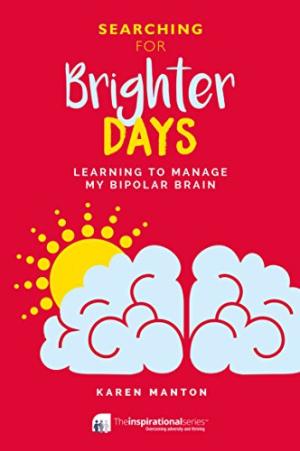
Book Review: Searching for Brighter Days Learning to Manage my Bipolar Brain- Karen Manton (Trigger Press)

karenmanton1

I bought this amazing book, because I very much wanted to read about another womans experience of bipolar disorder, living in the UK like me. It is also published by the great mental health publisher Trigger Press as part of their Inspirational Series. Their aim is to educate and battle stigma. I had previously read Hope Virgos book about anorexia published by them and I felt that this would be a challenging but good read.

Karen writes very eloquently about her life living with undiagnosed bipolar disorder. For many years she was in and out of hospital, with no proper diagnosis or understanding from the medical profession of her illness. She was sectioned multiple times due to mania and depression and although she healed from her episodes, they kept coming back with a vengeance. This was largely because she did not have a name for what she was experiencing and many times was discharged from hospital without proper support.

Growing up in the North East of England, Karen went on to work, marry and have children but had to balance this with the ever increasing and erratic episodes of her bipolar. This included psychosis, hallucinations and delusions as well as deep depression. However, during one hospitalisation, Karen met a new psychiatrist who finally diagnosed her and set her on the bright path that she is on. She began taking medication and engaging with therapy and support. She had a name for the illness and what she was going through. As she writes, she was searching for brighter days and eventually found them, despite many losses in her life.

For me, this book is a must read. You can buy it on Amazon and other book stores online as well as on the Trigger Press website. It is a really important work about succeeding against the odds and gives a comprehensive glimpse into life with bipolar disorder.

Thank you Karen for your bravery in writing this and sharing your story with the world!


Guest Post by Redfin.com: How to Alter Your Home to Treat and Prevent Seasonal Affective Disorder

Each summer, we become accustomed to sunshine and days that never seem to end. We are outside, being active, and absorbing plenty of Vitamin D. It’s no wonder we feel so good! When fall starts to set in and daylight savings comes, our bodies receive less sunlight and we are often confined to indoor activities to combat the cold. With such a dramatic change, it’s easy to slip into a state of feeling hopeless, distracted, or even depressed. These feelings alone could be symptoms of seasonal affective disorder (SAD).

Seasonal affective disorder is a type of depression that occurs when the seasons change, primarily in winter. Everyone reacts differently, but the warning signs sometimes include:

  • Depressed mood
  • A sense of hopelessness
  • Difficulty concentrating
  • Decreased energy
  • Changes in appetite
  • Altered sleep patterns
  • Lack of interest in activities you typically enjoy
  • In some cases, people with SAD experience suicidal ideation. If you have felt any of these symptoms, talk to your doctor as soon as possible.

But don’t worry, you’re not alone! Roughly 10 million US residents suffer from SAD each year, and another 20 percent suffer with a milder form of it. There are many more sufferers around the world. In fact, it’s very treatable. So while you’re huddled inside keeping warm, we are going to discuss ways you can treat or prevent SAD this winter simply by altering a few things inside your home.

Switch up your Lights

Using light therapy boxes can provide relief from SAD. Sitting near a light box for around 30 minutes a day, typically after waking up, provides similar light to a bright, sunny day. Keep your eyes open but don’t look directly in the light box. It’s perfect for sitting on your desk, makeup table, or where you eat breakfast.

Secondly, using a full spectrum bulb or daylight bulb helps some people find relief from darkness. Although it’s not powerful enough to mimic daylight, it’s a great way to reduce darkness in your house. Utilize bright lights to create a reading nook or inspirational space in your home. You can also purchase a treadmill or stationary bike and place it near these mood-enhancing lights, surrounded by plants. These ideas can help give you your “outside” fix even in winter, and can go a long way in fighting seasonal depression.

Add Greenery to Your Home

Bringing more plant life into your home is a great technique for managing SAD. You can fill the rooms you visit often with green, colorful, blooming plants, or set up a room or area in your home that can be a sadness-free retreat. Set up a yoga mat to practice mindfulness next to an exercise area; adding movement to your day will help produce endorphins and serotonin that can improve mood.

If you’re all about gardening, building a DIY greenhouse in your backyard is a great fall/autumn activity that can help you get ready for the winter months. You’ll be able to grow vegetables and fruits year-round, which can help improve your mood since you won’t have to miss your favorite summer treats.

Bring in Some Colour

Take a look around you and ask yourself, do the colours in my home make me feel good? If the answer isn’t “yes,” then it might be time to switch up your home’s colour scheme.

If you’re surrounded by dull or dark colours outside, you might feel the tug of depression more deeply if those are the same colours you’re surrounded by inside. A fresh coat of paint might be just what you need! Paint your walls colours that inspire warmth and joy, like a cosy sunrise or warm, light blue water. Plus, adding a home improvement project to your to-do list can help boost your energy and creativity during a time when laziness lurks around the corner. Studies have shown that setting, working toward and achieving goals can be a big mood booster any time of the year.

If painting is too much work, you can also swap out your throw pillows or blankets for brighter colours. Duvets and pillow case covers are an easy way to change the appearance of your home without throwing out your current décor and or having to commit to a new style long-term.

Finally, hang up some of your favorite photos of you and your friends, family, or pets. Research shows that recalling times of happiness can provide a dose of happiness in a blue moment.

Don’t forget the kitchen

Eating more fruits and vegetables is a proven method for tackling many kinds of depression, including seasonal affective disorder. An easy and fast way to consume more fruits and vegetables is to make a morning smoothie. Embrace daily healthy eating by exploring new recipes online and from your friends. Cold months lend themselves perfectly to soups, stews and crockpot recipes. Try new ingredients, and invite your friends over to taste the results. Not only will the food feel good, but your company will, too! Even when your instinct is to avoid social situations, having friends and family over can be the push you need to feel more upbeat and happy.

And while you’re in the kitchen, check out your surroundings. If the room is highlighted with grey, steel appliances, consider adding pops of upbeat color and warm touches to brighten your mood. Paint the backsplash behind your sink a warm butter or khaki shade, add pops of green alongside wispy plants, or add bright coloured appliances like a teapot, coffee maker, or mug display. Even if you aren’t noticing the colors in a room at every moment, they can still impact your thoughts and emotions.

Put Some Soul into Your Surroundings

Customize your home to give off positive vibes that boost your mood year-round. Surround yourself with things that inspire you like your favorite music, art you love, or quotes from authors.

Consider how music makes you feel. You can purchase and install a surround sound or multi-room music system to pipe in your favorite tunes whether you’re in the bathroom or the bedroom. A simple Bluetooth speaker works wonders too!

If you enjoy the outdoors but the lack of sun and warmth are keeping you indoors, bring the outside in. Set up a room or a corner where you can experience similar activities, like a trainer for your bicycle, yoga mat, or some free weights to keep you in-shape.

Last but not least, consider design schemes that will inspire a positive attitude. Put some soul into your surroundings. Choose decor that will help you build confidence, feel happy, or bring back memories. Start by making a list of things that you know make you smile, and then find ways to create an environment that replicates those same feelings.

While experts are still unsure the exact cause of seasonal affective disorder, whenever changes come around the corner (big or small) humans have an emotional response. You don’t have to be diagnosed with SAD to feel a bit of the blues during the colder, darker months. Luckily, SAD is very treatable and these home tips for managing feelings of depression can help anyone, any time of the year.

Post courtesy of Redfin

As a reminder, our tips are only suggestions and if your feeling of sadness persists, contact a therapist near you.

Guest Post by UnitedMind Laughter Yoga: How to get the most out of your Job and Wellbeing.

Being unhappy at work isn’t just ‘one of those things’ you need to put up with, even in today’s society where hating your job can seem to be glorified. You don’t have to be incredibly passionate about your industry or role to still enjoy coming in (although it helps if you do love it!) , and there are a few tips and tricks that can help transform that negative outlook into a positive one.

Have a carrot at the end of a stick

Spending your time at a job you don’t like is always going to be stressful, so we recommend thinking about the carrot at the end of your stick when you’re staying late or having a busy day. What are you saving for? What are you looking forward to? You might not care about the company you’re doing the work for, but you will care about the dream you’re putting the money towards.

There’s nothing wrong with working a job for the pay check; we all need a roof and food. However, if you really want to start genuinely enjoying your job more, we recommend trying to get more out of it than just a pay slip at the end of the month; or at least get more out of that pay slip.

Get pleasure out of purpose

In Happiness by Design, Paul Dolan speaks about how we derive pleasure from purpose, and this is directly important to how we should approach work. Doing the bare minimum isn’t great for the company or team you work in, and “just enough” will start to mentally make you feel inadequate. Inadequacy usually leads to anxiety,  and sometimes you feel awful. You  then a cocktail for a terrible working environment and for your own wellbeing.

Instead, you should try hard at your job , as long as it is not affecting your health. Positive peer reviews and promotions can reward the work you put in, which will make you feel more positive, and that positivity can snowball from there into something considerable.

Hard work and happiness breed confidence, so even if you still don’t like the place where you work, there’s nothing stopping you from taking this new found conviction to go and land a job you will love. Sometimes a fresh start is all you need.

Turn your co-workers into friends

Walking in to an office full of people that you don’t know and aren’t friendly with can make work a lonely experience. However, if you socialise with your co-workers and make an effort to speak to them, then you might even start looking forward to work because you’ve got Emma that you can speak to about the match at the weekend or David who you can chat with about the latest episode of your favourite show.

We recommend, even if it means leaving your comfort zone, that you go to as many work outings as you can. Drinks after work are always good at making everyone feel more comfortable around each other, but even going to something like a light yoga session at lunch could be the start of a routine to bring you and your colleagues closer together.

A nod and smile in the hallway is, relatively speaking, a small gesture – but it can make a workplace seem so much more welcoming.

You and your space

If you have a desk, something as small as tidying it can do a lot to change your mind set. If you have papers and rubbish all over your work space, you will start to feel cluttered and swamped; physically and mentally. The process of throwing away everything you don’t need can feel very relieving and almost like a detox.

Personalising your work space can also help make work more enjoyable. A picture of a loved one, a little happy picture/ object or even a plant you can look after all help make your area feel yours; we can forget how important individuality is sometimes.

This article was provided by the team at United Mind, who provide laughter yoga for those that want to have a little fun while improving their mental and physical health. Thanks also to Jack Bird.

Sources: