Reflections- Being Bipolar is not the end.

hopeshines1

This blog post was prompted by a blog I had written a few months ago for Rethink Mental Illness about living with Bipolar 1 disorder. I received a message from a mother whose teenage daughter was suicidal and very unwell and was receiving treatment from CAMHS child and adolescent mental health service . This same mother has stayed in touch with me and updates me with her daughters progress.

I was the same age as her daughter is now when I became unwell. I was only 16, still a child but on the brink of adulthood, at a time where teenage life can be confusing, even without a mental illness!  Being diagnosed at 16 changed my life in many ways. I had to come to terms with having a chronic illness, with being ‘different’, with taking medication daily for the rest of my life, with not drinking alcohol, with feeling insecure about my own mind and self for a long time. Its a lot to take in, at that age in particular.

Being Bipolar is not the end. Yes it can cause havoc and play with your sense of self, cause insecurities about your mind, make you psychotic or manic/ hypomanic, make you depressed and suicidal, make you anxious and terrified and many other symptoms. But it is not the end. With help from support networks and professional medical teams, you can recover. You can get better. You can achieve.

What changed everything for me was taking Lithium. It has stabilised my moods and they don’t fluctuate as intensely, so I am not symptomatic. It was a gamble taking it, as is taking most psychiatric medication, its trial and error. But, as Bipolar runs in my family, I knew having the right chemical balance was key because my moods were all over the place.

I still have bad days and panic and anxiety from time to time. However they are no way near as bad as when I was on the wrong medication.

At 16, I had a very uncertain future. The Doctors told my family I wouldn’t get my A levels (despite having got good grades at GCSE) or go to university. I proved them wrong. I went to university and got my BA, I went travelling to India and Ghana where I volunteered and I went to drama school to do a Masters degree which I attained, despite the difficulties in my mood and the stress it did create. This wouldn’t have been possible without the support network and amazing family in my life. And of course, my need to do things despite the illness!

Achieving these things made my self esteem increase. There are times when I am not confident but having a severe mental illness is not the be all and end all. You can live with it, there are times which can be hell- but these make the sweet times better. I am back at work as well after being in hospital in 2014 and have tried to rebuild my life.

So today I am thinking of the teenage girl who is currently unwell at 16 and her family. And praying for her as we go into Shabbat (Jewish Sabbath).
Guest post: Loneliness at Valentines (by Eugene Farrell, AXA PPP)

lonely1

Valentine’s Day. For some, it’s a day full of romance and spending time with loved ones, yet for others, this focus can make them feel more isolated and alone.

According to the Office for National Statistics, Britain is the loneliness capital of Europe, with many Brits unlikely to know their neighbours or feel they have friendships that they believe they can rely on in a crisis.

Research by the charity, Relate, found that 9% of Brits of all ages don’t have a single close friend, while separately, a study by AXA PPP healthcare that British adults aged 18 to 24 are four times as likely to feel consistently lonely than those over 70.

 “The build-up to Valentine’s Day and the day itself can be quite intense, which is difficult for those who are already feeling isolated or lonely,” explains Eugene Farrell, Head of Trauma Support Services at AXA PPP healthcare.

Although loneliness is often associated with the elderly, it’s actually an issue which can affect the physical and mental wellbeing of people of all ages.

In fact, studies have found that loneliness can increase the risk of high blood pressure, and have an impact on cognitive decline, dementia and depression. While addressing your experience of loneliness may take time, taking steps to build new and improve existing connections will help to improve your overall wellbeing.”

Here, Eugene gives his top tips on how to overcome feelings of loneliness:

1.     Making new connections can be an obvious way to combat loneliness and yield positive results, for example joining a group or class you are interested in will increase your chances of meeting like-minded people to connect with. Increasingly too we are turning to the internet for companionship, with community groups existing in almost every niche interest group you could imagine.

2.     Be more open. If you feel that you have plenty of connections but don’t feel close to any of them, the underlying issue may be that you need to open up to them more to deepen your connection, as an example letting the friend or acquaintance in on a vulnerability felt or your honest opinion about an issue.

3.     Stop comparing yourself to others. The desire to ‘keep up with the Joneses’ is not a new one, however the rise of social media has only exacerbated the problem by giving individuals the chance to constantly compare themselves to others. If you’re already feeling lonely, the idea that everyone else’s life is more idyllic than yours can make you feel even more isolated and alone. This can lead us to ‘compare and despair’ – which further exacerbates our negative experiences. Remind yourself that people only share what they want others to see about their lives. Don’t form unrealistic expectations about life and friendship based on what you see online.

4.     Keep all lines of communication open. Having a chat with a friend or relative over the phone can be the next best thing to being with them. Or you can stay connected with loved ones online. Video chat, exchange photos and keep up to date with the latest news from friends and family with Facebook, Instagram, Snapchat or simply keep in contact by email.

5.     Volunteering is also a great way to meet new people and feel good about helping others. It will not only allow you to give something back to your community but will also help you to feel more connected, involved and needed. There are lots of volunteering roles that need your skills and experience. It can also have a positive effect upon your mental health through helping others.

6.     Pride comes before a fall. Don’t be afraid to reach out to people and ask for help, companionship or just a chat. They may be feeling lonely too!

7.     Take it slow. If you’ve felt lonely for a while, or experience anxiety around new social situations, throwing yourself in at the deep end could only act to exacerbate the problem. Instead, dip your toes into the water first by going to a local café or sports event where you are surrounded by people, and just enjoy sharing their company. Or try a class where you can dive into the activity itself to distract you from the pressure of introducing yourself to people straight away. With loneliness, slow and steady often wins the race.

If you think you might be struggling with symptoms of loneliness, find more tips and advice at AXA PPP healthcare’s Mental Health Centre.

Guest Post by Adar: Relationship Abuse and PTSD (Post Traumatic Stress Disorder)

abuse1

Adar talks about the relationship abuse and PTSD they have suffered and how they are near recovery, with a combination of therapies including EMDR treatment. 

PTSD (Post Traumatic Stress Disorder) and I have been in each other’s lives for past 10 years. Yet, up until 3 years ago, it was my secret…that I had no name for.

I am very close to my recovery (yes, recovery), which is why I feel I can write this blog now, to highlight the following:

A. I was 18 when my abusive relationship started, he was also 18, and yes…he was Jewish, and known within a circle of Jewish people (I am Jewish). Abuse can happen to anyone, at any age, of any race.

B. PTSD: Because I have it now, doesn’t mean I will have it forever. I am getting the help I need to treat it, and my PTSD isn’t triggered 99.9 percent of the time. Be kind to everyone you meet, as that person may be going through a secret struggle.

C. There are varying degrees of PTSD, yes some people are affected enough to not leave the house. I am fortunate enough this isn’t my case, but a lot of people can get out, everyone’s triggers are different, and everyone reacts differently when triggered.

D. My message to anyone with PTSD: please please please get help, or please put a close one in touch with help. The treatments work, you can get the treatments on the NHS (and maybe even through your work), and via Private facilities. I have put two links below to two very helpful websites:

http://www.nhs.uk/Conditions/Post-traumatic-stress-disorder/Pages/Treatment.aspx

http://www.ptsduk.org/

So, here is my story:

I was in an abusive relationship from the age of 18 for 3 years. If you google abuse, you will find five types; I experienced four- emotional, physical, religious, sexual…and I assume if my relationship had entered into marriage…financial.

When it comes to expressing my feelings about what happened to me, I became the master at making people think that everything was ok. But behind closed doors, I was in shock, mentally and physically… for years.

Friends that were around at time, had no idea what was happening to me, and neither did my own parents. In the aftermath, I buried everything, out of protection for the people around me, and because I was still trying process what had happened me. Physically, I was already showing signs of my mental state; being diagnosed with a lung condition because acid had mysteriously tipped into my lungs (looking back, potentially caused by the fight or flight, cortisol/stress, or something similar).

During all of this, I somehow managed to completed 2 degree’s (to a high standard), completed a summer on Camp as a leader in America, and Produced a year-long theatre production ….however, I was secretly drowning, and I couldn’t find a way to swim back to shore.

Fast forward, and 3 years ago, I started having panic attacks (4 years after I was well clear of the danger). At first these happened during the day, then started happening during my sleep. At times, this also came with an inability to speak, which there no physical explanation was for. It culminated in a trip to A & E, as my brain basically broke down. Before all of this, I had never had a panic attack, and I was not an anxious person.

A few months later, I was formally diagnosed with PTSD by my consultant, and after a wait, because of a bipolar 2 disorder diagnosis at the same time, I started EMDR treatment.

EMDR is AMAZING. FULL. STOP. It works by processing traumatic images that are stuck on one side of the brain, which couldn’t process themselves. When triggered, these images are like reliving the trauma (the image pops back up in your head). My therapist grades my disturbance on a scale of 1-10, and then uses my eye movements to process the images (by waving her fingers in front of my eyes). The idea is that the disturbance level decreases each time/ over time. It seems to be working for me; my therapist went over the list of problems I came to her with 2 months ago, and we checked a lot off the list! J

My therapist has also cleared up something important for me, which I want to pass on. I walked around trying to understand why I froze…why I just froze. My therapist said:

‘When things we cannot process at the time are happening to us, there is a survival instinct that makes us freeze…. After years of trying to figure it out, why someone so strong natured…just froze… now I understand. I hope that thought helps someone else out there, still trying to understand. We were trying to survive.’

With all the help I have been given, and the support of everyone close to me, I have managed to find a way to forgive my abuser, not for his sake, but for mine. I was carrying around a lot of hate and anger, and it was taking me down, from the inside. I am not suggesting this will work for everyone, but it has for me. I can move on now knowing that karma will one day kick in…and God is watching everything.

To conclude, yes, sometimes I feel like a ticking time bomb, and yes, I have to be vigilant of potential triggers right now, (I carry a bottle of cinnamon with me, in case I feel overwhelmed: using a sense to distract the brain), and I think I will always struggle to tell my friends what really happened (but they have been amazing), but I can see the light at the end of the tunnel.

I didn’t think I’d be able to say this 3 months ago, but bring on my knight in shining armour…ok ok…. maybe just a date, with a nice boy…in Nandos restaurant and a life full of my fulfilling dreams. Bring.it.on.

‘Back from the edge, back from the dead

Back before demons took control of my head

Back to the start, back to my heart

Back to the [girl] who would reach for the stars’

– James Arthur

The Head On Mental Health Awareness Shabbat Project.

The past almost 2 months, I have been volunteering with the Jewish Association for Mental Illness (Jami) helping plan and coordinate one of their projects with colleagues. This project took place last weekend in the UK Jewish community -and was a cross communal Shabbat (Sabbath) education project taking place in synagogues, Jewish schools and student societies up and down the country.

It was supported by every level of religious observance and in the end we had over 80 communities involved, holding educational talks, reading sermons, holding themed friday night dinners and hosting speakers on mental health. Some communities had talks from speakers at Jami or those with lived experience of mental health issues, or those who are psychiatrists or psychologists.

Our aim was to battle stigma and get people talking. Jami and our team were just amazed by the level of response and positivity towards the project which seemed to grow and grow and reach communities far away including in Scotland!

We also had 150 people at a panel event organised by Jami about mental health topics, where a great discussion was had.

Times are changing and hopefully we will see stigma in the community fall. I am currently getting over a rather nasty cold-and taking time to rest but I wanted to write this to say how much I truly have loved volunteering with pioneers of the event and seeing the project grow to be so successful.

My article for Self Harm UK- ‘I don’t want to hide anymore (about stigma)’

selfharmuk

I am delighted to announce a blog collaboration with the amazing charity Self Harm UK (a part of Youthscape).

I have written a blog for them on my experience of mental health stigma as an ill teenager and what made me speak out further. In the past, I have had self harming thoughts and I myself like reaching out to teens and young people who are suffering out there- so they know they are not alone. I am so pleased to collaborate with Self Harm UK on this and my article can be found here:

Click here to read my article:

https://www.selfharm.co.uk/articles/i-dont-want-to-hide-anymore

Who are Self Harm UK?

From their website selfharm.co.uk:

‘ SelfharmUK (formally selfharm.co.uk) started out of the work of Youthscape, a local charity based in Luton, Bedfordshire, UK. Since it’s beginnings in 1993, the charity has developed a strong and professional reputation for delivering caring, child-centred work, which focuses on the emotional and social needs of all young people. Youthscape works alongside all young people, regardless of race, background, or faith.

By 2004, Youthscapes’s work increasingly involved young people engaging in self-harm. It wasn’t long before a plan began to form to try and reach them them, starting with the provision of informal support groups in local schools. With the help of funding from BBC Children in Need and other grant-making Trusts, the project was able to appoint a specialist staff team in 2005 and develop a more coherent provision that included art projects and therapeutic group programmes. Training and advice for parents and professionals soon followed, in conjunction with the Local Authority and local schools.

In 2008, Youthscape responded to the growing number of enquiries for support and advice coming from outside Luton by beginning to plan for a national project that could support young people from all over the UK. Further planning and fund raising led to the establishment of SelfharmUK later that year and the appointment of a Project Manager

The development of a website was a key part of our initial vision… to have a safe online space available to inform and support young people who self-harm, as well as cater for the needs of their siblings, parents and friends. We also wanted to provide information and training for professionals like youth workers, teachers and social workers.

We wanted to create a safe, pro-recovery site for people to use to communicate with others and express their experiences through the use of blogs, stories, poetry and art. Our next goal was to develop an online group programme – Alumina – which has enabled young people from all over the UK to engage with our staff in real time in order to explore the deeper issues surrounding self-harm. For some it had been the catalyst needed to reduce or stop their harming behaviour, while for others it has proven empowering, enabling them to seek further support in their local area.

We already have a multimedia training programme available to professionals in the UK. Our ongoing vision is to see this rolled out more comprehensively; to serve every part of the UK in supporting and nurturing young people who may be experiencing difficulties with self-harm.

There remains much to be done but we remain committed to improving the lives of anyone impacted by self-harm. Providing effective support for parents and siblings will be a major goal in the near future.

For now, the project remains part of Youthscape as a separate element of this registered charity.’


The best way to support a friend or family member through anxiety and depression.

I have been asked by my friends to write an article about how best to support someone through a mental health issue. There is not a one sized fits all answer, due to the fact that every illness and person is unique with their own brain chemistry and life experience. However, I am  going to offer a few tips on what you can do if someone is suffering from an anxiety disorder or depression (for this article I am going to leave out other illnesses eg bipolar, schizophrenia, psychosis, addictions but will speak about them at a later date)

So what can you do if your loved one is suffering from  an anxiety disorder/ depression?

Anxiety disorders are a group of multi faceted disorders which can include things like generalised anxiety, social anxiety, health anxiety, OCD, PTSD and more. Your loved one may be suffering from lack of sleep, nightmares, inability to sit still, palpitations, racing or obsessive thoughts, panic attacks and hyperventilation. They may feel more on edge, or in the case of OCD- be checking and analysing everything. Anxiety disorders run in certain patterns and all are unique to the individual- what one person with anxiety may have will be different to another, however there are some general patterns to anxiety.

When a person is suffering from anxiety, they may also have physical health symptoms as above due to the increase in adrenaline and the stress hormone, cortisol.

Depression or depressive disorders are sometimes caused due to a chemical imbalance in the brain (not enough seretonin) and can require medication to return the brain to its usual state. Some are a mixture of chemical imbalance and challenging life experiences or brought on from a period of stress eg divorce, moving house, losing a baby, having a baby, being unemployed etc . Symptoms typically can include loss of motivation, feeling tearful, low and hopeless, not wanting to engage socially or be involved with activities one enjoys.

If your loved one is suffering from anxiety or depression the best way you can help is by speaking and interacting with them calmly- not judging them or accusing them of anything bad, but simply being a laid back, supportive friend or partner. If someone can’t socialise, its best to just text once in a while and check up on how they are doing- or send a hand written note or card. Most importantly, do not pressure the person to see you, talk to you or go out.. but just be there for them calmly as a listening ear and encourage them to do small achievable things for themselves.

It is good to encourage your friend to go out with you but not to pressurise. Similarly, getting a bit of fresh air can help. If your friend or loved one is at crisis point ie threatening to take their own life, feeling suicidal, not eating or sleeping and being involved in self harming or risk taking behaviours, it is very important to do the following:

1) If a friend is suicidal, listen to them but do not promise to keep it a secret. You must tell their nearest relative/ best friend/ someone they trust if you believe they are in danger of a suicide attempt or at harm to themselves . Encourage them to see their GP immediately or speak to a help line and the GP will be able to tell you if a psychiatric referral is needed. A psychiatrist and team known as the Crisis Team will then  step in to help.

2) If a loved one you live with is suicidal, go with them to the Doctor or get a doctor to come out to you. There is stigma around this BUT if your loved one is really ill and their brain is effectively temporarily ‘broken’ much like a broken leg, it needs fixing. Your loved one needs help and support to recover whether its medication, counselling or more support at home. Do not blame yourself. This is an illness- not something you have done.

Ultimately, be loving, caring and supportive and CALM- however angry or frustrated you feel. Being frustrated to someone who is unwell can cause them to have feelings of guilt, low self esteem or worthlessness which the depression/ anxiety may perpetuate.

Be there as a support and listening ear but make sure you have a break and take time for you too.

My time recovering in the Acute Day Treatment Unit

adtu3
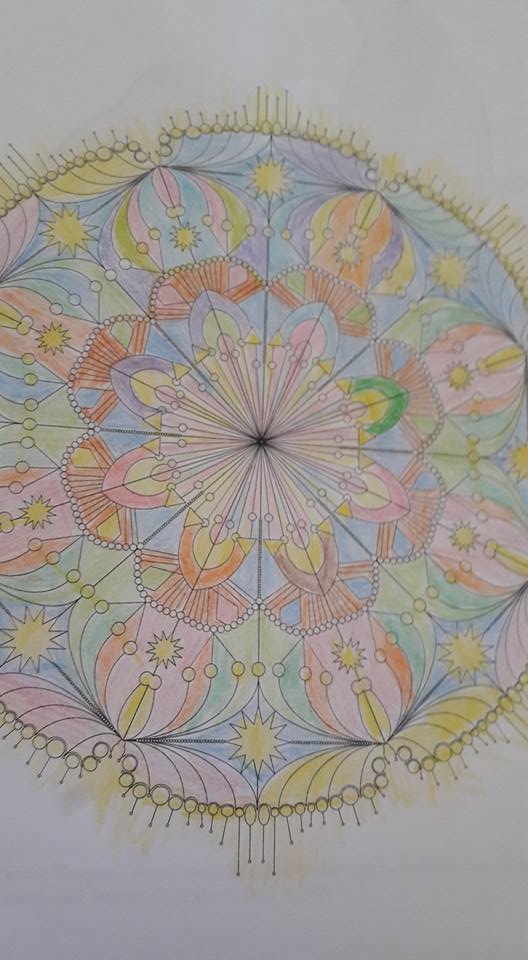
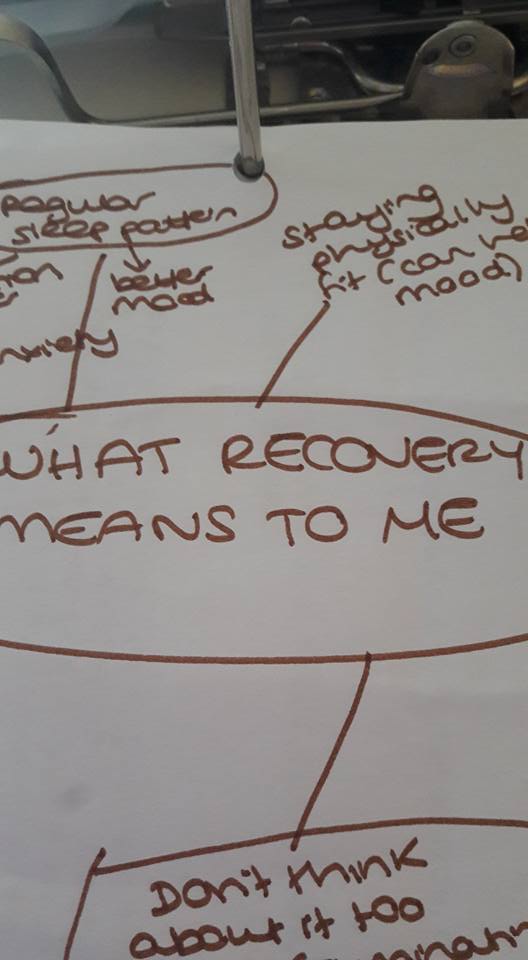
(my art therapy)

As I have previously written, in 2014, I suffered from a very acute period of mental illness- a manic bipolar episode. I had to stay in hospital for 3 months before I began my recovery process at home. Part of that recovery process was being referred to an Acute Day Treatment Unit (ADTU).

ADTU is effectively a hospital day therapy ward- where groups are run on things like anxiety management, recovery techniques, anger management, assertiveness, relaxation/ meditation to music, arts and crafts and groups such as playing games eg table tennis or quizzes. It is there as a short stay intervention. Some like me had been in hospital already very unwell and some had been referred to ADTU to stop them having to go into hospital and to get them better through therapies.

People are referred there with all kinds of illnesses- depression, bipolar, schizophrenia, eating disorders, drug, alcohol and gambling addictions, psychosis, acute anxiety disorders eg PTSD/ OCD and more.

As well as the therapy groups with occupational therapists, the ADTU has psychiatric nurses, psychiatrist and therapists who support you during your stay. I was there largely because I had been through a very traumatic period of bipolar illness and also because I had decided to change medication to a new mood stabiliser- Lithium.

This meant that as well as the therapy sessions, I had to get used to a new medicine regime and weekly blood tests to determine my Lithium level. When you start Lithium, the level in your blood fluctuates- if it goes too high your body can have a toxic reaction. Luckily this never happened to me but there were times when I was quite low and depressed as the Lithium level was too low. So for about 8 weeks, I had regular blood tests.

In ADTU, you get given a key worker- an occupational therapist or nurse who works with you through your stay and acts a bit like a therapist- they are your support team for when you are there. At ADTU, I lived at home and went in every day 5 days a week. It was challenging as there were constantly new people coming in and out- some very poorly. However I made some incredible friends.

My first important friend I met on my first day! We both began at ADTU at the same time and started our induction. She also has bipolar disorder and we were quite similar- both loving all things girly, glittery and of course- unicorns! We got on well from the beginning, sat with each other in therapy groups, where we both regularly fell asleep in the relaxation to music sessions. She is an amazing and brave woman- who I am honoured to call a friend and we are still in touch today!

I made other friends as well, from sitting in the lounge and chatting in the mornings. One of these was my friend who loves sport and we would chat about what she was doing on her degree. She is also another amazing one who I am still in touch with!

ADTU is meant as a short stay intervention but due to my acute illness and change of medication I was there longer than almost anyone else. This became frustrating as I kept seeing people being discharged and I was still there. In the end after 12 weeks where I became used to all the staff and therapy groups and felt a bit like a veteran (some people are only there for 2 weeks) I emerged still fragile but stronger than I had been.

I owe so much to the wonderful staff- especially my occupational therapist key worker and the therapist running the arts and crafts and recovery groups. The staff were so supportive and kind.

In the UK, there are now only two ADTUs in the whole country as funding has been cut. However, I can honestly say that without the staff there and my new friends- I would have found life so much harder. I owe them so much.

Here are  some of my photos from the therapy folder I kept.

This blog is dedicated to my friends from ADTU who are making amazing strides- my 2 closest friends are now studying for Masters Degrees!

adtu1

Guest Post: Quite Great- Psychotherapy to combat stress in the Music Industry.

helen-brice1

Todays guest post is by Quite Great and Helen Brice, psychotherapist and music industry professional.

Music PR and Marketing Company, Quite Great, has formed a unique partnership to help musicians overcome the day to day stresses and strains of the music industry. By teaming up with Helen Brice, a specialist psychotherapist and skills coach, the pioneering PR company has introduced a new psychotherapy service.

 Quite Great have twenty years experience working with musicians of all styles, from all over the world. During this time they have developed an exceptional understanding of musicians and the challenges they face – from the emotional strains of building a career, to the psychological issues that can be developed as fame grows.

Specialist psychotherapist, Helen Brice, has over twenty years experience in the music industry; covering music arrangement, performance, audio production, publishing, artist management and A&R. She is a music graduate and regularly performs in the UK and overseas with the London Bulgarian Choir and the BBC Symphony Chorus. As an active musician Helen has a unique attunement to the pressures and psychological issues that musicians encounter – making her the perfect person to head up the new service.

As Pete Bassett, founder of Quite Great, elaborates: “Every recording artist and performer of music has to have at least two sides to their personality in order to really reach the heights that they wish to achieve. As they go through each stage in their musical career they have to deal with many pressures – from demands made on them by managers, labels and agents, through to handling being ‘dropped’ by labels, and at times, coming to terms with the fact that their popularity is diminishing.”

“These differing stages,” he continues, “can cause real emotional turmoil needing a specialist approach to be taken. There are also other more straight forward challenges that musicians need help with, for example how to overcome ‘stage fright’, and how to build the confidence and thick skin required to face media reviews and online critics. In order to believe they can overcome all problems to become a star, musicians need the self assuredness of an Olympic athlete!”

Helen Brice, (UKCP, MUPCA Accred, MBACP, FRSA) founded Stimmung Therapy Services in 2009 at Harley Street, and receives referrals and enquiries relating to her specialist psychotherapy and skills coaching from all over the world. Helen offers complete flexibility for appointments at her central London practice, as well as via Skype – perfect  for the working lifestyle of musicians and performers. A service unique to Stimmung is emergency onsite psychotherapy and coaching for performance anxiety. This would be backstage at the performance venue, or off set at a live broadcast, or even at the recording studio.

By combining their expertise, Quite Great and Helen Brice, are offering a distinct psychotherapy service that will make a huge difference to both the personal lives of musicians and their careers. For more information, please visit www.quitegreat.co.uk or contact ask@quitegreat.co.uk

Fighting mental health stigma: a personal journey

I have had bipolar disorder for almost 13 years, along side depression, anxiety, psychosis, hypomania and manic symptoms- which ebb and flow and fluctuate. Now that I am on the right medication these bipolar symptoms are kept under control. For most of these 13 years, I didn’t feel I could speak out about my conditions.

My family and close friends have always been very supportive but I felt ashamed. Ashamed of where my brain could go to when unleashed and its chemistry got confused. Ashamed of why I was either suicidally depressed or hyper and manic to a point of having to be sectioned to a psychiatric ward. Ashamed of my illness, confusing my identity with the illness, which made me worried about others judgement of me.

I was diagnosed at a very vulnerable age- 16 years old and as we know teenagers can be cruel. Although I experienced a lot of kindness and empathy, after a hypomanic episode abroad where I was disinhibited, I experienced a lot of cruel rumours from other teens I knew. Rumours that were stupid but that called me many names and compared me to evil things that I do not want to repeat. What was at the most basic of these insults? In my opinion, fear.

People fear what they cannot see and cannot understand.

People in their teen years do not want to be different- and I was the embodiment of difference.

If people can’t comprehend something and it is threatening- they judge or use name calling to feel better.

At 16, I represented a world of chaos at which many could not understand. Perhaps now they will.

I have spent a long time coming to terms with my illness and what it means, finding the right treatment and medication and the right support networks around me. I have incredibly supportive friends and family.

So what does the above treatment boil down to?

Stigma.

Stigma is according to an online dictionary- ‘ A mark of disgrace associated with a particular circumstance , quality or person’

For so long, I felt this ‘mark of disgrace’ and until I was 25, although close friends and family knew about my illness, I didn’t write blogs the way I do now. This was because I wanted to hide this illness that lodged in my brain chemistry.

I don’t want to hide any more and neither should I.

In 2014, I was hospitalised and sectioned for a severe manic episode encompassing psychosis, delusions and hyperness/ disinhibition.

It was shortly after going through the most traumatic experience of my life that I realised. Life is short. I need to help others. If I can break down the stigma and help others through my writing and other work then I will.

Mental Illness must no longer be a ‘mark of disgrace’ but must be seen as a partly physical illness in the brain, deserving and worthy of good treatment and empathy from others.

This post is dedicated to those friends who asked me to write on this and all my friends for their love and support

A Personal Note and Festive Appeal

beyourownlight
I can’t believe that its so very nearly the end of 2016! So many things have happened this year and it has been a remarkable year in so many ways.

Its hard to believe that only 2 and a half years ago, I was living on a hospital ward for 4 months receiving treatment for a bipolar manic episode that included psychosis, delusions and mania. I wasn’t well enough to be back at home for a long time and it was a turbulent process that ripped my whole world apart- I was only 25 and it had come out of the blue.

I look back and think that it has made me stronger and made me totally appreciate life and medication and support networks when I am well. It has meant  I can help others through my blogging and advocacy work and that I can have a better understanding of my own brain. I hope one day there will be more funded research into bipolar.

As it is almost Christmas and Chanukah, I just wanted to highlight Be Ur Own Lights Festive Appeal for Jami (Jewish Association for Mental Illness). Jami are a small charity operating to help people in the UK Jewish Community. I fundraise for them to help their services including day centres, hospital visits, work programmes and befriending. They are on the front line of battling stigma.

Please give whatever you can to the charity to help fulfill their incredible work. Without Jami, life would be a whole lot harder for so many.

Wishing everyone a happy and healthy Festive period.

To donate just click on this just giving link and follow the instructions:
https://www.justgiving.com/fundraising/BeUrOwnLight