How I stopped Self Medicating my Post Traumatic Stress Disorder- PTSD and found Recovery by Peter Lang

Peter Lang shares his amazing story of recovery from drug and alcohol addiction, homelessness and Post Traumatic Stress Disorder.  Trigger warning: please be careful when reading, talk of drug use. 


Most people think of veterans when they think of Post-Traumatic Stress Disorder (PTSD). Unfortunately, I know all too well that PTSD can also affect civilians. PTSD is defined as the psychiatric disorder that happens following a traumatic event. While war is a common traumatic event that causes PTSD, it’s not the only kind of trauma. Traumatic events can include abuse, life-threatening illnesses, and serious accidents.

As a homeless drug addict, I experienced my share of traumatic events. I spent most of my twenties without a home: couch surfing with acquaintances and strangers all over the country, living on the streets of Philadelphia, and living on the beach in Maui. Throughout this time, I used every substance you can think of: alcohol, heroin, cocaine, meth, prescription medication. I drank so much, I developed avascular necrosis in my hips, which later led to a bilateral hip replacement after a car accident at age 30.

After I got hit by a car when crossing a street in Philadelphia, my mom asked me to come down to Georgia to stay with her. I spent the next two years in a wheelchair. Though I tried periodically to stop drinking and using drugs—with some success—I still struggled. I know now that one of the main reasons I was struggling was that I was trying to self-medicate my PTSD.

On the street, I experienced many traumatic events. There were so many times I got beaten up or taken advantage of or almost died. Once in Hawaii, I did die, and they had to revive me in the hospital. The doctor told me with the amount of alcohol I had in my bloodstream, it was a miracle I was alive.

In early 2016, I met a woman who changed my life. We fell in love almost immediately after meeting each other, and we got married a year later. We are about to celebrate our one-year wedding anniversary.

She made me see that it was okay to ask for help with my PTSD. I didn’t have to feel like I had to take care of it all the time. She made me see that a great deal of my struggles with substances was because I was just trying to numb the pain from traumatic events I hadn’t dealt with.

At one point, I was prescribed benzodiazepines, which did help my PTSD. However, I was never able to take the medication the way I was supposed to, and they became just another substance for me to abuse as opposed to a helpful tool.

It was clear that in order to stop self-medicating, I was going to have to see a counsellor and confront my traumatic events. I started seeing a therapist regularly, and she has helped me immensely. She has helped me to open my eyes and stare the traumatic memories in the face, knowing that they don’t define me.

Another tool that was incredibly helpful for me was meditation. By meditating, I could learn how to become spiritually centered and stop identifying with the painful memories. I’ve also been greatly helped by Buddhist-based 12-step meetings, which have given me a unique perspective on the 12 steps of Alcoholics Anonymous.

Now, I’m doing better than ever. My wife and I are ridiculously in love, we just moved into a nice house, and I’m working full-time as a freelance writer and marketer. I wouldn’t be where I was today if I was unable to deal with my PTSD. I would have never been able to stay clean and sober if I kept self-medicating.

I still struggle with my PTSD frequently. It hasn’t gone away. But now I have the tools to handle any episodes that do come up.

Many people suffering from a substance use disorder are also suffering from a co-occurring mental health disorder. You can treat one without also treating the other. Luckily, you don’t have to. There are plenty of resources that will help you to seek the treatment that you need. All you have to do is ask for it and be open to it.

Peter Lang is a freelance writer from Atlanta, Georgia. He occasionally writes for The Recovery Village. In recovery himself, he has dedicated himself to helping others struggling with substance abuse.


Light Beyond Self Harm by Kaitlyn W at withbeingalive.wordpress.com

The author Kaitlyn blogs at www.withbeingalive.wordpress.com . Trigger warning: talks about self harm behaviours (but not graphically), please be careful when reading.

When you are curled within the cradling, spiked tentacles of self-harm – one wrapped around each wrist, and another brushing away any tears – those pesky alternatives of “holding an ice cube!” or “colour in!” can seem shallow; laughable even. You are shoulder-deep in the swampy mud that is self-harm, the goop surrounding you can feel ever-rising, and there is a stigma of wading in this particular swamp – you should be ashamed that you are.


During self-harm, it can feel impossible to have hope. A hope for a different reality can feel light years and stone barricade walls away. It can feel like the darkness (or swamp mud, whichever you would prefer to call it) is all consuming, your actions are all that you are, and the glittery, floaty wings of change have no way to weave in.


However, it is my privilege to share today that you are so much more than self-harm tells you that you are. Consequently, that there is hope beyond self-harm, and that this hope is yours. Ultimately, self-harm does not need to have a role in your life.


Despite how inherently wrongly created and badly designed for life you may feel, this is not who you truly are. Despite the mess, the exhausting racket that constantly parties too hard in your brain, remember that you are only witnessing this all from one perspective. You exist not only to yourself, right now, but also to child you and future you, to other people, and you exist beyond the darkness you feel. In all these other ways, you are who you are, and you are not the engulfing darkness. You have the potential to be who you are, to live the life you deserve to live; to be in the light beyond self-harm.


It’s safe to say that self-harm exists as a little bundle of menace, born from doubts, fears, life experiences, unhealthy coping strategies, and maybe a few other things thrown into the mix too. Although that can feel like an awful lot, or perhaps literally everything, which is an incredibly heavy load to carry, it really isn’t everything. Your doubts and fears can simply be. They inherently don’t have to control your behaviour. As for a way to cope, there are plenty of other ways to cope too. Self-harm isn’t the sole solution or the only option.


In a grumbling, gravelly voice, self-harm can mutter about how you won’t be able to survive without it. That you deserve the constricting boundaries that self-harm makes you believe you are worthy of. In these times, it can really help to recognise that this is self-harm talking. That these thoughts aren’t you, and that you don’t need to act upon them. You could imagine that self-harm is a preteen yelling at the Xbox, or maybe you like the swamp monster with tentacles idea. Either way, give self-harm an identity that’s not you. Self-harm then becomes an annoying, whining brat whose tantrums you can work on ignoring, rather than indulging. Do you really think self-harm deserves a brownie?


What also really helps to pry yourself free from self-harm’s sticky little claws, is finding out what works for you. Go to therapy or a support group and engage in professional help; they have spent several years training to help people in exactly the same situation. Find someone you can talk to; a small yarn can go a long way. Try out those alternatives (and there are so many more too) that were mentioned at the beginning; they can seem plain kooky, but give them a go! I guarantee that there will be at least one that can ease self-harm’s whinging, taking it down from a full-blown tantrum in the middle of the supermarket, to perhaps a soft snivel on the bottom step of the staircase.


To end with, there is light and hope in having a life beyond self-harm. You have the potential to exist as bigger and brighter, as vast and brilliant, than what self-harm croaks about you. Go out there and stomp and shout, and simply be – be loud, be radiant – you are greater than what self-harm tells you that you are

Words Save Lives- Jessicas Story for NHS Organ Donation: Waiting for Kev

Today is a slightly different post than normal, but just as important. My friend Jess writes a blog called Waiting for Kevin and has recorded this video to get people to sign up to the NHS Organ Donation register .

Who is Kevin I hear you ask? Kevin is the name of Jess’s new kidney, one she is waiting for in hospital while on dialysis (a machine that helps with kidney function- to keep you well). Jess was diagnosed with diabetes as a teenager and found out she would need an organ transplant last year.

She dreams of working, getting a pet, travelling, living life to the full– things most of us take for granted. Jess is only 30 and she is the most amazing, strong, wonderful human being- I am proud to be her friend.

Understandably, physical health issues can also impact on our mental health too and that is why I am sharing this. In the video, you will see that Jess’s incredible art works, help her when she is waiting around in hospital and she is incredibly talented.

So please watch and share this video and blog and if you can and live in the UK- sign up to the Organ Donation Register.

Jess is on Twitter @waitingforkev where you can find her blog too. She has previously commented on this issue on major radio stations and on BBC Breakfast TV. 

My article for Metro.co.uk: ‘What I wish people knew about Mental health medication and Weight gain’

Today I was published for the first time on the Metro.co.uk website, with quotes from my friend Jonny Benjamin MBE, Dr Amy Jebreel- psychiatrist and Dr Clare Morrison, GP at Med Express UK. I enclose a snippet here and link to the full article. This is an intensely personal article for me, about weight gain on mental health medication and I know so many of you can relate to this. I would love to hear your feedback!

metro1
(image: Ella Byworth for Metro.co.uk)

‘At age 15, I was referred to a psychiatrist for a serious episode of depression and anxiety (later known to be bipolar disorder). With parental permission, I was put on an anti-psychotic medication olanzapine, to calm my mind. 

What I didn’t know then, was that olanzapine is one of the worst drugs for weight gain, and although the drug calmed my mind, I put on several stone in weight. As a vulnerable teenager, being overweight was upsetting for my body image and self-esteem.’

Read full article: http://metro.co.uk/2018/01/16/what-people-dont-understand-about-mental-health-medication-and-weight-gain-7231252/?ito=cbshare

Twitter: https://twitter.com/MetroUK | Facebook: https://www.facebook.com/MetroUK/


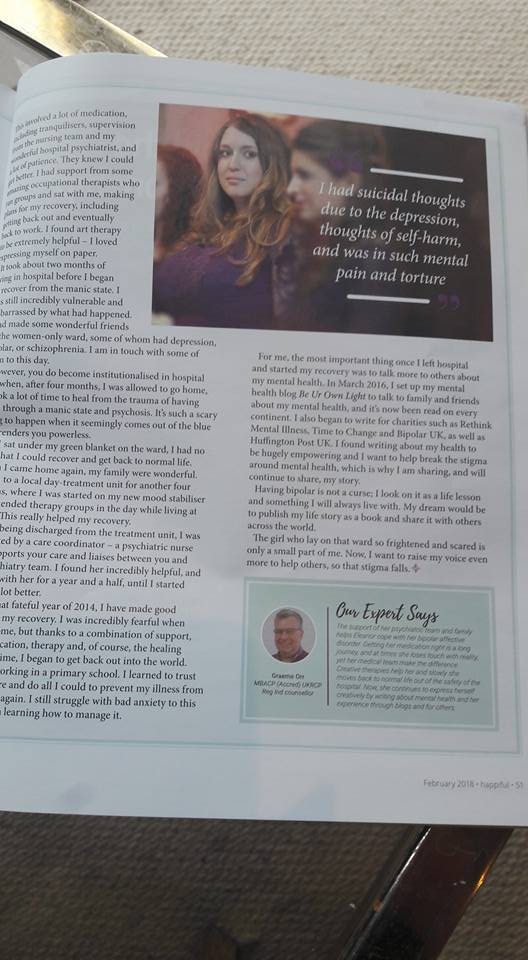
‘A Unpredictable manic episode meant I was hospitalised for my bipolar disorder’: for Happiful Magazine February 2018 Issue

happifulmag
(image: E Segall and Happiful Magazine)

Hi everyone,

I am thrilled to be able to share my story of recovery from bipolar disorder for the first time in print (!) at Happiful magazine, a UK magazine solely dedicated to mental health.

You can read it online here:  https://subscribe.happiful.com/ click read e-magazine and turn to pages 50-51. If you live in the UK, you can also order the magazine there by post or buy a copy in most major UK supermarkets!

As I say in my article,

‘Having bipolar is not a curse, I look on it as a life lesson and something I will always live with. My dream would be to publish my life story as a book and share it with others across the world… The girl who lay on that ward so frightened and scared is only a small part of me. Now, I want to raise my voice even more to help others, so stigma falls’   

I hope you enjoy reading it and leave a message for me in the comments if you do.

On Working as a Mental health Writer and sharing my story with Bipolar.

writerpinterest
(image: Pinterest)

A few weeks ago, I took the leap in working as a freelance writer specialising in mental health and lifestyle. I have been writing for several years now on the blog, for charities and Huffington Post, but now I am aiming to reach wider media and hopefully get paid too. I began with a dream. My dream was and is to write for the big womens magazines in this country, about my story with bipolar but also to write about mental health, spread awareness and battle stigma. As well as this, to help other women (and men who read my work and life story) feel less alone. I began to take the steps to do this.

First, I had to learn how to pitch and write a good pitch email. I had and am continuing to research the Features Director/Editor of each magazine and then pitch some original writing ideas to a small amount of them at one time. I have pitched my story of recovery to a few and this week I am being published by Happiful Magazine (www.happiful.com), which I am so excited about. I am also writing an article for a major UK publication and will reveal all soon. Another great magazine is discussing my ideas at their Features meeting so fingers crossed- you never know! This week, too, I was featured in Metro in a blog by Cat Phillips on January blues. So lots of amazing things happening thank God.

My dream has also been to share my story in book form and become a published author. So, I am currently learning how to write my life story as a book and talking to a publisher- who may or may not publish my work. However, its great for me to formulate my story about living with bipolar and how I have reached a form of recovery. I am in process of writing sample chapters to be considered at present. Its a bit nerve wracking because you don’t know what will happen but also exciting. I love to write. Knowing I am forming a book manuscript makes me happy.

And lastly- I have been working on this here blog. Which I absolutely love doing. I am so thrilled to have that work recognised as a Finalist in the UK Blog Awards. Looking forward to meeting the other bloggers in my category. I love that here on the blog we are continuing to grow followers and thank you all for reading. Its wonderful to share other peoples stories too.

Thank you to all of you for your support and love and comments/shares. It means the world. Remember- you can do what you put your mind too. I have off days too. Just do what you can on the good days. Much love xo

7 Reasons for Alcohol and Drug Addiction Stigma: By Ryan Jackson

albert
(image: Pinterest)

Stigma is a set of pre-conceived false beliefs that people have against a particular group of people. According to the World Health Organization’s website, stigma is a major cause leading to discrimination and exclusion. Not only does it disturb the personal life of a person, stigma can also limit their chances of obtaining proper jobs and housing. The unfortunate thing about stigma is that it’s not based on facts, but rather on assumptions and generalizations that have been embedded into society.

7 reasons addiction carries a stigma

The American Society of Addiction Medicine characterises addiction as a “primary, chronic disease of brain reward, motivation, memory and related circuitry.” The National Institute on Drug Abuse defines addiction as a ‘chronic, relapsing brain disease” that changes the structure and functionality of the brain.

So, why do so many people still think of addiction as a moral failing? Why do they still refer to victims of substance misuse disorders as meth freaks, alcoholics, junkies, crackheads and garden-variety drunks?

The answer is simple as it is depressing: because that’s the way it’s always been.

Addicts are scorned by communities, and celebrities with addictions are exploited or hounded by paparazzi. And, while the government purports to view addiction as a disease, it often works in opposition to that position through the “War on Drugs,” which counts most drug users as criminals. Even those of us in the treatment community still—consciously or unconsciously—employ stigmatising programming and language—such as when we focus on “dirty” urine.

So despite widespread agreement that addiction is best understood as a complicated behavioural-biological scenario that requires treatment, the system is hard-wired to prolong stigmatisation, and stigma contributes to addiction’s lethality.

Of course, there is a long history of mental illness being misunderstood and stigmatised,  in state hospitals or prisons, which was beautifully captured by the director Lucy Winer in her recent highly-acclaimed documentary, Kings Park. Addiction and mental health problems are still spoken of in hushed tones, and patients and their families are still blamed. This is changing, but there is still stigma. 

The idea that those with addictive disorders are weak, deserving of their fate and less worthy of care is so inextricably tied to our zeitgeist that it’s impossible to separate addiction from shame and guilt. Addiction comes with a second punch in the gut: the burden of being treated like a second-class citizen and expected to act accordingly. Stigma impacts us all, both consciously and unconsciously, and is perhaps the single largest contributor to the mortality rate. Consider these eight points:

  1. People fail to seek treatment.

Most people who struggle with an addictive disorder fail to seek treatment, in part because of their concern that they will be labeled an “addict” and that the stigma will stick. 

Often, a crisis precipitates treatment, so the problem is already well-advanced. If we removed the stigma, guilt and shame from the equation, people would find it easier to make a realistic, objective assessment of their substance misuse and discuss it openly with a health care provider.

  1. The medical profession fails to treat addicts properly.

Can you think of other situations in which the health care system abdicated responsibility for dealing with a health care issue that afflicts such a huge segment of the population? For far too long, those people who did seek treatment, often following a crisis, found no appropriate reception from the medical community. Doctors were slow to recognize addiction as treatable, and so patients were encouraged to find help outside of the medical community, in 12-step programs that based on non-scientific practices, normally anathema to physicians.

12-step programs helped many, but those that did not succeed there found themselves in the unenviable position of having been directed to a place by their doctor, having the recommended solution ineffective and being reluctant to return to their physician for further help. A better paradigm? The medical community should recognize addictive behavior as part of its purview and would apply evidence-based approaches in their practices.


  1. The mental health profession ostracizes people with addictive disorders.

It is routine in some mental health settings for persons with substance misuse problems to be discharged from treatment when substance misuse is revealed. They’re told that the drinking or drug use renders them “unavailable” for the work of psychotherapy and that they need to “get clean” first by going to a chemical dependency or substance abuse treatment program. They are told that whatever issues seem pressing and paramount to them are “just the drugs talking’

It’s common for clinicians to believe that before they can help a patient with the various traumas, interpersonal conflicts, intrapsychic issues and other problems that other people are  helped with in psychotherapy (and which are, of course, related to their use of substances) the patient needs to first become abstinent from substances. Many patients who are sent to traditional drug treatment programs that are abstinence-focused end up neither “clean and sober” nor receiving good psychotherapy.

  1. Funding for addiction treatment is discriminatory.

In spite of the huge impact and cost of addictive disorders on society, the way that addiction treatment is funded (in America) is disproportionately low. Despite passage of Federal Mental Health Parity legislation, mental health and substance use disorders continue to be treated differently—and often poorly—compared to “medical” illnesses.

What if there was no stigma in addiction? Given its huge cost to society, addiction should be funded and paid for on a level playing field with medical problems.


  1. Addicts get sent to jail.

Where substances are concerned, people go to jail for the possession of something that is part and parcel of their addiction. Most of the money that governments spend on “drug control” is spent on criminal justice interdiction rather than treatment and prevention.

Here again, clearly, is a system with stigmatisation at its roots: blaming, punishing and making moral judgements instead of providing treatment and other help that would change behavior. The more of a stigmatising stance one takes towards substance misuse the more likely one is to support criminalisation of drug offenses and the less likely is to support insurance coverage and treatment for drug addiction. Taking the stigma out of addiction argues for prevention and treatment as opposed to prosecution and incarceration.


  1. Even when people do get to treatment, stigmatization can continue and contribute to poor treatment outcomes.

It is critical to recovery that treatment programs not send messages to patients that are blaming (for relapse) and shaming (for being weak). People enter treatment at a vulnerable moment, psychologically and in terms of their brain chemistry. Addiction comes with a hard-to-escape sense of failure that recapitulates prior disappointments and works in opposition to growth.

Patients have spent a lifetime trying to silence the “inner critic” that repeats “I’m-not-good-enough” messages, so it’s critical that the culture and language of treatment provide a healthy soil in which patients can grow seeds of hope that are vital to recovery. In an optimal treatment setting, patients aren’t expected to play the role of one-who-should-be-ashamed. Instead, they are intrinsically involved in planning their own treatment, helping to choose the goals and techniques of treatment.

  1. They confront stigma-based roadblocks constantly.

Those in recovery from addiction face ongoing stigma and discrimination. People in recovery are faced with obstacles, especially those who have been in treatment or in the criminal justice system for chemical dependency. Employment, education, insurance and the ability to vote are all fraught with uncertainty and discrimination for those in recovery.

People in recovery have a harder time finding and keeping jobs, getting licenses, food stamps, benefits that help their children.  In other words, important aspects of living that are so critical to a stable recovery for persons who have been treated for addiction, such as employment, housing and providing for one’s family are that much harder to get. Things need to change. Having struggled with addiction in the past should not make life that much more difficult now. End the stigma.


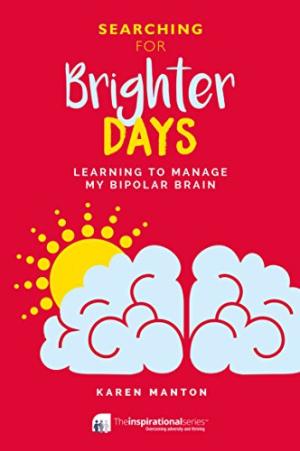
Book Review: Searching for Brighter Days Learning to Manage my Bipolar Brain- Karen Manton (Trigger Press)

karenmanton1

I bought this amazing book, because I very much wanted to read about another womans experience of bipolar disorder, living in the UK like me. It is also published by the great mental health publisher Trigger Press as part of their Inspirational Series. Their aim is to educate and battle stigma. I had previously read Hope Virgos book about anorexia published by them and I felt that this would be a challenging but good read.

Karen writes very eloquently about her life living with undiagnosed bipolar disorder. For many years she was in and out of hospital, with no proper diagnosis or understanding from the medical profession of her illness. She was sectioned multiple times due to mania and depression and although she healed from her episodes, they kept coming back with a vengeance. This was largely because she did not have a name for what she was experiencing and many times was discharged from hospital without proper support.

Growing up in the North East of England, Karen went on to work, marry and have children but had to balance this with the ever increasing and erratic episodes of her bipolar. This included psychosis, hallucinations and delusions as well as deep depression. However, during one hospitalisation, Karen met a new psychiatrist who finally diagnosed her and set her on the bright path that she is on. She began taking medication and engaging with therapy and support. She had a name for the illness and what she was going through. As she writes, she was searching for brighter days and eventually found them, despite many losses in her life.

For me, this book is a must read. You can buy it on Amazon and other book stores online as well as on the Trigger Press website. It is a really important work about succeeding against the odds and gives a comprehensive glimpse into life with bipolar disorder.

Thank you Karen for your bravery in writing this and sharing your story with the world!


Holiday Break Update: Fairy Lights, Writing and Self Care Rest.

I have had a really relaxing and at times, busy, break. I always try to pace myself because sometimes when I do too much, I get overly tired or anxious, which has a knock on effect for the rest of the week. Its important that I don’t do too much at once.

Although we don’t celebrate Christmas, my boyfriend and I went to the Christmas at Kew Light installations. They were so beautiful with a tunnel of fairy lights, oversized baubles, stars and snowflakes hanging from trees, coloured fairy light displays on the lake, different coloured trees and singing trees, burning fire and glittery fake trees, coloured pods changing colour to music and the Palm House light show with a Winter theme. The trail was just incredible, I really recommend it! There are also rides, a kids show and little kiosks selling mulled drinks and hot chocolate.

Then, I have been spending the past few days with family and been working a lot on my writing- on my book manuscript and also on another project for a magazine. It can get tiring and I invest a lot emotionally but I am so grateful to be able to write, and hope only positive things come out of it .

I have taken time as well for self care- to read, rest, relax so I don’t get overly anxious or exhausted. Yesterday I watched the Sex and the City Movie. I love Sex and the City, its brilliant. It makes me happy.

Hope you have all had a good break? Let me know what you have been up to. Remember self care is so important. Wishing you all a Happy and Healthy New Year 2018!

Reflections on 2017 and Festive Greetings from Be Ur Own Light!

Here at Be Ur Own Light, it has been a brilliant year in terms of writing, getting the message out there, engagement and gaining a new following. As well as regular blog posts on her life with bipolar and anxiety, I (founder, Eleanor) have written this year for other charities and media outlets. These include : Mind, Rethink Mental Illness, Time to Change,  Self Harm UK/ Youthscape, Brighton Wellness Centre, The Counselling Directory, Counsellors Cafe, ISMA, World Union of Jewish Students, Equilibrium Magazine and Happiful Magazine. There are upcoming collaborations to be published soon so stay tuned! I also hope to publish more for the Huffington Post in the new year.

The blog has grown into a strong following and particularly we have seen the growth from fellow bloggers on WordPress and Twitter which has been brilliant! Not to mention my loyal following on Facebook and other social media (and email). I have loved doing some Facebook Live videos and discussions too. Thank you everyone who regularly reads, comments, shares and for the awards given this year from fellow bloggers (Liebster, Sunshine, Mystery and of course being a Top 30 Social Anxiety blog and Top 100 Bipolar blog by Feedspot.com). I have also entered the blog into the UK Blog Awards and thank you to everyone who has voted so far.

I have hosted many incredible guest bloggers this year and thank you to all who have submitted high quality and excellent articles (in brackets is what they wrote about:

Lucy Boyle (Burnout Syndrome)
Quite Great and Helen Brice (Music Psychotherapy)
Bailey Chauner at Redfin (Seasonal affective disorder)
UnitedMind Laughter Yoga (Jobs and wellbeing)
Christina Hendricks at mentalhealthzen.com (PTSD and veterans)
Reviews Bee (Child Mental Health)
Mental Health and Money Worries  (Mental health and money)
Stephen Smith nOCD App (OCD)
Arslan Butt (Mental health)
Tony Weekes Unity MHS (his story)
Ellie Miles (Health anxiety)
Hope Virgo (Anorexia recovery/ book by Trigger Press)
Ann Heathcote Worsley Centre of Psychotherapy
Adar (PTSD and relationship abuse)
Marcus (Bipolar disorder)
Diamond E Health Informer (Mental Health and Technology)   
Lystia Putranto and Karina Ramos (Anxiety)
Paradigm San Francisco (Internet and teen mental health)
Juno Medical (Anxiety infographic)
Jasmine Burns (Binge eating disorder)
Bill Weiss (Opiate withdrawal)
Jessica Flores (Bipolar 2)
Jimmy Vick (Meditation)
Jay Pignatiello (Mindfulness and Meditation)
David Baum (365 Challenge for PTSD and Mind)
Karen (Anxiety as a mental health professional)
Dr Stacey Leibowitz-Levy (Online CBT) 

I have also written a lot about my journey with bipolar disorder and anxiety and hope to continue to do so in the new year!

Be Ur Own Light will be celebrating its second birthday in March 2018 and we can’t wait to see what next year holds.

We wish you all a very happy Christmas and New Year period- Festive Greetings to all!