
Top 10 Actions To Support Good Mental Health And Find Support- Mental Health Awareness Week 2026

(image: Mental Health Foundation)

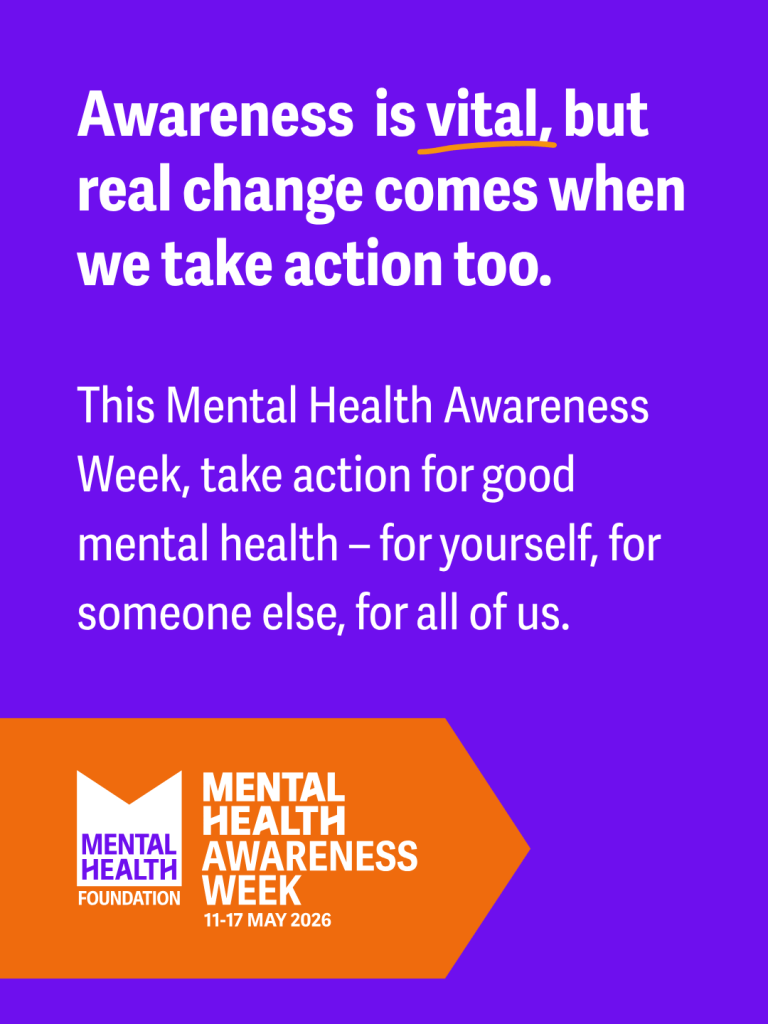
It’s Mental Health Awareness Week (with the Mental Health Foundation) and this year’s theme is Take Action for good mental health- for yourself or a loved one and for the wider community. They say, “we’re asking people to join us in taking action to support good mental health. Even small actions can help us feel hopeful and less powerless. And while our individual actions matter, when we come together we are even more powerful.”

Real change happens when we take action. Here’s some Top 10 tips from the Mental Health Foundation of simple actions to support good mental health, lift your mood and improve your ability to cope with life:

  1. Plan something to look forward to– Making plans for things we enjoy can increase our sense of hope, which is important for our mental health. It could be a plan to sit down with a cup of tea and take a quiet five minutes, or a long-term plan for an ambitious trip. Whether it’s a big or small goal, the important thing is to plan it.

2. Eat Well- One of the simplest ways to improve mental health is by eating a healthy, balanced diet. Not only can it support your emotional health, but introducing small habits, such as staying hydrated or having fruit snacks, can help make changes stick easier.

3. Get closer to nature- Spending time in nature can boost your mood, lessen stress, and help you concentrate.

4. Get good sleep- Good quality sleep helps your brain work better, lifts your mood, and is good for your overall health.

5. Get Creative– Spending time on creative activities is a great way to help ease stress and anxiety. Carve out some time to listen to music, paint, sing, or do whatever you enjoy most.

6. Move regularly- Being active can boost your mood and raise your self-esteem. It’s also an effective stress management technique. Whether you go for a walk, do some yoga, or vigorously clean the kitchen, it all counts.

7. Try Mindfulness- Being fully aware in the present moment can positively change the way you feel about life and how you approach challenges. Aim to notice the colour of the sky, the sound of leaves, or the feeling of your feet on the ground.

8. Friends- Having good relationships with others can help you feel like you belong, allow you to share experiences, and receive emotional support. It’s a great reason to have a catch-up with a friend on the phone.

9. Be Kind to yourself– Bad days happen to everyone. If you’re having a tough time, remember to treat yourself with kindness and understanding. You’re doing the best you can.

10. Talk things over with someone you trust- It can take a lot of courage to tell someone else how we’re feeling or what we’re finding hard. Just talking things through with a person we trust can feel like a relief and make us feel less alone.

(Source for Top 10 tips: Mental Health Foundation)

There are times when some of the above will be or feel too much, for example if facing a deep depression or a serious episode of mental illness. In these cases, the most important thing is to reach for help from your doctor or therapist (or both) and get referred in to mental health services to see a psychiatrist. Practising self care such as eating, sleeping and taking prescribed medication as well as simple things like showering and getting dressed can make a big difference on a day to day basis.

Remember that you are not alone and that you have so much to give and offer to the world. Take small achievable actions and reach for help and support from a trusted place, charity or helpline.

Support lines in the UK:

First port of call if a new referral (not already known) is to call 111 or request an urgent GP appointment

  • call 116 123 to talk to Samaritans, or email: jo@samaritans.org for a reply within 24 hours
  • if you’re under 19, you can also call 0800 1111 to talk to Childline – the number will not appear on your phone bill
  • There are other specialist organisations if needed for specific communities.
(Image: Mental Health Foundation)

Exciting News- We Are A Vuelio Top 10 UK Mental Health Blog Again!

Thanks to our friends at Vuelio, who not only ranked as again as a Top 10 UK Mental Health blog which is amazing- but included this little blog in the top 5!!

This is our highest ranking and I am so honoured. Thanks to all the writers and business/brands we work with too for their hard work in creating content.

This blog is in its 7th year now and can’t wait to see what the next year will bring. This is particularly special as this week is Mental Health Awareness Week too. The aim of this blog is to provide information to help people feel less alone and to dispell any myths of stigmas around mental illness.

Well done to all on this list and all the fab mental health bloggers out there.

You can see the list here: https://www.vuelio.com/uk/social-media-index/mental-health-blogs-uk-top-10/

Thank you Vuelio team!

Eleanor x

The Road to Recovery: On PTSD, Trauma and the Future… by Eleanor for Mental Health Awareness Week

Trigger Warning: sexual assault, details of assault and severe mental illness

Hi everyone,

Its been a while but I thought I would put type to keyboard and write a blog for more mental health awareness.

Since my book was published, I haven’t written many follow up personal blogs, purely because the launch of my life story into the public domain felt overwhelming and scary. 6 months on, I am used to it being out there but I have been working hard in EMDR trauma therapy to help myself.

See, the truth is that right now the Bipolar Disorder for me is stable and under control on my medicines. I still get side effects- weight gain, dry mouth and thirst, but my mind is generally healthy in terms of the Bipolar- no mania or depression. Anxiety and panic yes but Bipolar, not really at the moment.

Yet, almost lurking unseen after I left hospital in 2014 and began my recovery was the fact I was traumatised by my experiences of going into psychosis (losing touch with reality via delusions, false beliefs) and my experiences when being sectioned. I will just give an overview as the rest is in my book- but this included- being restrained, being attacked by other patients and seeing them self harm, being injected with Haloperidol (an anti psychotic) in front of both male and female nurses in a part of the body I didn’t want, being chased round A and E by security men in genuine fear of my life, dealing with lawyers and going to tribunals while ill, thinking I had been abused by family and was locked up by a criminal gang and fearing my family were against me. My bipolar mind could not cope.

Just before this all happened, I was very vulnerable and was sexually assaulted by a man I knew through friends and all of this trauma stayed with me.

I did what most of us with severe mental illness and assault survivors do- I tried to rebuild my life. I tried to work in schools helping children with special educational needs. I tried to work for a mental health charity as a peer support worker for people like me. I began to blog and write and share as therapy- from charities to national newspapers. Bit by bit, as I wrote out what I has been through, I started to slowly heal. But, the symptoms of the extreme panic remained. I lost jobs because of it. I became depressed. I started dating but I often had to cancel dates- (before I met Rob, my husband who listened to me talk about it all and didn’t bat too much of an eyelid.)

I was in a state of flux, a state of transition. I knew I had trauma still living in my brain and body. I had been physically and sexually assaulted, I had been mentally violated- I had been sectioned twice in a few months and now I was sent home to try and rebuild my life as a 25 year old single woman.

I share this important blog, not to share that I am a victim- because I am not. I want to share that I believe for about 5 years, I have been suffering with some of the symptoms of Post Traumatic Stress Disorder (PTSD). My therapist believes the same.

The panic attacks that grip me with fear before work or the day ahead when I have to leave the house. The fear of going out or travelling at night alone. The fear of being taken advantage of and having to trust men again (thank you to my husband for helping ease this pain). The fear of exploitation, of losing my mind, of not trusting mental health professionals any more.

My panic attacks get triggered by certain events- it could be having to speak about my life or book, or seeing people I don’t feel comfortable with, of feeling exposed, of worrying about others judgement. I am still healing from all I have been through and experienced. The PTSD means that I have to take medication (Propranolol) to function sometimes. It means that I experience flashbacks in my body- I feel gripped with fear, I get chest pain and shallow breathing and I start to cry. I had one the other day at 4am….. thank the lord for meds so I could calm down and sleep.

My therapist is incredible and we have been working since October to process the roots of my trauma and panic disorder. We use a combination of rapid eye processing with talking therapy which helps to tackle each and every trauma- and we are still at the tip of the iceberg. It takes time to process the deep rooted experiences in my brain- we are getting there slowly.

For me, in many ways my future is uncertain. My medicines have long term physical side effects. Motherhood will be more of a challenge due to medication and my mental health- I am still processing the choices I will have to make, which I will write in another blog.

I want to end this blog by saying- if you know someone with anxiety, PTSD, another anxiety disorder or something like bipolar or schizophrenia- Be Kind. You never know what someone has gone through.

The NHS waiting lists for help are too long, services are too underfunded- all my treatment has been private provided by my family due to being stuck on a list for years. I am lucky, not everyone is. 

I hope this blog gives some information about my experiences of PTSD since leaving hospital 6 years ago. It is by far the most personal thing I have posted since publishing my book but I hope it helps you feel less alone.

Positivity and Hope are key.  Meeting my husband and my therapist changed my life for the better as I slowly rebuild and find an equilibrium again.

Love,

Eleanor x

Mental Health Awareness Week: The Mental Health Foundation: Body Image 13th-19th May 2019

mentalhealthawarenessweek

(image: Mental Health Foundation)

This week, starting today is the Mental Health Awareness Week by the UK charity the Mental Health Foundation. Its theme is looking at Body Image, how we think and feel about our bodies.

Mental Health Foundation say ‘Body Image can affect us all at any age- during this week we are publishing new research and campaigning for change’    .

They continued,

Last year we found that 30% of all adults have felt so stressed by body image and appearance that they felt overwhelmed or unable to cope. That’s almost 1 in every 3 people.

Body image issues can affect all of us at any age and directly impact our mental health.

However there is still a lack of much-needed research and understanding around this.

As part of Mental Health Awareness Week:

  • We will be publishing the results of a UK-wide survey on body image and mental health.
  • We will look at body image issues across a lifetime – including how it affects children and young people, adults and people in later life.
  • We will also highlight how people can experience body image issues differently, including people of different ages, genders, ethnicities and sexualities.
  • We will use our research to continue campaigning for positive change and publish practical tools to help improve the nation’s relationship with their bodies.’
  • The good news is that we can tackle body image through what children are taught in schools, by the way we talk about our bodies on a daily basis and through policy change by governments across the UK.’

For more on how you can get involved see : https://www.mentalhealth.org.uk/campaigns/mental-health-awareness-week


What UK Charities are doing for Mental Health Awareness Week and helping to break stigma by Eleanor for Metro.co.uk (Extract)

Today my article for Mental Health Awareness Week (by the mental health foundation) went live on the Metro.co.uk website. I worked with the Foundation, Samaritans, Young Minds and Time to Change to discuss their initiatives to help break stigma against mental illness and do something active in our communities.

Here is an extract of the article link to the full piece: http://metro.co.uk/2018/05/15/its-mental-health-awareness-week-how-are-charities-fighting-the-stigma-surrounding-the-subject-7533330/

mentalhealthaweek
(image: Eleanor Segall)

This week is Mental Health Awareness Week,  The event run by the Mental Health Foundation, has been running for 18 years. ‘Admitting it was shameful and embarrassing’ – what it’s really like to have kleptomania This year’s theme for Mental Health Week is: ‘Stress: Are We Coping?’.

Tackling stress, The Mental Health Foundation says, can go a long way to prevent anxiety, depression, self-harm and suicide, and it has commissioned the biggest ever survey into stress-related issues in the UK.

The survey, of 6,000 people across the UK, found some startling findings: in the last year almost three-quarters of people have at some point felt so stressed they felt overwhelmed or unable to cope.

It revealed that 74% of UK adults have felt so stressed at some point over the last year they felt overwhelmed or unable to cope, and that 83% of 18- to 24 year-olds said this, compared to 65% of people aged 55 and over.

Mental Health Foundation director Isabella Goldie says: ‘Millions of us around the UK are experiencing high levels of stress and it is damaging our health. ‘Stress is one of the great public health challenges of our time, but it still isn’t being taken as seriously as physical health concerns.’

Talking and breaking the stigma that surrounds mental illness is also hugely important So how are charities working to break down this stigma? We spoke to a number of them to find out.

The Mental Health Foundation

It is hoped that Mental Health Awareness Week will educate on stress and mental health, and start to open the conversation on coping methods and support, such as therapies, support networks and medication. The foundation is running the Green Ribbon scheme, a charity pin that can be bought.  Worn during Mental Health Awareness Week, It allows people to show support for good mental health for all, with all proceeds going to support the work of the foundation. Actor David Harewood posted a photo on Instagram about the campaign as he is an ambassador.

He says: ‘This year I am supporting MHAW. I am putting my face to the campaign and making a BBC documentary on the subject because 30 years ago I had a breakdown myself.

‘I am not sure why it has taken so long for me to go public with it, but, to be honest, I’ve been so busy over the past seven to eight years I haven’t really had the time. ‘Ever since I did last year, I have been astonished by the number of people who have come to me with their own experiences of mental health, encouraged by my frank admission.’

The Foundation wants the green ribbon to be the international symbol for mental health awareness. It is encouraging family and friends or colleagues to get together and have a chat about mental health over a curry. There are quiz ideas and  competitions to keep your guests engaged and to raise money for the Foundations work in mental health. To learn more, visit mentalhealth.org.uk.

To read more about the other charities and see the full article click the link below.

Read more: http://metro.co.uk/2018/05/15/its-mental-health-awareness-week-how-are-charities-fighting-the-stigma-surrounding-the-subject-7533330/?ito=cbshare

Twitter: https://twitter.com/MetroUK | Facebook: https://www.facebook.com/MetroUK/