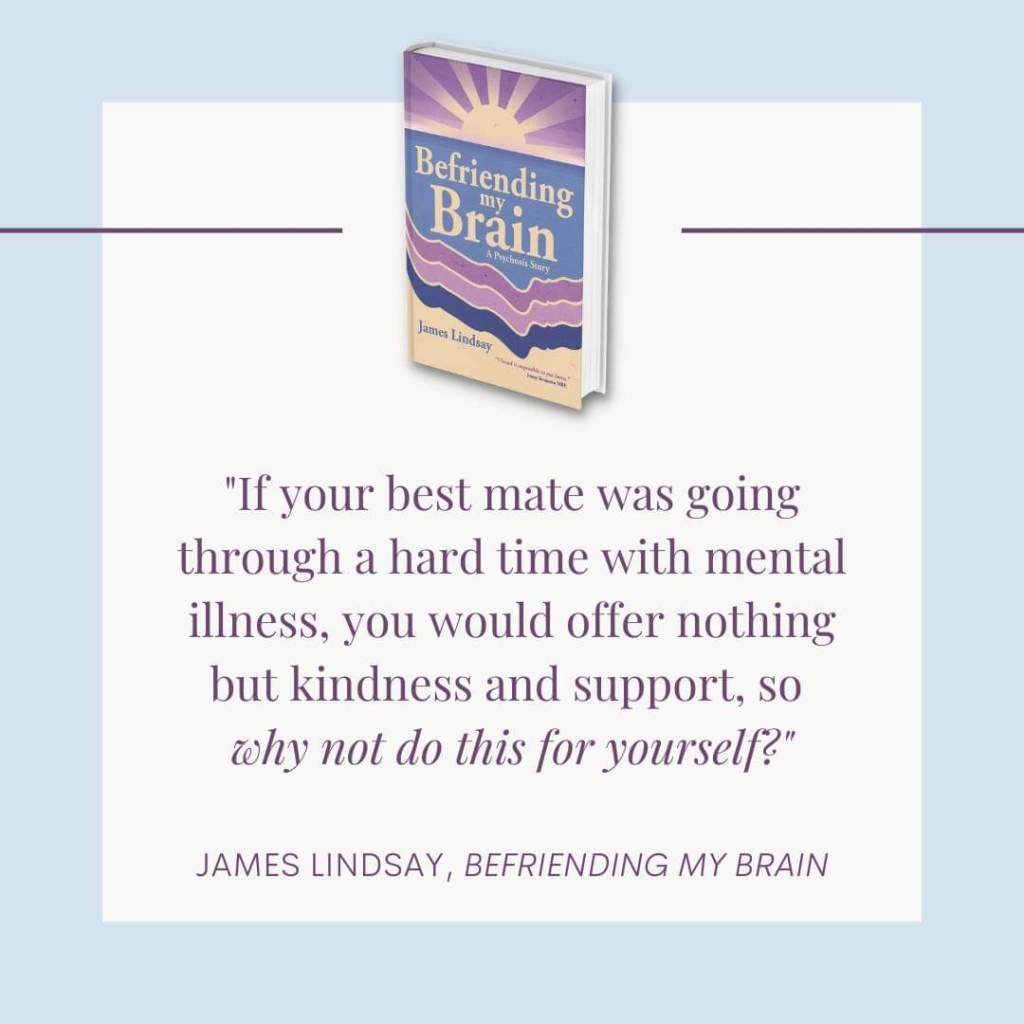
I first ‘met’ my Twitter friend James Lindsay online when he was first starting to talk about his schizoaffective disorder and psychosis. James also works for Mind doing important work in the mental health sphere and we both live locally to one another. I am really proud of James’s determination, not only in his own life, but to help others through his writing and his new book ‘Befriending My Brain’ with Cherish Editions (Trigger Publishing).
An eye-opening memoir about a young man’s descent into schizoaffective disorder– and the steps he took to regain control of his life.
It’s no secret that, in recent years, mental health has become a major topic of conversation. But just because many people feel comfortable discussing their depression, anxiety or other mental health conditions, doesn’t mean that we have removed all stigma from such diagnoses. This is especially true when it comes to psychotic disorders, which affect less than 1 in 100 people in the UK each year (Mind), thus leaving these disorders shrouded in mystery. It doesn’t help that what the media portrays as schizophrenia or psychosis is not always what the sufferer experiences in real life.
As such, it’s vital that we start to bring psychotic disorders, including psychosis, to the forefront. According to a 2016 report from Public Health England, “psychosis is one of the most life-impacting conditions in healthcare.” But with the proper treatment and understanding, it doesn’t have to be life-altering. The same report states that the sooner someone is treated for their psychosis, the better the chances that they will recover and return to their normal lives.
James Lindsay has experienced the ups and downs of schizoaffective disorder first-hand, and his book does the vital work of removing some of the mystery surrounding such a diagnosis. It includes the red flags he recognises in hindsight after psychosis landed him in hospital for the better part of a month, but it also retells the inspiring journey he took to recovery in all aspects of his life.
In his case, psychosis and his path to better mental health gave him a new passion in life: helping others through their own diagnoses and getting their lives back, just as he did. No matter where readers are on their journeys, James’ memoir will resonate and remind them, as he puts it, that “recovery is always possible, and hope is never far away.”
You can buy a copy of Befriending My Brain: A Psychosis Story by James Lindsay at Amazon, Trigger, Waterstones, WH Smith and all good bookshops.
MORE ABOUT THE AUTHOR Hailing from Watford, Hertfordshire, James Lindsay works for Hertfordshire Mind Network and uses his free time to advocate for mental health care by blogging and appearing on podcasts and TV. James enjoys playing football, going to the cinema, spending time with friends and family, and exploring new places, with his partner, Holly. Befriending My Brain is his first book.
No one’s life is perfect. At some point, we all face difficult challenges and struggles that can leave us feeling lost, powerless, and alone. If you’re currently dealing with a big life change, know that you’re not alone. Here are some tips for how to cope with the big changes life throws at us.
Acknowledge that change is hard, and give yourself time to grieve the loss of what was
Acknowledging the difficulty of coping with emotional hardships in life can be the first step toward healing. Change is never easy and it is natural to experience grief or sorrow over losing something familiar or safe. Taking the time to sit with those feelings will help give space for understanding rather than running away and pretending like everything is fine. Being compassionate to yourself throughout this process can allow you to accept the struggles you are facing, ultimately helping you venture forward.
Lean on your support system – friends, family, therapist, etc.
When grappling with emotional struggles in life, it is helpful to remember that you are never alone. Caring and reliable support systems of friends, family, and therapists can make a significant difference in your journey of healing. A strong foundation of accepting people will lift your spirits and provide valuable perspectives on your situation. You might find this through your community at school, going to a local group therapy meeting, or through a religious or other network. Every individual has different needs when it comes to dealing with emotional difficulties; leaning on those around you as a source of comfort can be an extremely supportive outlet, as you navigate through trying times.
Find healthy coping mechanisms that work for you
When dealing with difficult emotions, it is essential to find healthy ways to cope. Each person has different needs and preferences when it comes to finding relief from emotional hardships. Luckily, there is an abundance of coping mechanisms available. Whether it’s exercise, journaling, painting, or something else entirely, identifying which coping activities work best for you can help reduce stress in your life and give you an outlet for negative emotions. Being proactive in finding techniques that bring relief is the foundation for healing.
Create a new routine or structure for yourself to help with the transition
When dealing with emotional struggles in life, creating a new routine or structure for yourself can provide much-needed comfort and stability. This can range from something as simple as coming up with a plan for your daily tasks or an overarching chart that breaks down what you want to accomplish each week. Furthermore, it may be beneficial to set aside time where you can focus on self-care or just unplug and take a breather from the world around you. Though this type of change may seem daunting at first, having an established plan can give us control, which is often otherwise lacking during hard times. By putting confidence in yourself and investing effort in your goals, you can take strides on the path toward healing.
Be patient with yourself
Making a major change in life can be traumatic, and it is important to be patient with yourself as you adjust. Healing often happens one step at a time, so allow yourself the time and space to take whatever baby steps are necessary to feel better. Finding people who understand and can offer meaningful support along your journey is important, but make sure that the people you turn to also help you focus on your sense of strength and purpose rather than simply engaging in a pity party. With patience, you will eventually discover that you’ve healed enough that growth can start to occur.
Going through tough changes in life is never easy, but there are ways to make it more manageable. Acknowledge your feelings, reach out for support, find healthy coping mechanisms, and be patient with yourself. Give yourself time to grieve and adjust, and eventually, things will start getting better. Remember that you’re not alone – Lean on your loved ones and professionals for help when needed. You’re worth it.
Meghan Belnap is a freelance writer who enjoys spending time with her family. She loves being outdoors and researching new topics that help to expand her horizons. You can often find her buried in a good book or out looking for an adventure. You can connect with her on Facebook right here and Twitter right here.
Self-care is a buzzword that has become increasingly popular in recent years, with many people talking about how important it is to take care of ourselves. But what does self-care really mean? And more importantly, what are the benefits of self-care for mental health? Let’s take a look at why self-care is so important and how it can improve your mental well-being.
What Is Self-Care?
Self-care is any activity that we do deliberately in order to take care of our mental, emotional, and physical health. We all need different kinds of self-care depending on our individual needs, but some common examples include getting enough sleep, eating nutritious foods, exercising regularly, and taking time out to relax. Taking part in activities like these can help us manage stress levels and make us feel better about ourselves overall.
The Benefits of Self-Care for Mental Health
Self-care has many benefits for our mental health and well-being. Taking time out to practice self-care can help reduce stress levels, which can have positive effects on our mood and energy levels. It can also help us gain clarity and perspective on problems we may be facing in life as well as helping us feel more connected to ourselves. Regularly engaging in activities such as yoga or meditation can also help us develop coping skills for dealing with difficult emotions or situations. In addition, taking part in activities that give us pleasure, such as reading a book or going for a walk, can boost our moods and make us feel more positive about ourselves and life in general.
Self-Care Tips For Improved Mental Health
If you want to get started with self-care but aren’t sure where to begin, here are a few tips you can use:
• Take breaks throughout the day – even if it’s just five minutes – to recharge your batteries
• Make time for things you enjoy doing, such as reading a book or listening to music
• Get outside into nature whenever possible
• Connect with friends or family members who make you feel good
• Practice relaxation techniques such as deep breathing or visualization
• Eat healthy foods that will nourish your body
• Exercise regularly – this doesn’t have to mean hitting the gym every day! A simple walk around the block will do wonders for your mind and body
• Spend time alone – this could be journaling or simply sitting quietly with yourself
• Be kind to yourself – don’t forget that self-love is one of the best forms of self-care!
• Reaching out and getting psychiatric services also counts as self-care, as you are helping yourself feel better in a professional setting
Self-care is essential for maintaining good mental health and well-being. From eating healthy foods to taking regular breaks throughout the day, there are many simple things we can do every day that will benefit both our minds and bodies.
The key is finding what works best for you personally—what activities bring you joy and make you feel better? By taking some time each day just for yourself—whether it be reading a book or going outside into nature—you will soon start reaping the rewards of self-care!
Sober living can be a challenging journey for anyone. It’s important to have the support of family and friends as you go through this process. As someone who cares about your friend, you may want to reach out to show your support. Here are some thoughts on how best to do this.
Be Present and Listen
Your presence can be very powerful in helping a friend who is working on sobriety. Listening is one of the most important things you can do when you’re trying to show your support. Offer an open ear and an understanding heart, without judgment or criticism. Ask questions that show you care and demonstrate that you’re paying attention, such as “How are you feeling?” or “What do you need right now?” You don’t have to have all the answers; just being present and offering an understanding ear can make all the difference.
Recommend More Specialised Help if Needed
You may want to suggest or support your friend in seeking professional help if they need it. This could include group meetings, individual counselling sessions or even visiting a Drug Addiction Recovery Information Center. Let them know you are there for them and that you believe in their recovery journey.
Offer Non-Alcoholic Activities & Support Groups
If your friend is struggling with addiction, it’s important to find ways for them to fill their time with activities that don’t involve alcohol or drugs. Suggest things like going for walks together, visiting parks or museums, playing board games, etc., so they can still enjoy themselves without any temptation from alcohol or drugs. Additionally, attending support groups with them could be helpful in providing encouragement throughout their journey towards sobriety. This could help them gain strength from others who are also facing similar struggles and create a sense of community for them during this difficult time.
Be Patient & Encouraging
Most importantly, remain patient and encouraging throughout your friend’s recovery process. Sobriety doesn’t happen overnight; it takes commitment, hard work, and dedication to maintain sobriety in the long run–so stay by your friend’s side throughout their entire journey no matter how long it takes! Lastly, make sure that they know that they are not alone during this difficult time – everyone needs a little extra love once in a while!
Supporting a friend through sobriety is no easy task – but it is certainly possible if done with patience and empathy! Showing up for them with an open ear, offering non-alcoholic activities and support groups, plus encouraging words can make all the difference in helping them stay sober! With enough help from loved ones, anyone can take control of their addiction and live a healthier life full of hope and promise!
It’s a day like every other day before, but you can’t find the motivation to follow your typical routine. On average, you’d jump out of bed, drink a hot cup of coffee, and catch up with morning shows and podcasts before hitting the gym or work. But you somehow don’t feel like doing anything today; this happens at a particular time of year.
Seasonal affective disorder (SAD) is depression associated with seasonal changes, e.g., winter, fall (autumn), or summer. People tend to associate seasonal depression with “winter blues,” but it also appears in other seasons, and how to differentiate it from sadness is that SAD occurs in the same season every year for you.
Symptoms of seasonal depression
The symptoms of seasonal depression are divided into three categories:
General symptoms
● Loss of interest in activities you enjoy
● Sluggishness or hyperactivity
● Low moods that last all day, every day
● Insomnia or oversleeping
● Increased carbohydrate craving
● Loss of focus
● Low energy
● Suicidal ideation
Fall and winter SAD
Seasonal depression in the winter typically starts in the fall and lasts until after the winter, and these are the symptoms:
● Oversleeping
● Craving foods high in carbohydrates
● Weight gain
● Tiredness
Spring and summer SAD
Summer depression is more common during spring until summer, and the symptoms include:
● Weight loss
● Insomnia
● Anxiety
● Increased irritability
Are you slipping into seasonal depression?
As somebody who experiences seasonal depression in the winter, I can subjectively say there’s no ultimate method to cure or treat SAD, but there are tips to help you navigate it.
Tip #1: Identify the events that lead up to the seasonal depression
Are you in college and anxious about going home for winter break? Or you’re a mom about to spend her entire summer with extended family and it’s sapping your energy? It’s best to understand what happens when you experience seasonal depression so you understand the major problem and how to tackle it.
Tip #2: Don’t spend time alone
I understand how tempting it is to avoid people when you’re in a low mood, but spending time alone can make you brood over your intrusive thoughts, keeping you in a more depressed state. It’s best to invite your friends over if you don’t have the energy to see them and feel able to have them round. You don’t have to go too far out of the house or your comfort zone as long as you don’t spend too much time isolated.
Tip #3: Say NO to plans that make you feel uncomfortable
When you’re experiencing seasonal depression, you could be inclined to accept invitations just to escape the feeling of sadness, guilt and worthlessness. But you will only feel more drained by going to places you don’t want to be. Look after yourself.
Final tip
The ultimate hack that works for me during seasonal depression is being open about my suicidal ideation. Whether it’s second-hand suicidal or intrusive thoughts, I have a friend I can be vulnerable around, and I tell them everything that goes on in my mind during that period.
“What if they get tired of listening to me complain?”
It’s normal to feel guilty when you constantly complain to one person about your problems – you could feel like a burden and want to step back. But if that trusted friend or family member has never told you to stop talking or coming to them, you should keep going to them. And if that friend ever tells you that they are tired of hearing you complain, it doesn’t mean they hate you – your friends have probably internalised your problems too much and need a step back before continuing to be there for you.
In all, don’t be afraid to talk about how you feel when you experience seasonal depression, and remember, it will pass, so don’t make permanent decisions during that period.
I’m rooting for you and believe you’ll see better mental health days this year and beyond.
Author’s Bio
Obehi Iyobhebhe is a freelance writer in the business and psychology space. She’s passionate about helping people improve their life’s quality by paying attention to their mental health.
Obehi is also interested in helping entrepreneurs hit their business goals by creating blogs and email campaigns to generate leads.
Happy new year everyone! Gosh its nearly the end of January and I havn’t written a blog for a while so thought I would share some things that have been happening here and talk a bit about mental health stuff too.
Firstly, my mental health is fairly stable at the moment, as has been the case for a number of years. I don’t get typical bipolar depressive or manic episodes on my medications and this year is my 9th year out of hospital , which is always a positive. However, I still suffer with anxiety and stress and get overwhelmed so have to pace myself! I have bad days too where things feel too much but thankfully they don’t escalate into a depression.
So for the positives- I have achieved some huge anxiety wins for me. Since November, I have been on the tube (first time in 3 years), I have gone up to the West End with Rob to the theatre using public transport, my panic attacks have been lessening, I have been able to see more people in person and I also passed my probation at work and have been made permanent (huge win!). I am someone who struggles with agarophobia when I feel more anxious and stressed and going out alone can still be a challenge.
I have been allowing myself to venture into previously anxiety provoking situations- for example, I get cabs alone home from work. I had to start doing this last year and it helped me get back into the world again. It wasn’t easy due to many fears I had but I have been able to do it, slowly. My job is also hybrid so I can work from home too- but getting back out into the world and having kind work colleagues at an office has been such a vital part of my recovery too. My therapist has been so helpful in dealing with the panic attacks and anxiety and I do still get triggered but at the moment on a lesser scale. I still find blood tests, hospitals and general health stuff scary because of what I have been through. I really recommend therapy.
I sometimes do have to cancel arrangements when things feel too much so am sorry to anyone I have had to postpone… its not easy and I hate doing it as I feel bad… but I am learning the balance of looking after me and socialising too. I don’t always get it right but I am trying.
Then, my friend in Bushey, Lee, texted me a few weeks back and asked if I would like to speak in my childhood community for the Jami (Jewish charity) Mental Health Awareness Shabbat. I hadn’t done public speaking about my story since before Covid in 2019, when I spoke with my Dad Mike at Limmud and at Chigwell shul (synagogue, my husbands community). I have had drama training so for me speaking publicly as someone else is OK, but when I have to stand up and share my own story, I get nervous as its so personal. The first time I was asked to speak in a shul at Belsize Square, I made it to the community but my Dad had to give the talk by himself as i was too panicked to attend the service. I managed in time to dip my toe in slowly, always with the support of my Dad and my therapist.
This talk in Bushey felt significant. It’s the Jewish community I grew up in and was a part of until I was 23. I felt like I was going home. The Bushey team told me they had two other speakers, but would I like to speak and share my story with bipolar disorder?
I thought to myself… I am ready, my panic attacks and social anxiety are more under control. To me being asked to come home to Bushey shul was a sign. My Grandpa Harry passed away in 2021 from Covid- and he and Grandma had lived in Bushey since the 1990s, when we were little. Our family lived in both Bushey and Bushey Heath and I studied at Immanuel College, across the road from our home and my grandparents. The area contains so many happy memories for me. I knew the new senior Rabbi and Rebbetzen, as he had officiated at my grandparents funerals and was so kind to our family. My Dad is also still a member of the shul and I still know a lot of people who live in the community too. Its a very special community and one I am proud to be from (and still feel.a small part of despite not being a local anymore).
So, I decided, with my Dad and Rob’s support on the day (and anxiety meds), that I could stand up in shul and speak with the other two speakers on the Shabbat (sabbath) morning. My Mum and step dad were supporting from afar and looking after our guineapigs.
The senior Rabbi and Rebbetzen hosted us for the Friday night which was wonderful as we got to meet lots of new couples and see the Ketts, the other Rabbi and Rebbetzen! For lunch after the service, we went to Lee’s house, which was very special as she was my batmitzvah teacher and is a good family friend.
I was initially told the talk was going to be in a break out room- but on the day it was decided that it would be from the pulpit. Last time I ventured to that pulpit and stood up there was when I was 12 years old, sharing my batmitzva portion of the Torah. The year my Dad was very ill and diagnosed with bipolar. I became ill just 3 years later.
Now, here I was back as a married woman of 34, revealing about the mental illness that had found its way into my family and caused a lot of devastation. However, the main reasons I wanted to stand up and talk about bipolar disorder are because I know that this illness runs in families, many Jewish families struggle with it. I wanted to give the message that you can live with this illness but you can have periods of remission, recovery, you can find hope.
And as I spoke to the audience of people – many of whom I had known since my childhood, who saw me grow up and saw my family eventually leave Bushey for Edgware, I felt humbled. I felt honoured to be asked to speak and I hoped that by sharing my own journey with bipolar (being diagnosed at 16, in hospital twice, the last time in 2014 for a very serious manic episode), that I could touch someone who needed to hear it. My Dad gave me permission to tell his story too.
When I grew up in. the early 2000s, talking about mental illness and particularly in Jewish spaces, was not the norm. I hope that through sharing my own journey and my Dads (he was undiagnosed for 9 years until he was 44), that I will have helped someone.
Most importantly, I felt I had come home. The kindness and warmth shown to me by the members of the Bushey community who I have known since I was a little girl was something so incredibly special and touching. People confided in me after the service about their own struggles. Others thanked me for sharing my story. I was hugely touched by the other two speakers who spoke after me about their own journeys with mental health and their children’s. I won’t name them here in case they want to be anonymous but I learnt so much from them and their experiences.
So I want to say a huge thank you to Lee, to the Rabbis and Rebbetzens and to everyone in Bushey who I have known for years and have loved- for hosting us, for inviting me to talk about something so personal in such a special community. It touched my heart. I really hope it helps.
I genuinely did not know how I stood up there to speak to 90 odd people- what kept me going is knowing I was doing this to help eradicate the stigma of mental illness but also I hope that the words I spoke gave comfort to anyone going through mental illness, that it does get better. It can improve. You won’t be ill forever.
When I was unwell in 2014, Jonny Benjamin MBE was speaking and sharing about mental illness. He taught me that sharing your story to help others is vital. So thanks Jonny for all your support too (whether you knew you gave me the courage or not :).
I also want to thank Jami charity, Laura Bahar and Rabbi Daniel Epstein. I was part of the volunteering team that helped set up the first mental health awareness shabbat. The project has blossomed and is now annual and it is truly wonderful to see.
What I want to clarify is that although I am currently a lot better with my anxiety, it is very much a grey area, day by day thing. That can be hard for people to understand- how one day you can be great with loads of energy and the next you have to stay home and recuperate- self care. But I think knowledge of mental health is increasing now, so do check in with your friends and family and offer a safe space without judgement- its so helpful.
Thank you again for reading this if you got this far. You can do whatever you put your mind too- reach for help from medical teams, medication, therapists and never give up.
As soon as the 1st of January hits, every advertisement seems to switch from encouraging total indulgence, to tips and tricks on how to ‘better’ yourself both mentally and physically. Such a drastic change in narrative can cause your New Year to begin in a stressful, pressurised manner, and can even lead to burnout.
With this in mind, Dr Catherine Carney of private rehabilitation centre, Delamere, has offered some tips and tricks to combat the anxiety that January can bring. As well as this, she will also outline the most common causes of New Year burnout, making it easier for you to avoid them.
Setting unrealistic goals
While there is nothing wrong with being ambitious, pushing yourself too hard is destined to lead to disappointment and a feeling of failure. Rather than comparing yourself to people on social media platforms, it is always better to write a short list of smaller, more obtainable goals.
Once you have achieved these, you can start to work on more difficult ones. This may be easier said than done due to toxic hustle culture being everywhere, but it is important to remember that everybody progresses at a different pace. If you attempt too much in one go for example, telling yourself you will go to the gym every day or read 10 books a month, you could mentally and physically crash and burn.
Comparing your progress to someone else’s
As stated previously, different people achieve things in their own time, which is crucial to remember around New Year. If somebody you know has started running 10k a day and you are struggling to get past 5k, then try not to punish yourself – or worse, exert yourself too much and cause an injury.
Your body and your mind can only do so much in a certain period, so it is always important to remember to rest and recharge. Not allowing yourself to do this can lead to you wanting to isolate yourself from others, due to feeling like a failure, as well as making you feel exhausted and worn out. Taking small, realistic steps is key when it comes to forming a new habit.
Forgetting to plan your time
Many people find themselves struggling with day-to-day life in general, so adding a new task or activity can cause them to be completely thrown off. Telling yourself you will go for a run, read a book, or do some writing, but not planning a specific time, could lead to you becoming stressed and irritated – especially if you do not end up doing the task.
Juggling work, sleep, a social life, eating healthily, and leisure activities can be very difficult, so it is handy to write tasks and goals down. Setting a specific time would allow you to get things done prior to the new activity you are trying to stick to, as well as allowing you to fill your time efficiently and with things you enjoy.
Neglecting rest, relaxation, and meditation
Sitting down and allowing your body and mind to recharge is possibly the most effective way of avoiding burnout. It can be very easy to forget about this, especially with hustle culture making people feel guilty for not being productive. However, mentally recharging will allow you to feel more energised when it comes to tackling your New Year’s Resolutions.
Meditation and general wellness has been proven to lessen feelings of anxiety and depression, allowing you to clear your mind after a challenging day and re-centre your energy. While wellness is not the right path for everybody, it could be worthwhile to give it a try, especially if your resolutions have left you feeling sluggish.
Forgetting to see friends and family
Many people experiencing depressive feelings will feel compelled to socially isolate themselves. This can be for a number of reasons, ranging from feeling too emotionally exhausted to leave the house, to not wanting people to know how they are feeling. However, as depressive thoughts go hand-in-hand with burnout, it is crucial to maintain contact with friends and family – especially around the New Year.
If you have not achieved something you told people you would, or are generally feeling like you are underachieving, socially withdrawing may feel like a comforting thing to do. Sharing your thoughts and worries with a loved one will allow them to offer words of encouragement and support, as well as a potential solution to your issue. For example, if your goal is to go to the gym more often, your friend could offer to go with you.
Eating disorders come in many shapes and sizes. They can be hard to identify, as they can develop slowly over time, or they can be immediately apparent. Knowing the symptoms of an eating disorder and understanding the best way to seek help is important in order to help those who are suffering from these illnesses.
Signs of an Eating Disorder
Eating disorders often manifest themselves through physical changes in appearance, as well as psychological changes such as mood swings, isolation, and feelings of guilt or shame. There are a few signs that may indicate someone is struggling with an eating disorder:
Dramatic changes in weight or body shape (either gaining or losing weight suddenly)
Avoiding social situations where food is involved
Obsessive counting of calories or talking about dieting constantly
Obsessive exercising (working out excessively even when injured)
Preoccupation with food, body image, and weight gain/loss
Negative self-talk (criticizing one’s own body image)
If you have any reason to believe that someone you care about has an eating disorder, it’s important to get them help right away. The longer someone goes without treatment for an eating disorder, the more difficult it becomes for that person to overcome the illness
It’s also important to remember that a person doesn’t need to show all the signs listed above for it to be considered an eating disorder; if you suspect something is wrong, trust your instincts and reach out for help.
Seeking Treatment for Eating Disorders
If you think someone may have an eating disorder it’s important not to ignore the warning signs. The best course of action is always to seek professional medical advice. A psychiatrist or therapist will be able to diagnose any underlying issues and recommend treatment options based on their experience and expertise.
Treatment options for eating disorders vary depending on the individual but typically include some combination of psychotherapy, cognitive behavioural therapy (CBT) or other therapies, medication management, nutrition counselling, and lifestyle coaching. It’s essential that individuals receive support from family members during treatment so they can stay focused on their recovery journey.
Eating disorders are serious mental health conditions that require professional medical attention in order to be treated properly. If you think someone might have an eating disorder it’s important not to ignore the warning signs but rather seek professional advice right away in order for the individual to receive a proper diagnosis and treatment plan tailored specifically for them.
With proper treatment, individuals with eating disorders can learn how to manage their mental health around food, body image, and emotional well-being so they can live a healthy life.
This article was written by freelance writer Brooke Chaplan.
Mental illness can affect anyone, regardless of age, gender, or background. It is important to recognise the signs and symptoms of mental illness in order to get help as soon as possible. Knowing what to look for can be tricky, so here are some common warning signs that you or a loved one may need psychiatric help.
Unexplained Changes in Mood and Behaviour
One of the most common signs of mental illness is a sudden and unexplained change in mood or behaviour. This could include changes in sleep patterns, eating habits, energy levels, attitude towards others, or motivation levels. If you notice any sudden shifts in these areas that last more than two weeks and cannot be attributed to a specific event or life change, it may indicate an underlying mental health issue.
Negative Self-Talk or Rumination
Another sign that someone needs professional help is if they frequently engage in negative self-talk or ruminate on the same thoughts over and over again. For example, if they often say things like “I’m not good enough” or “I can’t do anything right” without any basis for those statements, this could be a sign that something more serious is going on beneath the surface. Additionally, if someone spends hours every day thinking about their mistakes from the past without being able to move forward—this could also be an indication that professional help is necessary.
Isolation from Friends and Family
Finally, if someone begins isolating themselves from friends and family members more often than usual—or does not seem interested in having conversations with them—this could be another indicator that something more serious is happening mentally. It’s normal for people to want some alone time once in a while—but if you notice your loved one consistently avoiding social activities and interactions with others over long periods of time—it may mean they need extra emotional support from a professional psychiatrist before they can get back on track.
Other Behaviours
Other behaviours you should watch out for is frequent tearfulness, self harm thoughts or ideas, suicidal thoughts and ideation- as this indicates someone is reaching a crisis point with their mental health. In some there may be an increase in activity or mania. This can lead to psychosis- where your mind loses touch with reality, common in bipolar disorder and schizophrenia (but can also happen outside these conditions).
Mental health issues are complex and often difficult to recognise at first glance. However, it’s important to understand that early intervention can make all the difference when it comes to managing mental illness effectively. If you notice any of these warning signs in yourself or a loved one—don’t hesitate to reach out for help!
Professional psychiatric services should always be sought out when necessary as this will create better outcomes for everyone involved in the long run. In the UK, that may be via the NHS but due to overwhelmed services, if you can afford private treatment, go down this route as it will be quicker!
This article was. written by Brooke Chaplan, freelance writer.
Your wedding day is meant to be a truly special time, a day to celebrate your love with friends and family. Once you’re engaged, you’ll likely find many people want to know what you’re doing for the wedding – with some people expecting a big, showy day, with everyone in your extended family getting an invite.
Weddings are exciting, but they can also be overwhelming, especially if you don’t love large social gatherings or find the fuss and fanfare that traditionally comes with the day a little anxiety-inducing. However, the most important thing about your wedding day is that it is right for you and your partner, not what everyone else expects from you. Here, we show you how you can still have a dream wedding day, but keep things calm and sensory-friendly.
Get comfortable with your venue
Often, couples have one chance to view their venue before booking, and then they might only get one visit in before the big day. This is especially true if it’s a popular venue, or you want to get married in peak season. Unfortunately, this can leave you feeling a little unsettled on the day of your wedding, since you aren’t familiar with the space and don’t have your own familiar things around you.
If this is something you’re concerned about, you may want to opt for a less popular venue, or one that you’re already familiar with, such as a local church, hall or even a family home. This will allow you to make several visits before the big day, so that you feel comfortable with your surroundings and can relax and enjoy the moment.
Keep things small- if that’s what you want
Big weddings can come with a lot of noise, talking and a huge amount of people to organise. Keeping things small and only inviting your closest friends will mean that you don’t have as much sensory input to deal with, but it also means they’re likely to respect your needs. If you have any specific requirements, consider communicating this with your guests beforehand, so you can arrive assured that no one is going to cross your boundaries.
Making the decision about your guest list as soon as possible will allow you to speak to people well in advance of the big day, and handle those conversations in the best setting for you, whether that’s written, over the phone or in person.
Consider your outfit
Weddings usually mean wearing a special dress or suit, but sometimes those with sensory issues can find the feel of certain fabrics or seams can cause problems. If this is the case for you, then make sure to find a dressmaker, tailor or clothing brand that you feel comfortable with, so that you’re not distracted by your outfit on the day.
Wear ear plugs
Even with a small number of guests and a quiet venue, there can still be a lot of stimulation if you’re sensitive to noise. Wearing discreet ear plugs can allow you to soften the impact of this noise and enjoy your day without getting overwhelmed. There are plenty of subtle options available, but if you’re worried about them being obvious in your wedding photos, you could take them out for the solo and couple shots, since it’s just likely to be you and your photographer at this time.
(image: Sooz at Unsplash)
Plan for breaks
When planning your day, work with your venue so that you don’t feel rushed or under pressure at any time. Incorporate plenty of breaks into the schedule, and make sure you leave some time for just you and your partner to soak up the joy after the ceremony. You could go for a walk, or sit quietly in a separate room – whatever you need, speak to your venue to make sure you can get that special time. Not only will this help you deal with any sensory overwhelm, but it’s also just a really lovely way to celebrate together and take your first moments as a married couple.
A calmer day
By carefully planning your day to meet your needs, you can relax and enjoy the wedding planning process. Invite your closest friends and family, raise a glass, and celebrate your love together in a way that is perfect for you.














 beurownlight.com