The Head On Mental Health Awareness Shabbat Project.

The past almost 2 months, I have been volunteering with the Jewish Association for Mental Illness (Jami) helping plan and coordinate one of their projects with colleagues. This project took place last weekend in the UK Jewish community -and was a cross communal Shabbat (Sabbath) education project taking place in synagogues, Jewish schools and student societies up and down the country.

It was supported by every level of religious observance and in the end we had over 80 communities involved, holding educational talks, reading sermons, holding themed friday night dinners and hosting speakers on mental health. Some communities had talks from speakers at Jami or those with lived experience of mental health issues, or those who are psychiatrists or psychologists.

Our aim was to battle stigma and get people talking. Jami and our team were just amazed by the level of response and positivity towards the project which seemed to grow and grow and reach communities far away including in Scotland!

We also had 150 people at a panel event organised by Jami about mental health topics, where a great discussion was had.

Times are changing and hopefully we will see stigma in the community fall. I am currently getting over a rather nasty cold-and taking time to rest but I wanted to write this to say how much I truly have loved volunteering with pioneers of the event and seeing the project grow to be so successful.

My article for Self Harm UK- ‘I don’t want to hide anymore (about stigma)’

I am delighted to announce a blog collaboration with the amazing charity Self Harm UK (a part of Youthscape).

I have written a blog for them on my experience of mental health stigma as an ill teenager and what made me speak out further. In the past, I have had self harming thoughts and I myself like reaching out to teens and young people who are suffering out there- so they know they are not alone. I am so pleased to collaborate with Self Harm UK on this and my article can be found here:

Click here to read my article:

Who are Self Harm UK?

From their website selfharm.co.uk:

‘ SelfharmUK (formally selfharm.co.uk) started out of the work of Youthscape, a local charity based in Luton, Bedfordshire, UK. Since it’s beginnings in 1993, the charity has developed a strong and professional reputation for delivering caring, child-centred work, which focuses on the emotional and social needs of all young people. Youthscape works alongside all young people, regardless of race, background, or faith.

By 2004, Youthscapes’s work increasingly involved young people engaging in self-harm. It wasn’t long before a plan began to form to try and reach them them, starting with the provision of informal support groups in local schools. With the help of funding from BBC Children in Need and other grant-making Trusts, the project was able to appoint a specialist staff team in 2005 and develop a more coherent provision that included art projects and therapeutic group programmes. Training and advice for parents and professionals soon followed, in conjunction with the Local Authority and local schools.

In 2008, Youthscape responded to the growing number of enquiries for support and advice coming from outside Luton by beginning to plan for a national project that could support young people from all over the UK. Further planning and fund raising led to the establishment of SelfharmUK later that year and the appointment of a Project Manager

The development of a website was a key part of our initial vision… to have a safe online space available to inform and support young people who self-harm, as well as cater for the needs of their siblings, parents and friends. We also wanted to provide information and training for professionals like youth workers, teachers and social workers.

We wanted to create a safe, pro-recovery site for people to use to communicate with others and express their experiences through the use of blogs, stories, poetry and art. Our next goal was to develop an online group programme – Alumina – which has enabled young people from all over the UK to engage with our staff in real time in order to explore the deeper issues surrounding self-harm. For some it had been the catalyst needed to reduce or stop their harming behaviour, while for others it has proven empowering, enabling them to seek further support in their local area.

We already have a multimedia training programme available to professionals in the UK. Our ongoing vision is to see this rolled out more comprehensively; to serve every part of the UK in supporting and nurturing young people who may be experiencing difficulties with self-harm.

There remains much to be done but we remain committed to improving the lives of anyone impacted by self-harm. Providing effective support for parents and siblings will be a major goal in the near future.

For now, the project remains part of Youthscape as a separate element of this registered charity.’


The best way to support a friend or family member through anxiety and depression.

I have been asked by my friends to write an article about how best to support someone through a mental health issue. There is not a one sized fits all answer, due to the fact that every illness and person is unique with their own brain chemistry and life experience. However, I am  going to offer a few tips on what you can do if someone is suffering from an anxiety disorder or depression (for this article I am going to leave out other illnesses eg bipolar, schizophrenia, psychosis, addictions but will speak about them at a later date)

So what can you do if your loved one is suffering from  an anxiety disorder/ depression?

Anxiety disorders are a group of multi faceted disorders which can include things like generalised anxiety, social anxiety, health anxiety, OCD, PTSD and more. Your loved one may be suffering from lack of sleep, nightmares, inability to sit still, palpitations, racing or obsessive thoughts, panic attacks and hyperventilation. They may feel more on edge, or in the case of OCD- be checking and analysing everything. Anxiety disorders run in certain patterns and all are unique to the individual- what one person with anxiety may have will be different to another, however there are some general patterns to anxiety.

When a person is suffering from anxiety, they may also have physical health symptoms as above due to the increase in adrenaline and the stress hormone, cortisol.

Depression or depressive disorders are sometimes caused due to a chemical imbalance in the brain (not enough seretonin) and can require medication to return the brain to its usual state. Some are a mixture of chemical imbalance and challenging life experiences or brought on from a period of stress eg divorce, moving house, losing a baby, having a baby, being unemployed etc . Symptoms typically can include loss of motivation, feeling tearful, low and hopeless, not wanting to engage socially or be involved with activities one enjoys.

If your loved one is suffering from anxiety or depression the best way you can help is by speaking and interacting with them calmly- not judging them or accusing them of anything bad, but simply being a laid back, supportive friend or partner. If someone can’t socialise, its best to just text once in a while and check up on how they are doing- or send a hand written note or card. Most importantly, do not pressure the person to see you, talk to you or go out.. but just be there for them calmly as a listening ear and encourage them to do small achievable things for themselves.

It is good to encourage your friend to go out with you but not to pressurise. Similarly, getting a bit of fresh air can help. If your friend or loved one is at crisis point ie threatening to take their own life, feeling suicidal, not eating or sleeping and being involved in self harming or risk taking behaviours, it is very important to do the following:

1) If a friend is suicidal, listen to them but do not promise to keep it a secret. You must tell their nearest relative/ best friend/ someone they trust if you believe they are in danger of a suicide attempt or at harm to themselves . Encourage them to see their GP immediately or speak to a help line and the GP will be able to tell you if a psychiatric referral is needed. A psychiatrist and team known as the Crisis Team will then  step in to help.

2) If a loved one you live with is suicidal, go with them to the Doctor or get a doctor to come out to you. There is stigma around this BUT if your loved one is really ill and their brain is effectively temporarily ‘broken’ much like a broken leg, it needs fixing. Your loved one needs help and support to recover whether its medication, counselling or more support at home. Do not blame yourself. This is an illness- not something you have done.

Ultimately, be loving, caring and supportive and CALM- however angry or frustrated you feel. Being frustrated to someone who is unwell can cause them to have feelings of guilt, low self esteem or worthlessness which the depression/ anxiety may perpetuate.

Be there as a support and listening ear but make sure you have a break and take time for you too.

My time recovering in the Acute Day Treatment Unit

adtu3
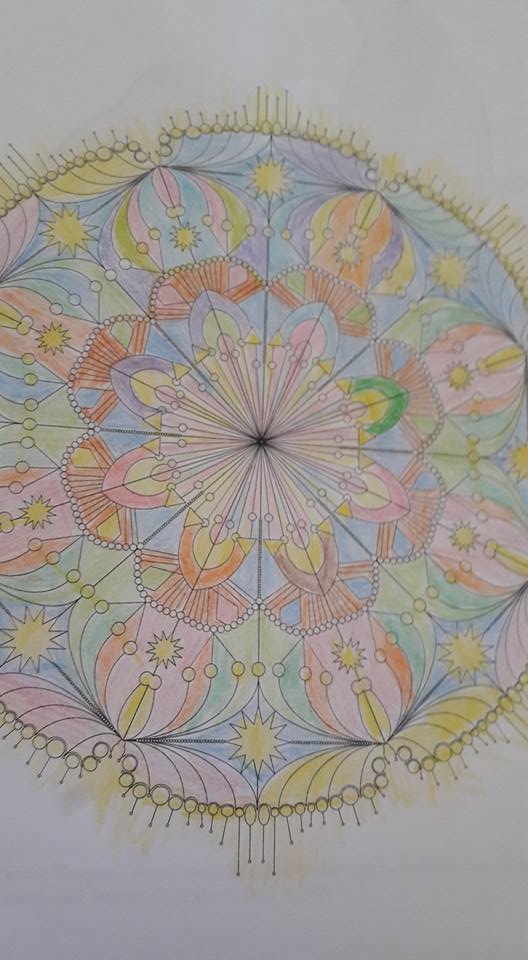
(my art therapy)

As I have previously written, in 2014, I suffered from a very acute period of mental illness- a manic bipolar episode. I had to stay in hospital for 3 months before I began my recovery process at home. Part of that recovery process was being referred to an Acute Day Treatment Unit (ADTU).

ADTU is effectively a hospital day therapy ward- where groups are run on things like anxiety management, recovery techniques, anger management, assertiveness, relaxation/ meditation to music, arts and crafts and groups such as playing games eg table tennis or quizzes. It is there as a short stay intervention. Some like me had been in hospital already very unwell and some had been referred to ADTU to stop them having to go into hospital and to get them better through therapies.

People are referred there with all kinds of illnesses- depression, bipolar, schizophrenia, eating disorders, drug, alcohol and gambling addictions, psychosis, acute anxiety disorders eg PTSD/ OCD and more.

As well as the therapy groups with occupational therapists, the ADTU has psychiatric nurses, psychiatrist and therapists who support you during your stay. I was there largely because I had been through a very traumatic period of bipolar illness and also because I had decided to change medication to a new mood stabiliser- Lithium.

This meant that as well as the therapy sessions, I had to get used to a new medicine regime and weekly blood tests to determine my Lithium level. When you start Lithium, the level in your blood fluctuates- if it goes too high your body can have a toxic reaction. Luckily this never happened to me but there were times when I was quite low and depressed as the Lithium level was too low. So for about 8 weeks, I had regular blood tests.

In ADTU, you get given a key worker- an occupational therapist or nurse who works with you through your stay and acts a bit like a therapist- they are your support team for when you are there. At ADTU, I lived at home and went in every day 5 days a week. It was challenging as there were constantly new people coming in and out- some very poorly. However I made some incredible friends.

My first important friend I met on my first day! We both began at ADTU at the same time and started our induction. She also has bipolar disorder and we were quite similar- both loving all things girly, glittery and of course- unicorns! We got on well from the beginning, sat with each other in therapy groups, where we both regularly fell asleep in the relaxation to music sessions. She is an amazing and brave woman- who I am honoured to call a friend and we are still in touch today!

I made other friends as well, from sitting in the lounge and chatting in the mornings. One of these was my friend who loves sport and we would chat about what she was doing on her degree. She is also another amazing one who I am still in touch with!

ADTU is meant as a short stay intervention but due to my acute illness and change of medication I was there longer than almost anyone else. This became frustrating as I kept seeing people being discharged and I was still there. In the end after 12 weeks where I became used to all the staff and therapy groups and felt a bit like a veteran (some people are only there for 2 weeks) I emerged still fragile but stronger than I had been.

I owe so much to the wonderful staff- especially my occupational therapist key worker and the therapist running the arts and crafts and recovery groups. The staff were so supportive and kind.

In the UK, there are now only two ADTUs in the whole country as funding has been cut. However, I can honestly say that without the staff there and my new friends- I would have found life so much harder. I owe them so much.

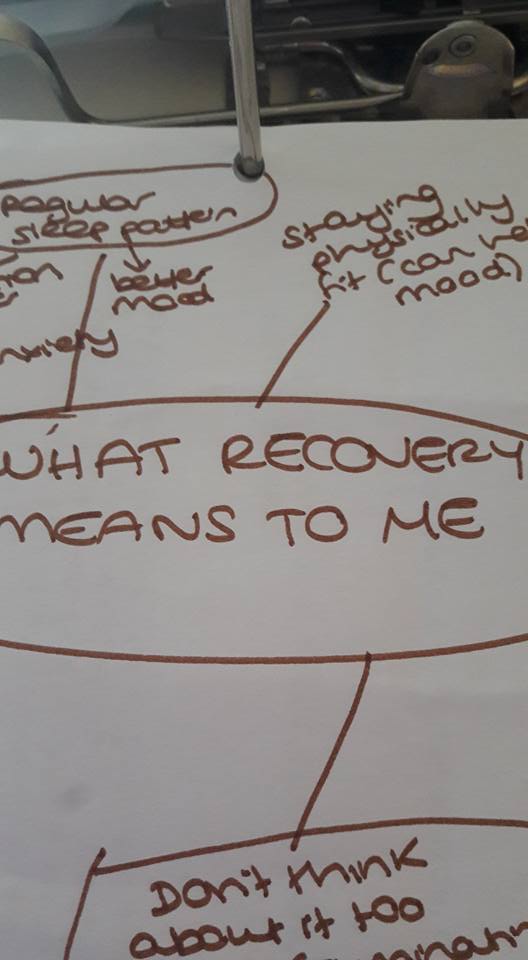
Here are  some of my photos from the therapy folder I kept.

This blog is dedicated to my friends from ADTU who are making amazing strides- my 2 closest friends are now studying for Masters Degrees!

adtu1

Guest post: 5 easy yet effective ways to calm yourself down when feeling anxious

By Lystia Putranto and Karina Ramos at www.bookmeditationretreats.com

Anxiety is a thin stream of fear trickling through the mind. If encouraged; it cuts a channel into which all other thoughts are drained.

– Arthur Somers Roche

Sometimes nothing feels quite as awful than anxiety. In this state of mind, we tend to think of only the worst case scenarios. It robs us of our joy, makes us lose focus and leaves us feeling as if we have no control over our own lives.

Fortunately for us, there’s much we can do to reduce anxiety and its effects on our mind, body, and soul. Here are simple and fuss-free tips to apply that I have found to be effective to help me establish and maintain a calmer peace of mind in situations that previously would send me into a tailspin:

  1. Take Deep Breaths

It seems hard to believe that one of the simplest actions that you can take – taking deep breaths – may just be one of the most effective ways to calm ourselves down when we feel an anxiety attack coming on. Breathing deeply differs from our normal breathing (shallow breathing) as it requires your focus to breathe from your diaphragm as opposed to just breathing from your nose. Moreover, shallow breathing may often feel tense and constricted, whereas deep breathing induces relaxation.

By just taking a minimum of 10 deep breaths whenever you find yourself feeling anxious, you can instantly feel more peaceful and more importantly, it could bring our focus back to the present moment even in moments of panic or extreme anxiety. Through focusing our attention in the present moment, we are able to give our best effort in finding solutions to the issue(s) we worry about. Another great thing about this anxiety-reducing tool is that it is also accessible to you whenever and wherever you need it.

If you’re looking to gain a more lasting effect that you get from deep breathing, I highly recommend that you take up the practice of meditation. Not only will you be able to feel more at ease and calmer, you’re bound to also reap the many other benefits that come with meditation!

 2 Listen to Inspiring Tunes

I’m a true believer in the power of music and great tunes can be a great tool in lifting our spirits whenever we feel anxious or overwhelmed. Create a special playlist of your favorite inspiring (preferably upbeat) tunes and be sure to have them on hand to give you a spirit boost whenever you feel less than stellar. If you’re up for it, why not kick it up a notch and have yourself a dance party of one while you are listening to favorite music! It may sound silly but I personally have found it to be a great and quick way to lift my spirit and shake off those pesky anxieties.


  1. Let it Out

When we are plagued with anxiety, one of the best ways to alleviate yourself from that palpable worry is to talk it out with someone you trust. One of the toughest things to deal with when it comes to anxiety is the facade that you are alone and that you are the only one in the world who is going through challenging times. Feeling anxious and feeling like you have to keep it all bottled up is unhealthy and can often feel excruciatingly difficult.

The truth is, all of us have experienced anxiety and worry and this is why it is crucial for us to be able to turn to our spouse, friend, parent or sibling and share our troublesome thoughts. More often than not, you’d find that they too have experienced similar situations and would able to offer solutions to help you or at the very least, lend an emphatic shoulder to lean on.


  1. Jot it Down

If for one reason or another you feel uncomfortable sharing your feelings and thoughts to others, an alternative tool you can use is to keep a journal. That way, you can “spill” whatever you are going throughout and/or feeling in private. There’s something soothing and cathartic in writing out your inner most thoughts into paper that often leaves you feeling calmer and more at peace.

As someone who has journaled regularly since her early teen years, it became evident that most of my anxieties were just stories that I created and that my worries were far from being real. In writing our thoughts down consistently, you too may found most things that you have previously felt anxious or worried about in the past never actually end up happening. Our minds like to play tricks on us, making us focus on the worst scenarios of situations as opposed to what’s actually real and this is definitely something worth keeping in mind the next time we find ourselves filled with worry. As Dan Zadra, a renowned author said, “Worry is a misuse of imagination”.


  1. Get Physically Active

Science has provided much evidence that physically active people have lower rates of anxiety and depression than sedentary people (those who are not physically active). Exercise may also improve mental health by helping the brain cope better with stress and feelings of worry. In one study, researchers found that those who do regular vigorous exercise were 25 % less likely to develop depression or an anxiety disorder.

Whatever type of exercises you prefer, aside from being extremely beneficial to our health and fitness, making sure that you get your regular dose of exercise is a great way to reduce anxiety. Though it sounds counter-intuitive, exercise actually increases our endorphin levels which are our body’s “feel good” chemicals and this, as a result, helps us burn off excess adrenaline that we produce when we are at a heightened state of anxiety.
About Lystia Putranto

Lystia is a personal & professional development blogger who seeks to inspire and to motivate people to create and to live out their best lives. A proponent of meditation, she actively encourages those who seek to become their best selves to integrate meditation as part of their daily routine.


Guest Post: Quite Great- Psychotherapy to combat stress in the Music Industry.

helen-brice1

Todays guest post is by Quite Great and Helen Brice, psychotherapist and music industry professional.

Music PR and Marketing Company, Quite Great, has formed a unique partnership to help musicians overcome the day to day stresses and strains of the music industry. By teaming up with Helen Brice, a specialist psychotherapist and skills coach, the pioneering PR company has introduced a new psychotherapy service.

 Quite Great have twenty years experience working with musicians of all styles, from all over the world. During this time they have developed an exceptional understanding of musicians and the challenges they face – from the emotional strains of building a career, to the psychological issues that can be developed as fame grows.

Specialist psychotherapist, Helen Brice, has over twenty years experience in the music industry; covering music arrangement, performance, audio production, publishing, artist management and A&R. She is a music graduate and regularly performs in the UK and overseas with the London Bulgarian Choir and the BBC Symphony Chorus. As an active musician Helen has a unique attunement to the pressures and psychological issues that musicians encounter – making her the perfect person to head up the new service.

As Pete Bassett, founder of Quite Great, elaborates: “Every recording artist and performer of music has to have at least two sides to their personality in order to really reach the heights that they wish to achieve. As they go through each stage in their musical career they have to deal with many pressures – from demands made on them by managers, labels and agents, through to handling being ‘dropped’ by labels, and at times, coming to terms with the fact that their popularity is diminishing.”

“These differing stages,” he continues, “can cause real emotional turmoil needing a specialist approach to be taken. There are also other more straight forward challenges that musicians need help with, for example how to overcome ‘stage fright’, and how to build the confidence and thick skin required to face media reviews and online critics. In order to believe they can overcome all problems to become a star, musicians need the self assuredness of an Olympic athlete!”

Helen Brice, (UKCP, MUPCA Accred, MBACP, FRSA) founded Stimmung Therapy Services in 2009 at Harley Street, and receives referrals and enquiries relating to her specialist psychotherapy and skills coaching from all over the world. Helen offers complete flexibility for appointments at her central London practice, as well as via Skype – perfect  for the working lifestyle of musicians and performers. A service unique to Stimmung is emergency onsite psychotherapy and coaching for performance anxiety. This would be backstage at the performance venue, or off set at a live broadcast, or even at the recording studio.

By combining their expertise, Quite Great and Helen Brice, are offering a distinct psychotherapy service that will make a huge difference to both the personal lives of musicians and their careers. For more information, please visit www.quitegreat.co.uk or contact ask@quitegreat.co.uk

Fighting mental health stigma: a personal journey

I have had bipolar disorder for almost 13 years, along side depression, anxiety, psychosis, hypomania and manic symptoms- which ebb and flow and fluctuate. Now that I am on the right medication these bipolar symptoms are kept under control. For most of these 13 years, I didn’t feel I could speak out about my conditions.

My family and close friends have always been very supportive but I felt ashamed. Ashamed of where my brain could go to when unleashed and its chemistry got confused. Ashamed of why I was either suicidally depressed or hyper and manic to a point of having to be sectioned to a psychiatric ward. Ashamed of my illness, confusing my identity with the illness, which made me worried about others judgement of me.

I was diagnosed at a very vulnerable age- 16 years old and as we know teenagers can be cruel. Although I experienced a lot of kindness and empathy, after a hypomanic episode abroad where I was disinhibited, I experienced a lot of cruel rumours from other teens I knew. Rumours that were stupid but that called me many names and compared me to evil things that I do not want to repeat. What was at the most basic of these insults? In my opinion, fear.

People fear what they cannot see and cannot understand.

People in their teen years do not want to be different- and I was the embodiment of difference.

If people can’t comprehend something and it is threatening- they judge or use name calling to feel better.

At 16, I represented a world of chaos at which many could not understand. Perhaps now they will.

I have spent a long time coming to terms with my illness and what it means, finding the right treatment and medication and the right support networks around me. I have incredibly supportive friends and family.

So what does the above treatment boil down to?

Stigma.

Stigma is according to an online dictionary- ‘ A mark of disgrace associated with a particular circumstance , quality or person’

For so long, I felt this ‘mark of disgrace’ and until I was 25, although close friends and family knew about my illness, I didn’t write blogs the way I do now. This was because I wanted to hide this illness that lodged in my brain chemistry.

I don’t want to hide any more and neither should I.

In 2014, I was hospitalised and sectioned for a severe manic episode encompassing psychosis, delusions and hyperness/ disinhibition.

It was shortly after going through the most traumatic experience of my life that I realised. Life is short. I need to help others. If I can break down the stigma and help others through my writing and other work then I will.

Mental Illness must no longer be a ‘mark of disgrace’ but must be seen as a partly physical illness in the brain, deserving and worthy of good treatment and empathy from others.

This post is dedicated to those friends who asked me to write on this and all my friends for their love and support

Life is Possible: Guest Post by Megan

Megan is a blogger at http://www.themanicyears.com and writes about mental illness and bipolar disorder. She shares with us her positive outlook on life after overcoming adversity. 

I recently got asked a question that I have been asked quite a few times in my life before now. This question was asked by a distant acquaintance of mine; a person who was – until the past couple of months – previously a stranger to me.

The question was this;

“If you had the chance to go back in time, to redo any of your past choices, what would you change and why?”

I have thought about this in passing, at various points as I have progressed throughout my adult years. Usually, I shrug the question off with a   – ‘Yes, there’s probably lots of things I would change’ – without consenting to deeper reflection and proceed to let the thought slowly slip from my mind, like a shallow pool of water that gently drains through the gaps in my fingertips when I attempt to cup it in my hands, leaving its damp trace as a reminder to be embraced again at a later time.

In this occurrence, something about the flow of the conversation between me and this person, made me pause and take the time to delve deeper in to my  introspections, generating the need to deliver an open, raw and honest answer.

I looked back, escaping the present moment by retrograding through a virtual journey within my memories, my life, my youth, the relationships that I’d built and the ones that were torn down. And in that first instance; all I saw was pain.

Up until 2013, I endured a heart-wrenching and debilitating conquest to seek the right kind of help for my issues, and was finally diagnosed with Bipolar Disorder. After the herculean efforts that resulted in this conclusion, I couldn’t quite decide if I had been awarded with a victory badge, or had my autonomy snatched away from me and handed down a stigmatised label of shame.

I had always been a painfully anxious and emotional child, but my first ‘real’ symptoms began when I was 12 years old; I started suffering from psychotic breaks and harmful thoughts. As far as my fragmented memory takes me, I understand this came about as a result of my mothers illness and attempted suicide . It was an attempt for which the blame was placed on me, when I’d packed up my things and left home one day through the impact of her own mental illness. What once were just about manageable emotional waves, became uncontainable storms.

My teenage years to follow were a struggle. Inevitably withdrawing from my peers, I lost myself in my pain and in the midst of it all and I made a lot of wrong choices. By the age of 18, I had turned to risk taking and harmful behaviours in an attempt to seek some sort of alleviation and my mood swings were wildly out of control. The relationship with my mother, even with my friends, had turned in to a wreck of nothing but dysfunctional scraps. Connecting with others was a difficult task, especially when I went back to my studies. A slow withdrawal from society will eventually disconnect you completely from other people. It puts you in a glass box placed high upon the shelves of the unwanted. In those classrooms, I disappeared. I was invisible, slowly degenerating in to the ashes of battle that I had lost a long time ago.

For the last ten years of my life, I feel that I have lost and wasted my youth. Did I choose to turn my back to my own self worth, to my recovery? Did I make a comfy home in the land of unforgiveness in the attempt to punish myself? Did I regret making these – I could argue – deliberate choices?

But when I look back from this day, I find myself understanding the result and my reasoning to that fateful question. And my answer to the question is; I would not change it one bit.

In this moment, I see the value of what I have in my life now, as a result of what lead me here. I now see that I can thank myself that I did not give up on my studies, turning my hurt in to a driver to fuel my career – a notion that I did not realise at the time. I now see, that those people I distanced myself from who walked away, are those people which I’d unconsciously sifted out from the small circle of treasures I am blessed have in my life and who I call ’true’ friends. I now see, that although forever present, these scars that trace through my whole body have toughened and healed. I now see the infinite possibilities and the beauty of life within the depths of my child’s eyes, and I see a reflection of my own growth in there.

If I had not endured my past at all, would I have been in the place that I am now? Would I even dream of risking all the wealth that I have in my life in this moment in time?

I now see, that I won the battle all along. I now see, that life is possible.

On paper, I may be just an ‘unfortunate’ label of a chronic and debilitating mental health disorder, who drew the bad hand in life. But behind the diagnosis, behind the long term medication, hides an unbelievable journey that led me to this present day. And I wouldn’t change any of it for the world.


 

Monday Update: Rethink and Thank You

This is just a short update post- I just want to thank everyone who visited my blog as a result of my Rethink article and everyone who read the article and found it useful!
It is always a pleasure to write for such an important and caring charity and I love writing and partnering with Rethink.

I have also been receiving some brilliant guest posts to my inbox which will start going up soon.

Thank you for making the Be Ur Own Light community the shining light that it is and is becoming.

Love from a cold, grey London but with warmth 🙂

Surviving Depression and Suicidal thoughts: a blog for Rethink Mental Illness

beyourownlight
https://www.rethink.org/news-views/2016/12/surviving-depression-and-suicidal-thoughts

Thank you to Rethink for publishing my blog under a pseudonym, for the graphic and sharing my story of hope over adversity.

Rose is the blogger behind Be Your Own Light blog, which provides great articles about living with mental illness, from both herself and guest bloggers. Below she talks to us about how she has dealt with depression and suicidal thoughts. 

When I was 15 years old, I experienced my first depressive episode. I felt unable to leave the house or see friends as the depression brought about an increase in anxiety . My parents looked after me as best they could and I was taken to see an adolescent psychiatrist who put me on anti depressants coupled with therapy. I gradually got better again with time and managed to do well in my exams.

I was eventually hospitalised voluntarily after more periods of illness and at 16 years old, diagnosed with bipolar affective disorder. Understandably, the diagnosis changed my life. I am now 28 and have been taking medication since then. Not long ago, I survived a suicidal depression that I had in the winter of 2013, 6 months before I went into hospital.

At this time, It was apparent that for several years my medication was not controlling my low moods. I would get really depressed very quickly, feel overly emotional when stressed and felt like I had to hide myself away. I began sleeping too much to escape the inner turmoil and to get respite. Sleep became my balm and escape.

However, it was when I began sleeping from 9-5 pm with a quick break for food, not getting washed and dressed or answering my phone and not being able to get in to work, that the psychiatrist was called to the house to see me.

I remember crying and crying- in such pain in my mind. For me, the depression felt so chemical- I knew I needed to change my medication but I didn’t know why everything felt like ‘wading through treacle’. Why couldn’t I find the joy in life anymore, I asked myself? I just couldn’t cope with the painful negative thoughts and feelings and started thinking irrationally that I would be better off not here in the world.

These suicidal thoughts were extremely challenging to deal with.  I was so scared by them that I would tell my parents constantly how I was feeling. I wanted to get the thoughts out my head and so telling people became my salvation- I believe if I had bottled it up, I may not be here today.

Eventually, over time, my medical team worked together to put me on the right  medication- Lithium. The Lithium has changed and saved my life. My brain chemistry is stable, I no longer feel suicidal or depressed. I get up early in the morning and I want to do things with my day. This took a long time but to anyone feeling suicidal- please reach for help.

You can get better- it is your brain playing tricks on you with an illness. I want to spread a message of hope, recovery and survival- life can be dark but if you hold on there is hope.