The Serenity Prayer, Hope and Manifestation

Whenever I have felt unwell, low, hopeless and like nothing would ever change (often after experiencing a low or high bipolar episode and being unemployed/ feeling very alone), I have found that certain prayers and ideas have comforted me and helped me grow and have hope.

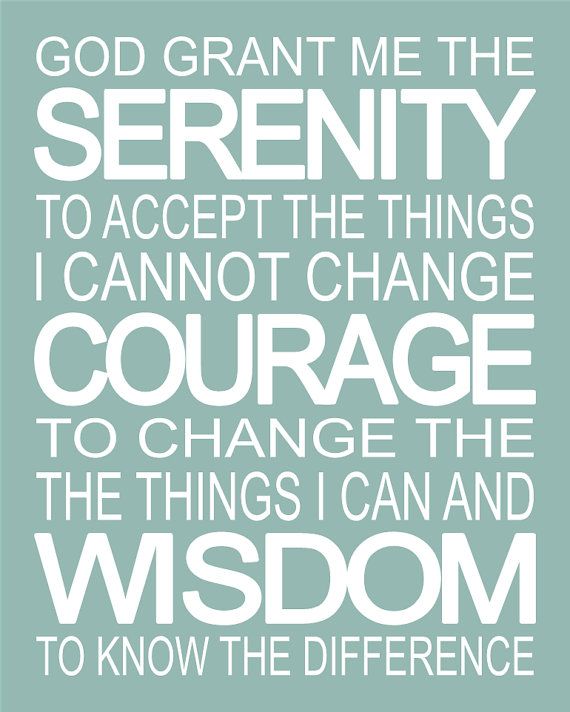
One of these (as well as many Jewish prayers) is the Serenity prayer. Its words give me comfort. They have even been put to a song by India Arie, whose music aims to heal others struggling with difficulties, broken hearts, stress, sadness.

So today I thought I would share it with you. I would say I am quite a spiritual person and I believe that prayers really do manifest if they are meant for you- your heart is listened too. At times when I have felt hopeless, I turned to God (if you don’t believe in God replace with the universe). And even if my prayers didn’t manifest directly at that exact moment- they often do manifest – even if it takes a year or two.

I hope this will help you feel a little comforted or healed, like it always does for me. Serenity is so important, even if it takes a long time to reach

Have hope :

serenity1

Living with Uncertainty- Life and Journeys with Mental Illness

flower1

*Trigger warning- talks about severe depression. Please be careful when reading*

There is so much I want to write on here that I havn’t yet written. Some topics  are too deep or painful for me to address- particularly surrounding certain aspects of previous hospitalisations. I hope one day I can share these with you. However, as a writer, I often get into the flow and just want to spill whats in my heart. So, this blog is about what living with mental illness can mean- its uncertainty and coming to terms with my own brain.

As most of you know, I was diagnosed with bipolar affective disorder, a mood disorder, as a teenager. I was poorly with depression and a mixed state in hospital when diagnosed and I don’t think fully came to terms with what the diagnosis meant until a few years later.

Being diagnosed so young instilled a lot of fear in me and a lot of avoidance. I decided not to drink alcohol or try drugs- as I didn’t know their effect on my brain and I was already  pretty anti drugs for many reasons. I knew my illness meant that the chemistry in my brain wasnt the same as everyone else without it- I had either too little seretonin causing depression, or too much causing hypomania and manic episodes. I felt often that despite taking mood stabilising medication and anti depressants and tablets to help PMS- that everything was uncertain. I had no idea when the next episode would strike- or if I would  be well enough recognise it.

I am lucky. My illness is very severe when it happens. Yet, I went 10 years without a manic episode or hospitalisation, though I suffered from acute depression that got truly so bad I didn’t want to be here anymore- which is quite a common side effect of being depressed. I was able to be supported at home and with my psychiatrist. I knew it was my depressed thoughts and not me- but this uncertainty  was incredibly stressful to myself and my family. I spent years being depressed and anxious and trying (and failing at times) to function- because my medication wasn’t holding me and my brain correctly.

Despite the uncertainty of so many things- dating, the effect of stressors in my life, work, etc- I am doing well at the moment. However, the uncertainty of the illness makes you worry that you could suddenly get ill again.

I practise a lot of self care- try to get to bed early, eat well, take my medication, tell my family or friends if feeling low etc. However, I always live with the knowledge that my Bipolar may pop up at different times in my life- and important times.

Due to having had this for 13 years- I am used to living with the chronic nature of my mental health condition. It can still be frightening and distressing and down right annoying. Yet, with the right support network and medical team, I know I can stay well for as long as my brain allows me- and I can get well and recover.

Recovery makes you stronger, Living through the pain makes you stronger, Surviving an episode makes you stronger.

You are not alone.

Guest Post by Juno Medical: 9 Things People with Anxiety Disorders Would Rather not Hear You Say

anxiety1

Anxiety disorders include generalized anxiety disorders, panic disorders, and social anxiety disorders. 1 in 12 people suffers from anxiety globally, and women are twice as likely as men to experience anxiety.

If you feel overwhelmed by the behaviour of a person with anxiety, try to put yourself in their shoes, and show understanding, not stigma.

For more see www.junomedical.com


Full Circle- From Bipolar and Mental Illness to Recovery

recovery1

It was summer 2014. I sat on a sadly impersonal green NHS couch in a quiet side room , my feet dangling over the edge, holding my wordsearch book and counting down the hours until I could leave the Day Unit. I had been feeling exhausted from my new medication, wobbly, teary and lacking in confidence all day and I had just started taking Lithium as a therapeutic medication. As such I had weekly blood tests as the Lithium level in my blood fluctuated between 0.4 and the optimum dose of 0.8, where you start to feel much better.  Lithium has to reach a certain amount in the blood to work on your brain (where it stops or tames mania and mood disorders).  They also had to check it didn’t become toxic in my blood and so weekly tests were needed which were exhausting at the time.

I had just received test results that day informing me that I was feeling a bit fragile because the Lithium was only at 0.4 in my blood. All I wanted to do was hide away from the rest of the therapy group in that little room, peacefully colouring in photos and doing wordsearches to keep me occupied. All I really wanted to do was go home, to where I felt safe and I didn’t have to face the reality of being ill.

This was at the beginning of my recovery journey in 2014. I had left hospital as an in patient after a manic episode and was a voluntary patient at an Acute Day Unit specialising in group therapies. Eventually, I grew to love it and the other people there- although I always wanted to leave faster than the Doctors thought I was ready! I stayed there 3 months in total and some people stay there 2 weeks. I very much needed the healing nature of the therapies even though I didn’t feel it at the time.

I realised these past few weeks how far I have come in my journey- from ill service user needing the support of my psychiatrist, nurses and OTs, to not needing that support currently (on 6 monthly psychiatrist meetings) and helping others in a similar setting in my new job.

I really have come full circle. There may be times when I am ill again in the future or not feeling at my best. I may need more support again. I may get panic attacks or mania or depression. However, for now I am feeling positive and hoping I stay well for a long time on my medication.

Recovery is possible. I am so thankful to all who have helped me on my journey and continue to provide guidance and love.

Be Ur Own Light is One year old!

one1

I can’t believe my blog, Be Ur Own Light – started on March 1, 2016 is 1 year old today.

My journey with blogging has been so exciting, inspiring and wonderful. It has reached every part of the world and a huge number of countries in UK, Europe, USA, Canada and South America, China, India and other Asian countries, Africa, the Middle East and Australasia. It is such a blessing to be read world wide!

When I began this blog it was a diary to explain and help recover from my anxiety disorder. However, over time it has evolved into so much more!

As I grew in confidence and found other kindred spirits in my writing, I began to write for other organisations and also receive and upload guest posts on mental health topics.

This year I have written blogs for Rethink Mental Illness, Time to Change, Bipolar UK, Self Harm UK, Phobia Support Forum, Counsellors Cafe, Monologues Project and the Bossing It! Academy. I have written 4 blogs for Rethink and have loved collaborating with each charity and organisation. Special mention to Louie Rodrigues at Rethink.

I have also received amazing guest posts from these wonderful charities and writers who shared their hearts in order to battle stigma. Thank you:

– Breathe Life
-Ashley Owens at Generally Anxious
– ISMA stress management
– Stephanie at Making Time for Me
– Adar (PTSD)
– Deepdene Care
– Joshua (bipolar article)
– Michael J Russ
-Richie at Live Your Now
– Megan at the Manic Years
– Quite Great Music psychotherapy
-Lystia Putranto and Karina Ramos
-Eugene Farrell at AXA PPP
-Marcus at Psychsi
– Paradigm Centre San Francisco

I can’t wait to receive more guest submissions over time!

In the past year Be Ur Own Light has grown into a #lighttribe of thousands. On Twitter we are now 2,287 , Facebook 265 of my friends and family, Instagram is 2156,  and we have 127 dedicated WordPress followers. Thank you to each and every one of you for following, commenting, sharing and reading and for helping fight stigma through talking..

This blog has also raised money for Jami mental health charity and I am excited to be starting work for Jami soon.

Its been an incredible year of sharing, writing and breaking down barriers. Its OK to talk about mental illness and mental health. Its alright to feel lost or broken or ill. Seek support for recovery and you can get better. You are not alone.

With gratitude and love on our first birthday 

Guest post by Marcus – 7 Tips to Improve the Symptoms of Bipolar Disorder

dephope

Bipolar disorder (formerly referred to as manic depression) is a condition characterized by mood oscillations- moving between high and low mood. A person suffering from bipolar disorder experiences mood changes and these changes are often erratic and unforeseen.

Symptoms of this disorder regularly change and that is one of the reasons why it can be such a difficult condition to treat and keep a consistent state of mood and activity for sufferers. However, it is possible!

Little things can help and here are 7 tips that might just help make symptoms slightly better:

  1. Make sure you get the Right Amount of Sleep

People who suffer from bipolar disorder often have erratic sleeping patterns. It is believed that one-quarter of these cases sleep too much at night while about a one-third experience difficulty in falling sleep, thereby suffering from insomnia.

As irregular sleeping patterns may precipitate depressive episodes, experts advise setting up an alarm to ensure one gets up at the same time each morning as well as setting fixed hours for sleep in the evening so that the body can adapt to this necessary function.

  1. Consistently take your prescribed Medication

According to Cara Hoepner, a nurse practitioner who also has this condition, discipline is the key when it comes to taking medication prescribed for bipolar disorder. However, she also agrees this can be a difficult task, seeing as some of the medications commonly prescribed (such as Lithium) require constant monitoring via blood tests to ensure they do not become harmful to the patient. Lithium can be toxic in rare cases and so its important to work with a good medical team.

Coupled with the fact that skipping medication will often trigger a relapse, she advises that all patients with this condition should exercise diligence and discipline in taking their meds. Tablet boxes can be very helpful for multiple medications.

  1. Shun Drugs and Alcohol

An expert in bipolar disorder, Bearden, claims that nearly half of patients of bipolar disorder have problems with substance abuse. He also states that this is one of the major reasons why many treatments do not succeed, due to it impeding recovery.

He therefore advises that while alcohol may appear a welcome refuge for bipolar patients in that it temporarily relieves depression, the mere fact that it triggers a depressive state in the brain as well as erratic sleeping patterns and mood oscillations, goes against the purpose. In addition, alcohol and drugs may impair cognitive functioning and hinder chances of  recovery- they exacerbate high and low episodes in the condition.

  1. Invest in Therapy

One of the best ways to improve bipolar disorder symptoms is to invest in therapy, including talking therapies, CBT, art therapy and more. While it may seem unappealing to many patients, therapy actually goes a long way in improving their chances of recovery.

Cognitive behavioural therapy helps patients understand and interpret events and thoughts, thereby enabling them to get back to their normal routine. There are other therapies which assist recovery and maintaining stable relationships .

  1. Learn the Triggers

Learning the triggers of bipolar disorder may help the patient nip the episode in the bud by actually dealing with these triggers before they develop into a full-blown episode.

Some of the triggers that make people unwell include sleep deprivation, social isolation and stressors eg divorce, death, change or job or having a baby . Other major changes in your life may also trigger depressive or manic tendencies, especially if they disrupt your routine so be careful to look after yourself in times of high stress.

  1. Learn the Side Effects

The most common side effect of taking Lithium or other anti psychotic medication  is metabolic syndrome, a side effect that majorly involves the impairment in the functionality of the kidney and the pancreas. A spectrum of effects such as high cholesterol, insulin resistance and weight gain would ensue, and this is where you need to deal with the to keep optimal health. A healthy diet and exercise is always important.

  1. Connect with Friends and Family (Support Network)

If you have a good support network, its so important to share how you are feeling with    close relations or best friends. By discussing your problems with those you trust, they hopefully will provide the emotional support needed to get through difficulties and help recommend further treatment or come with you to the Doctor.

In a nut shell, do not sit back and let your mood disorder take over without help. Speak out and let your friends and family help you out. In some families, there is a stigma so please do be careful as to who you let in when you are unwell.

Living with bipolar disorder is not an easy experience. However, by understanding how to deal with the symptoms, you can certainly improve your symptoms to keep you healthy and well. Read widely and remember that however debilitating episodes can be, Bipolar can be managed on medication and with therapy and. support. You are not alone.

Marcus regularly blogs at psysci, a psychology, science blog that examines the latest research and explains how findings can impact and improve people’s lives

Therapy Tales Part One.

My therapy journey began at just 15 years old- when I went to see the school counsellor for talking therapy due to suffering my first anxious and depressive episode (before I was diagnosed as bipolar).

Since then- 13 years later, I have tried many different kinds of therapies to help heal me from my anxiety disorder and help manage my bipolar disorder. Therapy still has a stigma, which is wrong,- but it is vital to the healing and recovery of mental illness and general healing from stressful life events eg deaths, divorce, moving house, illness.

I have done many forms of therapy, starting off with talking therapies- where you talk to your therapist about whats going on in your life (and sometimes they psychoanalyse in order to help you). I then did 3 lots of Cognitive Behavioural therapy (CBT). This is where you unpack your negative thoughts and assumptions that cause your illness in thought records, where you learn to challenge thoughts and change behaviour. However, for me, CBT was frustrating. I felt like I couldn’t fully apply it and it didn’t click with my brain.

I felt that the anxiety and panic I was dealing with was very much in the subconscious- and so the CBT could not eradicate the emotional, deep response that had formed within me to certain situations. It was then I began to realise the power of exposure therapy- which is essentially, exposing yourself to your feared situation slowly, with support. The more I went out, the more people I saw and the more I did, the anxiety began to lessen. It boosted my self esteem too to know I could overcome my fears. It is something that has to be practised and you have to be kind to yourself too and in the right head space for it to work,.

Of course, therapy works in conjunction with medications and it is also vital to make sure you like your therapist and have a good relationship with them. If you dread seeing them and you aren’t getting much from it, they are likely to be the wrong therapist for you.

I have done many other therapies: art therapy (which I loved and recommend hugely if you enjoy it), meditation and deep breathing (which I still do and which really helps my anxiety) and of course the unique therapy that friends and family bring. There are more therapies out there including ACT and its always worth googling therapies.

Ultimately, don’t be too scared about sharing with a therapist. They are trained professionals, have seen it before and they are there to support you. It is also very much trial and error. Even though CBT wasn’t for me, I found other therapies which have worked.

Just be aware that NHS therapy waiting lists are months long, so if you have the money to get private care, do.

I have worked with both psychologists, psychotherapists, occupational therapists (during a period of group therapy) and of course psychiatrists in order to keep well. It is very much a collaborative effort and now I am much better, I can deal with it with my support network (with my psychiatrist in the background)

I hope you find the right course of therapy for you and know you can heal from whatever stresses you are dealing with.

On Meditation for Relaxation and Healing.

I write this blog post from a very healing place where a relative of mine lives- the Cotswolds, Gloucestershire in England. It is a place of nature, green fields, hills, farms, animals and I associate its beauty with rest and relaxation. (There are shops and cinemas here too though- I think I would miss that!). The Cotswolds are a great place for me to rest and recharge my batteries. I find that the pace of life is slower and quieter here and when I have been working hard and need a break, I visit here and come back rejuvenated.

So, this blog is about meditation, a form of relaxation and clarity of mind that I have found healing.

I discovered meditation a few years ago but didn’t really start doing it until about a year ago, when I downloaded a free app called Headspace. This allowed me to have 10 free sessions of 15 minute meditations. At the time, I was suffering from work anxiety and related panic attacks. I found that listening to a guided meditation, recorded so I could play it when lying on my bed before sleep,  very helpful and relaxing. It centred me and made me focus less on my anxious thoughts and worries about my career and illness. I just had to breathe and relax for that minute, whatever else was happening outside of it.

Meditation is a guided visualisation, focusing on the breath and slowing down breathing for relaxation and clarity, through inhaling deeply and exhaling slowly. It also teaches you how to relax muscles in your body, if you choose a deep muscle relaxation meditation. The person guiding you may tell you to breathe in deeply then out slowly, clench or unclench muscles and focus on the breath and the present mindfully, in order to relax you and sharpen the senses.

Meditation is not about falling asleep, although I often do it before I go to sleep. It is about centring yourself in your present reality, clearing your mind and worries through focusing on deep breathing and /or guided visualisations or affirmations. This eventually relaxes your subconscious and keeps you grounded in the present, linked to mindfulness.

I recently listened to a fantastic meditation which included positive life affirmations ‘You can do it’, ‘You are strong and confident’, whilst breathing in and out. This was by the amazing practitioner Holly Matthews, at the Bossing It Academy. I listened to this twice and did the exercises the night before a job interview. It really works on the subconscious level and helps you feel strong and confident!

I first was introduced to meditation as a healing therapy through regular Day unit relaxation sessions when I came out of hospital. We were taken through a guided visualisation of a relaxed place eg a beach or a starry night and followed our breathing and relaxation of muscles. I then bought CDs of relaxation music to listen to at home. When I was a teenager, I had previously listened to similar relaxation music and I find it can be incredibly healing if suffering from anxiety disorders in particulat as it focuses you and permits relaxation.

Meditation is an ancient Eastern art, practised by Buddhists and others in Asia, which has come to us in the West. It is so unbelievably powerful at managing stress and anxiety and I would thoroughly recommend doing it, with a recording of  professional guiding you through the process or listening to relaxation music. There are even meditation classes out there you can take as well as music on Youtube and other websites!

So remember to breathe, ground yourself in your present, listen to the sounds around you but bring it back to your breathing and your current reality. I have found meditation helps heal me and I hope it helps you too.

Reflections- Being Bipolar is not the end.

This blog post was prompted by a blog I had written a few months ago for Rethink Mental Illness about living with Bipolar 1 disorder. I received a message from a mother whose teenage daughter was suicidal and very unwell and was receiving treatment from CAMHS child and adolescent mental health service . This same mother has stayed in touch with me and updates me with her daughters progress.

I was the same age as her daughter is now when I became unwell. I was only 16, still a child but on the brink of adulthood, at a time where teenage life can be confusing, even without a mental illness!  Being diagnosed at 16 changed my life in many ways. I had to come to terms with having a chronic illness, with being ‘different’, with taking medication daily for the rest of my life, with not drinking alcohol, with feeling insecure about my own mind and self for a long time. Its a lot to take in, at that age in particular.

Being Bipolar is not the end. Yes it can cause havoc and play with your sense of self, cause insecurities about your mind, make you psychotic or manic/ hypomanic, make you depressed and suicidal, make you anxious and terrified and many other symptoms. But it is not the end. With help from support networks and professional medical teams, you can recover. You can get better. You can achieve.

What changed everything for me was taking Lithium. It has stabilised my moods and they don’t fluctuate as intensely, so I am not symptomatic. It was a gamble taking it, as is taking most psychiatric medication, its trial and error. But, as Bipolar runs in my family, I knew having the right chemical balance was key because my moods were all over the place.

I still have bad days and panic and anxiety from time to time. However they are no way near as bad as when I was on the wrong medication.

At 16, I had a very uncertain future. The Doctors told my family I wouldn’t get my A levels (despite having got good grades at GCSE) or go to university. I proved them wrong. I went to university and got my BA, I went travelling to India and Ghana where I volunteered and I went to drama school to do a Masters degree which I attained, despite the difficulties in my mood and the stress it did create. This wouldn’t have been possible without the support network and amazing family in my life. And of course, my need to do things despite the illness!

Achieving these things made my self esteem increase. There are times when I am not confident but having a severe mental illness is not the be all and end all. You can live with it, there are times which can be hell- but these make the sweet times better. I am back at work as well after being in hospital in 2014 and have tried to rebuild my life.

So today I am thinking of the teenage girl who is currently unwell at 16 and her family. And praying for her as we go into Shabbat (Jewish Sabbath).

Guest post: Loneliness at Valentines (by Eugene Farrell, AXA PPP)

Valentine’s Day. For some, it’s a day full of romance and spending time with loved ones, yet for others, this focus can make them feel more isolated and alone.

According to the Office for National Statistics, Britain is the loneliness capital of Europe, with many Brits unlikely to know their neighbours or feel they have friendships that they believe they can rely on in a crisis.

Research by the charity, Relate, found that 9% of Brits of all ages don’t have a single close friend, while separately, a study by AXA PPP healthcare that British adults aged 18 to 24 are four times as likely to feel consistently lonely than those over 70.

 “The build-up to Valentine’s Day and the day itself can be quite intense, which is difficult for those who are already feeling isolated or lonely,” explains Eugene Farrell, Head of Trauma Support Services at AXA PPP healthcare.

Although loneliness is often associated with the elderly, it’s actually an issue which can affect the physical and mental wellbeing of people of all ages.

In fact, studies have found that loneliness can increase the risk of high blood pressure, and have an impact on cognitive decline, dementia and depression. While addressing your experience of loneliness may take time, taking steps to build new and improve existing connections will help to improve your overall wellbeing.”

Here, Eugene gives his top tips on how to overcome feelings of loneliness:

1.     Making new connections can be an obvious way to combat loneliness and yield positive results, for example joining a group or class you are interested in will increase your chances of meeting like-minded people to connect with. Increasingly too we are turning to the internet for companionship, with community groups existing in almost every niche interest group you could imagine.

2.     Be more open. If you feel that you have plenty of connections but don’t feel close to any of them, the underlying issue may be that you need to open up to them more to deepen your connection, as an example letting the friend or acquaintance in on a vulnerability felt or your honest opinion about an issue.

3.     Stop comparing yourself to others. The desire to ‘keep up with the Joneses’ is not a new one, however the rise of social media has only exacerbated the problem by giving individuals the chance to constantly compare themselves to others. If you’re already feeling lonely, the idea that everyone else’s life is more idyllic than yours can make you feel even more isolated and alone. This can lead us to ‘compare and despair’ – which further exacerbates our negative experiences. Remind yourself that people only share what they want others to see about their lives. Don’t form unrealistic expectations about life and friendship based on what you see online.

4.     Keep all lines of communication open. Having a chat with a friend or relative over the phone can be the next best thing to being with them. Or you can stay connected with loved ones online. Video chat, exchange photos and keep up to date with the latest news from friends and family with Facebook, Instagram, Snapchat or simply keep in contact by email.

5.     Volunteering is also a great way to meet new people and feel good about helping others. It will not only allow you to give something back to your community but will also help you to feel more connected, involved and needed. There are lots of volunteering roles that need your skills and experience. It can also have a positive effect upon your mental health through helping others.

6.     Pride comes before a fall. Don’t be afraid to reach out to people and ask for help, companionship or just a chat. They may be feeling lonely too!

7.     Take it slow. If you’ve felt lonely for a while, or experience anxiety around new social situations, throwing yourself in at the deep end could only act to exacerbate the problem. Instead, dip your toes into the water first by going to a local café or sports event where you are surrounded by people, and just enjoy sharing their company. Or try a class where you can dive into the activity itself to distract you from the pressure of introducing yourself to people straight away. With loneliness, slow and steady often wins the race.

If you think you might be struggling with symptoms of loneliness, find more tips and advice at AXA PPP healthcare’s Mental Health Centre.