Many people might tell you that admitting you have a problem is the first step to battling addiction. Their intentions might be good, but does your journey to sobriety and recovery really start until you decide you want to live better? Knowing where to start when battling addiction is crucial to improving your odds of success.
Your Doctor
Your personal physician probably already suspects or even knows about your addiction, even if you’ve never mentioned it to them. It’s their job to help you with your physical health, and they will have access to more tools you might use than nearly anyone. Your conversations with your doctor are totally confidential, so this is a very safe place to start when battling addiction.
Find a Facility
Not all forms of addiction require going into a rehab facility. However, some might. There are facilities available, such as Awakenings Health and Wellness Centre that are top-notch in helping people dig deeper than the obvious superficial issues. Also, the right rehab center can dramatically improve your odds of getting past any addiction and have a better fighting chance at living a clean life ahead of you.
Friends and Family
This one can be tricky. Friends and family might be some of the people most likely to support you through your addiction battle, but some of them might also be the most judgemental. In fact, some relatives might even be contributors to your addiction. Turn to those you think you can trust.
Employee Benefits
You probably don’t want to tell your actual supervisor that you are battling addiction, but your employee benefits might have a hotline you can call privately. If your health insurance or other benefits include rehab programs or counseling of any kind, it might be at low or even no cost to you.
Spiritual and Religious Advisors
Individuals such as these may not feel qualified to help you with your addiction and recovery, and yet they might also truly want to help you. They might be able to point you in the direction of people and programs who can help you. So, whether it’s a priest, rabbi, or even a yoga teacher you study under, see if they have any referrals or connections you might use.
Help Is Out There
Battling addiction is a journey that can leave you feeling very alone, and overcoming it can only happen if you personally do it. However, even though no one else can get you over your addiction, they can be of tremendous assistance to you while you try to get clean.
Window to the Womb, the UK leading provider of private Baby Scan Services for pregnant women, has partnered with BlueSkeye AI to launch Avocado.
Avocado is a brand new pregnancy App which uses cutting-edge AI technology to support effective mood management. Window to the Womb is rolling out the use of the Avocado App across all 44 clinics nationwide enabling women who attend for early and later pregnancy ultrasound services to access their scan images and scan reports digitally. In their drive to support women in early stages and throughout pregnancy, Window to the Womb has worked with BlueSkeye AI to provide a range of additional services within the App including the ability to log a pregnancy diary, access mindfulness or exercise material and order personalised baby scan photos.
(image: avocadoapp.co.uk)
Managing Emotional Wellbeing and Moods
Avocado provides women with the ability to understand and manage their mood and emotional wellbeing throughout pregnancy. Recognising that pregnancy and preparing to have a baby is such a big life event it is well understood that pregnancy can be an emotive time and a trigger for mental ill health. Pregnancy hormones can be a likely contributor to changes in mood, as well as other triggers including fatigue and sleep deprivation.
The Maternity Mental Health Alliance, a UK charity that is focussed on addressing the needs of women during pregnancy reported that 1 in 10 women experience perinatal mental problems and more needs to be done to support women during pregnancy. The lived experiences of women, as documented and made available to listen to by MIND, who have experienced perinatal mental illness indicate there is more to be done to help raise awareness in society about the prevalence of anxiety and depression (and other mental illness) during pregnancy.
Avocado enables women to track their mood alongside other key pregnancy metrics whilst managing their private scan appointments and much more. The app directs women to useful resources including the NHS’ Every Mind Matters mental health and wellbeing resource.
”At Window to the Womb, we are privileged to meet and provide services to thousands of women at different stages of their pregnancies. We are committed to ensuring that women are well supported as they access our services and we are keen to ensure that women are empowered to self-manage their mental and emotional wellbeing during this time” said Managing Director of Window to the Womb, Tony Harrison.
BlueSkeye AI is a fast growth tech company based in Nottingham creating AI you can trust, and is on a mission to improve wellbeing and patient health outcomes by delivering accessible and objective services and products that help patients understand and manage their mental health and wellbeing. The ethical AI company’s technology is underpinned by Behaviomedics, pioneered by BlueSkeye AI’s CEO, Professor Michel Valstar.
“Our core technology automatically analyses and synthesises the face and voice to monitor mood and other medically relevant expressed behaviour. We are delighted to work in partnership with Window to the Womb to apply our technology to help perinatal women understand and manage their mental wellbeing” said Professor Valstar, CEO of BlueSkeye.
The App is available to download on Apple and Android devices. A premium version is now available for subscription and includes additional features that promote wellbeing during pregnancy.
You sabotage your relationships when things feel too calm.
You panic when your partner goes on a family vacation, believing that they’re leaving you forever.
Perhaps you can’t stand hugs or gentle touch.
Maybe you’ve wondered to yourself: “What in the world is wrong with me?! Am I just not cut out to have close friends or a romantic relationship?”
Actually, that’s not the case! You deserve close relationships– everyone does. If you resonate with these scenarios, though, you may have some unprocessed trauma– and that trauma may be making your relationships feel like a rusty, ungreased wheel.
You’re not alone. Here’s how trauma can blow our relationships off-course, and also, how self-compassion can help to ease that struggle.
Trauma Creates Hypervigilance
Trauma is any incident that overwhelms your ability to cope (abuse, neglect, or surviving a natural disaster, just to name a few examples). These abhorrent experiences cause our brains and bodies to swirl with cortisol, also known as the stress hormone.
After a seriously traumatic event (or relationship or childhood), our cortisol levels don’t always return to baseline. Often, the nervous system creates a new baseline of heightened stress response. In short: you don’t go back to being as calm as you were before the storm. Now, you’re hypervigilant all the time. You’re always stressed, always scanning for the next attack.
Unfortunately, relationships can’t be created without vulnerability, and vulnerability can’t happen if you’re constantly scanning for attack.
You might be hypervigilant in your relationships if:
You feel uncomfortable, fidgety, and unsafe during social situations
You constantly micro-analyse everything other people say to make sure they’re not going to hurt you
You constantly micro-analyse everything you say to make sure you don’t say anything “wrong”
Aversion to Intimacy
Trauma, and the excess cortisol it triggers, also creates an aversion to physical closeness. When we’re stressed (i.e., when our cortisol is on full blast), our nervous systems naturally resist being touched.
Do you find yourself shrinking away from hugs? Do you feel an urge to run away when someone gently touches your arm? That’s likely a trauma response.
Of course, if you’ve experienced assault or physical or sexual abuse, this is a double whammy. Since your trauma came from physical touch, your brain has registered any physical touch as dangerous– on top of your increased baseline level of cortisol. Of course you’d feel sick at the thought of a hug! If this sounds like you, go extra easy on yourself if you struggle with relationships; this struggle isn’t your fault.
So, This Sucks… How in the World Do I Heal?
Yes, it sounds bleak. If this is you, you may feel hopeless. I’m with you; I’ve been there. It’s not hopeless, though. This is healable.
Therapy: Do I Even Have to Say It?
Yes, healing this will probably require trauma-informed therapy. You’ll be surprised at how fast you can begin to shift once you see a therapist who validates your traumatic experiences.
Here’s a hint: Psychology Today’s find-a-therapist tool can help you easily find a trauma-informed therapist. (Make sure to select “trauma focused” under the “types of therapy” menu.)
Now That That’s Out of the Way: Self-Compassion Comes Next
I’m 100% serious when I tell you: you deserve to go easy on yourself.
I say this with firmness, and yet, I forget to go easy on myself most days. Regardless, it helps immensely to stop comparing your relationships to other people’s relationships (both friendships and romantic relationships!).
Yes, it may likely take you longer to learn how to develop lasting relationships, both friendly and intimate. It may seem unfair that making and keeping tons of friends, as well as a life partner, comes so easily to some, while you’re struggling to simply text one person back.
Know what? It is unfair. You shouldn’t have gone through the trauma that you went through. What this means, though, is that you can recognize that you face more relational setbacks than someone who didn’t suffer the same trauma as you did. You’re starting further behind with a ball and chain tied to both feet.
Thus: you can stop comparing, and you can stop feeling like you’re “behind” somehow. Always try to recognize even your tiniest victories, even and especially the challenges which seem “easy” to other people.
Wrapping Up
Relationships make our lives juicy and sparkly, and so, if trauma has impacted your ability to form relationships (I’m with you!), then you’re probably struggling.
Try your best to go easy on yourself. You’ve been through a slog of painful experiences that, unfortunately, can make life on Earth feel like walking straight uphill all the time. Therapy helps. Self-compassion helps.
And yes, I know it’s tiring, but there is help for you out there. Just keep going.
Taylor Blanchard is a freelance mental health and wellness writer for hire. Her lived experience and extensive knowledge on mental health, emotional wellness, and spirituality guide her to create deep, compassionate blog posts, which she hopes will help people to feel less alone in the world. Self-care for Taylor looks like staring at the sky, drinking cacao while listening to metal, or cuddling with her rescue Pitbull mix.
When I was a child, growing up in Hertfordshire, my biggest dream (other than being a wife and mummy one day, because yes even then I dreamt of that) was to be an actress in the West End. I could think of nothing more exciting than standing on a stage, performing and I wanted to go to drama school from age 11. I went in the end at age 23 to do my masters degree at Royal Central in London, after doing a 3 year degree featuring Drama at Goldsmiths. I was so excited to have achieved a dream of mine, even though for many reasons I decided not to act professionally.
However, sometimes, long held dreams, things that are part of the core of our being, of our inner identity, can be a little harder to achieve. Sometimes, we find ourselves on the less travelled path, we feel different from our friends and family because our lives, for whatever reason, are different. We have to consider our health in a unique way. We have to try and surrender our fears to the universe and hope that everything will work out OK.
When I was diagnosed with bipolar disorder at 16, I was still a child and I didn’t know what it would feel like to be an adult, needing a cocktail of medication daily in order to have stable brain chemistry. And how this medication might affect my body and mind- and considering children in the future as a woman with bipolar and all that brings- discussions with psychiatrists, difficult decisions to be made, do I carry my own baby, what will make things safer for me?
As I look ahead to 2022, I know that our dreams are there to be fulfilled. I know that I must trust and have faith that whatever happens, whatever 2022 brings to us, I will always have hope and I know my husband will too.
Wishing you all a happy and healthy 2022 – may all our dreams manifest for the good.
Self care of both our mind and our appearance can really boost our mental health. When it comes to looking after our smile, your teeth are important. Taking care of your teeth and gums is an essential part of taking care of your overall health, stopping you from becoming unwell, but it can also help improve your confidence too.
Unlike other physical transformations, transforming your smile is something that can be simple and affordable, and you’ll be able to enjoy long-term benefits by doing it.
Could a new smile be on the cards for you in 2022? Take a look at these ways to transform your smile for a dazzling way to welcome in the new year.
Visit your dentist
The first place to go if you want to transform your teeth is the dentist. A lot of people have fallen behind on their appointments as a result of the pandemic, but it’s important that you visit your dentist regularly to make sure your teeth stay in good health. Your dentist will be able to recommend treatments that will improve your smile, as well as give you advice on how to take care of your teeth.
Take better care of your teeth at home
Improving your smile is something that takes time, and you’ll need to develop permanent habits to keep them looking their best. Some of the best practices for healthy teeth include brushing your teeth twice a day and making sure you use a quality mouthwash and flossing aid to keep plaque and bacteria at bay. Maintaining those good habits will help keep your teeth looking clean and polished for a smile you can be proud of.
Look at treatments that will transform your teeth
If you’re unhappy with your teeth, there are things you can do to change how they look. Invisible braces, teeth whitening and even dental implants at Dental Excellence’s clinic can make a big difference to your smile, with treatments able to transform your smile quickly and affordably. Cosmetic dental treatments are an investment worth making, making a big difference to your teeth and your confidence too.
Work on yourself to help put a smile on your face
Transforming your smile doesn’t just happen on the outside, you need to feel good about yourself to smile too. Some self-compassion and self-care could help you work on your inner confidence to give you something to smile about. Do things that make you happy, like seeing friends or your favourite hobbies – it will make a big difference to how you feel.
If you need to speak to someone about what you’re feeling, reach out – you don’t want to face mental health problems alone.
A lot of new year’s resolutions and plans fall at the first hurdle, but transforming your smile is a realistic goal you can stick to. Develop some better oral health habits and see your dentist regularly – it will help you keep your teeth and gums healthy and can impact the rest of your health too.
A new year means a fresh start, so get ready to start 2022 with a new outlook and a smile on your face.
This article was written by a freelance writer and contains links.
Its nearly here everyone! Just 4 days until our country (the UK) stops and celebrates Christmas (or uses the day as a chance to see family because they’re off work, like we do!).
The pressure is taken off for me during this period because its just a chance for relaxation for us as we’re Jewish, we don’t have the same expectations for the day as others. However, I know for many people Christmas is a stressful time where they see family they don’t normally see and may feel they have to hide how they are truly feeling with their mental health. The pressures are also on for the cost of food and gifts during this time and many people get into debt too.
We already have less daylight during this time and with the Covid pandemic a lot of people are feeling lower and more anxious . This has been the new normal for us all for over a year and particularly here in England where we have record numbers of Omicron Covid cases- but aren’t yet in lockdown.
I know I have been feeling a bit more anxious lately to do with Covid and other things… but I am also going to be kind to myself and give myself a break and time off work to relax also! I love sitting eating Quality street or a Terrys chocolate orange (yum) with loved ones and watching a good film like The Holiday… thats my favourite. Second is the Muppets Christmas Carol. Third Love Actually. Whats yours?
(image: lilartsy: Pexels)
I am lucky my bipolar is in remission and I am stable on medication. So I don’t have to worry about severe depressive or manic episodes right now. But, I still need to look after myself or practise self care- lots of sleep, not too much sugar, and check in with myself or my therapist if needed if my anxiety flares.
Obviously, over Christmas lots of NHS mental health professionals aren’t available but you can reach out to helplines such as Samaritans 116 123 (UK) if you need someone to talk to who will just listen.
You can also text SHOUT to 85258 if you’re in crisis and need support.
In an emergency, if you have a phone line to a hospital outpatient crisis team that are working over Christmas, call that and if not in an emergency you may have to go to Accident and Emergency (but there could be long waits).
Wishing you all a very happy holidays, a peaceful festive season. This time can also be hard for people with alcohol or drug addictions or eating disorders, as Christmas is often a time with plenty of alcohol and triggering things.
Remember that its OK to be struggling but tell people you trust and reach for support. May your Christmas/ holiday season be merry and bright- and if it isn’t, remember things can get better from here, you can recover and you can be helped. Always tell someone you trust if you feel suicidal or want to harm yourself, so you can be protected and helped through these feelings.
When you need help solving complex problems in your life, you turn to those who are considered to be “experts”. In this case, that may mean working with either a therapist or perhaps a life coach, which is an option gaining in popularity with more and more people. While working with either of these will be similar in many ways, there are distinct differences between a therapist and a life coach.
Licensing and Credentials
To begin with, major differences exist in terms of credentials and licensing. A life coach may have a college university degree in psychology or counselling and have many years of experience working with clients but is not a qualified therapist. On the other hand, a therapist is required in most cases to not only possess graduate-level training, but also be properly licensed where they practice.
Past or Future
When you work with a therapist, the focus usually is on past traumas that are impacting your current life, such as being abused when you were a child. But when you work with a life coach, these sessions often pinpoint specific problems that are happening right now that are impeding your ability to move forward. For example, you may work with a life coach to discover a new type of career you would find more fulfilling.
Long-Term or Short-Term
When most people begin visiting a therapist, they may continue to do so for many years, or in some cases forever. However, personal life coaching is more of a short-term commitment. In fact, the goal of the life coach is to give you the tools and skills needed to eventually coach yourself, but some therapies also aim to do this too.
Structured or Unstructured
While you may have thought therapy sessions are very structured, they are typically quite the opposite. In fact, therapy sessions are guided by the patient and the type of therapy is used to treat them. While a personal life coaching session has the coach, and you, working on developing goal-oriented strategies that let you experience personal and even professional growth along the way.
In conclusion, depending on your situation, it is always possible you may at some point in your life work with both a therapist and life coach. Whether you have sessions with a therapist to work through unresolved childhood trauma or seek out a life coach to help you achieve a better balance between your personal and professional lives, you will soon learn why these professionals and their services are so valuable to clients.
Lizzie Weakley is a freelance writer from Columbus, Ohio.
I am absolutely delighted to read and review this incredible childrens book from the Sophie Says series by author and award winning campaigner Esther Marshall (with illustrator Buzz Burry).
Esther’s story is close to my heart as not only is she from my own community but her late sister Rebecca z’l was a doctor who had bipolar disorder and sadly passed away a few years ago, while Esther was writing her second book. Esther has shared that it was her sister who encouraged and inspired her idea to write the childrens books that she couldn’t see for her own child (in terms of positive messages, inspiring rolemodels and diverse characters in terms of both race and gender). Through her sister’s struggles, Esther also began to include positive mental health messages on talking and sharing emotions, self belief and self esteem too.
Esther has said,
“I knew from the second my son was born I wanted to teach him that girls were just as strong and powerful as boys, that people from different backgrounds to him could teach him things and he should listen and be kind to everyone. The problem was, all the books I could find to read to him had:
Mostly male characters (even the animals)
Little to no diversity or representation
No female role models he could look up to
So I decided that if I couldn’t find the book I wanted to read to my son, I’d better write my own.
I want all children to know and believe that they can achieve their dreams regardless of gender, race, religion or class”,
Esther at Sophie Says has not only thought about what stories she wants to tell through the books, but what messages children reading them will take and absorb. She has partnered with illustrator Buzz Burry and comments, ‘we are helping children bypass harmful stereotypes before they set in by changing the face of children’s literature. Our mission is to enable all children to grow up feeling equipped and empowered to face their futures. To learn more about themselves, others and the world around them. We are helping parents to teach their children positive messages and providing a toolkit to navigate some of the trickier conversations.‘
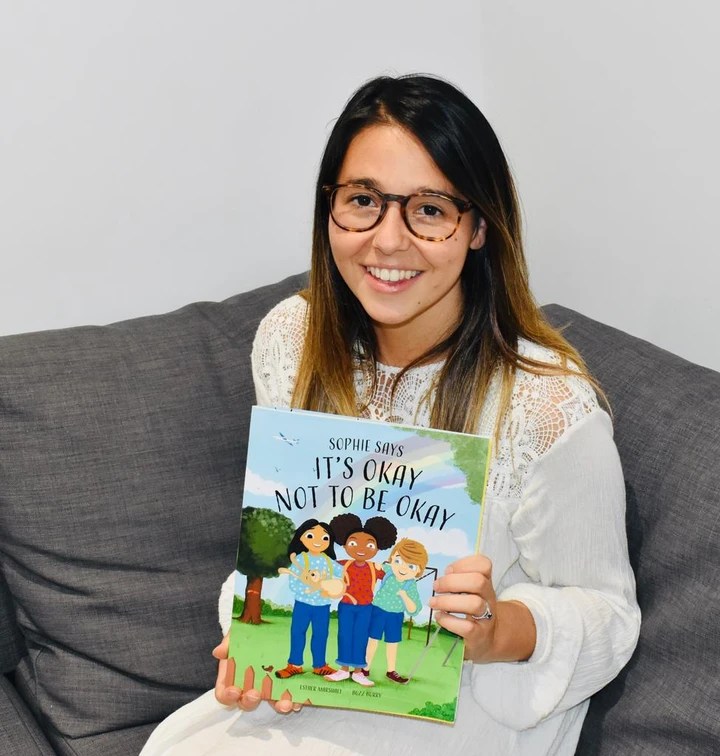
Esther very kindly gifted me copies of her first two books- Sophie Says I Can I will– which is about a little girl Sophie with big dreams and no limits. and Sophie Says It’s Okay Not To Be Okay which focuses on Sophie, Jordyn and Jamie on their journey as they learn that it’s okay to talk about their feelings and it’s okay not to be okay. The books are for children in the early years, ages 3-7 years and reading the books with either parents, carers or teachers is recommended. Esther told me she has ‘tried to create books which cater to both home and school so that it can be embedded in both parts of a child’s life and become the foundation of them building resilience at an early age.’
Sophie Says It’s Okay not to be Okay is a very special book- and one of the first I have seen to address children’s mental health in an age appropriate way, to teach children about their emotions and that it’s OK to feel sad, scared or worried. The book follows Jamie who is looking down and feeling sad but whose best friends Sophie and Jordyn help him through and Sophie tells him ‘its okay not to be okay’. They take him to the zoo to help him feel better and speak to Sophie’s older sister Meghan who is wise and will give good advice. Esther named the character after Meghan, Duchess of Sussex who she met with Prince Harry and other young leaders and was inspired by (she gave them a copy of the book too!)
Meghan (the character) says this important message,
”It’s okay to be sad and okay to feel down. Just make sure you have good friends around. There may be days when you feel you’re alone but around us, you’ll always be at home. Its Okay not to be okay”
The book also reinforces self belief and esteem , reiterating that ‘YOU are enough!’ and encourages children to talk about their feelings because it can help. Jamie then says he will speak about his feelings in a place he feels safe in the zoo,
‘I don’t really know how to describe how I feel As I can’t work out what’s in my head and what’s real.
He said ‘ a smile may be what you see, but that’s not what I feel inside me
There are times I feel quite alone because these feelings are unknown
Some days I’m happy and some days I’m sad and other days I just feel so bad’
(image: Esther Marshall/Buzz Burry/Sophie Says)
His friends then show him support and love, take him to the funfair, all while reinforcing positive kindness and support- ‘Yes we can!” . The book talks positively about the kindness of friendships always being a safe space to talk. This is so important for children particularly in the early years who are learning to understand their feelings.
Esthers writing is beautiful- on one of the last pages of the book she says ‘Whatever you do, be kind, you never know what’s going on in someone’s mind’.
The book was informed by her sister Rebecca’s struggle with mental illness (bipolar disorder). Esther has said, ‘I had always planned to write another book all around mental health to help children understand their feelings and talk about them more openly, and I sadly lost my sister, Rebecca, to mental illness as I was writing it. So the second book Sophie Says It’s Okay not to be Okay is dedicated to her memory’.
Esther wanted to amplify the message and so it was released on World Mental Health Day. The book provides a toolkit for parents who want to help their children to express their own emotions.
She has been visiting schools and doing zoom readings of her book to share the messages for her. Esther told me, I would love that as a result of children reading the Sophie Says books that children understand these vitally important lessons through a fun way of learning and it helps them build resilience and confidence to go out and achieve their full potential whilst being able to understand and manage both their physical and mental health. .’.
Esther is a true force of nature and someone who inspires me so much. She has just released a third book in the series Sophie Says Be Proud of Who You Are which is about Sophie and the rest of the Sophie Says crew on their exciting seaside adventure as they help their friend Priya build her confidence, as they guide her through believing in herself and being proud of who she is. The perfect book to help your child build their confidence and self esteem!
I would recommend the Sophie Says books to all parents, teachers and carers of young children. I can’t wait to see how this brand grows and what Esther achieves (she has achieved so much already!). She should be rightly proud of her work and all she has created.
To learn more about Sophie Says and buy the books click here
Hi, I’m the founder of Sophie Says and the author of the books within the series. The idea for the first book (Sophie Says I Can, I Will) came to me after having my son, Asher (who is the first and most important reader of all the books!).
I knew I wanted him to grow up understanding that both girls and boys could achieve anything that they set their minds to, but I couldn’t find any books that featured a female lead character (a human one, not an animal one!) that really represented the message I wanted to teach him. So I thought, if I can’t find the story I want to tell, I’d better write it myself.
I was gifted two books in exchange for an honest review. Any links are unpaid. These books are incredible.
When you think of older people, what comes to mind? Most likely, you think of a frail older man or woman sitting in a rocking chair on the porch with his or her grandchild. This image is often comforting, but it’s not always accurate. As life expectancy increases, so will the number of seniors needing support as they navigate this time in their lives.
Let’s take a look at the five ways you can support mental wellness for the elderly through compassion and care.
Mental Health: Dementia and Depression
Mental health is defined as a state of well-being in which every person realises their unique potential and can cope with the everyday stresses of life. It encompasses our emotions, beliefs, thoughts, and behaviours related to our physical and spiritual health.
Studies have found that over 50 per cent of older adults with dementia experience depression. This figure becomes even more striking when considering that depression rates are higher in women than men. Depression can lead to loneliness and feeling disconnected from society, which might be exacerbated for those who aren’t familiar with mental health issues.
Depression can also lead to poor self-care behaviours like eating poorly or not taking care of personal hygiene because they cannot enjoy their day-to-day activities such as cooking or cleaning. People may find it challenging to socialise during this time because they’re trying so hard not to feel negative emotions like sadness or anger that might come up unexpectedly during a conversation.
It can be worth discussing how they can get support from a care facility such as Oakland Care where they will have round the clock care and support for their mental and physical wellbeing.
5 Ways to Support Mental Health
1. Be a friend
One of the most important things you can do to support mental health in the elderly is being a friend. It’s easy to think of someone who is elderly as being alone, but they don’t want to be. They rely on friends and family members more than ever before. This can help provide them with some comfort and companionship during difficult times.
2. Have compassion for them
It’s good to show seniors compassion when they need it the most. Not only will this improve their mental health, but it will also give you the chance to see a side of your loved one that you might not know about otherwise.
3. Offer loving care
It’s essential for all people in your life, including elderly family members, friends or caregivers, to remember that every person is different and deserves love on their terms. The elderly need specific forms of care and various types of love depending on their circumstances.
4. Send cards or gifts
Gifts sent with care can help people feel less alone and know they have support. Choosing something special to them.
5 Get help
Sometimes, the best thing you can do is to contact a medical professional such as a GP or hospital doctor who can get them the proper care.
Above all, make sure they are well supported and cared for.
This article was written by a freelance writer and contains affiliate links.
What do you love about this time of year? Although i don’t celebrate Christmas, I absolutely love many things about this season of celebration, including Chanukah that has just been and the way this time of year can feel super cosy!
Heres my list and what I am looking forward to:
Blankets, PJs and warm socks
Festive songs- got to love Mariah
Feeling cosy/ hygge indoors
Hot chocolate with or without marshmallows
Gingerbread men
Twinkly fairy lights and the London Christmas Lights
If you celebrate Christmas- your christmas tree
Time with family and friends
For me, Chanukah- lighting candles each night and celebrating, which we did last week 🙂 we eat doughnuts
Giving gifts to those I love
Being with my husband and having chill time- his birthday is just after Christmas too. And cuddling our guineapigs Midnight and Nutmeg.
Christmas markets
Going to the theatre (as long as we are still allowed)
Having days off work to watch good TV with family
Sex and the City returning as And Just Like That, Emily in Paris second season and hopefully a new season of Bridgerton will be on its way soon.
My Body Shop pampering treats (perks of the job).
Helping others and doing good deeds
This time of year can also be a time of loneliness, poor mental health and lots of other awful things people are facing such as poverty or homelessness. But today, as I always focus on the heavier issues, i am looking for the positives – butGive your time to others who need it too. if youre able.














 beurownlight.com