
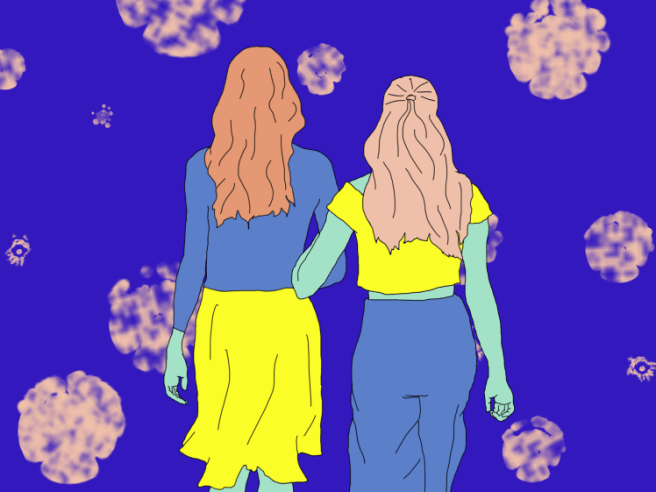
Extract from my latest Metro.co.uk article: 6 people share their experiences of friendship during Mental Illness

metrofriends

(image: Ella Byworth for Metro.co.uk)

I have bipolar disorder and four years ago I was hospitalised for a severe manic episode.

Without the love, kindness and support of my friends, I definitely would not have recovered as well.

Their support reminds me I am not alone and helps me to feel loved and safe. But mental ill health can be frightening for those who do not understand it, and sometimes friendships can be lost when one person experiences a mental health condition.

Some people may find it hard to cope with symptoms of a friend’s illness and, as such, cut ties or back away.

Jessica Valentine, psychologist at the Brighton Wellness Centre spoke to Metro.co.uk. She says: ‘Sometimes having a friend with a mental health illness can be draining. ‘On the other hand, it’s good to experience the journey of mental health; the ups and the downs, from a personal level. ‘You really get to ‘feel’ your friend come out of the depression. And, it somewhat makes you feel that you are living it too, side by side, helping them.’

The Mental Health Foundation explains that friendship can ‘play a key role in helping someone live with or recover from a mental health problem and overcome the isolation that often comes with it.

It advises that many people who manage to hold onto friendships while experiencing a mental health condition can see those friendships become stronger as a result.

I wanted to see the role of friendships in other peoples’ lives, either when they were coping with a mental health condition, or when they had witnessed a friend in crisis.

Here six people explain their experiences:

Read their experiences and rest of article: http://metro.co.uk/2018/03/01/6-people-share-their-experiences-of-friendship-during-mental-illness-7343290/?ito=cbshare

Twitter: https://twitter.com/MetroUK | Facebook: https://www.facebook.com/MetroUK/

Dispelling the Online stigma: Twitter, Antidepressants and #MedsWorkedforMe

I wasnt going to write a blog on this because it might feed the Twitter trolls. But I have decided that its really important that I speak out about whats been going on this week on there, in realm of mental health on social media. Theres been a lot of stigma against medication as well as much support for it.

This week, a study by Oxford University and published in the psychology medical journal the Lancet, found that anti depressants work and are effective in a large number of cases. It was hailed as the first major study to prove this. Some medications were found to be more effective than others, but it provided a fantastic proof- that anti depressant medications do help relieve depression in many cases. They are not just a placebo pill.

However, of course, there are a large number of people who have had bad experiences with anti depressants and want to make their voices heard- yet often at the expense of those of us who it works for.

On Twitter, using the trending hasthtag #antidepressants and #medsworkedforme, I shared that anti depressants coupled with my mood stabilisers, have very much helped my bipolar disorder. My brain chemistry and illness is such that unmedicated I can have episodes of suicidal depression, psychosis and mania. My medication keeps my moods balanced and well, so I can function and live a normal life. I have been on anti depressants for almost 15 years now. I have been on fluoxetine, duloxetine and now sertraline.

The only bad experience I ever had with them is when my previous mood stabiliser stopped working and due to an increased dose of duloxetine to relieve my depression (which it did), I tipped over into a fast and unpredictable manic episode. This is the risk that those of us with bipolar run.

Yet, by and large my experiences with meds have been hugely positive. They keep me stable and well.

Unfortunately, on Twitter, I got trolled for the first time by people sharing the following ‘helpful’ opinions (they were not helpful and highly stigmatised):

1) You should reduce your sugar intake as sugar causes highs and lows and is addictive as cocaine. If you reduce your sugar, your bipolar will improve.

(To this I had to reiterate that no medication and less sugar will make my illness worse… and that excess sugar does not cause bipolar 1 disorder.. i.e. it does not have that impact on my mood swings.. bipolar is a real illness in the brain. Reducing sugar may help with overall health but seriously you are going to tell me this?)

2) Others asked what alternative therapies I had tried- eg exercise instead of medication. I reiterated the above re psychosis and suicidal ideation. Which unfortunately cant be treated with exercise alone.

3) People shared their own stories eg the man who had multiple severe illnesses and takes no medication because ‘it shortens life span’ and its a medical fact apparently that these medications cause psychosis. (Some psychiatric meds cause side effects but psychosis- really? Also why would you tell me it will shorten my life?)

There was a lot of what I would call militant stigma against medication, either by people who fear it or have experienced negative effects.

While medication is not for everyone, we shouldn’t be shaming people for taking it. I shouldn’t be shamed for keeping my brain healthy and well through taking meds. And neither should any of you.

Make sure you fight this stigma (and the block button is always useful).

Love,

Eleanor