This World Mental Health Day, clinical experts in bipolar have today announced that successive failings in government policy could have led to a significant reduction in quality of care for those living with bipolar in the UK.
Despite vast improvements in key areas of mental health, the average age for people to get a diagnosis of bipolar is 34 if someone was diagnosed within the past five years, compared to 26 if someone was diagnosed 30 or more years ago.
“It is shocking that today people are living with undiagnosed bipolar for longer than they were when the charity was formed 40 years ago. The current average delay to diagnosis is 9.5 years. That’s nearly a lost decade where people are struggling with confusing symptoms without getting the vital bipolar-specific treatment and support they need,” said Simon Kitchen, CEO of leading charity Bipolar UK.
“This delay is having catastrophic consequences, with the Bipolar Commission finding that more than a third of the 2,458 people surveyed had attempted suicide because of this delay. This is backed up by research which shows that ‘time to treatment’ is significantly associated with hospitalisations and lifetime suicide attempts.
Tragically, global research estimates that up to 1 in 5 people will take their own life and 60% of people with bipolar will attempt suicide at least once during their lifetime.
It is well established that bipolar has the highest risk of suicide of any mental health condition, yet it is only mentioned once in the Government’s recently published national suicide prevention strategy.
CEO of Bipolar UK CEO, Simon Kitchen, said, “Since Bipolar UK was founded as a charity 40 years ago, we have never stopped campaigning on behalf of those living with bipolar and their families.
“To help prevent the high rate of suicide in those with bipolar and to reduce this unacceptable waiting time for a diagnosis, we are currently campaigning for the Government to commit to prioritising bipolar in the implementation of their national suicide prevention strategy and to commit to reducing the average delay to diagnosis to five year within five years.”
The Bipolar Commission’s Bipolar Minds Matter report launched in parliament in November 2022 includes several recommendations that experts in bipolar and clinicians believe will reduce diagnosis time, improve the quality of life and reduce the high risk of suicide for those living with bipolar.
Kitchen added; “The current care system for bipolar is broken, resulting in an ineffective and inaccurate pathway to diagnosis.
“It is shocking that diagnosis delays are worse now than when Bipolar UK was founded 40 years ago.
“Although we are providing as much support as we can, we desperately need the government to sit up and take action before we lose even more people to suicide.”
On Monday 11th September, I am looking forward to being on a webinar on Bipolar and Suicide prevention for Bipolar UK charity, with their CEO Simon Kitchen and a police officer, Ashley Brice (pictured), who specialises in suicide prevention for people in crisis in Wales. This is a difficult topic to discuss and one that will be tackled with empathy.
In 2021, I was hospitalised for the second time in my life, due to an acute psychotic episode as a result of my then-recent diagnosis of Bipolar Disorder (Type One). Hospitalisation is one of the scariest, most unsettling periods of time but – a sometimes – necessary stage to recovery. I was so deep within my psychosis for the first week of my admission that I was quite oblivious to my surroundings and the people I was sharing the space with.
However, when my psychosis started to subside and I began to return to my true self, more free from delusions and mania, I was struck with a strong feeling of not belonging. I felt truly and utterly lost.
My ward was made up of around fifteen other women, with varying diagnosis, in differing mental states and from different walks of life. Yet, somehow I still felt like an outsider.
At first I was trying to think why. Was it because I was a Northerner in a Southern hospital? Was it because I was one of few that was the same ethnicity as myself? Was it that I was younger than most? There were so many factors that could have been the result of me feeling at a loss and not finding belonging.
Ultimately, no one wants to feel like they belong inside a psychiatric hospital. However, I believe there is merit in feeling like you have a place and in finding a sense of belonging helped me to have grounding and a base that wasn’t initially there.
Here are a few factors, of which helped me to find belonging:
Acceptance – A lot of my initial struggle was the complete denial, fuelled mainly by my delusional thoughts, that I wasn’t mentally ill and I was in the wrong place. The acceptance that I was a patient in a place that was designed to help me was a key turning point within my recovery. I belonged and thus was worthy of treatment and a future.
Routine – Although I grappled with feeling like I was becoming institutionalised, I think sticking to the routine of the ward was really important. Asides from the benefits of attending meal times, having the structure meant seeing familiar faces, both staff and patients and having positive interactions.
Involvement – Attending the therapy sessions that were available were so beneficial. My ward had a brilliant occupational therapist and other specialists that would come in to do structured sessions such as music therapy, cooking or yoga classes. Again, I got to see familiar faces and it brought with it a sense of community.
Authenticity – One of my biggest struggles throughout both manic, and depressive periods, is finding it hard to connect to my true authentic self. Reconnecting to myself and allowing myself to just be me meant that I felt more relaxed and at ease.
Finding this sense of belonging in a place where no one wants to belong ultimately gave me the grounding to go forward and look forward to a brighter future.
Katie is a freelance writer who lives with bipolar disorder in recovery and has courageously shared her experiences of being hospitalised here.
(image: Jessica Kingsley Publishers and Cara Lisette)
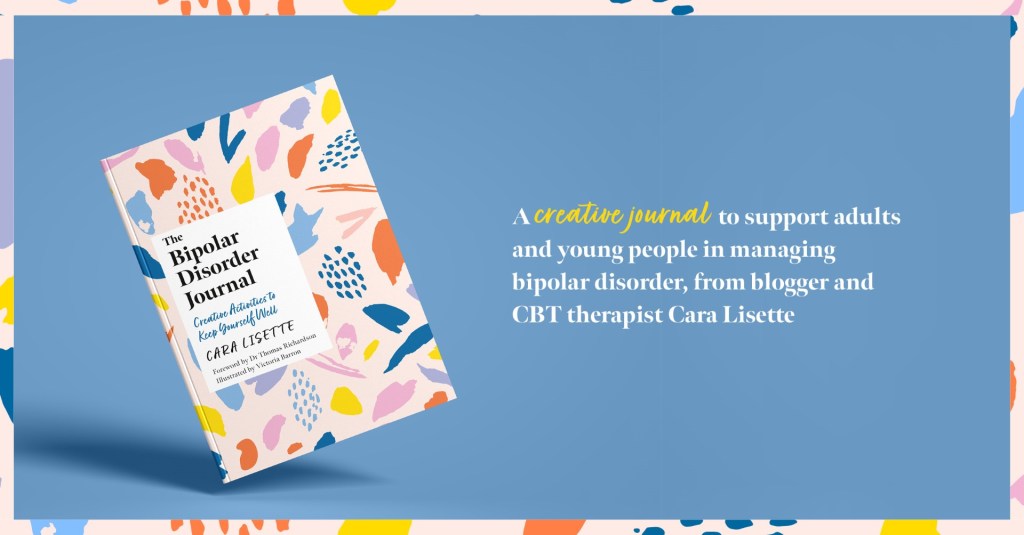
I have followed the work of friend Cara Lisette for quite some time. Cara is not only a fellow mental health blogger, author (of the Eating Disorder Recovery Journal and Recovery Journal series) and advocate, but she lives with bipolar disorder and an eating disorder in remission. Cara is also a trained CBT Therapist and uses techniques that have worked for her and many others, to help people.
She created the Bipolar Disorder Journal: Creative Activities to Keep Yourself Well (with Jessica Kingsley Publishers) using evidence based techniques such as CBT and mindfulness with journalling prompts, creative activities, colouring pages and motivational quote pages to help you stay well and keep on track. It is designed to help those with bipolar disorder to understand and manage our condition, from someone with lived experience, who has learnt how to manage her condition.
Cara and the publisher say, ‘The techniques in this journal support those with bipolar in recognising and coping with episodes of depression, mania, and psychosis, understanding their triggers, and finding ways of seeking support. This journal is intended for those who want to learn more about themselves and live a full and happy life.’
Cara and Jessica Kingsley Publishers have very kindly gifted me a journal of my very own to use, thank you! It looks amazing and I will be using it and reviewing it very soon!
If you would like to get a copy of this amazing creative journal click here. and it can be found in all good bookshops.
Note: This is not a paid ad, I was gifted a journal and wanted to share about it as I believe in Cara’s mission to help others with bipolar disorder.
Today is World Bipolar Day and for those of us living with bipolar disorder we know that living with it every day, year round is more accurate. However today is our day to talk about life with mental illness and to try and eradicate the stigma around the illness… ‘crazy lady’ ‘nuts’ ‘drama queen’.
World Bipolar Day is designed to raise awareness worldwide of bipolar conditions and to work to eliminate social stigma whilst providing information to educate and help people understand the condition.
Even though I live in remission/recovery with the illness, I am medicated daily to be this way, and I have undergone years of therapy and learnt coping methods too, with support from family.
Well, before I found medication that stabilises my bipolar highs and lows, life looked very different.
There were times I couldn’t work. I was so depressed I lay in bed in all day, only getting up to eat. I was scared to have a shower and wash my hair.
Life looked bleak. All I wanted was my duvet and oblivion. I had intrusive thoughts about ending my life, I was in a lot of emotional pain and this would last for weeks, sometimes months on end.
Bipolar isn’t just a bit high or a bit low…. its depression and mania, suicidal ideation and psychosis, self harm thoughts, hypersexuality, hyper activity, believing delusions that aren’t real…..SO much. Its episodic but it can ruin your life. Some turn to drugs, alcohol, sex to cope. Some hear voices too.
I have been in hospital twice for fairly long stays. I have been sectioned under the mental health act and held in a hospital unit against my will. I have been injected with sedatives to calm my mind and body when I couldn’t consent. I have met people in hospital who were suicidal, anxious, depressed, high on drugs, in psychosis. I lived on a ward where I heard people being restrained.
So, not much fun really. Luckily this month I am celebrating 9 years of remission out of hospital! I also came out of hospital as a nervous wreck and thankfully, therapy has helped.
(Image: speakingbipolar.com)
This blog is inspired by one of my followers who asked me what was my ‘Aha’ moment in recovery.
As well as finding the medicine Lithium, a salt that controls the mood fluctuations, the biggest thing I did for my own healing was go through therapy for my panic attacks and PTSD like symptoms. This was done with the support of my husband and family and because I has been on an NHS waiting list for 2 years, I needed help. My therapist and I have done EMDR trauma therapy which has helped me to process things.
In fact, I still do get anxiety attacks – just less. I have been in a very good place generally in the past year. Finding support at home, at work and from friends and family has been the most stabilising part.
I have had bipolar since I was 15, I am 34 and can tell you that this has not always been the case and my mental health has and will fluctuate.
I learnt recently that bipolar brains are neurodiverse, meaning our brain chemicals act differently to a neurotypical brain. Always good to understand the biology behind it too as this illness can be inherited and run in families- my Dad and I and other relatives have it.
On World Bipolar Day I hope:
-Employers adhere to the disability act and make reasonable adjustments to help those of us with bipolar to work in a better way for them, including hybrid working.
-People with mental illness aren’t fired because they can’t get to a physical workplace.
-Mental health services need better funding, so that people with bipolar can get a correct diagnosis sooner and get the help they need.
-People not in the Western world will get access to mental health medication and therapies that they desperately need.
On the 1st March 2016, I started this blog as a way to provide therapy for myself- as I was going through panic attacks, (caused by trauma). Can you believe that was 7 years ago?! I can’t! Since then I have had several years of therapy and my life changed so much too for the better- I met my husband, we got married and moved to our first home.
The blog has turned into a book Bring me to Light (with Trigger), writing for Metro.co.uk, Glamour, the Telegraph, Happiful, Rethink Mental Illness, Mind and other incredible organisations, I have partnered with large and small brands, charities, businesses, writers to create content that battles stigma on mental health. We have been awarded as a Top 10 UK blog by Vuelio since 2018 (thank you) and I love to share my story to help others and educate people about bipolar, anxiety, panic disorders, psychosis, mania and mental health in the workplace (amongst other mental health topics!). I have also recorded podcasts and have begun speaking in the community about bipolar with my Dad.
I cannot believe it has been 7 years since I opened up my computer to write- I was struggling. a lot. Writing has been such a therapy and a saviour to me.. and I hope this blog helps you too!
As always, I want to thank all my contributors and brands (sponsored or not), as well as the digital agencies and freelance writers who provide content too.
This year March 22- 23 we have featured (where it says my name, I wrote it!)
Happy new year everyone! Gosh its nearly the end of January and I havn’t written a blog for a while so thought I would share some things that have been happening here and talk a bit about mental health stuff too.
Firstly, my mental health is fairly stable at the moment, as has been the case for a number of years. I don’t get typical bipolar depressive or manic episodes on my medications and this year is my 9th year out of hospital , which is always a positive. However, I still suffer with anxiety and stress and get overwhelmed so have to pace myself! I have bad days too where things feel too much but thankfully they don’t escalate into a depression.
So for the positives- I have achieved some huge anxiety wins for me. Since November, I have been on the tube (first time in 3 years), I have gone up to the West End with Rob to the theatre using public transport, my panic attacks have been lessening, I have been able to see more people in person and I also passed my probation at work and have been made permanent (huge win!). I am someone who struggles with agarophobia when I feel more anxious and stressed and going out alone can still be a challenge.
I have been allowing myself to venture into previously anxiety provoking situations- for example, I get cabs alone home from work. I had to start doing this last year and it helped me get back into the world again. It wasn’t easy due to many fears I had but I have been able to do it, slowly. My job is also hybrid so I can work from home too- but getting back out into the world and having kind work colleagues at an office has been such a vital part of my recovery too. My therapist has been so helpful in dealing with the panic attacks and anxiety and I do still get triggered but at the moment on a lesser scale. I still find blood tests, hospitals and general health stuff scary because of what I have been through. I really recommend therapy.
I sometimes do have to cancel arrangements when things feel too much so am sorry to anyone I have had to postpone… its not easy and I hate doing it as I feel bad… but I am learning the balance of looking after me and socialising too. I don’t always get it right but I am trying.
Then, my friend in Bushey, Lee, texted me a few weeks back and asked if I would like to speak in my childhood community for the Jami (Jewish charity) Mental Health Awareness Shabbat. I hadn’t done public speaking about my story since before Covid in 2019, when I spoke with my Dad Mike at Limmud and at Chigwell shul (synagogue, my husbands community). I have had drama training so for me speaking publicly as someone else is OK, but when I have to stand up and share my own story, I get nervous as its so personal. The first time I was asked to speak in a shul at Belsize Square, I made it to the community but my Dad had to give the talk by himself as i was too panicked to attend the service. I managed in time to dip my toe in slowly, always with the support of my Dad and my therapist.
This talk in Bushey felt significant. It’s the Jewish community I grew up in and was a part of until I was 23. I felt like I was going home. The Bushey team told me they had two other speakers, but would I like to speak and share my story with bipolar disorder?
I thought to myself… I am ready, my panic attacks and social anxiety are more under control. To me being asked to come home to Bushey shul was a sign. My Grandpa Harry passed away in 2021 from Covid- and he and Grandma had lived in Bushey since the 1990s, when we were little. Our family lived in both Bushey and Bushey Heath and I studied at Immanuel College, across the road from our home and my grandparents. The area contains so many happy memories for me. I knew the new senior Rabbi and Rebbetzen, as he had officiated at my grandparents funerals and was so kind to our family. My Dad is also still a member of the shul and I still know a lot of people who live in the community too. Its a very special community and one I am proud to be from (and still feel.a small part of despite not being a local anymore).
So, I decided, with my Dad and Rob’s support on the day (and anxiety meds), that I could stand up in shul and speak with the other two speakers on the Shabbat (sabbath) morning. My Mum and step dad were supporting from afar and looking after our guineapigs.
The senior Rabbi and Rebbetzen hosted us for the Friday night which was wonderful as we got to meet lots of new couples and see the Ketts, the other Rabbi and Rebbetzen! For lunch after the service, we went to Lee’s house, which was very special as she was my batmitzvah teacher and is a good family friend.
I was initially told the talk was going to be in a break out room- but on the day it was decided that it would be from the pulpit. Last time I ventured to that pulpit and stood up there was when I was 12 years old, sharing my batmitzva portion of the Torah. The year my Dad was very ill and diagnosed with bipolar. I became ill just 3 years later.
Now, here I was back as a married woman of 34, revealing about the mental illness that had found its way into my family and caused a lot of devastation. However, the main reasons I wanted to stand up and talk about bipolar disorder are because I know that this illness runs in families, many Jewish families struggle with it. I wanted to give the message that you can live with this illness but you can have periods of remission, recovery, you can find hope.
And as I spoke to the audience of people – many of whom I had known since my childhood, who saw me grow up and saw my family eventually leave Bushey for Edgware, I felt humbled. I felt honoured to be asked to speak and I hoped that by sharing my own journey with bipolar (being diagnosed at 16, in hospital twice, the last time in 2014 for a very serious manic episode), that I could touch someone who needed to hear it. My Dad gave me permission to tell his story too.
When I grew up in. the early 2000s, talking about mental illness and particularly in Jewish spaces, was not the norm. I hope that through sharing my own journey and my Dads (he was undiagnosed for 9 years until he was 44), that I will have helped someone.
Most importantly, I felt I had come home. The kindness and warmth shown to me by the members of the Bushey community who I have known since I was a little girl was something so incredibly special and touching. People confided in me after the service about their own struggles. Others thanked me for sharing my story. I was hugely touched by the other two speakers who spoke after me about their own journeys with mental health and their children’s. I won’t name them here in case they want to be anonymous but I learnt so much from them and their experiences.
So I want to say a huge thank you to Lee, to the Rabbis and Rebbetzens and to everyone in Bushey who I have known for years and have loved- for hosting us, for inviting me to talk about something so personal in such a special community. It touched my heart. I really hope it helps.
I genuinely did not know how I stood up there to speak to 90 odd people- what kept me going is knowing I was doing this to help eradicate the stigma of mental illness but also I hope that the words I spoke gave comfort to anyone going through mental illness, that it does get better. It can improve. You won’t be ill forever.
When I was unwell in 2014, Jonny Benjamin MBE was speaking and sharing about mental illness. He taught me that sharing your story to help others is vital. So thanks Jonny for all your support too (whether you knew you gave me the courage or not :).
I also want to thank Jami charity, Laura Bahar and Rabbi Daniel Epstein. I was part of the volunteering team that helped set up the first mental health awareness shabbat. The project has blossomed and is now annual and it is truly wonderful to see.
What I want to clarify is that although I am currently a lot better with my anxiety, it is very much a grey area, day by day thing. That can be hard for people to understand- how one day you can be great with loads of energy and the next you have to stay home and recuperate- self care. But I think knowledge of mental health is increasing now, so do check in with your friends and family and offer a safe space without judgement- its so helpful.
Thank you again for reading this if you got this far. You can do whatever you put your mind too- reach for help from medical teams, medication, therapists and never give up.
Simon Kitchen, CEO of UK mental health charity Bipolar UK, says:
“Today’s announcement by the Prime Minister that mental health will receive £40.2 million in funding is a positive step in the right direction for the one in four adults experiencing mental illness in the UK.
Although the Government funding announcement does not include bipolar specifically, we are hopeful that the high prevalence and the enormous burden of the condition will mean the bipolar research community receives much needed boost from this announcement.
The Bipolar Commission Report we took to policy makers on 8th November, found that bipolar accounts for 17% of the total burden of mental health but traditionally only received 1.5% of mental health research funding. This needs to change.
There are over a million people living with bipolar in the UK and every day one person with the condition takes their own life. Ensuring bipolar gets its fair share of mental health research funding is critical for reducing the 9.5 years it takes on average to get a diagnosis and for improving patient outcomes.
Bipolar UK is the collective voice for people living with bipolar. Our clear position is that it is vital those living with the condition have as many treatment options available to them as possible and receive greater continuity of care so they can have a better quality of life.
It is possible for everyone with bipolar to live well and fulfil their potential.
Strong long-term relationships between individual clinicians and patients is a critical factor in this and there are currently not enough specialists in bipolar in the UK which leads to symptoms often being missed.
People living with bipolar have a suicide risk that’s 20 times higher than people without bipolar, a figure that could be significantly reduced with adequate funding.
There are more than a million people with bipolar in the UK — 30% more than those with dementia and twice as many as those with schizophrenia. Millions more are impacted through close friends and family.
Re-allocation of the funding that is already available will provide a significant improvement to people’s lives which is why we are asking for bipolar to be seen as a standalone mental health condition that requires its own share of the overall funding allocated to mental health.
People can live well with bipolar, but only if they have access to a clinician who knows them, their symptoms, their triggers, medical history, their family situation and their living arrangements to ensure on-going, effective care.”
(image: Bipolar UK: Simon Kitchen, CEO with this pledge )
Dr Guy Goodwin, Emeritus Professor of Psychiatry, University of Oxford and co-chair of The Bipolar Commission adds: “I have been treating people with bipolar for more than 40 years. Over that time, I have frequently been astonished by the stories of patients who have been poorly served by services ostensibly designed to help them live better lives.
“Bipolar accounts for 17% of the total burden of disease attributable to mental illness and yet there is no priority given to its specialist treatment in policy documents produced by the Department of Health.
“Instead, since the 1999 National Service Framework, bipolar has been lumped into policy documents as the invisible twin of schizophrenia. Worse still, bipolar gets a mere 1.5% of research resources.
Ignorance of the price paid for this policy neglect is no longer a defence.”
Please go to bipolaruk.org/bipolarcommission to read more about the work of the commission, fighting to get fair funding for bipolar disorder- Bipolar Minds Matter.
Please sign this petition to the NHS to speed up bipolar diagnosis to save lives. As I write in my book, my Dad Mike was diagnosed 9 years after he got ill and just 4 years before me. I believe I was only diagnosed at 16 years old because my Dad received his diagnosis. Additionally, my Dad was pushed to the brink of suicidal ideation (thoughts and plans of suicide) but was able to control this once he saw a psychiatrist finally after nearly 10 years- so many can’t. My Dad was saved just in time. He often says the love for his family stopped him, but for some, they are even more ill and cannot focus on this.
A new campaign by the amazing Bipolar UK charity and the new government Bipolar Commission to tell the NHS:
Speed up bipolar diagnosis to save lives · There’s an average delay of 9.5 years between people first contacting a health professional about symptoms and getting an accurate diagnosis of bipolar · 60% of people said this delay had a significant impact on their life · 84% of people said a diagnosis was ‘helpful’ or ‘very helpful’
A diagnosis makes it possible for someone to get effective treatment and support, and to live well with bipolar.
It’s estimated that at least 5% of people who take their own life have a diagnosis of bipolar. The shorter the delay in diagnosis, the sooner someone can empower themselves with effective self-management and foster a positive circle with fewer relapses in both the short and long-term.
In my own family, myself and other relatives here and abroad have been diagnosed with this condition. It is so important to get correct treatment.









 beurownlight.com